
The Development of 21st Century Learning Skills and Awareness of Global Warming Through Model-based Inquiry Learning for Student Teachers at Chiang Mai College of Dramatic Arts
Article Sidebar
Main Article Content
Abstract
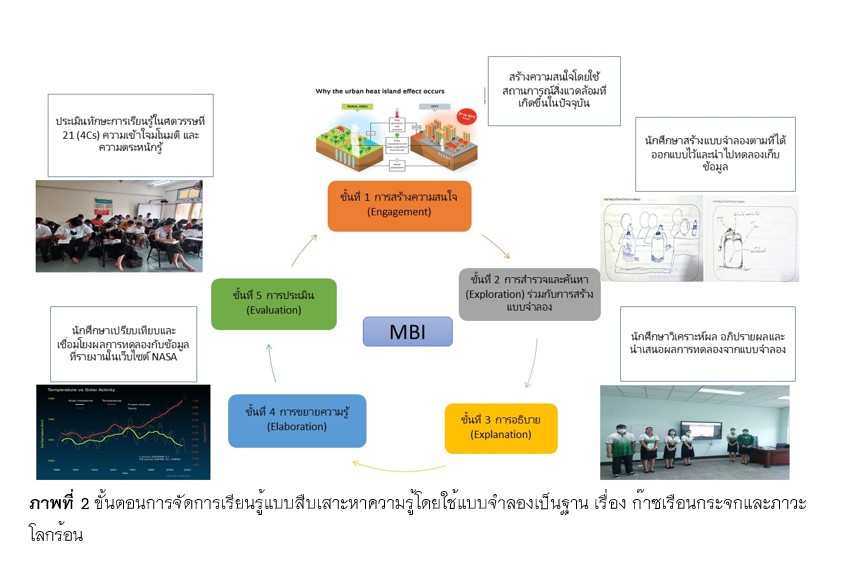
The purposes of this research were to compare (1) 21st century learning skills, (2) conceptual understanding of greenhouse gases and global warming, and (3) global warming awareness for student teachers at Chiang Mai College of Dramatic Arts. This preliminary experimental research involved a purposive sample of 24 third-year undergraduate students majoring in Music Education and Thai Dance Education during the first semester of the 2024 academic year. The research tools included two 3-hour model-based inquiry learning activities. Data were collected using a 21st century learning skills test, a conceptual understanding test, a global warming awareness questionnaire, and a student interview form on their opinions toward the learning activities. Data were analyzed using percentage, mean, standard deviation, normalized gain, Wilcoxon Signed Ranks Test, and content analysis.
The results revealed that (1) the students improved their 21st century learning skills from lower than a minimum criterion (https://latex.codecogs.com/svg.image?\bar{x} = 21.88, S.D. = 6.81, 44.65%) to a good level (https://latex.codecogs.com/svg.image?\bar{x} = 35.25, S.D. = 5.01, 71.94%) with a moderate normalized gain (<g> = 0.49). (2) Their conceptual understanding also improved from an average of 5.63 (S.D. = 1.13, 56.30%) to a good level 7.50 (S.D. = 1.25, 75.00%) with a moderate normalized gain (<g> = 0.43). (3) Their global warming awareness improved from an average level (https://latex.codecogs.com/svg.image?\bar{x} = 30.83, S.D. = 5.75, 68.51%) to an excellent level (https://latex.codecogs.com/svg.image?\bar{x} = 37.71, S.D. = 4.71, 83.80%) with a moderate normalized gain (<g> = 0.49). The Wilcoxon Signed Ranks Test indicated statistically significant differences at the 0.05 level between pre- and post-test scores in all three areas. Additionally, students reported enjoyment and engagement with the model-based inquiry learning activities. These findings suggest that model-based inquiry learning can effectively enhance 21st century learning skills, conceptual understanding, and global warming awareness among student teachers.
Downloads
Article Details

This work is licensed under a Creative Commons Attribution-NonCommercial-NoDerivatives 4.0 International License.
References
Applied Educational Systems. (2022). What are 21st century skills? Retrieved from https://www.aeseducation.com/blog/what-are-21st-century-skills
Bachelor of Education Program at Chiang Mai College of Dramatic Arts. (2019). Bachelor of Education Program in Dance Education. Chiang Mai: Chiang Mai College of Dramatic Arts. [In Thai]
Bolger, M. S., Osness, J. B., Gouvea, J. S., & Cooper, A. C. (2021). Supporting scientific practice through model-based inquiry: A students’-eye view of grappling with data, uncertainty, and community in a laboratory experience. CBE—Life Sciences Education, 20(4), ar59.
Daiporn, D., Channok, C., Dathong, W., & Chokchaloemwong, D. (2022). A study on the effects of model-based inquiry pedagogy on 21st learning and innovation skills of the students Grade 3 in a virtual science classroom. Journal of Education, Mahasarakham University, 16(4), 35-46. [In Thai]
Dani, D. E., & Stigall, A. L. (2021). Landslides: Using model-based inquiry to investigate local mass wasting events. Science Scope, 44(4), 46-55.
Dhiensawadkij, D. (2022). The media literacy of urban people in climate change news. Journal of Journalism, Thammasat University, 15(2), 9-57. [In Thai]
Gray, R. E., Bai, Y., & Campbell, T. (2025). Uncovering earth’s history: A model-based inquiry unit on the grand staircase. Science Scope, 48(3), 23-29.
Hake, R. R. (1998). Interactive-engagement versus traditional methods: A six-thousand-student survey of mechanics test data for introductory physics courses. American journal of Physics, 66(1), 64-74.
Jiménez-Liso, M. R., Bellocchi, A., Martinez-Chico, M., & Lopez-Gay, R. (2022). A model-based inquiry sequence as a heuristic to evaluate students’ emotional, behavioural, and cognitive engagement. Research in Science Education, 52(4), 1313-1334.
Jiménez-Liso, M. R., González-Herrera, M., & Banos-González, I. (2020). Socio-ecological controversies in the news as trigger of a model-based inquiry instructional sequence about the effect of global warming on the great barrier reef. Sustainability, 12(11), 4676.
Karen, K. A., Snyder, B. A., & Adams, R. (2024). Investigating a role for model-based inquiry in an undergraduate introductory biology lab. The American Biology Teacher, 86(6), 352-360.
Koonkaew, A. (2017). Statistics for research. Bangkok: Chulalongkorn University Printing House. [In Thai]
Leiserowitz, A., Smith, N., & Marlon, J. R. (2011). American teens’ knowledge of climate change. Yale University. New Haven, CT: Yale project on climate change communication, 5.
López-Banet, L., Aguilera, D., Jiménez-Liso, M. R., & Perales-Palacios, F. J. (2021). Emotional and cognitive preservice science teachers’ engagement while living a model-based inquiry science technology engineering mathematics sequence about acid-base. Frontiers in Psychology, 12, 719648.
Luanmanee, A., Pitiporntapin, S., & Boonsoong, B. (2022). Development of 11th grade students' science communication in the learning unit of transport in vascular plant using model-based inquiry teaching. Ratchaphruek Journal, 20(3), 185-200. [In Thai]
Manosorn, C., & Samiphak, S. (2022). Effect of inquiry instruction and games on students’ climate. Journal of Education and Innovation, 24(2), 75-84. [In Thai]
Martelli, A. (2020). Environmental education action with urban tree planting in order to neutralize greenhouse gases. South Florida Journal of Development, 1(1), 2-10.
Meilander, J., Gray, R., Gross, J., & Caporaso, J. G. (2025). Education for sustainable development: Model-based inquiry using composting toilets and microbiome data science in higher education. Journal of College Science Teaching, 54(4), 1-8. https://doi.org/10.1080/0047231X.2025.2472138
Ozcan, H., Çetin, G., & Koştur, H. İ. (2020). The effect of PhET simulation-based instruction on 6th grade students’ achievement regarding the concept of greenhouse gas. Science Education International, 31(4), 348-355.
Panphet, A., & Bongkotphet, T. (2023). Model-based inquiry to develop mental model of 7th grade students on thermal energy topic. Journal of Roi Kaensarn Academi, 8(8), 493-509. [In Thai]
Partnership for the 21st Century Learning. (2019). Frameworks & resources. Retrieved from https://www.battelleforkids.org/networks/p21/
Phola-iai. (2020). The development of indices and tools for assessing public awareness of climate change. Retrieved from Department of Climate Change and Environment, Ministry of Resources and Environment: https://eservice.dcce.go.th/media?media_group_code=10. [In Thai]
Posa, P. & Suttiwan, W. (2024). Fostering students' critical thinking and modeling skills in Grade 6 based on inquiry-based learning and model-based learning. Research and Development Institute Journal of Chaiyaphum Rajabhat University, 6(1), 142-154. [In Thai]
Srichaitung, P., Wuttisela, K., & Supasorn, S. (2024). Science learning management and learning skills development for the 21st century learners. Journal of Science & Science Education, 7(1), 227–244. [In Thai]
Suya, S. & Kaewkhong, K. (2021). Effect of model based learning to eclipses conceptions of lower secondary school students. Journal of Graduate Studies and Social Sciences, Uttaradit Rajabhat University, 11(1), 73-85. [In Thai]
Thaweejit, P. & Huntula, J. (2018). Conceptual change on climate change of 7 graders through Model-Based Inquiry (MBI). Journal of Education Khon Kaen University (Graduate Studies Research), 12(4), 19-32. [In Thai]
Thipayapharaphonkul, B., Junphet, A., & Phasertmuaeng, D. (2016). Manual of assessment nursing clinical skills with OSCE. Nontaburi: Yudtarin printing. [In Thai]
Toahom, T., & Jantakoon, J. (2024). A development of training curriculum for coping with drought to enhance knowledge and awareness in climate change adaptation for high school students. Journal of Modern Learning Development, 9(11), 491-504. [In Thai]
Ubon Ratchathani University Human Research Ethics Committee. (2024). UBU-REC-29/2567 - Development of 21st century learning skills by using model-based inquiry learning on climate change for Chanthaburi College of Dramatic Arts students. Ubon Ratchathani: Ubon Ratchathani University.
World Economic Forum. (2016). New vision for education: Fostering social and emotional learning through technology. Retrieved from https://www3.weforum.org/docs/WEF_New_Vision_for_Education.pdf
Yewell, R., & Gray, R. E. (2024). Remarkable adaptations: A model-based inquiry into emperor penguins. Science and Children, 61(5), 51-55.
