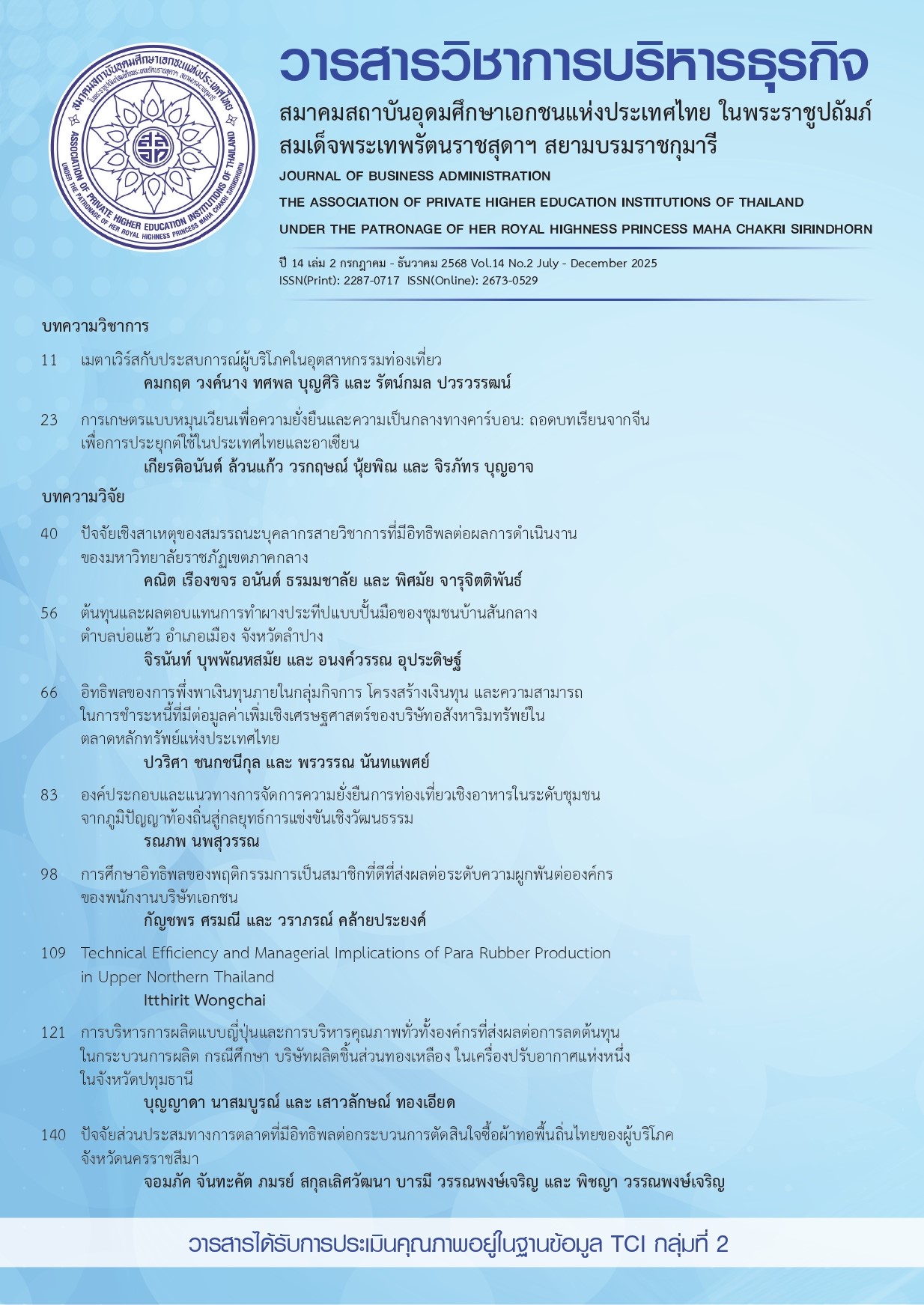
การศึกษาอิทธิพลของพฤติกรรมการเป็นสมาชิกที่ดีที่ส่งผลต่อระดับความผูกพันต่อองค์กรของพนักงานบริษัทเอกชน
คำสำคัญ:
อิทธิพลของพฤติกรรม , ความผูกพันองค์กร , พฤติกรรมการเป็นสมาชิกที่ดีต่อองค์กรบทคัดย่อ
วัตถุประสงค์ในการวิจัยครั้งนี้เพื่อศึกษาระดับความผูกพัน ปัจจัยที่ส่งผลต่อพฤติกรรมการเป็นสมาชิกที่ดีต่อองค์กรและ ความสัมพันธ์ระหว่างความผูกพันของบุคคลที่มีต่อองค์กรกับพฤติกรรมการเป็นสมาชิกที่ดีขององค์กรของพนักงานบริษัทเอกชน ประชากรที่ใช้ในการวิจัยครั้งนี้ คือ พนักงานผู้ที่ปฏิบัติงาน จำนวน 140 คน ใช้แบบสอบถามเก็บข้อมูล และวิเคราะห์ข้อมูลด้วยสถิติพรรณา ค่าสัมประสิทธิ์สหสัมแบบสเปียร์แมน และการวิเคราะห์การถดถอยพหุคูณ พบว่า ระดับความผูกพันองค์กรที่มีความสัมพันธ์ต่อการเป็นสมาชิกที่ดีขององค์กรและพฤติกรรมของบุคคลต่อการเป็นสมาชิกที่ดีขององค์กรอยู่ในระดับมากที่สุด สำหรับความสัมพันธ์ระหว่างลักษณะทางประชากรศาสตร์กับตัวแปรความผูกพันองค์กร และพฤติกรรมของบุคคลต่อการเป็นสมาชิกที่ดีขององค์กร พบว่า สถานภาพ ระดับการศึกษาและรายได้เฉลี่ยของพนักงาน มีความสัมพันธ์กับความผูกพันด้านความรู้สึก และสถานภาพของพนักงาน มีความสัมพันธ์กับพฤติกรรมด้านการให้ความช่วยเหลือในระดับต่ำและระยะเวลาในการปฏิบัติงาน มีความสัมพันธ์เชิงลบกับพฤติกรรมด้านการให้ความร่วมมือในระดับปานกลาง และยังพบว่า เพศ มีความสัมพันธ์กับพฤติกรรมด้านการพัฒนาผลงาน ในระดับปานกลาง เมื่อพิจารณาการวิเคราะห์การถดถอยพหุคูณ กลุ่มตัวแปรอิสระ ได้แก่ ฝ่ายพัฒนาผลิตภัณฑ์ รายได้ระหว่าง 25,000 – 35,000 บาท สามารถอธิบายความผันแปรของความผูกพันที่มีต่อองค์กรในภาพรวมได้ร้อยละ 7.2 และกลุ่มตัวแปรอิสระ ได้แก่ ตำแหน่งผู้บริหารระดับสูง เพศชาย รายได้ต่ำกว่า 15,000 บาท ฝ่ายคลังสินค้า/จัดส่ง สามารถอธิบายความผันแปรของพฤติกรรมการเป็นสมาชิกที่ดีต่อองค์กรในภาพรวมได้ร้อยละ 18.8 และเมื่อกำหนดให้ตัวแปรพฤติกรรมการเป็นสมาชิกที่ดีต่อองค์กรเป็นตัวแปรส่งผ่าน พบว่ามีเพียงตัวแปร หน่วยงานฝ่ายพัฒนาผลิตภัณฑ์ สามารถอธิบายความผูกพันของบุคคลที่มีต่อองค์กรผ่านตัวแปรพฤติกรรมการเป็นสมาชิกที่ดีต่อองค์กร้อยละ 33.8 โดยตัวแปรพฤติกรรมการเป็นสมาชิกที่ดีต่อองค์กรสามารถอธิบายความผันแปรได้สูงสุดร้อยละ 24.8 ผลการวิจัยนี้ สามารถนำไปประยุกต์ใช้ในองค์กรเพื่อเพิ่มระดับความผูกพันต่อองค์กรของพนักงานบริษัทเอกชนให้มีความเข้มแข็ง
เอกสารอ้างอิง
Allen, N. J., & Meyer, J. P. (1990). The measurement and antecedents of affective, continuance and normative commitment to the organization. Journal of occupational psychology, 63(1), 1-18.
Coffman, C., & Gonzalez-Molina, G. (2025). Follow this path: How the world's greatest organizations drive growth by unleashing human potential. Hachette+ ORM.
Godbersen, H., Dudek, B., & Ruiz Fernández, S. (2024). The relationship between organizational commitment, commitment to supervisor and servant leadership. Frontiers in Organizational Psychology, 2, 1353959.
Greenberg, J. (1993). The social side of fairness: Interpersonal and informational classes of organizational justice. In R. Cropanzano (Ed.), Justice in the workplace: Approaching fairness in human resource management (pp. 79–103). Lawrence Erlbaum Associates, Inc.
Harland, D. G. (1972). Health and welfare indicators. Government of Canada, Department of Regional Economic Expansion.
Karawit, S. (2020). Factors affecting employees’ organizational commitment: A case study of the Business Stakeholder Engagement unit of a company (Master’s thesis). Mahidol University. [in Thai]
Katz, D., & Kahn, R. L. (1978). The social psychology of organizations. Wiley.
Koontz, H., & Weihrich, H. (1993). Management: A global perspective (10th ed.). McGraw-Hill International Editions.
Milkovich, G. T., & Boudreau, J. W. (1996). Human Resource Management (7th ed.). Richard D. Irwin.
Northcraft, G. B., & Neale, M. A. (1990). Organizational behavior: A management challenge. The Dryden Press.
Organ, D. W. (1988). Organizational citizenship behavior: The good soldier syndrome. Lexington Books.
Podsakoff, P. M., MacKenzie, S. B., Paine, J. B., & Bachrach, D. G. (2000). Organizational citizenship behaviors: A critical review of the theoretical and empirical literature and suggestions for future research. Journal of management, 26(3), 513-563.
Porter, L. W., Steers, R. M., Mowday, R. T., & Boulian, P. V. (1974). Organizational commitment, job satisfaction, and turnover among psychiatric technicians. Journal of Applied Psychology, 59(5), 603–609. https://doi.org/10.1037/h0037335
Putsom, W. (2020). The relationship among organizational climate, leader-member exchanges and affective commitment towards positive organizational behavior of a not-for-profit organization in Thailand. Journal of Business Administration the Association of Private Higher Education Institutions of Thailand, 9(2), 146-165.
Schnake, M., & Dumler, M. P. (1997). Organizational citizenship behavior: The impact of rewards and reward practices. Journal of Managerial Issues, 9(2), 216-229.
Silva, I., Dias, Á., & Pereira, L. (2024). Determinants of employee intention to stay: a generational multigroup analysis. International Journal of Organizational Analysis, 32(8), 1389-1418.
Spector, A., Thorgrimsen, L., Woods, B. O. B., Royan, L., Davies, S., Butterworth, M., & Orrell, M. (2003). Efficacy of an evidence-based cognitive stimulation therapy programme for people with dementia: randomised controlled trial. The British Journal of Psychiatry, 183(3), 248-254.
Sheldon, M. E. (1971). Investments and involvements as mechanisms producing commitment to the organization. Administrative science quarterly, 16(2), 143-150.
Tang, T. L. P., & Sarsfield-Baldwin, L. J. (1996). Distributive and procedural justice as related to satisfaction and commitment. SAM Advanced Management Journal, 61(3), 25–31.
ดาวน์โหลด
เผยแพร่แล้ว
รูปแบบการอ้างอิง
ฉบับ
ประเภทบทความ
สัญญาอนุญาต
ลิขสิทธิ์ (c) 2025 วารสารวิชาการบริหารธุรกิจ สมาคมสถาบันอุดมศึกษาเอกชนแห่งประเทศไทย

อนุญาตภายใต้เงื่อนไข Creative Commons Attribution-NonCommercial-NoDerivatives 4.0 International License.
บทความที่ลงตีพิมพ์ในวารสารวิชาการบริหารธุรกิจ สมาคมสถาบันอุดมศึกษาเอกชนแห่งประเทศไทยต้องเป็นบทความที่ไม่เคยได้รับการตีพิมพ์เผยแพร่ หรืออยู่ระหว่างการพิจารณาตีพิมพ์ในวารสารอื่นๆ การละเมิดลิขสิทธิ์เป็นความรับผิดชอบของผู้ส่งบทความโดยตรง

