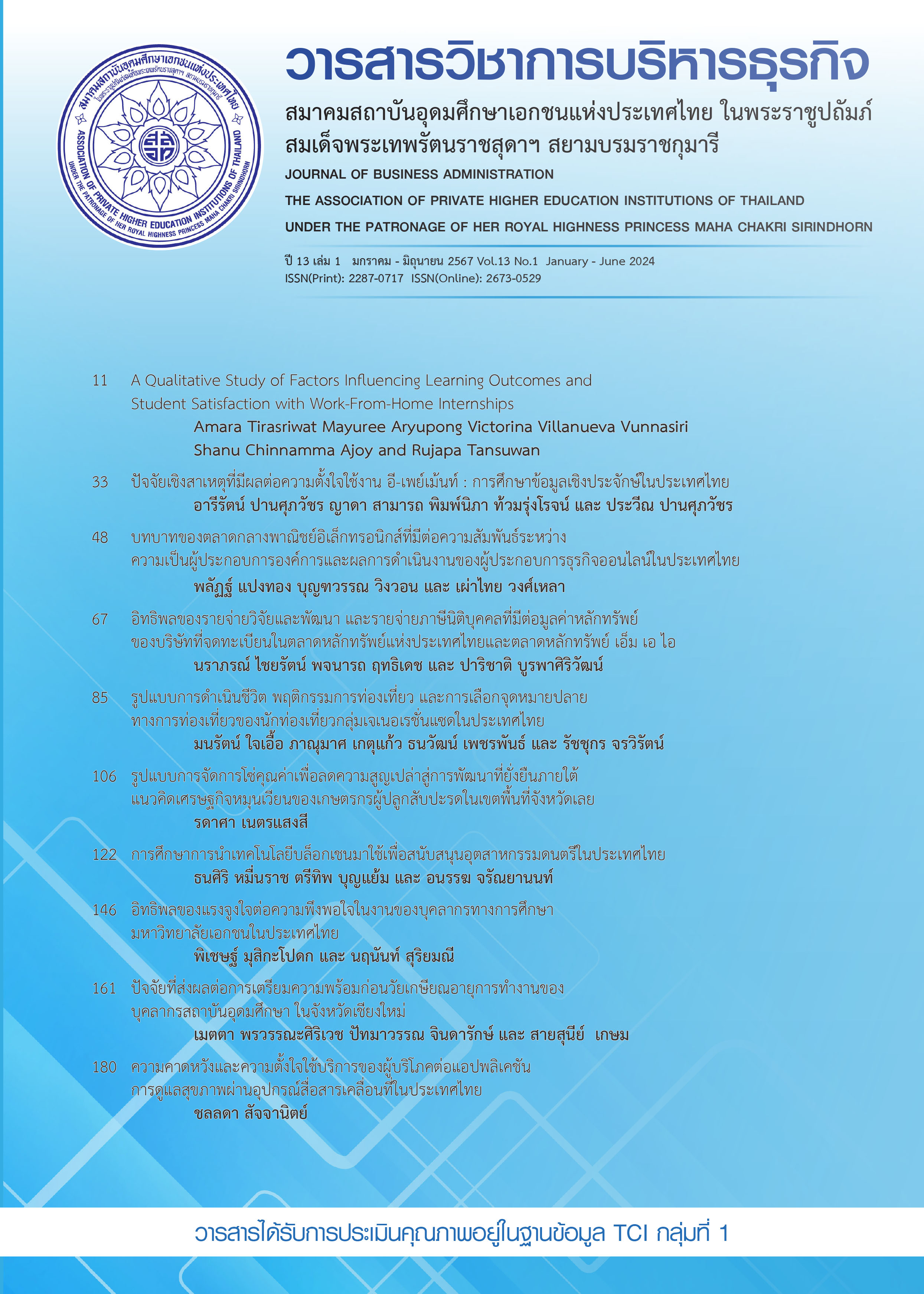
การศึกษาการนำเทคโนโลยีบล็อกเชนมาใช้เพื่อสนับสนุนอุตสาหกรรมดนตรี ในประเทศไทย
คำสำคัญ:
เทคโนโลยีบล็อกเชน, อุตสาหกรรมดนตรี, ห่วงโซ่อุปทานบทคัดย่อ
งานวิจัยนี้มีวัตถุประสงค์ เพื่อศึกษาปัญหาและข้อจำกัดตลอดจนความท้าทายในอนาคตที่เทคโนโลยี บล็อกเชนมีต่ออุตสาหกรรมเพลงในประเทศไทย เพื่อศึกษาคุณประโยชน์ของเทคโนโลยีบล็อกเชนต่ออุตสาหกรรมเพลงในประเทศไทย และเพื่อสร้างทางเลือกในการประยุกต์เทคโนโลยีบล็อกเชนกับการส่งเสริมวงการเพลงไทย งานวิจัยนี้ใช้วิธีการวิจัยเอกสาร และการสัมภาษณ์เชิงลึกกับบุคคลที่มีความรู้และความเชี่ยวชาญด้านเทคโนโลยีบล็อกเชนซึ่งเป็นที่ยอมรับอย่างกว้างขวางในสื่อสังคม และในสังคมไทยที่ยินดีให้ข้อมูล จำนวนทั้งสิ้น 5 คน ผลการศึกษาพบว่าความคลุมเครือของกฎหมายที่เกี่ยวข้องกับเทคโนโลยีบล็อกเชนยังเป็นข้อจำกัดสำคัญที่ต้องได้รับการแก้ไข เพื่อผลักดันเทคโนโลยีบล็อกเชนให้เข้ามามีบทบาทในอุตสาหกรรมเพลงของไทยมากขึ้น เทคโนโลยีบล็อกเชนจะช่วยแก้ไขปัญหาลิขสิทธิ์และสร้างช่องทางใหม่ในการสร้างรายได้ให้กับวงการเพลงในประเทศไทย รวมถึงสร้างแหล่งรายได้ใหม่ให้กับผู้ที่อยู่ในห่วงโซ่อุปทานของอุตสาหกรรมเพลง เช่น การซื้อขายเพลงในรูปแบบ NFT ที่ให้สิทธิพิเศษแก่แฟน ๆ ตลอดจนการสร้างระบบนิเวศของศิลปินเอง เป็นต้น ผลการศึกษานี้นำไปสู่ข้อเสนอแนะให้ภาครัฐให้ความสำคัญกับการออกกฏระเบียบ และข้อบังคับที่เกี่ยวข้องกับเทคโนโลยีบล็อกเชนให้มีความชัดเจนมากยิ่งขึ้น ในขณะที่ผู้ที่อยู่ในอุตสาหกรรมดนตรีสามารถใช้ประโยชน์จากเทคโนโลยีบล็อกเชนเพื่อการสร้างระบบนิเวศทางธุรกิจของตนเองอันเป็นประโยชน์สำคัญของธุรกิจ
เอกสารอ้างอิง
Alharby, M., & Moorsel, V. A. (2018). The impact of profit uncertainty on miner decisions in blockchain systems. Electronic Notes in Theoretical Computer Science, 340, 151-167.
Arcos, L. C. (2018). The blockchain technology on the music industry. Brazilian Journal of Operations & Production Management, 15(3), 439-443.
Atlam, H. F., Alenezi, A., Alassafi, M. O., & Wills, G. (2018). Blockchain with internet of things: Benefits, challenges, and future directions. International Journal of Intelligent Systems and Applications, 10(6), 40-48.
Brand Age Online. (2022, April 21). Asawin Rojmethawee shows his perspective on "Music Streaming in Thailand can still go further than you think." Brand Age Online. https://www.brandage.com/article/30552 [In Thai]
Caporale, V. (2021, April 10). Blockchain in Southeast Asia. The Borgen Project.
https://borgenproject.org/blockchain-in-southeast-asia/
Chen, X., Qu, X., Qian, Y., & Zhang, Y. (2022). Music recognition using blockchain technology and deep learning. Computational Intelligence and Neuroscience, 2022, 1-13. Doi: 10.1155/2022/7025338.
Christensen, C. M., Raynor, M. E., & McDonald, R. (2015). What is disruptive innovation?
Harvard Business Review, 93(12), 44-53.
Chunnapiya, N. (2022). NFT ART An applied art of technology, the industry of the new normal. Design Echo Journal, 3(2), 2-10. [In Thai]
Creswell, J. W. (1998). Qualitative inquiry and research design: Choosing among five traditions. Sage publications.
Crosby, M., Pattanayak, P., Verma, S., & Kalyanaraman, V. (2016). Blockchain technology:
Beyond bitcoin. Applied Innovation, 2(6-10), 71.
Coinman. (2021, September 15). What is Blockchain? The biggest intermediary revolution in history. Finnomena. https://www.finnomena.com/coinman/blockchain/ [In Thai]
De León, I. L., & Gupta, R. (2017). The impact of digital innovation and blockchain on the
music industry. Inter-American Development Bank. https://publications.iadb.org/en/impact-digital-innovation-and-blockchain-music-industry
Deloitte. (2016). Blockchain Technology: 9 Benefits & 7 Challenges Disrupting Multiple
Industries. Deloitte Insights.
Efanov, D., & Roschin, P. (2018). The all-pervasiveness of the blockchain technology. Procedia computer science, 123, 116-121.
Gheorghe, P. N. M., & Soltanisehat, L. (2018). A new structure for the music industry. FAIMA Business & Management Journal, 6(3), 51-61.
Gürfidan, R., & Ersoy, M. (2021). Blockchain-based music wallet for copyright protection in audio files. Journal of Computer Science & Technology, 21(1), 11-19.
Halgamuge, M. N., & Guruge, D. (2022). Fair rewarding mechanism in music industry using smart contracts on public-permissionless blockchain. Multimedia Tools and Applications, 81(2), 1523-1544.
History of bitcoin. (2017). History of Bitcoin the World’s First Decentralized Currency. History of Bitcoin. http://historyofbitcoin.org/
Hosoi, T., Kim, J., Stainken, D., & Caro, F. (2016, October 12). Disintermediation in the recorded music supply chain. The UCLA Anderson Blog. http://blogs.anderson.ucla.edu/global-supplychain/2015/08/disintermediation-in-the-recorded-music-supply-chain.html
Huang, D. C., Liu, L. C., Deng, Y. Y., & Chen, C. L. (2022). A digital media subscription management system combined with blockchain and proxy re-encryption mechanisms. Symmetry, 14(10), 2167.
Idokogi, D. (2021). Decentralizing creativity: A tenable case for blockchain adoption in the entertainment industry. Rutgers Computer & Technology Law Journal, 47, 274.
Industry Research Co. (2023). Crypto Wallet Market: Trends and Growth Drivers Analysis | 2030. Linkedin. https://www.linkedin.com/pulse/crypto-wallet-market-trends-growth-drivers-analysis
Inthason, S. & Yusukkee, S. (2022). Non-Fungible Token (NFT) digital asset make money. Journal of Management Science Review, 24(1), 173-212. [In Thai]
Jinwiriya, D. (2019). Adoption blockchain in procurement process. [Unpublished master’s thesis]. Mahidol University. [In Thai]
Kim, K. C. H. (2019). The impact of blockchain technology on the music industry. International journal of advanced smart convergence, 8(1), 196-203.
Kumar, N. M., & Mallick, P. K. (2018). Blockchain technology for security issues and challenges in IoT. Procedia computer science, 132, 1815-1823.
Li, N. (2022). Combination of blockchain and AI for music intellectual property protection. Computational Intelligence and Neuroscience, 2022, 1-8.
Merchant, M. (2022). An overview of the cryptocurrency regulations in Switzerland.
Cointelegraph. https://cointelegraph.com/learn/an-overview-of-the-cryptocurrency-regulations-in-switzerland
Minaev, A. & Ivanov, I. (2022, January 3). 91+ Blockchain Statistics: Understand Blockchain in 2021. Techjury. https://techjury.net/blog/blockchain-statistics/
Muenratch, T. (2022). Blockchain technology that will transform the music industry. Music Journal, 27(6), 52-57. [In Thai]
Nilchinda, K. (2017). Consumer protection over contract relating to blockchain. [In Thai] [Unpublished master’s thesis]. Assumption University.
Notabene. (2020, January 28). Crypto Travel Rule in Singapore by the Monetary Authority of Singapore (MAS). Notabene. https://notabene.id/world/singapore
O'Dair, M., & Owen, R. (2019). Financing new creative enterprise through blockchain technology: Opportunities and policy implications. Strategic Change, 28(1), 9-17.
Owen, R., & O'Dair, M. (2020). How blockchain technology can monetize new music ventures: an examination of new business models. The Journal of Risk Finance, 21(4), 333-353.
Paradon, E. (2021, May 5) Youngohm, a famous Thai rapper, releases a new piece that sparks the NFT trend. Beartai. https://www.beartai.com/news/it-thai-news/618119 [In Thai]
Patrickson, B. (2021). What do blockchain technologies imply for digital creative industries? Creativity and Innovation Management, 30(3), 585-595.
Paul, C., Teddy, A., Jessica, G., Michel, M., Aaron, S. (2021a) Blockchain + the Music Industry Succeeding Where the GRD Failed. Blockchain + the Music Industry. https://theblockchaintest.com/uploads/resources/na%20-%20Blockchain%20+%20the%20Mucis%20Industry%20%20-%20na.pdf
Paul, P., Aithal, P. S., Saavedra, R., & Ghosh, S. (2021b). Blockchain technology and its types—A short review. International Journal of Applied Science and Engineering (IJASE), 9(2), 189-200.
Qureshi, A., & Megías Jiménez, D. (2020). Blockchain-based multimedia content protection: Review and open challenges. Applied Sciences, 11(1), 1.
Reed, J. (2020). The Supply Chain of Digital Music: Empowering Independent Artists Through. Availability and Accessibility [Senior Theses]. University of South Carolina https://scholarcommons.sc.edu/cgi/viewcontent.cgi?article=1384&context=senior_theses
Sabbagh, C. R. (2019). Envisioning a compulsory-licensing system for digital samples through emergent technologies. Duke Law Journal, 69, 231.
Sattaya-aphitan, T. (2018, August 28). Review your knowledge about Blockchain. Medium. https://drtan.medium.com/blockchain-3691dded54a3 [In Thai]
Scott, J. (2006). Social research and documentary sources. Documentary research, 1, 23-79.
Shang, Y. (2022). A comprehensive evaluation method for the effectiveness of public health-oriented music performance art based on blockchain technology. Journal of Environmental & Public Health, 2022, 1-10.
Sitonio, C., & Nucciarelli, A. (2018). The Impact of Blockchain on the Music Industry, 29th European Regional Conference of the International Telecommunications Society (ITS): "Towards a Digital Future: Turning Technology into Markets?". International Telecommunications Society (ITS), Calgary.
Suknuntee, W. (2020, December 7). Blockchain History and Evolution. Medium. https://medium.com/bitkub/blockchain-history-4715c886bf78 [In Thai]
TCDC Connect. (2020, June 18). Music Industry 101 What is the music industry like? Creativethailand. https://www.creativethailand.org/article-read?article_id=32473#musicIndustry [In Thai]
Techsauce Team. (2016, December 16). Blockchain kickstarts the music industry with case studies. Techsauce. https://techsauce.co/tech-and-biz/how-blockchain-can-disrupt-the-music-industry-2 [In Thai]
Torbensen, A., & Ciriello, R. (2019). Tuning into blockchain: Challenges and opportunities of
blockchain-based music platforms. Twenty-Seventh European Conference on Information Systems (ECIS2019), Stockholm-Uppsala, Sweden.
Wang, N., Xu, H., Xu, F., & Cheng, L. (2021). The algorithmic composition for music copyright protection under deep learning and blockchain. Applied Soft Computing, 112, 107763.
Wichaidit, C. (2020). Blockchain & E-commerce current trends and progress. Trade Policy and Strategy Office Journal, 10(105), 3. [In Thai]
Wikström, P. (2020). The music industry: Music in the cloud. John Wiley & Sons.
Zhang, Y. (2022). Increasing cyber defense in the music education sector using blockchain zero-Knowledge proof identification. Computational Intelligence and Neuroscience, 2022, 1-7.
Zhao, B., Fang, L., Zhang, H., Ge, C., Meng, W., Liu, L., & Su, C. (2019). Y-DWMS: A digital watermark management system based on smart contracts. Sensors, 19(14), 3091.
Zhao, S., & O'Mahony, D. (2018). Bmcprotector: A blockchain and smart contract-based application for music copyright protection. In Proceedings of the 2018 International Conference on Blockchain Technology and Application (pp. 1-5). https://doi.org/10.1145/3301403.3301404
ดาวน์โหลด
เผยแพร่แล้ว
รูปแบบการอ้างอิง
ฉบับ
ประเภทบทความ
สัญญาอนุญาต
ลิขสิทธิ์ (c) 2024 วารสารวิชาการบริหารธุรกิจ สมาคมสถาบันอุดมศึกษาเอกชนแห่งประเทศไทย

อนุญาตภายใต้เงื่อนไข Creative Commons Attribution-NonCommercial-NoDerivatives 4.0 International License.
บทความที่ลงตีพิมพ์ในวารสารวิชาการบริหารธุรกิจ สมาคมสถาบันอุดมศึกษาเอกชนแห่งประเทศไทยต้องเป็นบทความที่ไม่เคยได้รับการตีพิมพ์เผยแพร่ หรืออยู่ระหว่างการพิจารณาตีพิมพ์ในวารสารอื่นๆ การละเมิดลิขสิทธิ์เป็นความรับผิดชอบของผู้ส่งบทความโดยตรง

