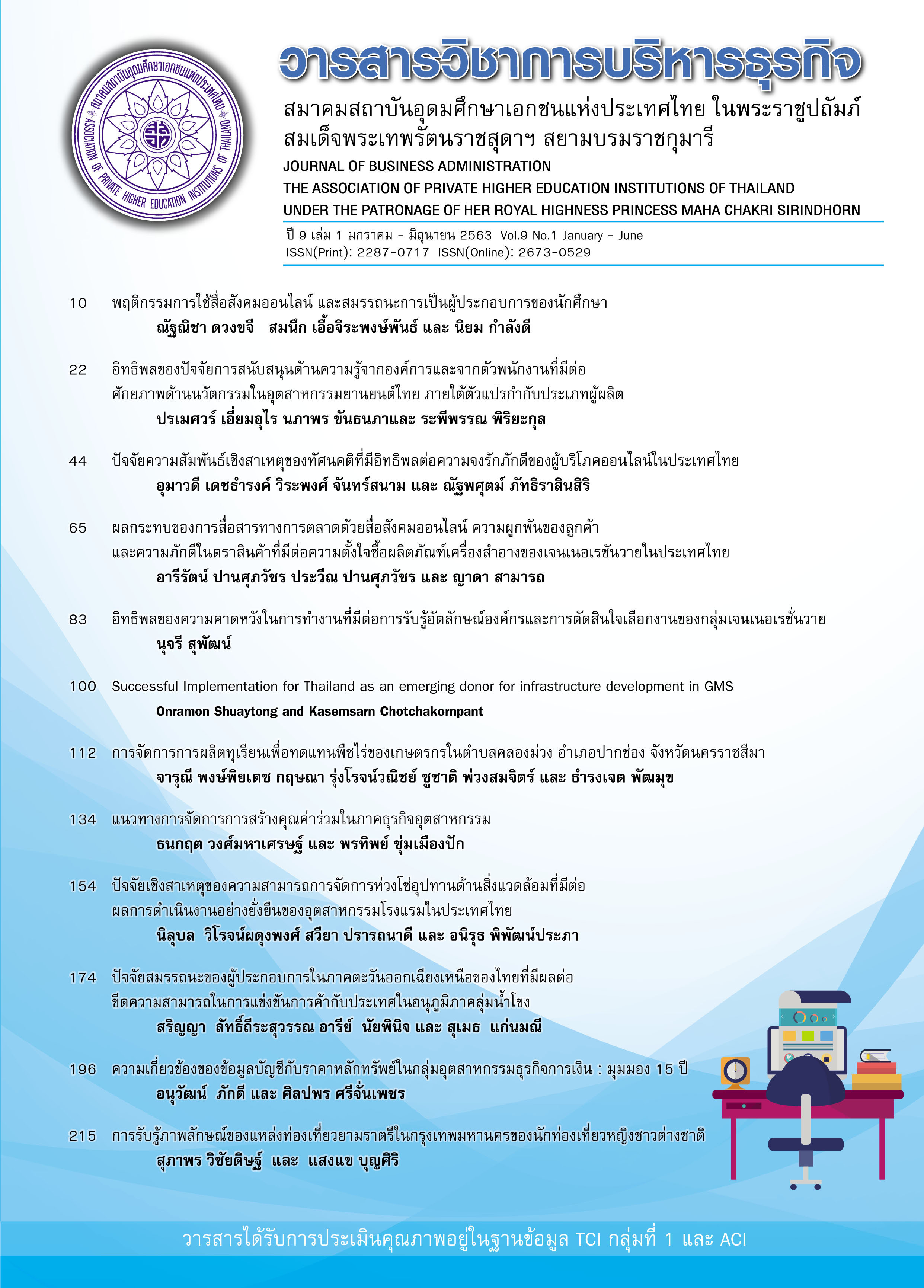
Influence of Work Expectation on Organizational Identification and Job Selection of Generation Y
Abstract
This research aimed to study the mediating effect of the organizational identification on
the relationship between the expectation of Generation Y on the job characteristics, supervisory
support, employer obligations, organizational structure and job selection. Questionnaire survey
with 402 Generation Y people who were visiting the job fairs was conducted. Content validity of
the measurements was verified by the three experts while the analysis of Cronbach's Alpha
Coefficient was performed to ensure the reliability of the measurements. Structural equation modeling
was performed to analyze data. The results indicated that job characteristics and supervisory
support had indirect influences on job selection while the expectation on organizational structure
had both direct and indirect influences on job selection via organizational identification. The
highlight of the study was on the mediating role of the organizational identification on the career
expectations of Generation Y and their job selection. The findings indicated that Generation Y people
do not select the jobs that are fun, exciting, fitting with their life-styles nor having open-minded
and understanding managers. The job characteristics and managerial styles could influence the
organization identification but the job selection is based largely on organizational identification
and the expectation on the organizational structure.
References
Basar, U., & Basim, N. (2015). Effects of organizational identification on job satisfaction: Moderating role of organizational politics. Journal of Yönetim ve Ekonomi, 22(2), 663-683.
Broadbridge, A., Maxwell, G., & Ogden, S. (2007). 13_2_30: Experiences, perceptions and expectations of retail employment for Generation Y. Career Development International, 12(6), 523-544.
Brown, S. (2004). Where this path may lead: Understanding career decision-making for post college life. Journal of College Student Development, 45(4), 375-390.
Chatman, J. (1991). Matching people and organizations: Selections and socialization in public accounting firms. Administrative Science Quarterly, 36(3), 459-484.
Cheema, S., Afsar, B., Al-Ghazali, B., & Maqsoom, A. (2020). How employee's perceived corporate social responsibility affects employee's pro-environmental behavior?: The influence of organizational identification, corporate entrepreneurship, and environmental consciousness. Corporate Social Responsibility and Environmental Management, 27(2), 616-629.
Edwards, M., & Peccei, R. (2010). Perceived Organizational Support, Organizational Identification, and Employee Outcomes: Testing a Simultaneous Multifoci Model. Journal of Personnel Psychology, 9(1), 17–26.
Fok, R., & Yeung, R. (2016). Work attitudes of Generation Y in Macau’s hotel industry: Management’s perspective. Worldwide Hospitality and Tourism Themes, 8(1), 83-96.
Gautam, T., Dick, R., & Wagner, U. (2004). Organizational identification and organizational commitment: Distinct aspects of two related concepts. Asian Journal of Social Psychology, 7(3). 301-315.
Hamzagic, E. (2018). The Importance of the organizational identification in forming organizational perception. International Review, (1-2), 1-11.
Hatch, M., & Schultz, M. (2000). Scaling the tower of Babel: Relational differences between identity, image and culture in organizations. In M.J. Schultz., M.J. Hatch., & M.H. Larsen. (eds.), The Expressive Organization: Linking Identity, Reputation, and the Corporate Brand.
(pp.11-35). New York: Oxford University Press.
He, H., Pham, H. Q., Baruch, Y., & Zhu, W. (2014). Perceived organizational support and organizational identification: Joint moderating effects of employee exchange ideology and employee investment. International Journal of Human Resource Management, 25(20), 2772–2795.
Hershatter, A., & Epstein, M. (2010). Millennials and the world of work: An organization and management perspective. Journal of Business and Psychology, 25 (2), 211-223.
Hom, P., & Kinicki, A. (2001). Toward a greater understanding of how dissatisfaction drives employee turnover. Academy of Management Journal, 44(5), 975-987.
Hurst, J., & Good, L. (2009). Generation Y and career choice: The impact of retail career perceptions, expectations and entitlement perceptions. Career Development International, 14(6), 570-593.
Kline, R. (2011). Principles and Practice of Structural Equation Modeling. (3rd ed). New York: The Guilford Press.
Knight, D., Crutsinger, K., & Kim, H. (2006). The impact of retail work experience, career expectation and job satisfaction on retail career intention. Clothing and Textiles Research Journal, 24(1), 1-14.
Kong, H., Wang, S., & Fu, X. (2015). Meeting career expectation: Can it enhance job satisfaction of Generation Y? International Journal of Contemporary Hospitality Management, 27(1), 147-168.
Kopanidis, F., & Shaw, M. (2014). Courses and careers: measuring how students’ personal values matter. Education + Training, 56(5), 397-413.
Lim, H. L. (2012). Generation Y workforce expectations: implications for the UAE. Education, Business and Society: Contemporary Middle Eastern Issues, 5(4), 281-293.
Liu, J., Hui, C., Lee, C., & Chen, Z. (2012). Fulfilling obligations: Why Chinese employees stay. The International Journal of Human Resource Management, 23(1), 35–51.
Moriano, J., Molero, F., Topa, G., & Mangin, J. (2011). The influence of transformational leadership and organizational identification on intrapreneurship. International Entrepreneurship and Management Journal, 10, 103–119.
Nunnally, J. (1978). Psychometric theory. (2nd ed). New York: McGraw-Hill.
Office of Small and Medium Enterprises Promotion. (2019) Executive Summary: White paper on SME 2019: Retrieved from https://www.sme.go.th/
Pew Research Center. (2018). Millennials are the largest generation in the U.S. labor force. Retrieve from https://www.pewresearch.org/fact-tank/2018/04/11/millennials-largestgeneration-us-labor-force
Queiri, A., Yusoff, W., & Dwaikat, N. (2014). Generation-Y employees’ turnover: Work-values fit perspective. International Journal of Business and Management, 9(11), 199–213.
Raines, C. (2003). Connecting Generations: The Sourcebook for a New Workplace. Menlo Park, California: Crisp Publications.
Rani, N., & Samuel, A. (2016). A study on generational differences in work values and personorganization fit and its effect on turnover intention of Generation Y in India. Management Research Review, 39(12), 1695-1719.
Rothman, M., & Sisman, R. (2016). Internship impact on career consideration among business students. Education + Training, 58(9), 1003-1013.
Sathyakumar, J., & Ramakrishnan, M. (2013). Work place expectations and organizational commitment of generation "Y": A case study at selective business school. TSM Business Review, 1(1), 1-13.
Smidts, A., Pruyn, A., & van Riel, C. (2001). The impact of employee communication and perceived external prestige on organizational identification. Academy of Management Journal, 44(5), 1051-1062.
Sultan, S., de Waal, A., & Goedegebuure, R. (2017). Analyzing organizational performance of family and non-family businesses using the HPO framework. Journal of Family Business Management, 7(3), 242-255.
Vui-Yee, K., & Paggy, K. (2018). The effect of work fulfillment on job characteristics and employee retention: Gen Y employees. Global Business Review, 21(2), 1–15.
Wong, S., & Lui, G. (2010). Will parental influences affect career choice? Evidence from hospitality and tourism management students in China. International Journal of Contemporary Hospitality Management, 22(1), 82-102.
Yang, J., Nguyen, H., Xiong, X., & Wang, X. (2019). Feeling identified vs. behaving as such: A multi-study project on Chinese organizational identification and Chinese employees' identification profiles. Frontiers in Psychology, 10, 1-20.
Zikmund, W., Babin, B., Carr, J., & Griffin, M. (2013). Business Research Methods. (9th ed). Singapore: Cengage Learning.
Downloads
Published
How to Cite
Issue
Section
License
บทความที่ลงตีพิมพ์ในวารสารวิชาการบริหารธุรกิจ สมาคมสถาบันอุดมศึกษาเอกชนแห่งประเทศไทยต้องเป็นบทความที่ไม่เคยได้รับการตีพิมพ์เผยแพร่ หรืออยู่ระหว่างการพิจารณาตีพิมพ์ในวารสารอื่นๆ การละเมิดลิขสิทธิ์เป็นความรับผิดชอบของผู้ส่งบทความโดยตรง

