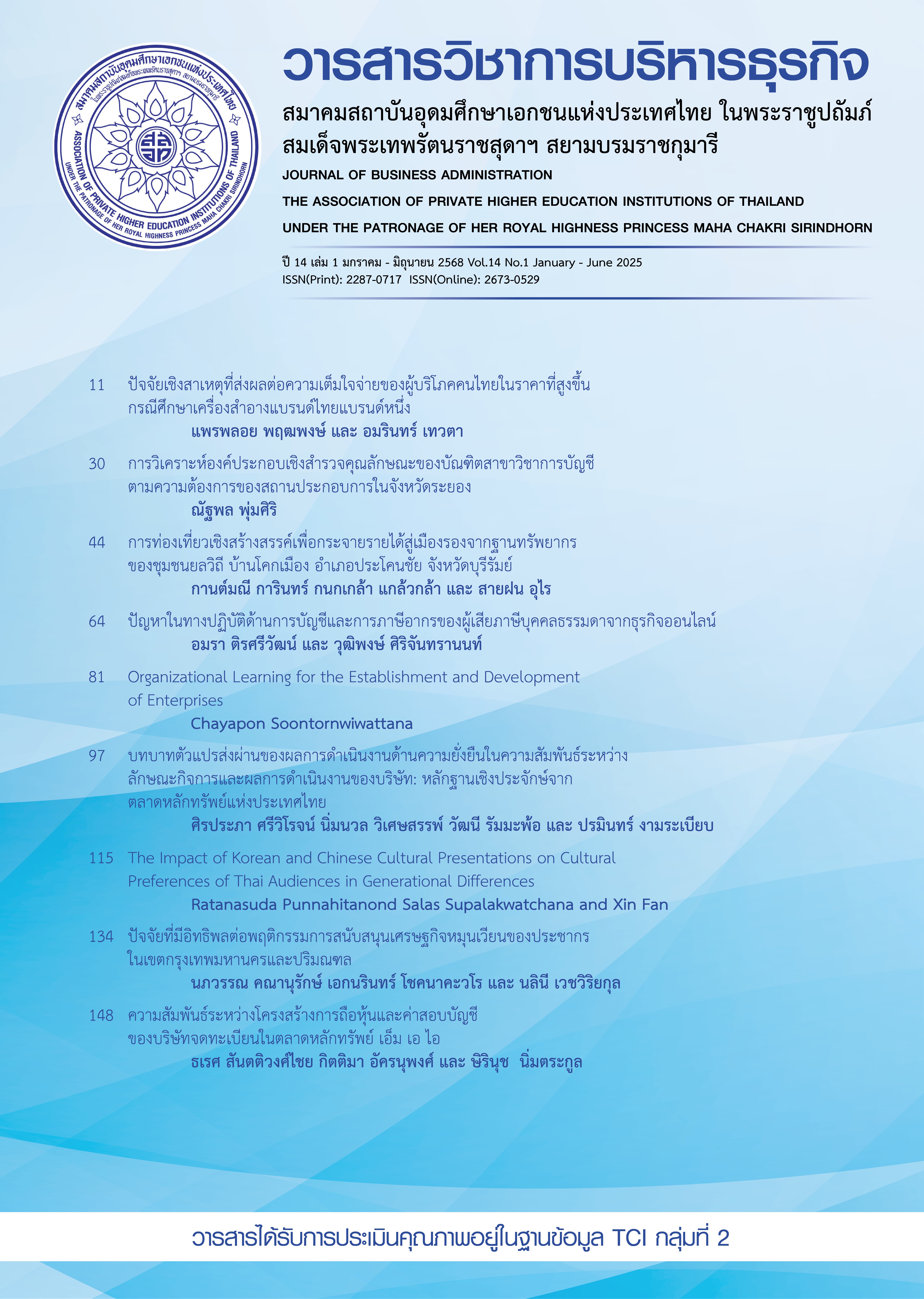
Causal Factors Affecting Willingness of Thai Consumers to Pay More: A Case Study of a Thai Cosmetic Brand
Keywords:
Willingness to pay, Thai consumers, Higher prices, Thai brand cosmeticsAbstract
The objectives of this research were to: (1) study Thai consumers' willingness to pay a higher price for a Thai brand of cosmetics, and (2) study the causal factors of brand image brand loyalty, brand equity, and purchase decisions towards Thai consumers' willingness to pay higher prices. of a Thai brand of cosmetics. This research is quantitative research by using a survey as well as distributing online questionnaires via Google Form to collect data via the Instagram inbox of a sample group of consumers. The sample of 400 customers of purposive sampling has purchased and is followers of a Thai cosmetic brand on the brand's official Instagram platform. The statistics used in the research consist of descriptive statistics, including frequency, percentage, mean, and standard deviation, and structural model analysis consistent with empirical data. The data collection period was from March to May 2024. The research results found that (1) Thai consumers are willing to pay a higher price for a Thai cosmetic brand, and (2) the structural model analysis was consistent with the empirical data with a weight of 0.27 – 0.67 (Chi-Square = 467.964, DF = 241, CMIN/DF = 1.942, RMSEA = 0.049, RMR = 0.034, GFI = 0.912, CFI = 0.932, IFI = 933 and TLI = 0.922). The relationship among the variables was found brand image to brand loyalty and purchase decisions (β= 0.650, 0.454), brand loyalty to brand equity (β = 0.992) and brand equity to purchase decisions and the willingness to pay a higher price (β = 0.563, 0.840). from the result of study, Thai cosmetic brand should use the strategy of creating a brand image that looks good, modern, safe and reflects good taste to create brand value for the brand, which will result in consumers being willing to pay a higher price.
References
Aaker, D. A. (1996). Measuring brand equity across products and markets. California management review, 38(3), 102-120.
Aaker, D. A., & Jacobson, R. (2001). The Value Relevance of Brand Attitude in High-Technology Markets. Journal of Marketing Research (JMR), 38(4), 485-493.
Bangkokbiznews. (2024, June 26). Beauty market expanded by 9.5%, pushing Thailand's soft power cosmetics. https://www.bangkokbiznews.com/health/well-being/1133071 [in Thai]
Belch, G. E., & Belch, M. A. (2018). Advertising and Promotion: An Integrated Marketing Communications Perspective. McGraw-Hill.
Chanapim, S., & Sangboonnak, R. (2021). Factors Affecting of Gen Y Female on Buying Behavior South Korea Cosmetic Brand in Bangkok. Journal of MCU Nakhondhat, 8(5), 177-190. [in Thai]
Etzel, M. J., Walker, B. J., & Stanton, W. J. (1997). Marketing (11th ed.). McGraw-Hill.
Fu, Y., & Chen, X. (2023). The Effect of Brand Attachment on Consumer Willingness to Pay Price Premiums Based on Cosmetic Products Insight. Highlights in Business, Economics and Management, 17, 14-20. https://doi.org/10.54097/hbem.v17i.11017
Hair Jr, J. F., Black, W. C., Babin, B. J., & Anderson, R. E. (2010). Multivariate data analysis (7th ed.). Pearson.
Hongma, T. (2022). The Relationship Between Brand Image, Brand Value and Loyalty in Imported Cosmetic Brands of Consumers in Nonthaburi Province. DRIRDI Research for Community Service Journal, 8(2), 79-94. [in Thai]
Jenareewong. I., & Sombultawee. K. (2022). Impact of Prototypical Brand Image and Korean Wave on PurchaseIntention of Experiential Product (Korean Cosmetics) Perspective. Kasetsart Applied Business Journal, 16(24), 49 – 72. [in Thai]
Keller, K. L. (2003). Understanding brands, branding and brand equity. Interactive Marketing, 5(1), 7-20. https://doi.org/10.1057/palgrave.im.4340213
Kotler, P., & Keller, K. L. (2016). Marketing Management (14th ed.). Shanghai People’s Publishing House.
MacCallum, R. C., Roznowski, M., & Necowitz, L. B. (1992). Model modifications in covariance structure analysis: the problem of capitalization on chance. Psychological bulletin, 111(3), 490-504.
Pundech, S. (2023). An Analysis of Consumers' Willingness to Pay for Jewelry and Gemstone Products. Rattanakosin Journal of Social Sciences and Humanities, 5(1), 49-64. [in Thai]
Srathongklat. P., & Sakulkijkarn. W. (2022). Brand Equity, Perception Factors, the Effects of Social Media Influencing the Purchasing Decisions and the Brand Loyalty of Tourists in Phuket. Journal of MCU Ubon Review, 7(3), 673 – 686. [in Thai]
Sun, C., & Xu, S. (2022). Discover The Influence of Brand Image for M·A·C Cosmetics. BCP Business & Management, 20, 758-767. https://doi.org/10.54691/bcpbm.v20i.1060
Suwaparbs. (2024, June 25). Cosmetic product market in the United States. DITP. https://www.ditp.go.th/ post/174973 [in Thai]
ThaiPublica. (2023, April, 28). How can the cosmetics market continue?. ThaiPublica. https://thaipublica.org/2023/04/krungthai-compass51/ [in Thai]
Wanichbancha, K. (2019). Quantitative analysis Management: Statistical methods (4th ed.). Chulalongkorn University Book Center. [in Thai]
Zulfakar, M. H., Anuar, M. M., & Talib, M. F. (2014). Conceptual Framework on Halal Food Supply Chain Integrity Enhancement. Procedia - Social and Behavioral Sciences, 21(2), 58 – 67. https://doi.org/10.1016/j.sbspro.2014.01.1108
Downloads
Published
How to Cite
Issue
Section
License
Copyright (c) 2025 Journal of Business Administration The Association of Private Higher Education Institutions of Thailand

This work is licensed under a Creative Commons Attribution-NonCommercial-NoDerivatives 4.0 International License.
บทความที่ลงตีพิมพ์ในวารสารวิชาการบริหารธุรกิจ สมาคมสถาบันอุดมศึกษาเอกชนแห่งประเทศไทยต้องเป็นบทความที่ไม่เคยได้รับการตีพิมพ์เผยแพร่ หรืออยู่ระหว่างการพิจารณาตีพิมพ์ในวารสารอื่นๆ การละเมิดลิขสิทธิ์เป็นความรับผิดชอบของผู้ส่งบทความโดยตรง

