
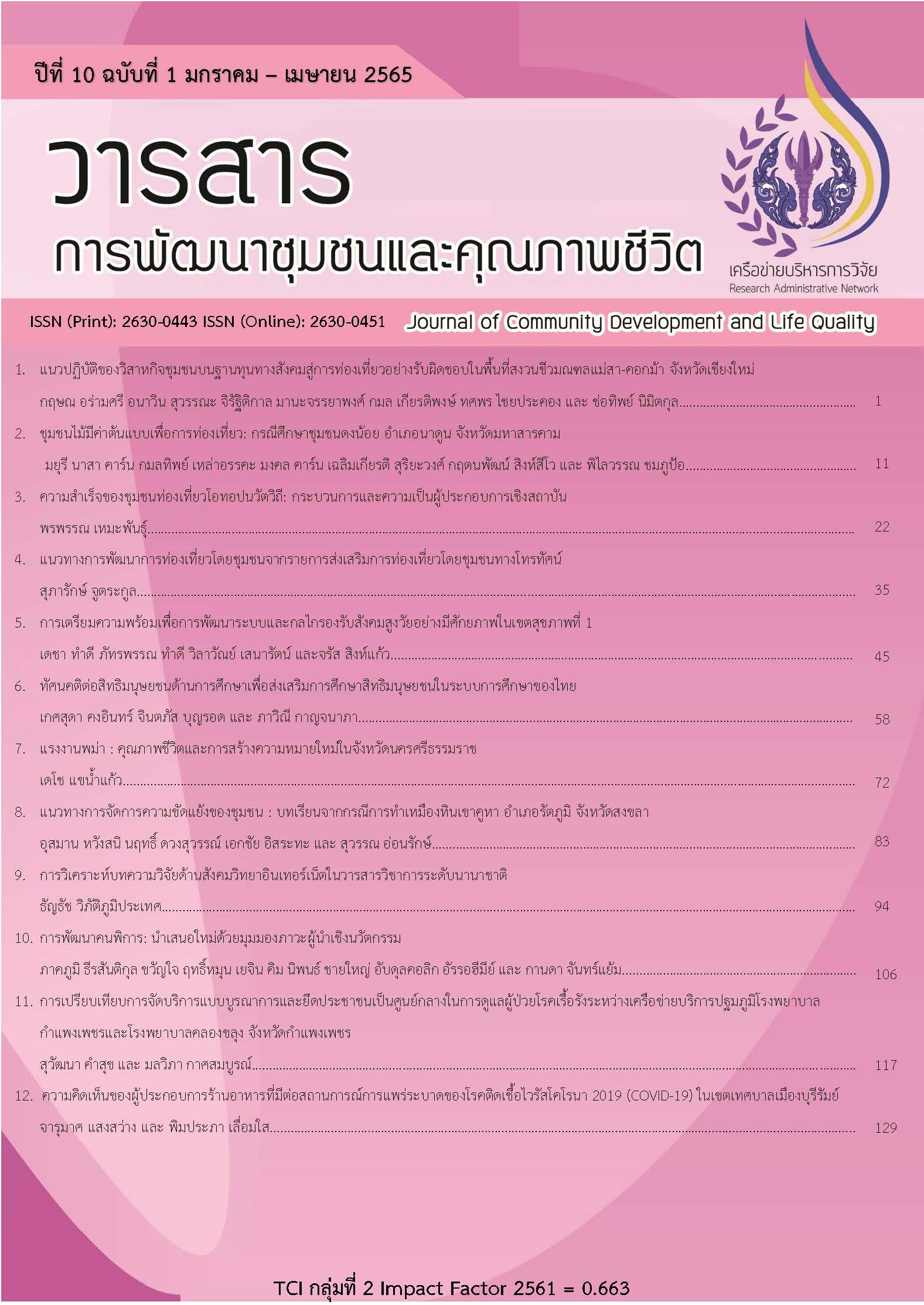
การพัฒนาคนพิการ: นำเสนอใหม่ด้วยมุมมองภาวะผู้นำเชิงนวัตกรรม
Article Sidebar
Main Article Content
บทคัดย่อ
การวิจัยเชิงคุณภาพครั้งนี้มีวัตถุประสงค์เพื่อ 1) เพื่อศึกษาหลักการ แนวคิด ทฤษฎี และงานวิจัยที่เกี่ยวข้องกับองค์ประกอบคุณลักษณะภาวะผู้นำเชิงนวัตกรรมของชุมชนสำหรับการพัฒนาโครงการนวัตกรรมเพื่อพัฒนาคนพิการ 2) เพื่อสรุปปัจจัยสำคัญในการพัฒนาผู้พิการภายใต้นำเสนอใหม่ด้วยมุมมองภาวะผู้นำเชิงนวัตกรรม โดยมีผู้ให้ข้อมูลหลักเป็นผู้นำชุมชน 6 ท่าน จาก 2 ชุมชนที่เคยได้รับรางวัลระดับชาติที่เกี่ยวกับภาวะผู้นำเชิงนวัตกรรมผ่านการสัมภาษณ์เชิงลึกด้วยวิธีการเลือกแบบเจาะจงชุมชนละ 3 ท่าน เลือกรูปแบบการสัมภาษณ์เชิงลึกตามทฤษฎีการเล่าเรื่อง และนำข้อมูลที่ได้มาวิเคราะห์ด้วยการวิเคราะห์เนื้อหา ผลการวิจัยพบว่า ปัจจัยความสำเร็จการใช้ภาวะผู้นำเชิงนวัตกรรมของผู้นำชุมชนในการพัฒนาคนพิการทั้งปัจจัยระดับบุคคล ปัจจัยระดับทีมงาน และปัจจัยระดับองค์การ ภายใต้การนำเสนอใหม่ด้วยมุมมองภาวะผู้นำเชิงนวัตกรรมสามารถสรุปเป็นข้อค้นพบความเชื่อมโยงของผู้นำแบบไม่เป็นทางการและผู้นำแบบเป็นทางการด้วยองค์ประกอบหลัก 3 ด้าน ได้แก่ ภาวะผู้นำ
ทุนมนุษย์ และนวัตกรรม
Article Details

อนุญาตภายใต้เงื่อนไข Creative Commons Attribution-NonCommercial-NoDerivatives 4.0 International License.
กองบรรณาธิการขอสงวนสิทธิ์ในการตรวจและแก้ไขบทความที่เสนอเพื่อตีพิมพ์ในวารสารการพัฒนาชุมชนและคุณภาพชีวิต
บทความหรือข้อความคิดเห็นใด ๆ ที่ปรากฏในวารสารการพัฒนาชุมชนและคุณภาพชีวิต เป็นวรรณกรรมของผู้เขียนโดยเฉพาะคณะผู้จัดทำไม่จำเป็นต้องเห็นด้วย และไม่ใช่ความรับผิดชอบของมหาวิทยาลัยและคณะผู้จัดทำ / บรรณาธิการ
เอกสารอ้างอิง
Allameh, S. M. and S.M. Davoodi. 2011. Considering transformational leadership model in branches of Tehran social security organization. Social and Behavioral Sciences 15: 3131-3137.
Bass, B.M. and B.J. Avolio. 1994. Transformational Leadership Development: Manual for the Multifactor Leadership Questionnaire. Consulting Psychologists Press, Palo Alto, California.
Birasnav, M. 2014. Knowledge management and organizational performance in the service industry: The role of transformational leadership beyond the effects of transactional leadership. Journal of Business Research 67(8): 1622-1629.
Burns, J. M. 1978. Leadership. Harper & Rows, New York Publishers
Cavazotte, F., V. Moreno and Hickmann. 2012. Effects of leader intelligence, personality and emotional intelligence on transformational leadership and managerial performance. The Leadership Quarterly 23(3): 443-455.
Chairasmisak, K. 2011. Oriental CEO. Chulalongkorn University Press, Bangkok. 137 p. (In Thai)
Choomnusonth, K. and T. Unaromlert. 2003. Development of models of self-management capabilities of people with disabilities for sustainable self-reliance. Silpakorn Educational Research Journal 8(2): 147-161. (in Thai)
Denti, L. and S. Hemlin. 2012. Leadership and innovation in organization: A systematic review of factors that mediate or moderate the relationship. International Journal of Innovation Management 16(3): 1240007, doi: 10.1142/
s1363919612400075.
Department of Empowerment of Persons with Disabilities. 2017. The Plan to Improve the Quality of Life for Persons with Disabilities the National Issue 5 2560-2564. Department of Empowerment of Persons with Disabilities, Bangkok. 57 p. (in Thai)
Department of Local Administration. 2017. Manual for Standards and Development of Quality of Life of People with Disabilities. The Agricultural Cooperative Federation of Thailand. Bangkok. 133 p. (in Thai)
Junkrapor, M. and K. Chienwattanasook. 2019. Establishing an innovative organization to drive towards the organizational excellence. Executive Journal 39(1): 52-66. (in Thai)
Kissi, J., A. Dainty, and M. Tuuli. 2013. Examining the role of transformational leadership of portfolio managers in project performance. International Journal of Project Management 31(4): 485-497.
Knezevich, S. J. 1984. Administration of Public Management. 4th ed. Harper and Row New York.
Horth, D. and D. Buchner. 2014. Innovation leadership: How to use innovation to lead effectively, work collaboratively, and drive results. Center for Creative Leadership Greensborough, NC.
Hunter, S. T. and L. Cushenbery. 2011. Leading for Innovation: Direct and Indirect Influences. Advances in Developing Human Resources 13: 248-265.
Luecke, R. 2009. The Innovator’s Toolkit. Harvard Business Press, Bostom.
Phaleepat, B. and P. Changrien. 2015. Guidelines for skills capacity development for the Thai disability’s labours to international competition. Suan Dusit Graduate School Academic Journal 11(2): 131-139. (in Thai)
Pochjanart, P. and K. Chienwattanasook, 2020. Innovative leadership for the competitive advantage of the organization in the 21st century. Journal of Management Science Review 22(1): 241-257. (in Thai)
Wang, X.H. and J. M. Howell. 2012. A multilevel study of transformational leadership, identification, and follower outcomes. The Leadership Quarterly 23(5): 775-790.
