
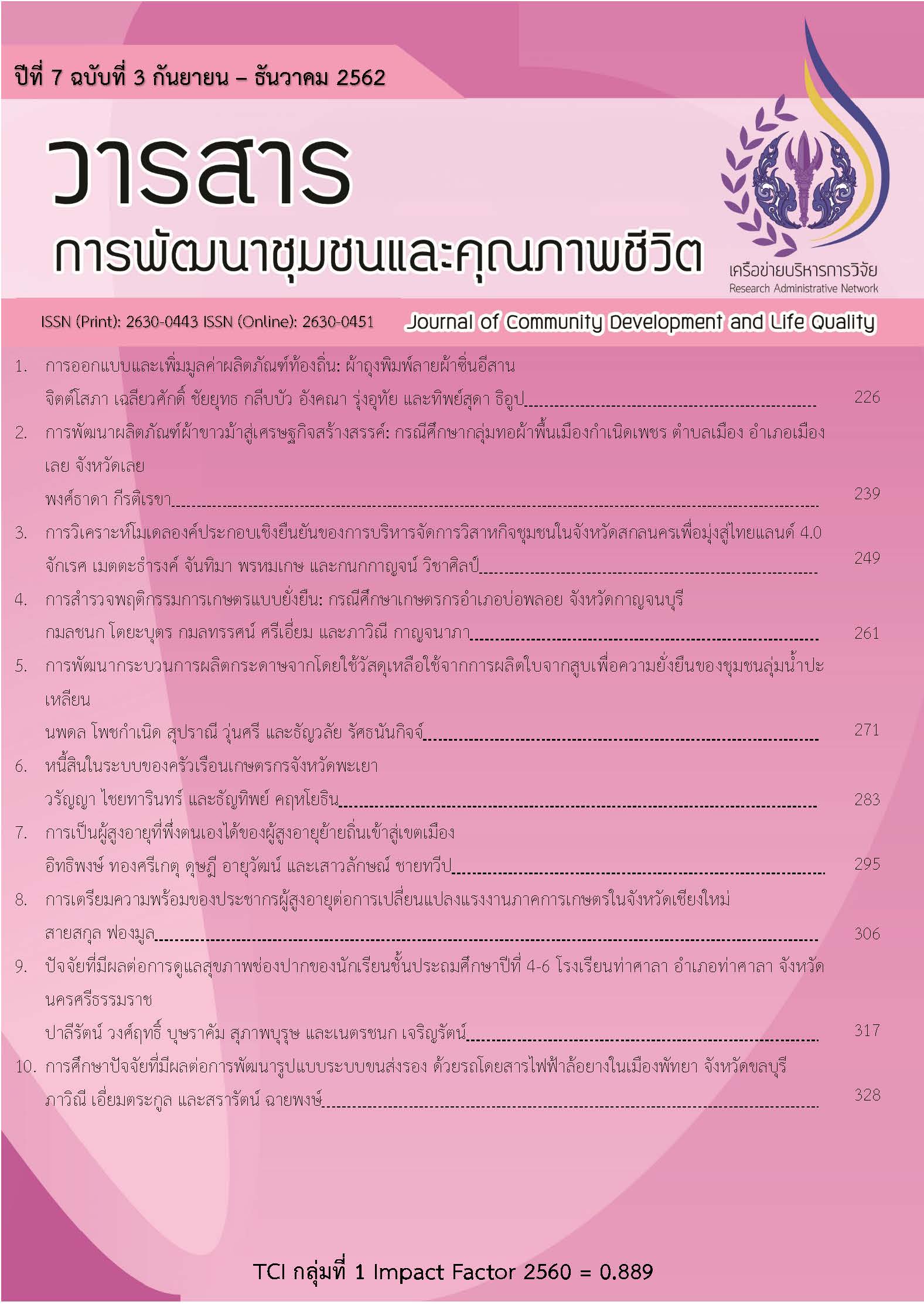
การส่งเสริมพฤติกรรมการเกษตรแบบยั่งยืน กรณีศึกษาเกษตรกรอำเภอบ่อพลอย จังหวัดกาญจนบุรี
Article Sidebar
Main Article Content
บทคัดย่อ
การวิจัยนี้มีวัตถุประสงค์เพื่อศึกษาพฤติกรรมการทำเกษตรแบบยั่งยืน กรณีศึกษาอำเภอบ่อพลอย จังหวัดกาญจนบุรี โดยได้ทำการศึกษากับกลุ่มเกษตรกรที่ทำการปลูกพืชและผลไม้ จำนวน 61 คน การศึกษาใช้การสัมภาษณ์ส่วนบุคคลควบคู่กับการใช้แบบสอบถาม ผลการศึกษาพบว่า พฤติกรรมการปลูกพืช เกษตรกรให้ความสำคัญการเลือกปลูกพืชตามสภาพแวดล้อมและความชำนาญเกี่ยวกับพืชมากที่สุด รองลงมาคือ การปลูกพืชตามฤดูกาลและความเหมาะสม การปลูกพืชตามความพร้อมของเงินลงทุน การปลูกพืชตามลักษณะทางกายภาพของดิน การปลูกพืชตามการคาดการณ์ด้านราคาในเวลาเก็บเกี่ยวผลผลิต การปลูกพืชจากระยะเวลาในการปลูก นอกจากนี้ เกษตรกรมีระดับความคิดเห็นต่อปัจจัยที่มีอิทธิพลต่อการปลูกพืชแลระดับมากด้านการเรียนรู้ ทัศนคติ อิทธิพลด้านการค้าและการตลาด และ ภูมิปัญญาวิถีชาวบ้านและวิถีชุมชน เกษตรกรต้องการให้ภาครัฐเข้ามาให้ความรู้ด้านการปลูกพืชและการหาตลาดรองรับผลิต
คำสำคัญ: พฤติกรรมการเกษตรแบบยั่งยืน ภูมิปัญญาวิถีชาวบ้านและวิถีชุมชน การเรียนรู้
Article Details
กองบรรณาธิการขอสงวนสิทธิ์ในการตรวจและแก้ไขบทความที่เสนอเพื่อตีพิมพ์ในวารสารการพัฒนาชุมชนและคุณภาพชีวิต
บทความหรือข้อความคิดเห็นใด ๆ ที่ปรากฏในวารสารการพัฒนาชุมชนและคุณภาพชีวิต เป็นวรรณกรรมของผู้เขียนโดยเฉพาะคณะผู้จัดทำไม่จำเป็นต้องเห็นด้วย และไม่ใช่ความรับผิดชอบของมหาวิทยาลัยและคณะผู้จัดทำ / บรรณาธิการ
เอกสารอ้างอิง
Charutwinyo, P. and Charutwinyo, C. 2018. The Farmer’s Problem and Solution Model in Thailand. Journal of Community Development and Life Quality 6(1): 153-162. (in Thai)
Department of Agricultural Extension. 2013. Crop Production Data. Retrieved from:
http://bophloi.kanchanaburi.doae.go.th/content/new%2057/A13052557.pdf (26 August 2018). (in Thai)
Esnard, R. et al. 2017. Factors Affecting the Value Added by Agricultural Cooperatives in Saint Lucia: An Institutional Analysis. Journal of Co-operative Organization and Management 5: 73-79.
Huls t, F. J. V. and Posthumus, H. 2016. Understanding (non-) Adoption of Conservation Agriculture in Kenyausing the Reasoned Action Approach. Land Use Policy 56: 303-314.
Mottaleb, K. A. 2018. Perception and adoption of a new agricultural technology: Evidence from a developing country. Technology in Society 55”\: 126-135.
Ministry of Agricultures and Cooperatives. 2011. Agricultural Development Plan During the 11th National Economic and Social Development Plan (2012-2016). (Online). Retrieved from: https://www.moac.go.th/action_plan-files-391491791793 (26 August 2018). (in Thai)
Ministry of Agricultures and Cooperatives. 2011. Agricultural Development Plan During the 12th National Economic and Social Development Plan (2017-2021). (Online). Retrieved from: http://tarr.arda.or.th/static2/docs/development_plan2559.pdf (26 August 2018). (in Thai)
Ngaingam, P. 2015. The Development of a Sustainable Agricultural System in Ban Lak Metre Community, Tung Khwang, Kamphaengsaeng, Nakhon Pathom Province, Area Based Development Research Journal 7(4): 91-123. (in Thai)
Suksan, I. 2016. Philosophy of Sufficiency Economy: Its Perception and Application in Thai Society. Research and Development Journal, Loei Rajaphat University 11(38): 96-104. (in Thai)
Yang et al. 2017. Performance Feedback and Supplier Selection: A Perspective from the Behavior Theory of the Firm. Industrial Marketing Management 63: 102-115.
