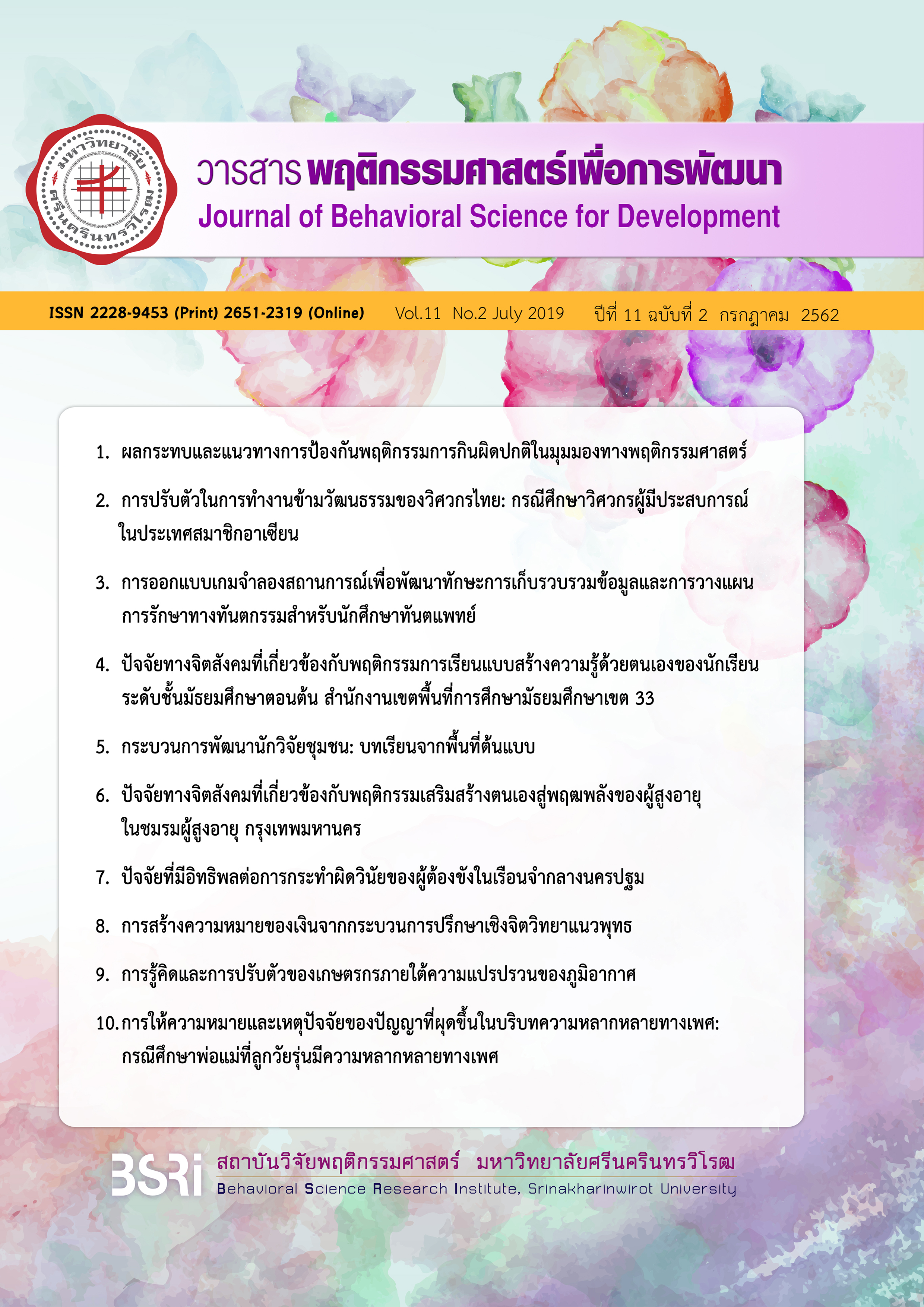
ผลกระทบและแนวทางการป้องกันพฤติกรรมการกินผิดปกติ: มุมมองทางพฤติกรรมศาสตร์
คำสำคัญ:
ผลกระทบ, แนวทางการป้องกัน, พฤติกรรมการกินผิดปกติ, มุมมองทางพฤติกรรมศาสตร์บทคัดย่อ
บทคัดย่อ
บทความนี้ เป็นบทความวิเคราะห์ที่นำเสนอถึงผลกระทบและแนวทางการป้องกันพฤติกรรมการกินผิดปกติ โดยผ่านมุมมองทางพฤติกรรมศาสตร์ ซึ่งให้ความสำคัญกับการใช้ศาสตร์ต่างๆ โดยมีการบูรณาการความรู้จากศาสตร์อื่นๆ ได้แก่ จิตวิทยา สังคมวิทยา มานุษยวิทยา และในสาขาวิชาอื่นๆ ร่วมกัน ในการทำความเข้าใจพฤติกรรมการกินผิดปกติ เพื่อให้เข้าใจถึงผลกระทบและแนวทางป้องกันที่อาศัยศาสตร์ต่างๆ นั้น โดยอธิบายภายใต้พื้นฐานทฤษฎีอิทธิพลสามทาง ในบทความนี้มีวัตถุประสงค์เพื่ออธิบายพฤติกรรมการกินผิดปกติของผู้หญิงไทย นำเสนอเป็น 4 ประเด็นหลัก ได้แก่ ความเข้าใจเบื้องต้นเกี่ยวกับโรคการกินผิดปกติ ผลกระทบของการมีพฤติกรรมการกินผิดปกติ แนวทางป้องกันการมีพฤติกรรมการกินผิดปกติ ซึ่งจากผลการศึกษาพบว่าปัจจัยจิตสังคมที่มีอิทธิพลต่อการมีรูปร่างสวยงามและพฤติกรรมการกินผิดปกติของผู้หญิงไทยทั้งวัยรุ่นตอนต้อนและวัยผู้ใหญ่ตอนปลาย ได้แก่ เจตคติที่มีต่อพฤติกรรมการกินผิดปกติ การรับรู้ความสามารถตนเองในการจัดการการมีรูปร่างสวยงาม การสนับสนุนทางสังคมจากกลุ่มเพื่อนในเรื่องการมีรูปร่างสวยงาม ตัวแบบจากสื่อของการมีรูปร่างสวยงาม การเข้าถึงแหล่งบริการที่เอื้อต่อการมีรูปร่างสวยงาม และการตัดสินใจแสดงพฤติกรรมการกินผิดปกติมีอิทธิพลทางตรงต่อพฤติกรรมการกินผิดปกติ ยกเว้นระดับเศรษฐกิจของครอบครัว และมีอิทธิพลทางอ้อมโดยผ่านการตัดสินใจแสดงพฤติกรรมการกินผิดปกติ ซึ่งส่งผลกระทบทางด้านร่างกาย จิตใจ อารมณ์และสังคมตามมา และในส่วนการป้องกันจะเน้นไปที่การป้องกันทางด้านระดับบุคคลและการป้องกันที่ต้องอาศัยบุคคลรอบข้างเข้ามาเกี่ยวข้อง
เอกสารอ้างอิง
Arcelus, J., Mitchell, A. J., Wales, J., & Nielsen, S. (2011). Mortality rates in patients with anorexia
nervosa and other eating disorders: A meta-analysis of 36 studies. Arch Gen Psychiatry,
68(7), 724-731. DOI: 10.1001/archgenpsychiatry.2011.74.
Ajzen, I., & Fishbein, M. (1980). Understanding attitudes and predicting social behavior. Englewood Cliffs, NJ: Prentice Hall.
______. (1991). The theory of planned behavior. Organizational Behavior and Human Decision Processes, 50, 182. DOI: 10.1016/0749-5978(91)90020-T
Andersen, R., & Aday, L. A. (1967). A decade of health services. Social Survey Trends In Use And Expenditure.
Chicago: University of Chicago.
Bandura, A. (1986). Social foundation of thought and action: Asocial cognitive theory. Englewood
Cliffs, New Jersey: Prentice-Hall.
Dancyger, I., Krakower, S., & Fomari, V. (2013). Eating disorders in adolescent: Review of treatment studies that include psychodynamically informed therapy. Child and Adolescent Psychiatric Clinics of North America, 22(1), 97-117. DOI: 10.1016/j.chc.2012.08.006
Deborah, R., Glasofer., David, A. F., Haaga., Louise Hannallah., Sara, E. Field., Merel Kozlosky.,
James Reynolds., Jack A. Yanovski., & Marian Tanofsky-Kraff. (2013). Self-Efficacy beliefs and eating behavior in adolescent girls at-risk for excess weight gain and binge eating disorder. International Journal Eat Disorders, 46(7), 663-668. DOI: 10.1002/eat.22160
Flay, B.R., Snyder, F.J., & Petraitis, J. (2009). The Theory of Triadic Influence. in DiClimente, R.J.,
Crosby, R.A., & Kegler, M.C. (Eds.) Emerging Theories in Health Promotion Practice and Research. San Francisco, Jossey-Bass, 451-510.
Herpertz-Dahlmann, B., Dempfle, A., Konrad, K., et al. (2015). Eating disorder symptoms do not
just disappear: The implications of adolescent eating-disordered behavior for body weight
and mental health in young adulthood. European Child & Adolescent Psychiatry, 24(6), 675-684. DOI: 10.1007/s00787-014-0610-3
Hongsanguansri, S. (2012). “Eating Disorder nai čhittawētchasāt” [Eating disorder in psychiatry].
Ramathibodi 3rd edition, Bangkok, 532-539.
Kaewanan, A. (2009). phrưttikam kānchai bō̜rikān sathāban sœ̄m khwām ngām mēdi khǣ khlinik khō̜ng phūbō̜riphōk nai khēt Krung Thēp Mahā Nakhō̜n. [Behavior of using medicare beauty institute services consumer clinic in Bangkok]. Independent research, Master of Business Administration thesis, Major subject Management Science, Sukhothai Thammathirat Open University.
Kaewporndawan, T., Pariwatcharakul, P., & Pimratana, W. (2013). “Criterion validity study of the
eating attitude test - yīsiphok ( Eat - yīsiphok Thai version ) among Thai females” [Criterion Validity Study of The Eating Attitude Test-26 (Eat-26 Thai Version) among Thai Females]. Warasan Smakhmcitphaethy haeng prathesthia, 58(3), 283-296.
Kathleen, M. Pike & Patricia, E. Dunne. (2015). The Rise of Eating Disorders in Asia: A Review.
Journal of Eating Disorders, 3 (33), 1. DOI: 10.1186/s40337-015-0070-2
Keski-Rahkonen, A., & Mustelin, L. (2016). Epidemiology of eating disorders in europe: Prevalence,
incidence, comorbidity, course, consequences and risk factors. Current Opinion in Psychiatry, 29(6), 340-345. DOI: 10.1097/YCO.0000000000000278
Kijchanpaiboon, S. (2012). sưksā phrưttikam kānlot namnak thī mai thūktō̜ng khō̜ng wairun læ
yaowachon Thai. [Study the incorrect weight loss behavior of Thai teenagers and youth]. Warasan Payaban, 39(4), 179-189.
Kristen E. Van Vonderen & William Kinnally. (2012). Media effects on body image: Examining media
exposure in the broader context of internal and other social factors. American Communication
Journal 2012 SPRING, 14(2), 41.
Madanat, H. N., Lindsay, R., & Campbell, T. (2011). “Young urban women and the nutrition
tansition in Jordan.” Public Health Nutrition, 14(4), 599–604. DOI: 10.1017/S1368980010002107
Mead, S., Hilton, D., & Curtis, L. (2001). Peer support: A theoretical perspective. Psychiatric Rehabilitation
Journal, 25(2), 135. Retrieved from https://www.ncbi.nlm.nih.gov/pubmed/11769979
Mustelin, L., Raevuori, A., Hoek, H. W., & Keski-Rahkonen A. (2015). Incidence and weight
trajectories of binge eating disorder among young women in the community. International
Journal of Eating Disorders, 48(8), 1106-1112. DOI: 10.1002/eat.22409.
Nadira Mallick, Subha Ray, & Susmita Mukhopadhyay, (2014). Eating behaviours and body weight
concerns among adolescent girls. Journal of Anthropology, 2014, 1-5.
DOI: org/10.1155/2014/257396
Nagl, M., Jacobi, C., Paul, M., Beesdo-Baum, K., Hofler, M., Lieb, R., & et al. (2016). Prevalence, incidence,
and natural course of anorexia and bulimia nervosa among adolescents and young adults.
European Child & Adolescent Psychiatry 25(8), 903-918. DOI: 10.1007/s00787-015-0808-z
Pike, K. M., Hoek, H. W., & Dunne, P. E. (2014). Recent cultural trends and eating disorders. Current Opinion in Psychiatry, 27, 436-442. DOI: 10.1097/YCO.0000000000000100
Richard, M. Perloff. (2014). Social Media Effects on Young Women’s Body Image Concerns:
Theoretical Perspective and An Agenda for Research. Springer Science and Business Media New York. Sex Roles. DOI 10.1007/s11199-014-0384-6. Feminist Forum Review Article. Publish online: 29 May 2014.
Sadock, B. J., Sadock, V. A., & Ruiz, P. (2015). Kaplan & Sadock’s synopsis of psychiatry: Behavioral
sciences/clinical psychiatry. 11th ed, Philadelphia: Lippincott Williams & Wilkins, 509-532.
Solmi, F., Hotopf, M., Hatch, S. L., Treasure, J., & Micali, N. (2016). Eating disorders in a multiethnic inner-city UK sample: Prevalence, comorbidity and service use. Social Psychiatric Epidemiology, 51(3), 369-381. DOI: 10.1007/s00127-015-1146-74
Suphaphon, T. (2010). Interesting Topic rư̄ang Anorexia Nervosa. [Interesting topic: Anorexia
nervosa]. Tuesday 14 December 2010, 13.00-15.00 hrs. Department of Psychiatry, Faculty
Medicine Ramathibodi Hospital.
The National Eating Disorders Collaboration. (2011). NEDC fact sheet-body image. Retrieved from https://www.nedc.com.au/assets/Fact-Sheets/NEDC-Fact-Sheet-Body-Image.pdf
Thomas, J. J., Lee, S., & Becker, A. E. (2016). Updates in the epidemiology of eating disorders in Asia and The Pacific. Current opinion in psychiatry, 29(6), 354-362. DOI: 10.1097/YCO.0000000000000288
Verplanken, B., & Faes, S. (1999). Good intentions, bad habits, and effects of forming implementation intentions on healthy eating. European Journal of Social Psychology, 29(5-6), 591-604.
DOI: 10.1002/(SICI)1099-0992(199908/09)29:5/6<591::AID-EJSP948>3.0.CO;2-H
Vilma Garrido, Riquenes Josefina & Sala Roca. (2015). Eating disorder risk and psychopathological
dimensions. Anuario de Psicologia/The Universitat Autònoma de BarcelonaJournal of Psychology, 45(1), 87-99.
Watson, H. J., & Bulik, C. M. (2013). Update on the treatment of anorexia nervosa: Review of clinical trials, Practice Guidelines and Emerging Intervention. In Psychological Medicine, 43(12), 2477-2500. DOI: 10.1017/S0033291712002620
Welch E, Ghaderi A, Swenne I. (2015). A Comparison of clinical characteristics between adolescent
males and females with eating disorders. BioMed Central Psychiatry, 15(1), 1-7,
DOI: 10.1186/s12888-015-0419-8