การพัฒนาหลักสูตรสถานศึกษา รายวิชาเพิ่มเติม กลุ่มสาระการเรียนรู้การงานอาชีพ สำหรับนักเรียนชั้นมัธยมศึกษาปีที่ 6
Article Sidebar
Main Article Content
บทคัดย่อ
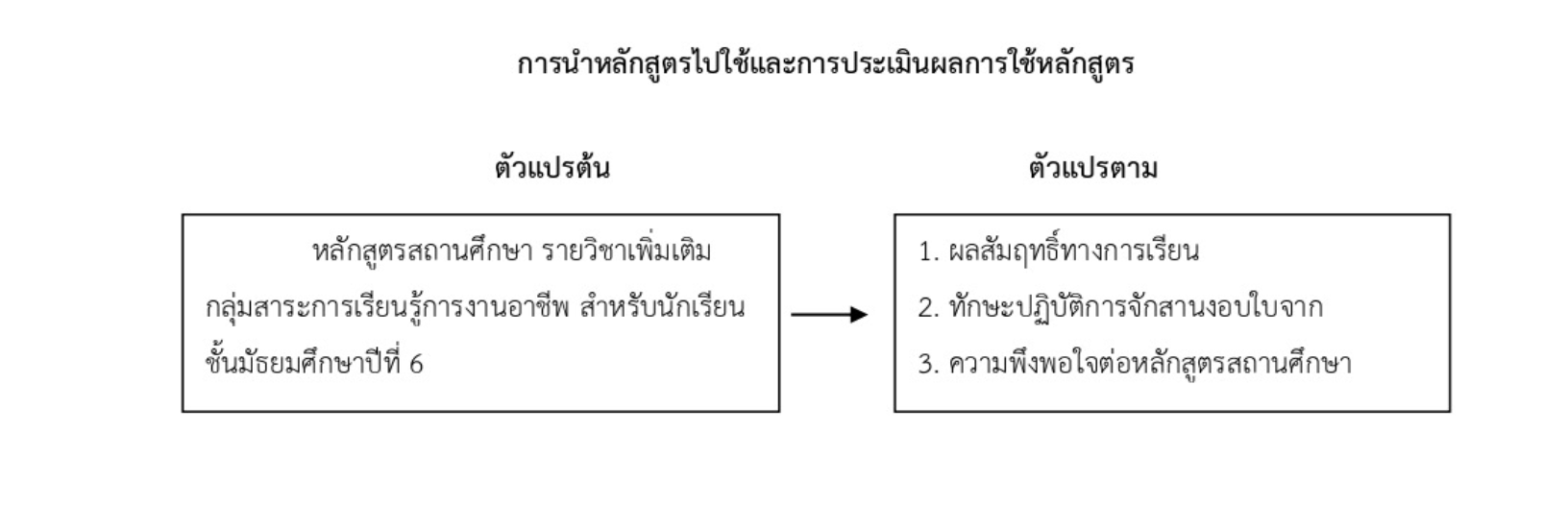
บทนำ: การพัฒนาหลักสูตรสถานศึกษา รายวิชาเพิ่มเติม กลุ่มสาระการเรียนรู้การงานอาชีพ สำหรับนักเรียนชั้นมัธยมศึกษาปีที่ 6 วัตถุประสงค์การศึกษา: 1) พัฒนาหลักสูตรสถานศึกษา รายวิชาเพิ่มเติม กลุ่มสาระการเรียนรู้การงานอาชีพ สำหรับนักเรียนชั้นมัธยมศึกษาปีที่ 6 2) เปรียบเทียบผลสัมฤทธิ์ทางการเรียนก่อนและหลังการใช้หลักสูตรสถานศึกษา รายวิชาเพิ่มเติม กลุ่มสาระการเรียนรู้การงานอาชีพ สำหรับนักเรียนชั้นมัธยมศึกษาปีที่ 6 3) เปรียบเทียบทักษะปฏิบัติการจักสานงอบใบจากก่อนและหลังใช้หลักสูตรสถานศึกษา รายวิชาเพิ่มเติม กลุ่มสาระการเรียนรู้การงานอาชีพ สำหรับนักเรียนชั้นมัธยมศึกษาปีที่ 6 และ 4) ศึกษาความพึงพอใจต่อหลักสูตรสถานศึกษา รายวิชาเพิ่มเติม กลุ่มสาระการเรียนรู้การงานอาชีพ สำหรับนักเรียนชั้นมัธยมศึกษาปีที่ 6 ระเบียบวิธีวิจัย: กลุ่มประชากรที่ใช้ในการวิจัยได้แก่ นักเรียนชั้นมัธยมศึกษาปีที่ 6/2 ที่กำลังเรียนอยู่ในภาคเรียนที่ 1 ปี การศึกษา 2566 โรงเรียนตราษตระการคุณ เลือกมาโดยวิธีเจาะจง ได้กลุ่มตัวอย่างที่ใช้ในการทดลองจำนวน 38 คน เครื่องมือที่ใช้ในการวิจัย ได้แก่ 1) แบบประเมินโครงร่างหลักสูตรสถานศึกษา 2) แผนการจัดการเรียนรู้ 3) แบบทดสอบวัดผลสัมฤทธิ์ทางการเรียน 4) แบบวัดทักษะปฏิบัติการจักสานงอบใบจาก และ 5) แบบประเมินความพึงพอใจต่อหลักสูตรสถานศึกษา สถิติที่ใช้ในการวิเคราะห์ข้อมูล ได้แก่ ค่าเฉลี่ย ส่วนเบี่ยงเบนมาตรฐาน และการทดสอบค่าที ผลการวิจัย: พบว่า 1) หลักสูตรสถานศึกษา มีผลการประเมินความเหมาะสมเท่ากับ 4.88 อยู่ในระดับ มากที่สุด 2) นักเรียนที่เรียนหลักสูตรสถานศึกษา มีผลสัมฤทธิ์ทางการเรียนหลังเรียนสูงกว่าก่อนเรียน อย่างมีนัยสำคัญทางสถิติที่ระดับ .01 3) นักเรียนที่เรียนหลักสูตรสถานศึกษา มีทักษะปฏิบัติการจักสานงอบใบจากหลังเรียนสูงกว่าก่อนเรียนอย่างมีนัยสำคัญทางสถิติที่ระดับ .01 และ 4) นักเรียนมีความพึงพอใจต่อหลักสูตรสถานศึกษา มีค่าเฉลี่ยความพึงพอใจเท่ากับ 4.85 อยู่ในระดับมากที่สุด
Downloads
Article Details

อนุญาตภายใต้เงื่อนไข Creative Commons Attribution-NonCommercial-NoDerivatives 4.0 International License.
** ข้อความ ข้อคิดเห็น หรือข้อค้นพบ ในวารสารสหวิทยาการสังคมศาสตร์และการสื่อสารเป็นของผู้เขียน ซึ่งจะต้องรับผิดชอบต่อผลทางกฎหมายใด ๆ ที่อาจเกิดขึ้นจากบทความและงานวิจัยนั้น ๆ โดยมิใช่ความรับผิดชอบของคณะนิเทศศาสตร์ มหาวิทยาลัยราชภัฏรำไพพรรณี **
เอกสารอ้างอิง
Academic Department of Trattrakarnkhun school. (2021). School curriculum of Trattrakarnkhunmueangtrat district. Trat.
Aekkapatchaiyawong, K. (2021). Developing Mathematics Achievement Using TAI Techniques Co- Operation Group Learning Activities with KWDL of Mathayom Suksa 4 Students. [Unpublished master’s thesis]. Rajabhat Maha Sarakham University.
Aiemsen, S. (2018). Curriculum Development. (Handout). Faculty of Education Suan Dusit University.
Boonprasert, U. (1999). School-Based Management of Education administration and Educational management Research Reports. Office of the National Education Commission.
Dechakup, C. (2006). Attitude and satisfaction in service Teaching materials, course set service Psychology, Unit 1-7 (4th Ed). Sukhothai Thammathirat University.
Khammanee, T. (2018). Science of Teaching: Knowledge for Effective Learning Organization.Chulalongkorn University Press.
Krongkaew P. (2003). A comparative study of consumer's satisfaction with marketing mix of major sanitary ware manufacturers: a case study in the Bangkok metropolitan area. [Unpublished master’s thesis]. Sukhothai Thammathirat OpenUniversity.
Ministry of Education. (2017). Basic Education Core Curriculum 2008 (Revised Edition 2017).
Ministry of Education. (2019). National Education Act B.E. 2542 and its amendments (No. 4) B.E. 2019.
Laipaitong, S. (2022). Development of local basketry pattern for applied design and contemporary home decoration of Chachoengsao Province. [Unpublished master’s thesis]. Burapha University.
Leesuwan, W. (1997). Basketry in Thailand. OS Printing House.
Ritphad, R. (2007). The People Satisfaction on the Management of Solid Waste in Sangsawang Municipality, Nongsang District, Udonthani Province. [Unpublished master’s thesis]. Mahasarakham University.
Sarncharoen, P. (2018). The Development of a Supplementary Course in the Learning Area of Occupations and Technology Entitled Making Fermented Rice Noodle (Khanomjeen) of prathomsuksa 5 students at Pongsatue (Rat-Prachasan) School. [Unpublished master’s thesis].Thepsatri Rajabhat University.
Shelly, D. F. (1995). Tackling family member compensation. American Printer.
Sinlarat, P. (2019). Principles: Management of Curriculum and Instruction (5th Ed).
Chulalongkorn University Press.
Songjohor, W. (2012). The development of school curriculum in social, religion and culture Learning Unit lam chakkarat koo baan of prathomsuksa 2 students. [Unpublished master’s thesis]. Nakhon Ratchasima Rajabhat University.
Sriboonruang, A. (2012). Development of a School Curriculum of Local Learning Strand on Lai–Muk Cotton Weaving for Mathayom Suksa 2 Students in Bannatongsaharajutid School Under the Office of Sakon Nakhon Primary Educational Service Area 1. [Unpublished master’s thesis]. Sakonnakhon Rajabhat University.
Srisaard, B. (2000). Introduction to Research. Suweerivasarn.
Sumongkol, P. (2012). Development of Local Curriculum on the Topic of food from lotus stem in the Career and Technology Learning area for Grade 5 Students at Bangplama District, Suphanburi. Journal for Social Sciences Research, 3(2), 5-25.
Taba, H. (1962). Curriculum Development Theory and Practice. Harcourt. Brace and World.
Thatthong, K. (2009). Developing the School Curriculum. Phetkasem Printing Group.
The Prime Minister's Office. (1999). Regulations of the Office of the Prime Minister on the Creation of a Good Government and Social Administration System, B.E. 2542.
Wiriyapanon, W. (1984). Basketry. Praepittaya.
Wohlstetter & Priscilla. (1995). Getting School-Based Management Right, Phi Delta Kappan, 77(1), 22-25.
Yapatang, L. (2022). Development of the Mathematical Problem Solving Ability Using Applied Cooperative Learning (TAI) and Polya's Problem-Solving Process for Grade 9 Students. [Unpublished master’s thesis]. Mahasarakham University .
