DEVELOPMENT OF A SELECTIVE COURSE IN THE OCCUPATION SUBJECT AREA FOR SECONDARY 6 STUDENTS
Article Sidebar
Main Article Content
Abstract
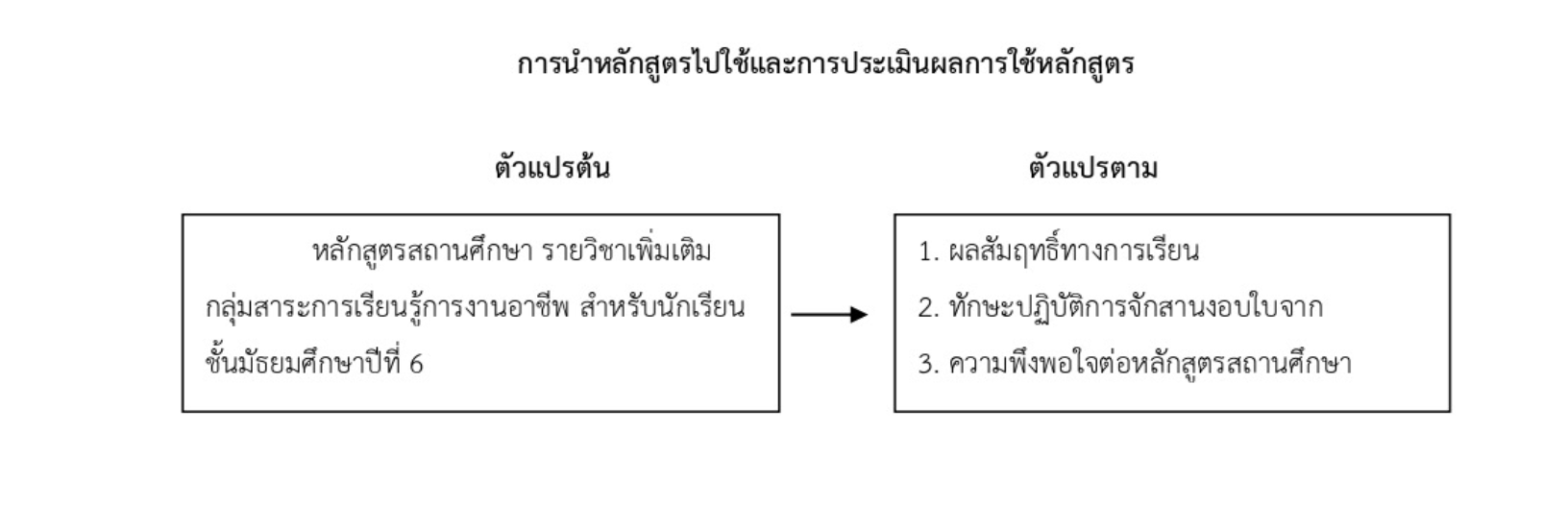
Introduction: This study focuses on developing a school-based curriculum for elective subjects in the occupational learning strand for Grade 12 students. Objectives: 1) To develop a school-based curriculum for elective subjects in the occupational learning strand for Grade 12 students; 2) To compare learning achievement before and after implementing the school-based curriculum for elective subjects in the occupational learning strand for Grade 12 students; 3) To compare palm leaf weaving practical skills before and after implementing the school-based curriculum for elective subjects in the occupational learning strand for Grade 12 students; and 4) To examine student satisfaction with the school-based curriculum for elective subjects in the occupational learning strand for Grade 12 students. Methods: The research population consisted of Grade 12/2 students enrolled in the first semester of the 2023 academic year at Trattrakarnkhun School, selected through purposive sampling, yielding an experimental sample of 38 students. The research instruments included: 1) a school curriculum framework evaluation form; 2) lesson plans; 3) a learning achievement test; 4) a palm leaf weaving practical skills assessment; and 5) a curriculum satisfaction evaluation form. Statistical analyses employed included means, standard deviations, and t-tests. Results: The results revealed that: 1) the school-based curriculum received an appropriateness evaluation score of 4.88, indicating the highest level of suitability; 2) students who studied the school-based curriculum demonstrated significantly higher post-instruction learning achievement compared to pre-instruction levels at the .01 significance level; 3) students who studied the school-based curriculum showed significantly improved palm leaf weaving practical skills post-instruction compared to pre-instruction levels at the .01 significance level; and 4) students expressed satisfaction with the school-based curriculum with a mean satisfaction score of 4.85, representing the highest level of satisfaction.
Downloads
Article Details

This work is licensed under a Creative Commons Attribution-NonCommercial-NoDerivatives 4.0 International License.
The author(s) is only responsible for data appearing in the submitted manuscript of Interdisciplinary social sciences and communication journal.Besides, this journal encourages and enables you to share data such as statements, contents, figures, etc. that support your research publication where appropriate, and enables you to interlink the data with proper citation.
References
Academic Department of Trattrakarnkhun school. (2021). School curriculum of Trattrakarnkhunmueangtrat district. Trat.
Aekkapatchaiyawong, K. (2021). Developing Mathematics Achievement Using TAI Techniques Co- Operation Group Learning Activities with KWDL of Mathayom Suksa 4 Students. [Unpublished master’s thesis]. Rajabhat Maha Sarakham University.
Aiemsen, S. (2018). Curriculum Development. (Handout). Faculty of Education Suan Dusit University.
Boonprasert, U. (1999). School-Based Management of Education administration and Educational management Research Reports. Office of the National Education Commission.
Dechakup, C. (2006). Attitude and satisfaction in service Teaching materials, course set service Psychology, Unit 1-7 (4th Ed). Sukhothai Thammathirat University.
Khammanee, T. (2018). Science of Teaching: Knowledge for Effective Learning Organization.Chulalongkorn University Press.
Krongkaew P. (2003). A comparative study of consumer's satisfaction with marketing mix of major sanitary ware manufacturers: a case study in the Bangkok metropolitan area. [Unpublished master’s thesis]. Sukhothai Thammathirat OpenUniversity.
Ministry of Education. (2017). Basic Education Core Curriculum 2008 (Revised Edition 2017).
Ministry of Education. (2019). National Education Act B.E. 2542 and its amendments (No. 4) B.E. 2019.
Laipaitong, S. (2022). Development of local basketry pattern for applied design and contemporary home decoration of Chachoengsao Province. [Unpublished master’s thesis]. Burapha University.
Leesuwan, W. (1997). Basketry in Thailand. OS Printing House.
Ritphad, R. (2007). The People Satisfaction on the Management of Solid Waste in Sangsawang Municipality, Nongsang District, Udonthani Province. [Unpublished master’s thesis]. Mahasarakham University.
Sarncharoen, P. (2018). The Development of a Supplementary Course in the Learning Area of Occupations and Technology Entitled Making Fermented Rice Noodle (Khanomjeen) of prathomsuksa 5 students at Pongsatue (Rat-Prachasan) School. [Unpublished master’s thesis].Thepsatri Rajabhat University.
Shelly, D. F. (1995). Tackling family member compensation. American Printer.
Sinlarat, P. (2019). Principles: Management of Curriculum and Instruction (5th Ed).
Chulalongkorn University Press.
Songjohor, W. (2012). The development of school curriculum in social, religion and culture Learning Unit lam chakkarat koo baan of prathomsuksa 2 students. [Unpublished master’s thesis]. Nakhon Ratchasima Rajabhat University.
Sriboonruang, A. (2012). Development of a School Curriculum of Local Learning Strand on Lai–Muk Cotton Weaving for Mathayom Suksa 2 Students in Bannatongsaharajutid School Under the Office of Sakon Nakhon Primary Educational Service Area 1. [Unpublished master’s thesis]. Sakonnakhon Rajabhat University.
Srisaard, B. (2000). Introduction to Research. Suweerivasarn.
Sumongkol, P. (2012). Development of Local Curriculum on the Topic of food from lotus stem in the Career and Technology Learning area for Grade 5 Students at Bangplama District, Suphanburi. Journal for Social Sciences Research, 3(2), 5-25.
Taba, H. (1962). Curriculum Development Theory and Practice. Harcourt. Brace and World.
Thatthong, K. (2009). Developing the School Curriculum. Phetkasem Printing Group.
The Prime Minister's Office. (1999). Regulations of the Office of the Prime Minister on the Creation of a Good Government and Social Administration System, B.E. 2542.
Wiriyapanon, W. (1984). Basketry. Praepittaya.
Wohlstetter & Priscilla. (1995). Getting School-Based Management Right, Phi Delta Kappan, 77(1), 22-25.
Yapatang, L. (2022). Development of the Mathematical Problem Solving Ability Using Applied Cooperative Learning (TAI) and Polya's Problem-Solving Process for Grade 9 Students. [Unpublished master’s thesis]. Mahasarakham University .
