THE COMPARISON OF MATHEMATIC LEARNING ACHIEVEMENT IN CALCULATING VOLUMES OF GEOMETRIC SHOPES BETWEEN TEACHING WITH THE TGT AND STAD TECHNIQUES FOR PRIMARY 6 STUDENTS
Article Sidebar
Main Article Content
Abstract
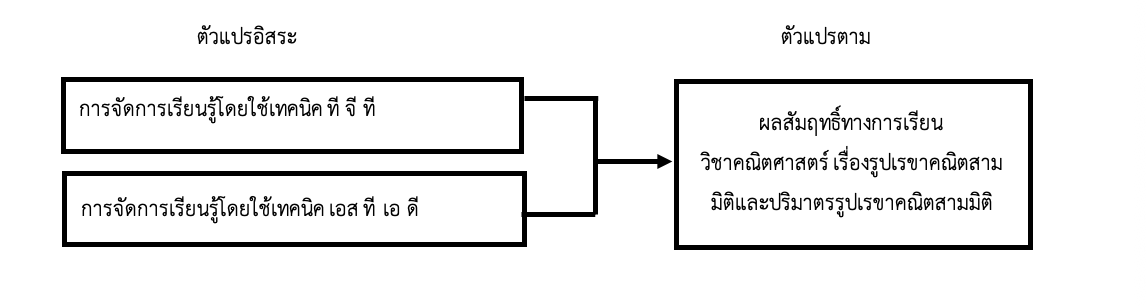
Introduction: In today's mathematics education, most teachers use lecture-based teaching methods, creating a learning atmosphere that does not sufficiently engage students, resulting in low academic achievement. Currently, there are teaching techniques that can increase students' motivation to learn mathematics, such as group-based learning techniques, including Team Games Tournament (TGT) and Student Teams Achievement Division (STAD). These cooperative learning techniques may enhance students' academic achievement. Objectives: To compare students' mathematics achievement before and after learning with the TGT and STAD techniques, and to compare the learning achievement between students taught using the TGT technique and those taught using the STAD technique. Methods: The sample group consisted of Grade 6 students from Joseph Wittaya School, Tha Mai District, Chanthaburi Province, during the second semester of the 2023 academic year, totaling two classrooms, selected through simple random sampling. The research instruments included lesson plans using the TGT and STAD techniques and an academic achievement test. The data were analyzed using mean, standard deviation, and t-test analysis. Results: The study found that students who learned using the TGT and STAD techniques showed a statistically significant improvement in mathematics achievement at the .05 level. Additionally, when comparing the two groups, there was a statistically significant difference in their learning achievement at the .05 level. Conclusion: Learning through the TGT and STAD techniques fosters student participation, enthusiasm, and a positive learning atmosphere, contributing to the enhancement of students' academic achievement.
Downloads
Article Details

This work is licensed under a Creative Commons Attribution-NonCommercial-NoDerivatives 4.0 International License.
The author(s) is only responsible for data appearing in the submitted manuscript of Interdisciplinary social sciences and communication journal.Besides, this journal encourages and enables you to share data such as statements, contents, figures, etc. that support your research publication where appropriate, and enables you to interlink the data with proper citation.
References
Jampa, C., Chuntra, C., & Kasemsukpipat. W. (2023). The Development of Mathematics Learning Achievement of Mathayomsuksa Two Students on Factorization of Second Degree Polynomials by Using Cognitively Guided Instruction and Team Games Tournament (TGT). Journal of Legal Entity Management and Local Innovation, 9(2), 96-108. https://so04.tci-thaijo.org/index.php/jsa-journal/article/view/259128/178736
Khammanee, T. (2016). Pedagogy. Knowledge for Effective Learning Process (20th Ed.).Chulalongkorn University Press.
Khammanee, T. (2023). Pedagogy. Knowledge for Effective Learning Process. (23rd Ed.).Chulalongkorn University Press.
Lowriendee, W., Kitroongrueng, P., & Sirisamphan, O. (2017). Proactive Learnin Management Strategies to Develop Thinking and Improve the Quality of Education for the 21st Century (7rd Ed.). Petchkasem Printing Group Co., Ltd.
Nuanchun, S. (2019). Mathematics Learning Achievement and Group Process Abilities on Real Number with STAD Teaching Technique Together with Mathematice Game of Mathayomsuksa 4 Students. [Master of Education Thesis, Thaksin University]. TSU-IR. http://ir.tsu.ac.th/xmlui/123456789/356.
Onsri, B. (2020). Effects of Mathematic Learning Activity Management Using Cooperative Leaning Stad
Technique With The Polya’s Problem Solving Process Of Prathom Suksa 4 Students. [Master's
Thesis, Burapha University]. BUUIR. https://buuir.buu.ac.th/bitstream/1234567890/8841/1/57912256.pdf
Office of Academic and Educational Standards, Office of the Basic Education Commission, Ministry of Education. (2008). Indicators and Core Learning Materials, Mathematics Learning Materials Group according to the Core Curriculum of Basic Education. 2008. Agricultural Cooperative Assembly Printing House of Thailand limit.
Office of the Basic Education Commission. (2017). Standard Quality Assessment Guide , Basic Education for Internal Quality Assurance of Educational Institutions. National Buddhist Office Printing House
Phujumnong, T., Wongsan, W., & Onamornrat, R. (2020). Comparison of Learning Achievement in History Subject of Learning ManagementCooperative Model by Using TGT Method and Normal Teaching Method Of Prathom Suksa 3 Students. Journal of Dhammasuksa Research, 3(2), 13-20. https://so07.tci-thaijo.org/index.php/dsr/article/view/452/359
Pulpipat, S., Plainsamai, J., Suntarin, P., Vilamart, K., & Kraipakdee, K. (2023). The Comparison of Learning Achievements on Foreign Language Words In Thai of mathayomsuksa 3 students at “Piboonbumpen” Demonstration School Burapha University with a Cooperative Teaching Method with TGT Technique and normal teaching. Journal of Education Burapha University, 35(1), 30-40. https://ojs.lib.buu.ac.th/index.php/education2/article/view/9841
Riedesel, A.C. (1990). Teaching Elementary School Mathematics. Prentic Hall.
Slavin, R. E.. (1995). Cooperative learning theory, Research and Practice (2nd Ed.). Simom & Schuster.
Srisa-ard, B. (2017). Revised Preliminary Research (10th Ed.). Suweeriya Sason Publishing House (Bangkok).
Sukkanan, K. (2015). The Comparison of Leaming Achievernent in Mathematics on Geometric of Prathomsuksa VI Students between The Cooperative Learning by using TAI and TGT Teaching Method. [Master Thesis, Rumpaiphanee Rajabhat University https://etheses.rbru.ac.th/pdf-uploads/allfile-150-file01-2016-02-05-09-44-50.pdf].
Sutthirat, C. (2018). 80 Learner-Centered Learning Management Innovations (8th Ed). P Balance Design & Printing.
Taweerat, P. (2000). Research Methods in Behavioral and Social Sciences (7rd Ed.). Educational and Psychological Test Bureau, Srinakharinwirot University.
Thongcharern, S., Yonwilad, W., Hembasat, P., & Pimpasalee, W. (2023). The Learning Management with Cooperative Learning TGT Technique on Statistics for Mathayomsuksa 2 students. Journal of Graduate School Sakon Nakhon Rajabhat University, 20(88), 31-38. https://so02.tci-thaijo.org/index.php/SNGSJ/article/view/255136/175495
