
THE REPRESENTATION OF WOMEN AS MAIN CHARACTERS UNDER THE CONCEPT OF FEMALE GAZE IN SOFIA COPPOLA’S FILMS
Article Sidebar
Main Article Content
Abstract
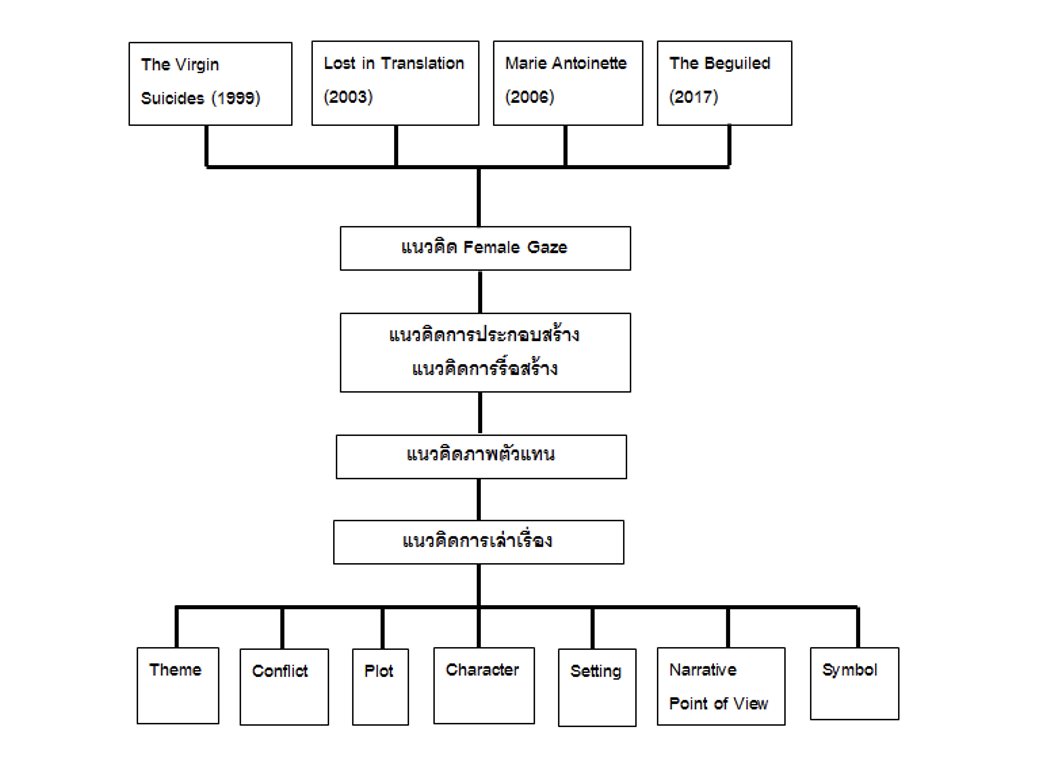
Introduction: The film industry has traditionally been dominated by male directors, resulting in fewer films featuring female protagonists and less focus on female roles. However, female directors such as Sofia Coppola have introduced the Female Gaze concept, which focuses on telling stories from a female perspective, without being dominated by male preferences. Objective: To analyze the representation of female protagonists through the concept of Female Gaze in Sofia Coppola's films. Methods: This is a qualitative research in which four of Sofia Coppola's films were specifically selected: "The Virgin Suicides" (1999), "Lost in Translation" (2003), "Marie Antoinette" (2006) and "The Beguiled" (2017) . The analysis is conducted through narrative elements combined with the concepts of construction, deconstruction, representation, and the Female Gaze. Results: The method of presenting female protagonists through the concept of Female Gaze in Sofia Coppola's films rejects the concept of Male Gaze or the male perspective. Instead, it focuses on creating female representations that reflect the reality of women in society. This is achieved by portraying the experiences, emotions, and relationships of female characters in films such as "The Virgin Suicides" (1999), which emphasizes the internal feelings of the Lisbon sisters as central female characters; "Lost in Translation" (2003), which depicts Charlotte's quest for self-identity as the female lead; "Marie Antoinette" (2006), which reconstructs the image of Marie Antoinette; and "The Beguiled" (2017), which redefines the role of women during the Civil War era. Conclusion: Therefore, the presentation of the main female character in the Female Gaze concept in Sofia Coppola's films. All these aspects help transform perspectives and elevate female characters to become as significant as their male counterparts.
Downloads
Article Details

This work is licensed under a Creative Commons Attribution-NonCommercial-NoDerivatives 4.0 International License.
The author(s) is only responsible for data appearing in the submitted manuscript of Interdisciplinary social sciences and communication journal.Besides, this journal encourages and enables you to share data such as statements, contents, figures, etc. that support your research publication where appropriate, and enables you to interlink the data with proper citation.
References
Purisinsi, W. (2002). Feminism: Movement and social thought of the 20th century (Satreeneeyom: Khabuankan lae naewkhit thang sangkom haeng sattaya tee 20). Khobfai Publishing
Mulvey, L. (1975). Visual pleasure and narrative cinema. Screen, 16(3), 6–18.
Johnston, C. (1975). Feminist politics and film history. In B. H. Kaplan (Ed.), Notes on women's cinema Society for Education in Film and Television.
Hall, S. (Ed.). (1997). Representation: Cultural representations and signifying practices. Sage Publications.
Barthes, R. (1974). S/Z: An essay (R. Miller, Trans.). Hill and Wang. (Original work published 1970)
Sallis, J. (1987). Deconstruction and philosophy: The texts of Jacques Derrida. The University of Chicago Press.
Swain, D. V. (1965). Techniques of the selling writer. University of Oklahoma Press.
Field, S. (1984). The screenwriter's workbook: Exercises and step-by-step instruction for creating a successful screenplay. Dell Publishing.
