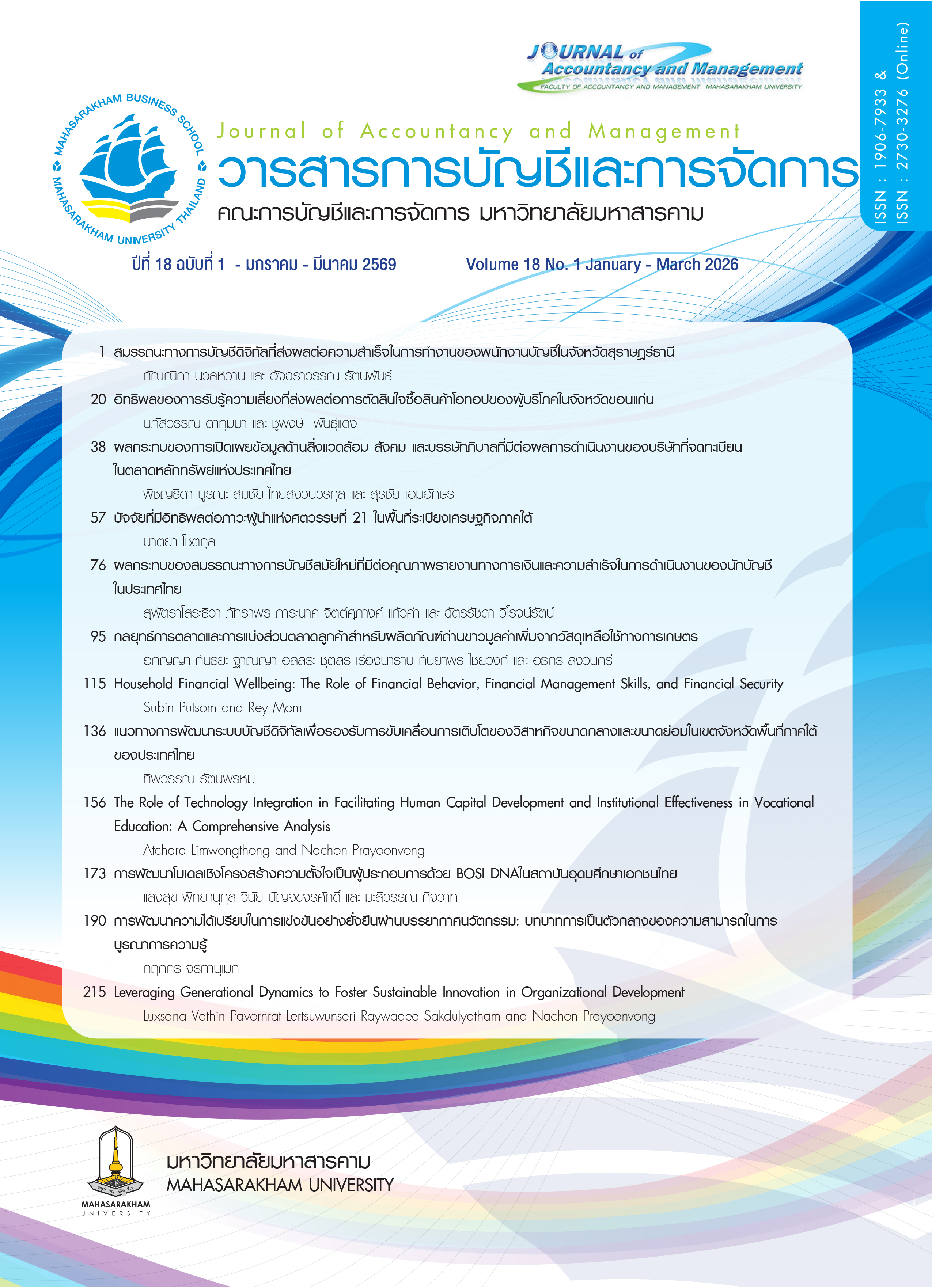
Household Financial Wellbeing: The Role of Financial Behavior, Financial Management Skills, and Financial Security
คำสำคัญ:
Financial Behavior, Financial Management Skills, Financial Security, Financial Well-beingบทคัดย่อ
The creation of household financial well-being is an essential aspect of people’s lives because it results from sound financial behavior, strong financial management skills, and financial security, which together enable individuals to manage daily expenses, plan for the future, and reduce financial stress. Therefore, the objective of this research is to explore the causal influence between financial behavior and financial management skills that affect financial security and the creation of financial well-being. This is a quantitative cross-sectional research with fieldwork to collect data from 179 households in Muak Lek District, Saraburi Province. This area was chosen as it reflects typical Thai households facing financial planning and security challenges. The collected data were analyzed through statistical values with Frequency, Percentage, Mean, Standard Deviation, Correlation Analysis, Confirmatory Factor Analysis (CFA), examination of the conceptual framework consistency, and testing of hypotheses using Structural Equation Analysis (SEM). The results of the hypothesis testing show a significant positive influence between financial behavior (cash planning, saving planning, investment planning, and financial planning) and financial management skills. In addition, financial behavior (saving planning and financial planning) has a positive influence on financial security, and financial behavior (saving planning, investment planning, and financial planning) has a positive influence on the creation of financial well-being of households. However, the results of the research found that financial behavior (cash planning and financial planning) has no influence on financial security and financial behavior (cash planning) has no influence on creating financial well-being for households. The findings of this research demonstrate the concept of creating financial well-being for households through financial behavior, financial management skills, and financial security as a part of solving the problem of increasing household debt and promoting financial management and financial planning through the use of appropriate and effective financial management skills to create household sustainability.
Downloads
เอกสารอ้างอิง
Abrantes-Braga, F. D. M., & Veludo-de-Oliveira, T. (2019). Development and validation of financial well-being related scales. International Journal of Bank Marketing, 37(4), 1025-1040.
Adee, S., Lau, E., & Wong, S. (2024). Mediating factors in retirement savings and well-being: a focused study on Sarawak. Cogent Economics & Finance, 12(1), 2422217.
Ajzen, I. (1991). The theory of planned behavior. Organizational behavior and human decision processes, 50(2), 179-211.
Ang, K. G. (2024). The Study of Achieving Personal Investment Success Through Financial Goal Setting. Available at SSRN 4844636.
Anuradha, P. A. N. S., Udayangani, T. T., & Jayarathna, G. S. (2024). Financial Planning and Self-control on Retirement Well-being through Financial Behaviour: Evidence from a Developing Country. Colombo Business Journal, 15(2), 28-53.
Arbuckle, M. R., McClain, M. T., Rubertone, M. V., Scofield, R. H., Dennis, G. J., James, J. A., & Harley, J. B. (2003). Development of autoantibodies before the clinical onset of systemic lupus erythematosus. New England Journal of Medicine, 349(16), 1526-1533.
Aquino, M. P., Cordova, E., Cuamag, J. A. P., Cupal, C. P. B., Fernandez, J. L., Geverola, J. H. F., ... & Suerte, A. M. V. (2025). Financial Management and Spending Behavior among 4ps Beneficiaries. International Journal of Research and Innovation in Social Science, 9(3), 4871-4896.
Azizah, A. N., Susilaningsih, S., & Noviani, L. (2024). The Influence of Financial Knowledge, Parental Financial Socialization, and Fear of Missing Out (FOMO) on the Financial Behavior of Gen Z students in Indonesia: Examining the Moderating Role of Gender. Jurnal Kependidikan: Jurnal Hasil Penelitian dan Kajian Kepustakaan di Bidang Pendidikan, Pengajaran dan Pembelajaran, 10(4), 1742-1752.
Bai, R. (2023). Impact of financial literacy, mental budgeting and self control on financial wellbeing: Mediating impact of investment decision making. Plos one, 18(11), e0294466.
Bank of Thailand. (2024). Revealing the survey results on Thai people's access to financial services... Challenges toward a sustainable future. Retrieved February 23, 2025, from https://www.bot.or.th/th/research-and-publications/articles-and-publications/articles/article-2024mar19.html
Byrne, B. M. (2001). Structural equation modeling with AMOS, EQS, and LISREL: Comparative approaches to testing for the factorial validity of a measuring instrument. International journal of testing, 1(1), 55-86.
Cheung, Y. L., Mak, B. S., Shu, H., & Tan, W. (2023). Impact of financial investment on confidence in a happy future retirement. International Review of Financial Analysis, 89, 102784.
Cho, E., & Kim, S. (2015). Cronbach’s coefficient alpha: Well-known but poorly understood. Organizational research methods, 18(2), 207-230.
Choi, K., & Seltzer, M. (2010). Modeling heterogeneity in relationships between initial status and rates of change: Treating latent variable regression coefficients as random coefficients in a three-level hierarchical model. Journal of Educational and Behavioral Statistics, 35(1), 54-91.
Choowan, P., Daovisan, H., & Suwanwong, C. (2024). Effects of Financial Literacy and Financial Behavior on Financial Well-Being: Meta-Analytical Review of Experimental Studies. International Journal of Financial Studies, 13(1), 1.
Choung, Y., Pak, T. Y., & Chatterjee, S. (2025). Digital financial literacy and life satisfaction: Evidence from South Korea. Behavioral Sciences, 15(1), 94.
Effendi, M., Herlianti, E., & Harsuti, H. (2024). The Impact of Personal Financial Management and Emotional Intelligence on Financial Well-being with The Mediation of Risk Management Attitude. Jurnal Informatika Ekonomi Bisnis, 17-22.
Fornell, C., & Larcker, D. F. (1981). Evaluating structural equation models with unobservable variables and measurement error. Journal of marketing research, 18(1), 39-50.
García-Santillán, A., Zamora-Lobato, M. T., Tejada-Peña, E., & Valencia-Márquez, L. (2025). Exploring the Relationship Between Financial Education, Financial Attitude, Financial Advice, and Financial Knowledge: Insights Through Financial Capabilities and Financial Well-Being. Journal of Risk and Financial Management, 18(3), 151.
Garg, N., Priyadarshi, P., & Malik, A. (2024). Financial well‐being: An integrated framework, operationalization, and future research agenda. Journal of Consumer Behaviour, 23(6), 3194-3212.
Goyal, K., Kumar, S., & Xiao, J. J. (2021). Antecedents and consequences of Personal Financial Management Behavior: a systematic literature review and future research agenda. International Journal of Bank Marketing, 39(7), 1166-1207.
Guo, B., & Huang, J. (2023). Financial well-being and financial capability among low-income entrepreneurs. Journal of Risk and Financial Management, 16(3), 181.
Hair, J. F., Gabriel, M., & Patel, V. (2014). AMOS covariance-based structural equation modeling (CB-SEM): Guidelines on its application as a marketing research tool. Brazilian Journal of Marketing, 13(2). 44-55.
Henseler, J., Hubona, G., & Ray, P. A. (2016). Using PLS path modeling in new technology research: updated guidelines. Industrial management & data systems, 116(1), 2-20.
Karin, K. (2022). Factors Influencing Household Debt Burden During the COVID-19 Situation of Farmers in Sakaeprong Sub-district, Buriram Province. Journal of Multidisciplinary in Humanities and Social Sciences, 5(2), 458-472.
Katnic, I., Katnic, M., Orlandic, M., Radunovic, M., & Mugosa, I. (2024). Understanding the role of financial literacy in enhancing economic stability and resilience in Montenegro: A data-driven approach. Sustainability,
(24), 11065.
Khunta, C. & Tangtrongpairoj, S. (2021). Thai Household Debts and the Sustainable Solutions. Journal of Liberal Arts and Management Science Kasetsart University, 8(1)131-145.
Khurshid, M., Azeem, M., & Hassan, A. S. (2024). Impact of Financial Literacy and Self-Control on Financial Well-Being: A Mediating Role of Financial Behavior. OEconomia, 7(1), 19-32.
Kline, R. B. (2016). Principles and practice of structural equation modeling. New York: The Guilford Press.
Lusardi, A., & Messy, F. A. (2023). The importance of financial literacy and its impact on financial wellbeing. Journal of Financial Literacy and Wellbeing, 1(1), 1-11.
Maslow, A. H. (1943). A theory of human motivation. Psychological Review, 50(4), 370.
Mathew, V., Cherian, N., & Justin, E. (2024). Unraveling financial well-being: A comprehensive systematic literature review. Multidisciplinary Reviews, 7(12), 2024290-2024290.
Muak Lek Subdistrict Administrative Organization. (2024). Administrative area. Retrieved February 23, 2025 from https://www.muakleksao.go.th/data.php?content_id=6#:~:text=จำนวนครัวเรือนในพื้นที่ตำบล,ข้อมูล%20ณ%202566)
Mungsing, R. (2025). Factors Affecting Household Money Management. Journal of Management Science Review, 27(1), 118-131.
Munyon, T. P., Carnes, A. M., Lyons, L. M., & Zettler, I. (2020). All about the money? Exploring antecedents and consequences for a brief measure of perceived financial security. Journal of Occupational Health Psychology, 25(3), 159-175.
Nogueira, M. C., Almeida, L., & Tavares, F. O. (2025). Financial Literacy, Financial Knowledge, and Financial Behaviors in OECD Countries. Journal of Risk and Financial Management, 18(3), 167.
Novita, W., Edriani, D., & Kusnara, H. P. (2024). The Impact Of Financial Management Skills, Financial Satisfaction, And Future Planning On Savings Levels. Management Studies and Entrepreneurship Journal (MSEJ), 5(1), 486-491.
Phelps, N., & Metzler, A. (2025). The Effects of Financial Knowledge, Skill, and Self-Assessed Knowledge on Financial Well-Being, Behavior, and Objective Situation. International Journal of Financial Studies, 13(1), 44.
Plungpongpan, J. (2023). The Relationship Between Accounting Literacy Financial Literacy Financial Inclusion and Growth of Community Enterprises in Chainat Province. Journal of Arts Management, 7(2), 402-419.
Rahman, M., Isa, C. R., Masud, M. M., Sarker, M., & Chowdhury, N. T. (2021a). The role of financial behaviour, financial literacy, and financial stress in explaining the financial well-being of B40 group in Malaysia. Future Business Journal, 7(1), 52.
Rahman, S., Kordovski, V. M., Tierney, S. M., & Woods, S. P. (2021b). Internet navigation skills for financial management: Associations with age, neurocognitive performance, and functional capacity. Neuropsychology, 35(6), 1-35.
Ringle, C. M., Wende, Sven, & Becker, Jan-Michael. (2015). SmartPLS 3. Bönningstedt: SmartPLS. Retrieved from http://www.smartpls.com
Rovinelli, R. J., & Hambleton, R. K. (1977). On the use of content specialists in the assessment of criterion-referenced test item validity. Dutch Journal of Educational Research, 2, 49-60.
Sabri, M. F., Anthony, M., Law, S. H., Rahim, H. A., Burhan, N. A. S., & Ithnin, M. (2023). Impact of financial behaviour on financial well-being: evidence among young adults in Malaysia. Journal of Financial Services Marketing, 1.
Saetao, J., Thathong, S., Promvisate, S., & Leenothai, N. (2024). Factors Affecting Personal Financial Management Behaviors of Higher Education Students in Muak Lek District, Saraburi Province. Journal of Rattana Bundit University, 19(1), 31–44.
Sajid, M., Ansari, M. A. A., Farooq, F., & Faheem, M. (2024). Sustaining and Stabilizing During Covid-19: Effective Management of Bank Financial Behavior through Digital Financial Inclusion. Pakistan Journal of Humanities and Social Sciences, 12(2), 1016-1027.
Shi, W., Ali, M., & Leong, C. M. (2024). Dynamics of personal financial management: a bibliometric and systematic review on financial literacy, financial capability and financial behavior. International Journal of Bank Marketing, 43(1), 125-165.
Shin, W. G., Jyung, M., Choi, I., & Sul, S. (2023). Perceived financial well-being and its association with frontostriatal functional connectivity, real-life anticipatory experiences, and everyday happiness. Scientific Reports, 13(1), 18739.
Subaida, I. (2024). The Influence of Financial Behavior on Financial Well-Being Through Financial Satisfaction. Jurnal Ekonomi Pembangunan, 22(01), 30-39.
Surwanti, A., Maulidah, M., Wihandaru, W., Kusumawati, R., & Santi, F. (2024). Financial management behavior Z generation. In E3S Web of Conferences (Vol. 571, p. 03003). EDP Sciences.
Tananuparp, A. & Sonpakdee, C. (2021). Factors Affecting Well-Being of Employees in Bangkok. Journal of Economics and Management Strategy, 9(2), 184-200.
Thailand Development Research Institute (TDRI). (2020). Financial behavior of Thai households and financial risks. Retrieved February 23, 2025 from https://www.nesdc.go.th/download/Social/Social_Report/2563_article_q1_002.pdf
Tiwasasit, A., Chutivong, N., Vongchavalitku, B. & Ponklang, P. (2021). A Model of Factor Controlling the Financial Well-being of Earners in Northeastern in Thailand. Hatyai Academic Journal, 19(1), 73-92.
Vieira, K. M., Matheis, T. K., Bressan, A. A., Potrich, A. C. G., Klein, L. L., & Rosenblum, T. O. A. (2023). Construction and validation of a perceived financial well-being scale (PFWBS). International Journal of Bank Marketing, 41(1), 179-209.
Winarta, S., & Pamungkas, A. S. (2021). The role of financial behavior, financial attitude, financial strain, and risk tolerance in explaining financial satisfaction. In Ninth International Conference on Entrepreneurship and Business Management (ICEBM 2020) (pp. 520-524). Atlantis Press.
Yeo, K. H. K., Lim, W. M., & Yii, K. J. (2024). Financial planning behaviour: a systematic literature review and new theory development. Journal of Financial Services Marketing, 29(3), 979-1001.
Yun, L., & Mao, Z. (2025). Psychological security, financial market participation, and residents' subjective well-being: An empirical analysis based on CFPS data. International Review of Economics & Finance, 97, 103744.
Zaimah, R., Sarmila, M. S., Azima, A. M., & Rosmiza, M. Z. (2021). Level of Financial Management Among Young Agro-Entrepreneur. International Journal of Academic Research in Business & Social Science, 11(9), 1042-1057.
ดาวน์โหลด
เผยแพร่แล้ว
รูปแบบการอ้างอิง
ฉบับ
ประเภทบทความ
สัญญาอนุญาต
ลิขสิทธิ์ (c) 2025 วารสารการบัญชีและการจัดการ

อนุญาตภายใต้เงื่อนไข Creative Commons Attribution-NonCommercial-NoDerivatives 4.0 International License.
บทความที่ได้รับการตีพิมพ์เป็นลิขสิทธิ์ของวารสารการบัญชีและการจัดการ
ข้อความที่ปรากฏในบทความแต่ละเรื่องในวารสารวิชาการเล่มนี้เป็นความคิดเห็นส่วนตัวของผู้เขียนแต่ละท่านไม่เกี่ยวข้องกับมหาวิทยาลัยมหาสารคาม และคณาจารย์ท่านอื่นๆในมหาวิทยาลัยฯ แต่อย่างใด ความรับผิดชอบองค์ประกอบทั้งหมดของบทความแต่ละเรื่องเป็นของผู้เขียนแต่ละท่าน หากมีความผิดพลาดใดๆ ผู้เขียนแต่ละท่านจะรับผิดชอบบทความของตนเองแต่ผู้เดียว