
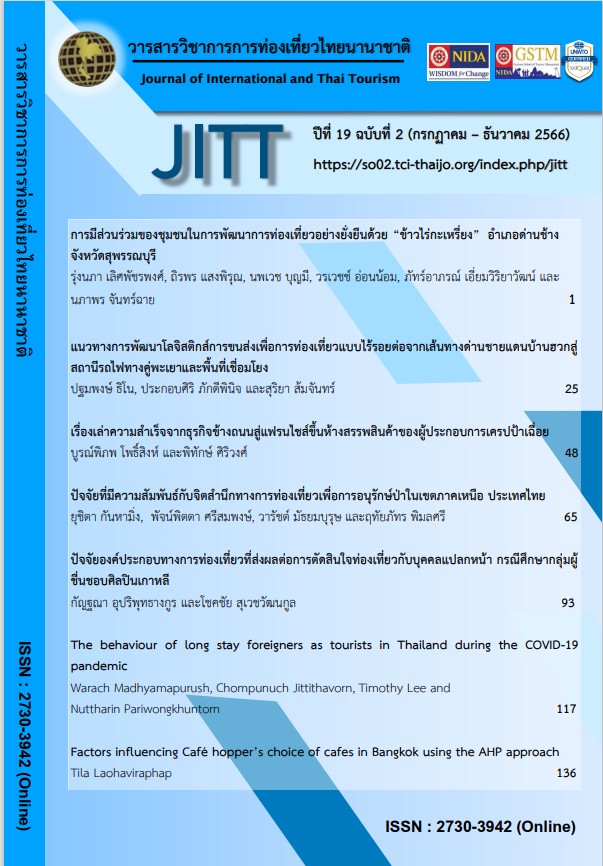
Components of Tourism that Affect the Decision to Travel with Strangers. A Case Study of a Korean Fanclub Components of Tourism that Affect the Decision to Travel with Strangers. A Case Study of a Korean Fanclub
Article Sidebar
Main Article Content
Abstract
This research is quantitative research. The purpose of this study was to study the tourism factors in making travel decisions with strangers among Korean artist enthusiasts. The sample group in the study was 125 samples of Korean artist lovers who decided to travel with strangers by random sampling. The questionnaire was used as a tool to collect data from the sample, and the results obtained were used for statistical analysis. Descriptive statistics were used: mean, standard deviation, and inferential statistics by testing the difference between group mean by Independent Samples T-Test and One-Way ANOVA. The results showed that the level of tourism components in making travel decisions with strangers among Korean artist enthusiasts included attraction, accessibility, facilities, accommodations, and activities as a whole were at a high level in all aspects. In addition, a comparison of travel elements in making travel decisions with strangers among Korean artist lovers. Classified by demographic characteristics, it was found that those who liked Korean artists with different occupations had significantly different levels of opinion about the components of tourism in terms of attraction and accessibility. The results of the study can be taken into account for strategic policy planning or activities to promote tourism, including developing tourism to be more suitable and in line with tourists.
Article Details

This work is licensed under a Creative Commons Attribution-NonCommercial-NoDerivatives 4.0 International License.
1. Any article contents published here are original work written, researched, analyzed, synthesized, compiled, and referenced by their own authorship. The editorial board does not entertain liability for article contents published here.
2. Manuscript articles published by our journal should not have been published before by any print or electronic media and should not be considered for publication by other journals at the moment. On duplicate publication, author shall be held solely responsible for violating copyright act.
3. Any published work for this journal belongs to the journal as its copyright. It is illegal to republish a portion, a partial portion, or all of it without a written approval from the editorial board of the journal
References
Cohen, J. (1977). Statistical power analysis for the behavioral sciences (Rev. ed.ed.). New York: New York: Academic Press.
Cohen, J. (1983). Applied multiple regression/correlation analysis for the behavioral sciences (2 nd ed.ed.). Hillsdale, N.J.: Hillsdale, N.J.: Lawrence Erlbaum Associates.
Collier, A., & Harraway, S. (1997). Principles of tourism. Auckland: Longman.
Cooper, C. & Boniface, B.G. (1998). Geography of Travel and Tourism. UK: Butterworth Heinemann.
DeCosta, P., Crowther, D., & Maloney, J. (2019). Investigating world Englishes: research methodology and practical applications: New York, NY: Routledge
DeFleur, M. L. & Ball-Rokeach, S. J. (1996). Theories of Mass Communication. London: Longman.
Dickman, C. R. (1996). Overview of the impacts of feral cats on Australian native fauna (pp. 1-92). Canberra: Australian Nature Conservation Agency.
Jenson, J. (1992). Fandom as pathology: The consequence of characterization. The adoring audience. New York and London: Routledge
Johnston, E. (2013). 5 Steps to understanding your customer’s buying process.[Online]. Available: http://goo.gl/YLFKX, 2022, Oct 5.
Likert, R. (1961). New patterns of management. New York: McGrow-Hill.
McOuail, D. (1994). The media audience - Alternative concepte of the audience. An introduction of mass communication theory. London: Sage
Puad Mat Som, A. & Ader, B. M. (2011). Tourist satisfaction and repeat visitation: Toward a new comprehensive model. International Journal of Human and Social Sciences, 6(1), 38-45
Swarbrooke, J., & Horner, S. (1999). Consumer behavior in tourism. Oxford: Butterworth Heinemann
Taherdoost, H. (2016). Validity and Reliability of the Research Instrument, How to Test the
Validation of a Questionnaire/Survey in a Research. International Journal of Academic
Research in Management, 5(3), 28–36
Tourism Western Australia. (2008).5A’s of Tourism. [Online] Available: http://www.tourism. com. 2022, December 23.
เคทีทีซี. (2561). EXO ทูตกิตติมศักดิ์ขององค์การส่งเสริมการท่องเที่ยวเกาหลีประจำปี 2018. [ออนไลน์] จาก https://www.happytokorea.com/travel-detail.php?id=201807051759057. 20 ตุลาคม 2565.
จิราภา วรเสียงสุข, (2556). ทฤษฎีสังคมวิทยายุคคลาสสิก. กรุงเทพฯ: เอ็ม แอนด์เอ็ม เลเซอร์พรินต์.
จุติมาศ เกลี้ยงเกลา. (2556). การศึกษาภาพลักษณ์ของกลุ่มศิลปินเกาหลีใต้ผ่านสื่อใหม่และ พฤติกรรมแฟนคลับ. วิทยานิพนธ์ปริญญามหาบัณฑิต, มหาวิทยาลัยเกษตรศาสตร์.
ชนพงษ์ อาภรณ์พิศาล, เพ็ชราภรณ์ ชัชวาลชาญชนกิจ และพรรณรัตน์ อาภรณ์พิศาล. (2563). ปัจจัยที่ส่งผลต่อการตัดสินใจมาท่องเที่ยวสะพานข้ามแม่น้ำแควจังหวัดกาญจนบุรี. วารสารสหวิทยาการวิจัย: ฉบับบัณฑิตศึกษา, 9(2), 42-48.
ชิตวร ประดิษฐ์รอด. (2557). ปัจจัยองค์ประกอบของแหล่งท่องเที่ยวและปัจจัยแรงจูงใจในการท่องเที่ยวที่ส่งผลต่อการตัดสินใจเลือกท่องเที่ยวปริมณฑลของคนวัยทำงานในเขตกรุงเทพมหานคร. การค้นคว้าแบบอิสระบริหารธุรกิจมหาบัณฑิต บัณฑิตวิทยาลัย, มหาวิทยาลัยกรุงเทพ.
ณัฐนันท์ ฐิติยาปราโมทย์. (2564). องค์ประกอบการท่องเที่ยวที่มีอิทธิพลต่อการตัดสินใจท่องเที่ยวเชิงธรรมชาติและวัฒนธรรมของนักท่องเที่ยวชาวจีน ตําบลอูเจิ้น มณฑลเจ๊อเจียง ประเทศสาธารณรัฐประชาชนจีน. วารสารมนุษยศาสตร์และสังคมศาสตร์ (สทมส.), 28(3), 189.
ตฤณ พริ้งประเสริฐ, พิทักษ์ ศิริวงศ์ และประสพชัย พสุนนท์. (2554). การศึกษาปัจจัยที่ส่งผลต่อการใช้บริการที่พักแบบเกสต์เฮาส์บริเวณถนนข้าวสาร. วารสารวิจัย มข. 11 (3), 121-130.
เทิดชาย ช่วยบำรุง. (2552). บทบาทขององค์กรปกครองส่วนท้องถิ่นกับการพัฒนาการท่องเที่ยวอย่างยั่งยืนบนฐานแนวคิดเศรษฐกิจพอเพียง. กรุงเทพฯ: สำนักพิมพ์คณะรัฐมนตรีและ ราชกิจจานุเบกษา.
ธัญญาพร ทาศักดิ์. (2564). ไม่มีเพื่อนก็ไม่เป็นไร! นักจิตวิทยาเผย “คุยกับคนแปลกหน้า” คือเรื่องปกติ แถมดีต่อใจอีกด้วย. [ออนไลน์] จาก https://missiontothemoon.co/softskill-talking-with-strangers/. 22 ตุลาคม 2565.
บุญเลิศ จิตตั้งวัฒนา. (2543). การจัดการอุตสาหกรรมการท่องเที่ยว. เชียงใหม่: มหาวิทยาลัยเชียงใหม่.
ปราณี หลําเบ็ญสะ. (2559). การหาคุณภาพของเครื่องมือวัดและประเมินผล. โครงการบริการวิชาการ ท่าสาบโมเดล. คณะครุศาสตร์, มหาวิทยาลัยราชภัฎยะลา.
ผู้จัดการออนไลน์. (2563) ท่องเที่ยวโซลฯ ผุดแคมเปญ BTS ‘SEE YOU IN SEOUL’กระตุ้นท่องเที่ยวเกาหลีใต้ ฝ่าวิกฤตโควิด-19. MGR Online. สืบค้นจาก https://mgronline.com. 15 ตุลาคม 2565.
มหาวิทยาลัยธุรกิจบัณฑิตย์. (2551). เอกสารการสอนวิชาอุตสาหกรรมการท่องเที่ยว. พิมพ์ครั้ง 3. กรุงเทพมหานคร : มหาวิทยาลัยธุรกิจบัณฑิตย์.
ยุบล เบ็ญจรงค์กิจ. (2542). การวิเคราะห์ผู้รับสาร. กรุงเทพฯ: ภาควิชาการประชาสัมพันธ์ คณะนิเทศศาสตร์จุฬาลงกรณ์มหาวิทยาลัย.
ศราวรรณ ไชยสุทธิเมธีกุล. (2558). การศึกษากระบวนการตัดสินใจเดินทางไปท่องเที่ยว ต่างประเทศด้วยตนเอง (FIT: Free Independent Traveler) ของคนไทย. การค้นคว้าอิสระปริญญามหาบัณฑิต, มหาวิทยาลัยธรรมศาสตร์.
ศูนย์วิจัยด้านการตลาดท่องเที่ยว. (2563). สถิติและรายจ่ายจากการท่องเที่ยวชาวไทยเดินทางออกนอกประเทศ. [ออนไลน์] จาก https://intelligencecenter.tat.or.th/articles/24451. 15 ตุลาคม 2565.
ศูนย์วิจัยด้านการตลาดท่องเที่ยว. (2565). รายงานข้อมูลสถานการณ์ท่องเที่ยวประเทศไทย มุมมองจังหวัด. [ออนไลน์] จาก https://econtent.tat.or.th. 15 ตุลาคม 2565.
สำนักนโยบายเศรษฐกิจมหภาค. (2565). ภาคการท่องเที่ยวและธุรกิจที่เกี่ยวข้องมีความสำคัญ. [ออนไลน์] จาก http://www.fpojournal.com/thai-tourism-situation/.15 ตุลาคม 2565.
สิริลักษณ์ สุขสวัสดิ์. (2561). Hello strangers: กาลครั้งหนึ่ง…เมื่อต้องคุยกับคนแปลกหน้า. [ออนไลน์] จาก https://urbancreature.co/hello-strangers/. 15 ตุลาคม 2565.
สุจิตรา วาชัยยุง และ โสมฤทัย สุนธยาธร. (2565). ความคาดหวังองค์ประกอบกํารท่องเที่ยว 5As ส่งผลต่อการตัดสินใจในการเดินทางท่องเที่ยวเชิงกีฬาของผู้สูงอายุชาวไทย ในกรุงเทพมหานคร. วารสารวิทยาศาสตร์การกีฬาและสุขภาพ, 23(2), 158-173.
หทัยรัตน์ ทับเคลียว. (2557). ปัจจัยที่มีผลต่อการตัดสินใจท่องเที่ยวประเทศสิงคโปร์ของนักท่องเที่ยวชาวไทย. การค้นคว้าอิสระปริญญามหาบัณฑิต, มหาวิทยาลัยธุรกิจบัณฑิต.
