
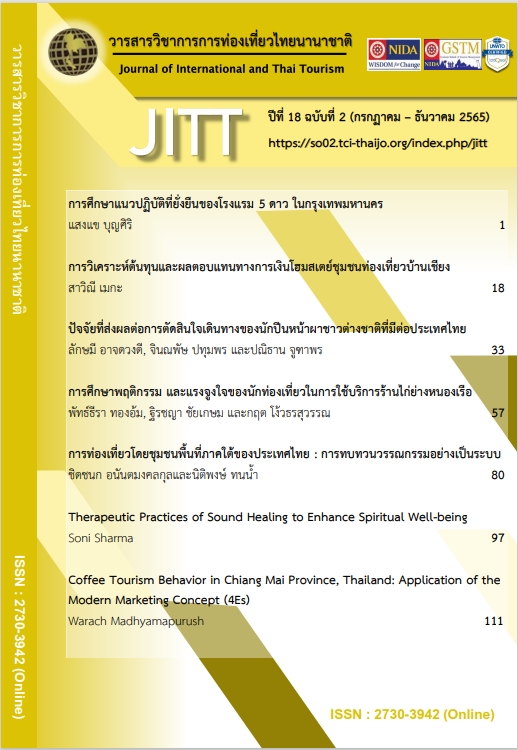
The Study of Sustainable Practices for 5 Star Hotels in Bangkok The Study of Sustainable Practices for 5Star Hotels in Bangkok
Article Sidebar
Main Article Content
Abstract
This research aimed to study the level of employee’ perceptions of sustainable practices and the level of organization commitment, and to explore the relationship of sustainable practice and the level of organization commitment of 5-star hotel in Bangkok. The sample group of this study were 158 hotel staffs. This research investigated results from the collected questionnaire by using convenient Sampling. The data were analyzed by using descriptive statistics, frequency, percentage, means, standard deviation, One way ANOVA analysis and Pearson’s Correlation Coefficient Analysis.
The research found that the level of employee’ perceptions of sustainable practices overall aspects were at the high levels ranking from the aspect of environment benefits, effective sustainable management, cultural heritage benefits, and social and economic benefits. The level of organization commitment overall aspects was at the high levels ranking from normative commitment at the highest level, follow by affective commitment, and continuance commitment. The relationship between the factors of Sustainable Practices and organization commitment in overall have positively correlation at high level statistically significant level of 0.01 (r = .751).
Keywords: sustainable practices, organization commitment, hotel
Article Details

This work is licensed under a Creative Commons Attribution-NonCommercial-NoDerivatives 4.0 International License.
1. Any article contents published here are original work written, researched, analyzed, synthesized, compiled, and referenced by their own authorship. The editorial board does not entertain liability for article contents published here.
2. Manuscript articles published by our journal should not have been published before by any print or electronic media and should not be considered for publication by other journals at the moment. On duplicate publication, author shall be held solely responsible for violating copyright act.
3. Any published work for this journal belongs to the journal as its copyright. It is illegal to republish a portion, a partial portion, or all of it without a written approval from the editorial board of the journal
References
Ahmed, H. A., Thowayeb, H.H., & Mohammed, M. E. (2020). A Descriptive of Green Hotel Practices and Their Role n Achieving Sustainable Development. Sustainability 2020, 12, 9624; doi:10.3390/su12229624.
Alipour, H., Safaeimanesh, F., & Soosan, A. (2019). Investigating Sustainable Practices in Hotel Industry from Employees' Perspective: Evidence from a Mediternean Island. Faculty of Tourism, Eastern Mediterranean University.
Cohen, J. (1977). Statistical power analysis for the behavioral sciences. New York: Academic
Faul, F., Erdfelder, E., Lang, A. G., & Buchner, A. (2007).
Faul, F., Erdfelder, E., Lang, AG. et al. G*Power 3: A flexible statistical power analysis program for the social, behavioral, and biomedical sciences. Behavior Research Methods 39, 175–191 (2007). https://doi.org/10.3758/BF03193146ods, 39, 175-191
Cohen, J. (1988). Statistical power analysis for the behavioral sciences. 2nd ed. New Jercy: Erlbaum.
Faul, F., Erdfelder, E., Lang, AG. et al. (2007). G*Power 3: A flexible statistical power analysis program for the social, behavioral, and biomedical sciences. Behavior Research Methods 39, 175–191. https://doi.org/10.3758/BF03193146
GSTC (Global Sustainable Tourism Council). (2013). Global Sustainable Touriam Criteria for Hotel and Tour Operators. Washington DC: Global Sustainable Tourism Council.
Kapera, I. (2018). Sustainable Development in The Hotel Industry: Between Theory and Practice in Poland. Turyzm / Tourism, 28(2).
Lee, J. H. (2012). A ntecedents and Consequences of Employee Engagement: Empirical study of Hotel Employees and Managers. Department of Hospitality Management and Dietelics, College of Human Ecology, Kansas State University.
Manning, T. (1999). Indicators of Tourism Suatainability. Tourism Management, 20, 179 - 181.
Meyer, J. P., & Allen, N. J. (1991). A three-component conceptualization of organizational commitment. Human Resource Management Review, 1(1).
Mowday, R. T., Porter, L. W., & Steers, R. M. (1982). Employee organization linkages: The psychology of commitment, absenteeism, and turnover. New York: Academic Press.
Peter. J., & Daphane, C. (2019). Sustainable Development Goals and the World’s Leading Hotel Groups. Athens Journal of Tourism. Volume 6, Issue 1, page 1-14.
Steers Richchard M. (1977). Antecedents and Outcome of Organizational Commitment. Administrative Science quarterly. 22 January.
The Global Sustainable Tourism Council (2012). GSTC Criteria for Hotels & Tour Operators’ version 2. Retrieved from https://www.gstcouncil.org/wp-content/uploads/2017/01/Thai-GSTC---H_TO-v2.pdf.
Weerapan & Tanayu, et al. (2018). ความผูกพันต่อองค์กรของพนักงานโรงแรมในอำเภอเกาะสมุย จังหวัดสุราษฎร์ธานี. วารสารการบริการและการท่องเที่ยวไทย. ปีที่ 13 ฉ. 2.
World Tourism Organization. (2021). Global tourism sees upturn in q3, but recovery remains fragile (UNWTO). UNWTO
Xie, L. (2020). Sustainable Tourism: Why Should Hotels Lead in This Effort? Retrieved from https://www.hospitalitynet.org/opinion/4096615.html.
