
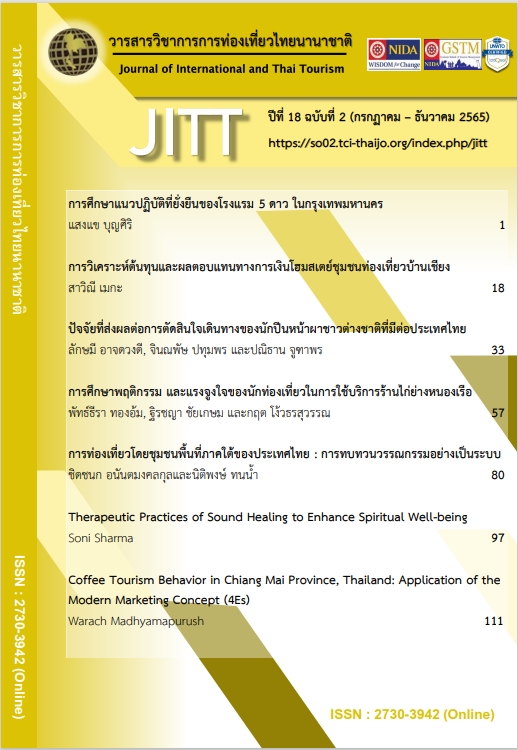
Financial Cost–benefit Analysis of Banchiang Homestay Factors Influencing Foreign Climber’s the Decision to Travel in Thailand
Article Sidebar
Main Article Content
Abstract
This study aims to study the context of Ban Chiang community-based tourism and to determine feasibility of investment in the community’s homestays by conducting Financial Cost-benefit Analysis. The results show that the World Cultural Heritage, Tai Phuan ethnic, and human capital are the keys to explaining the strength, value-added, and creativity of the community. However, the results of the financial feasibility of Ban Chiang homestay service shows that the level of feasibility of each homestay differs depending on the initial investment cost and the number of guests. Comparing between a newly-built homestay and a renovated one, the former is more restrictive in managing variable costs and occupancy and so are unable to recover the cost of an investment in a timely manner.
Article Details

This work is licensed under a Creative Commons Attribution-NonCommercial-NoDerivatives 4.0 International License.
1. Any article contents published here are original work written, researched, analyzed, synthesized, compiled, and referenced by their own authorship. The editorial board does not entertain liability for article contents published here.
2. Manuscript articles published by our journal should not have been published before by any print or electronic media and should not be considered for publication by other journals at the moment. On duplicate publication, author shall be held solely responsible for violating copyright act.
3. Any published work for this journal belongs to the journal as its copyright. It is illegal to republish a portion, a partial portion, or all of it without a written approval from the editorial board of the journal
References
Goodwin, H. & Santilli, R. 2009. Community-Based Tourism: a success? (ICRT Occasional Paper No. 11). http://www.andamandiscoveries.com/press/press-harold-goodwin.pdf
Macek, I.C. (2012). Homestays as Livelihood Strategies in Rural Economies: The case of Johar Valley, Uttarakhand, India (Master dissertation, University of Washington, Seattle, U.S.). Retrieved from https://digital.lib.washington.edu/researchworks/bitstream/handle/1773/21845/Macek_washington_0250O_10331.pdf?sequence=1
กรมศิลปากร. (2553). นำชมพิพิธภัณฑ์แห่งชาติบ้านเชียง. กรุงเทพฯ: อมรินทร์พริ้นติ้งแอนด์พับลิชชิ่ง
กาจ วัฒนศรีส่ง. (2545). การศึกษาความเป็นไปได้ทางเศรษฐศาสตร์ของโครงการสถานที่พักแรม
เพื่อตอบสนองต่อการท่องเที่ยวเชิงนิเวศ. การศึกษาค้นคว้าด้วยตนเอง, สาขาเศรษฐศาสตร์ธุรกิจ มหาวิทยาลัยเกษตรศาสตร์.
จิตราพร อุนสุวรรณ. (2552). การศึกษาความเป็นไปได้ในการลงทุนสถานที่พักแรมในรูปแบบ โฮมสเตย์ บริเวณตลาดน้ำอัมพวาจังหวัดสมุทรสงคราม. มหาวิทยาลัยธรรมศาสตร์/กรุงเทพฯ. DOI : https://doi.nrct.go.th/ListDoi/listDetail?Resolve_DOI=10.14457/TU.the.2009.678
ฉลองศรี พิมลสมพงศ์. (2542). การวางแผนและการพัฒนาตลาดการท่องเที่ยว. กรุงเทพฯ: คณะ มนุษยศาสตร์ มหาวิทยาลัยเกษตรศาสตร์.
ฐิติพร วรฤทธิ์. (2561). การวิเคราะห์ต้นทุน ผลตอบแทน และความคุ้มค่าของธุรกิจโฮมสเตย์ตามแนวเศรษฐกิจพอเพียงของชุมชนบ้านโคกเมือง ตำบลจรเข้มาก อำเภอประโคนชัย จังหวัดบุรีรัมย์. การประชุมวิชาการระดับนานาชาติ ครั้งที่ 2 พ.ศ. 2564. มหาวิทยาลัยราชภัฏบุรีรัมย์.
บุญฑริกา ใจกระจ่าง และวิชชุตา มาชู (2564). การวิเคราะห์ต้นทุนและผลตอบแทนของธุรกิจโฮมสเตย์เกิดใหม่ขนาดเล็ก: กรณีศึกษาโฮมสเตย์ชุมชนท่าฉาง จังหวัดสุราษฎร์ธานี. วารสารเทคโนโลยีภาคใต้, 14 (1), 24-39.
ประจำปีงบประมาณ พ.ศ. 2563. สืบค้นจาก http://www.udonthani.go.th/main/wp-uploadfile/strategy/Annual_Report2020.pdf
ประเสน ลีลาวุฒิประเสริฐ. (2556). การศึกษาปัจจัยที่ส่งผลต่อความยั่งยืนของธุรกิจโฮมสเตย์ในพื้นที่ภาคกลาง. วิทยานิพนธ์ปริญญาวิศวกรรมศาสตรมหาบัณฑิต, สาขาวิชาการพัฒนางานอุตสาหกรรม, มหาวิทยาลัยธรมมศาสตร์.
มิ่งสรรพ์ ขาวสอาด, อรุณี อินทรไพโรจน์ และ อรรถพันธ์ สารวงศ์. (2562). การศึกษาเศรษฐกิจท่องเที่ยวชุมชน จากโซเชียลมีเดียถึงชุมชนท่องเทียว่ อย่างครบวงจร. ร่างรายงานฉบับสมบูรณ์. เชียงใหม่ : มูลนิธิสถาบันศึกษานโยบายสาธารณะ.
เยาวเรศ ทับพันธุ์. (2543). การประเมินโครงการตามแนวทางเศรษฐศาสตร์. (พิมพ์ครั้งที่ 2). กรุงเทพฯ: สำนักพิมพ์มหาวิทยาลัยธรรมศาสตร์.
สริกา นนทะสร และ สรัญญา ศรีทองมาศ. (2564). การวิเคราะห์ต้นทุนและผลตอบแทนของธุรกิจโฮมสเตย์ในจังหวัดพระนครศรีอยุธยา. วารสารวิทยาลัยดุสิตธานี, 15(2), 80-97.
สำนักงานจังหวัดอุดรธานี. (2563). รายงานผลการดำเนินงานจังหวัดอุดรธานี
