
Chinese Ming Classic Novels and Japanization in Ukiyo-e Art
DOI:
https://doi.org/10.69598/sbjfa277764Keywords:
Chinese Classic Novel, Ming Dynasty, Ukiyo-e, Japanization, AdaptationAbstract
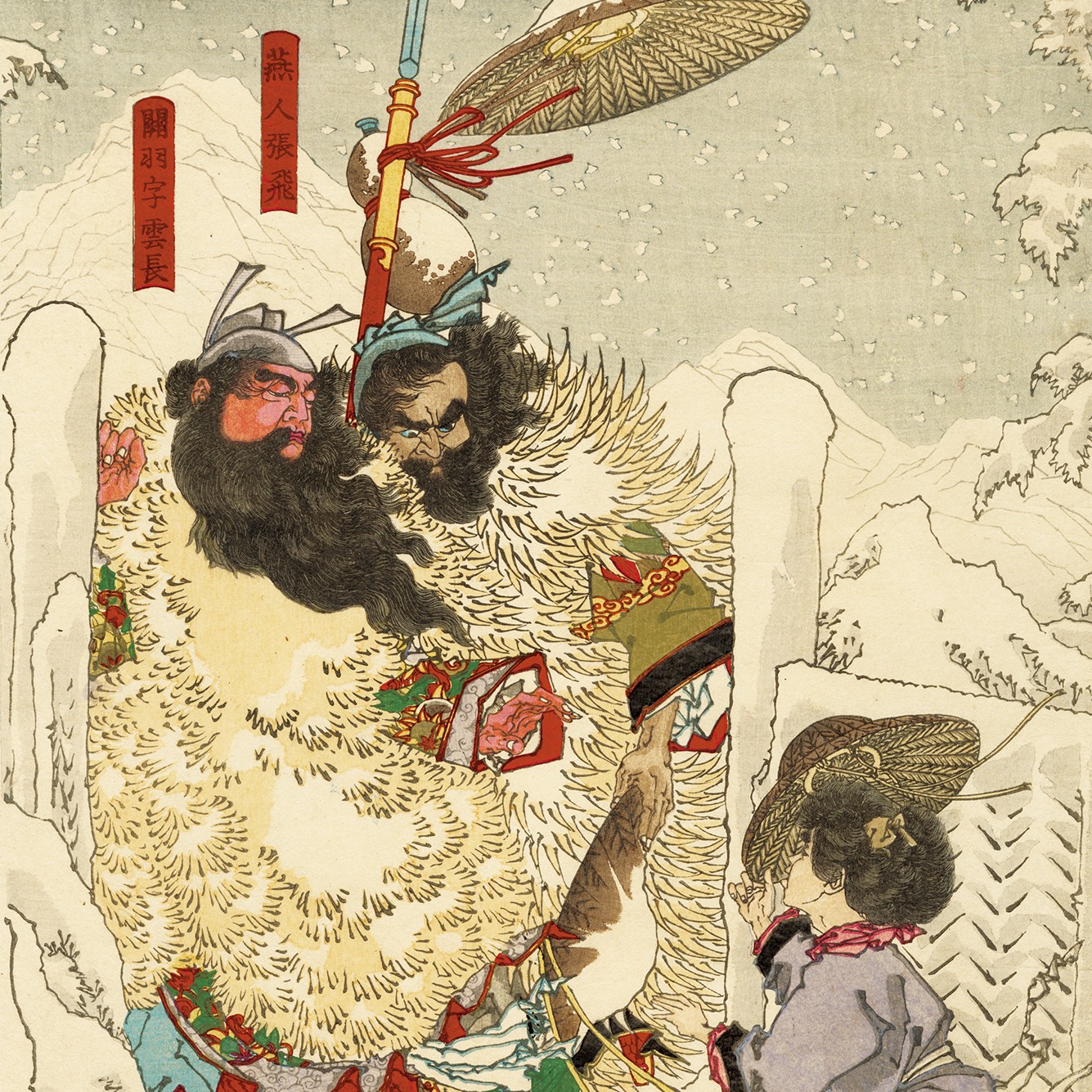
This qualitative research aimed to study Chinese classic novels in the Ming dynasty and the adaptation in Ukiyo-e art as Japanization. The objective of the article was to study about style and content adaptation from imaginative representation in Ming’s classic novels to Ukiyo-e woodblock printings in the 17th–19th century. The research analyzed two Chinese classic novels, “The Romance of Three Kingdoms” and “Tales of the Water Margin,” through the works of five Ukiyo-e artists: Katsushika Hokusai, Utagawa Kuniyoshi, Tsukioka Yoshitoshi, Utagawa Kunisada, and Toyohara Kunichika. The study found that Ming-novel-themed concepts in Japanese Ukiyo-e art not only followed in text translation but also were conducted by identity process and imagination of the artist. The combination and adaptation of different cultures led to Japanization. Style and content adaptation represent Japanese society in the Edo era. Cultural transmission of Chinese origin under the Japanization process turned into a new text. The artists were not strictly based on original content. There was the adaptation of artworks to fit in with artists’ and social popularity, based on aesthetic creativity by Ukiyo-e artists.
Downloads
References
ชัยยศ อิษฎ์วรพันธุ์. (2558). บริบททางสังคมวัฒนธรรมของภาพชุนกะ. วารสารศิลป์ พีระศรี, 2(2), 95-113. https://so02.tci-thaijo.org/index.php/jfa/article/view/241001/163863
ถาวร สิกขโกศล. (2566). สามก๊ก: จากวรรณคดีเอกของจีนมาเป็นวรรณคดีเอกของไทย. ใน ถาวร สิกขโกศล (บ.ก.), รวมบทความนานาสาระจีนวิทยา (น.271-282). ซีพี ออลส์.
มาลินี ดิลกวณิช. (2535). การละคอนญี่ปุ่น: ประวัติและศิลปะการแสดง. วารสารไทย-ญี่ปุ่นศึกษา, 9(3), 50-70. https://so02.tci-thaijo.org/index.php/japanese/article/view/52255
วิทยาลัยภาษาจีนปักกิ่ง, มหาวิทยาลัยครูหนานจิง และ มหาวิทยาลัยครูอันฮุย. (2550). ความรู้ทั่วไปเกี่ยวกับวัฒนธรรมประเทศจีน. สุขภาพใจ.
历朝驿站. (n.d.). (唐朝)变文流行. https://sharehistory.cn/sys-nd/2091.html
宫竹正. (2005). 浮世絵的故事. 陕西师范大学出版社.
Beijing Language and Culture University, Nanjing University, & Anhui University. (2007). General knowledge of Chinese culture. Sukhaphap Jai. [in Thai]
Clark, T. (2021). Hokusai The Great Picture Book of Everything. British Museum.
Dilokwanich, M. (1992). Japanese Drama: History and Performing Arts. Thai-Japanese Studies Journal, 9(3), 50-70. https://so02.tci-thaijo.org/index.php/japanese/article/view/52255 [in Thai]
Eli. (2021, September 26). E66C Tattooing-The Suikoden. A History of Japan. https://historyofjapan.co.uk/2021/09/26/tattooing-the-suikoden/
Fraleigh, M. (2022). A Faithful Translation: Tsūzoku sangokushi, the First Japanese Translation of Sanguozhi yanyi. In L. Guo, P. Sieber, & P. Kornicki (Eds.), Ecologies of Translation in East and South East Asia, 1600-1900 (pp. 59–88). Amsterdam University Press. https://doi.org/10.2307/j.ctv2r4kxds.5
Gong, Z. (2005). The Story of Ukiyo-e. Shaanxi Normal University Press. [in Chinese]
Goree, R. (2020). The Culture of Travel in Edo-Period Japan. Oxford Research Encyclopedia of Asian History. https://oxfordre.com/asianhistory/display/10.1093/acrefore/9780190277727.001.0001/acrefore-9780190277727-e-72
Hokusai, K. (1847). Cao Cao At Red Cliffs [colored silk, one scroll]. Shimane Art Museum. https://shimane-art-museum-ukiyoe.jp/nagata/c-nagata/h15-01.html
Isavorapant, C. (2015). Socio-Cultural Context of Shunga. Silpa Bhirasri (Journal of Fine Arts), 2(2), 95–113. [in Thai]
Kunichika, T. (1889). Kunichika Suikoden: The Scene at the Wakaji Temple [Color woodblock print, triptych-Oban-tate-e]. https://jp.japanese-finearts.com/item/list2/A1-98-116/Kunichika/Yakusha-e
Kunisada, U. (1820). Parody of Liu Bei (J: Gentoku) Visiting Zhuge Liang (J: Komei) in Wind and Snow (Gentoku fusetsu ni Komei o tazureru) [Color woodblock print, triptych-Oban-tate-e]. Ota Memorial Museum of Art. https://otakinen-museum.note.jp/n/n8a7990f1ac52
Kuniyoshi, U. (1827a). Leopard Head Lin Chong [Color woodblock print]. Wikipedia. https://ja.wikipedia.org/wiki/通俗水滸伝豪傑百八人之一個#/media/ファイル:Utagawa_Kuniyoshi_-_水滸傳_-林冲.jpg
______. (1827b). Ascetic Takematsu [Color woodblock print]. Wikipedia. https://ja.wikipedia.org/wiki/通俗水滸伝豪傑百八人之一個#/media/ファイル:Honcho_Suikoden_Goketsu_(BM_1973,0723,0.29_84).jpg
______. (1853a). Popular Romance of the Three Kingdoms / Liu Xuande Breaks the Siege of Beihai [Color woodblock print, triptych-Oban-tate-e]. Yamada-Shoten. https://www.yamada-shoten.com/english/detail.php?item_id=58606
______. (1853b). Popular Romance of the Three Kingdoms, Guan Yu's Five [Color woodblock print, triptych-Oban-tate-e]. Hara Shobo. https://www.harashobo.com/ukiyoe/ukiyoe_detail.php?print_id=36154
Munroe Hotes, C. (2013). Puppet Theatre Romance of the Three Kingdoms (人形劇三国志, 1982-1984). Nishikata Film Review: A Journey through Visual Culture. https://www.nishikata-eiga.com/2013/12/puppet-theatre-romance-of-three.html
Ohnuki, N. (2010). The Reception of Suikoden (Tales of Water Margin) in Japan and Its Visual Interpretation: Expansion of Visual Environment in Japan. The Journal of Asian Arts & Aesthetics, (4), 97-111. https://doi.org/10.6280/JAAA.2010.04.10
Sharehistory. (n.d.). (Tang Dynasty) was popular. https://sharehistory.cn/sys-nd/2091.html [in Chinese]
Sikkhakosol, T. (2023). Romance of the Three Kingdoms: From the Classic Chinese novel to From the Classic Thai novel. in T. Sikkhakosol, (Ed.), Collected Essay on Chinese Studies (pp.271-282). CP Alls. [in Thai]
Yoshitoshi, T. (1883). Gentoku Visits Komei in Snow Storm [Color woodblock print, triptych-Oban-tate-e]. Art of Ukiyoe. https://www.artofukiyoe.com/gallery/p/gentoku-visits-komei-in-snow-storm
______. (1885). Moon Rising over Nanping- Cao Cao [Color woodblock print]. British Museum. https://britishmuseum.org.cn/blog/the-last-Ukiyoe
Downloads
Published
How to Cite
Issue
Section
License
Copyright (c) 2025 ปานชีวา บุตราช, ปิยะแสง จันทรวงศ์ไพศาล

This work is licensed under a Creative Commons Attribution 4.0 International License.
The journal's editorial team does not have to agree with the views and comments in the author's article, nor are they responsible for the comments.









.jpg)