Guidelines for Developing Contemporary Art Activity Packages for Upper Elementary School Students: A Case Study of Bangkok Art and Culture Centre
DOI:
https://doi.org/10.69598/sbjfa276123Keywords:
Art Activity Package, Contemporary Art, Upper Elementary Student, Bangkok Art and Culture CentreAbstract
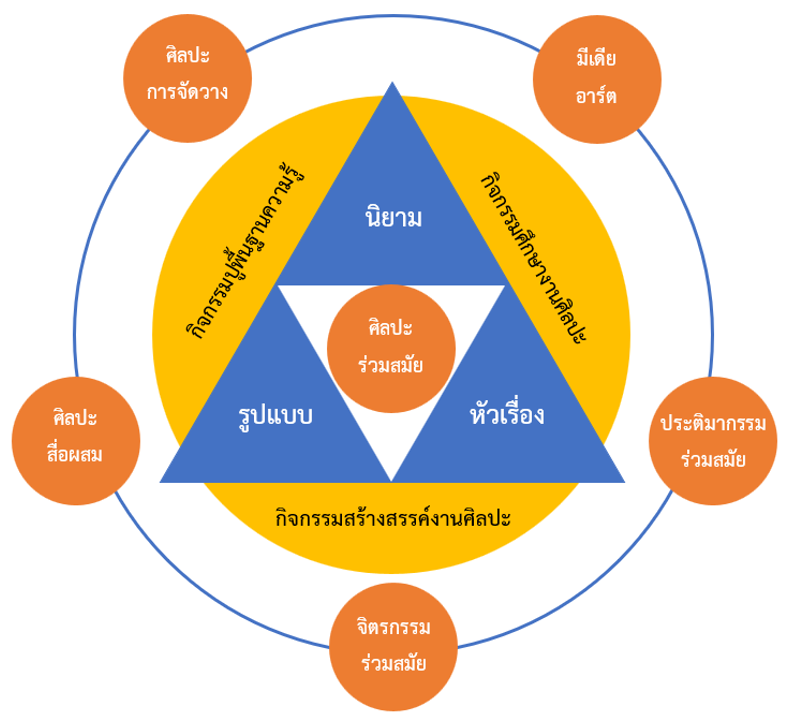
This article aims to study guidelines for developing contemporary art activity packages for upper elementary school students, using the Bangkok Art and Culture Centre as a case study. A mixed-methods research design was employed and carried out in three phases: 1) a review of related literature and previous studies; 2) a study of perspectives and opinions of art teachers, with a sample group of 102 art teachers from primary schools in Bangkok, selected through purposive sampling. The research instrument was an online questionnaire, with content validity verified by experts using the Index of Item-Objective Congruence (IOC); and 3) a focus group discussion to explore the views of relevant stakeholders, involving 15 experts, including 8 art teachers, 1 school administrator, 2 educational supervisors, 2 contemporary art specialists, and 2 staff members from the Bangkok Art and Culture Centre, also selected through purposive sampling. The research instrument was a set of focus group questions validated by experts using the IOC. Quantitative data were analyzed using descriptive statistics, while qualitative data were analyzed through content analysis. The research results can be summarized into five principles: developing a positive perspective on contemporary art through foundational understanding, observing artworks, and creating art; enhancing the perception of contemporary art through observation, analysis, connection, and reflection; integrating the content with the Basic Education Core Curriculum and classroom teaching context; selecting age-appropriate examples of contemporary art; and driving the learning process with the Bangkok Art and Culture Centre as the central hub.
Downloads
References
กระทรวงศึกษาธิการ. (2552). หลักสูตรแกนกลางการศึกษาขั้นพื้นฐานพุทธศักราช 2551. โรงพิมพ์ชุมนุมสหกรณ์การเกษตรแห่งประเทศไทย.
กำจร สุนพงษ์ศรี. (2558). ศิลปะสมัยใหม่. สำนักพิมพ์แห่งจุฬาลงกรณ์มหาวิทยาลัย.
ประพล คำจิ่ม. (2561). หอศิลป์ภายใต้สังกัดมหาวิทยาลัย: กรณีศึกษาหอศิลปวิทยนิทรรศน์ จุฬาลงกรณ์มหาวิทยาลัย พ.ศ.2538-2560. วารสารศิลปกรรมศาสตร์ จุฬาลงกรณ์มหาวิทยาลัย, 5(1), 30-45.
ประไพลิน จันทน์หอม. (2564). การศึกษาการจัดการเรียนรู้ศิลปะเพื่อพัฒนาทักษะผู้เรียนในศตวรรษที่ 21. วารสารครุพิบูล, 8(2), 253-266.
ศุภชัย อารีรุ่งเรือง. (2567). ประเด็นการวิพากษ์สังคมในศิลปกรรมร่วมสมัยไทย ตั้งแต่ พ.ศ.2557 – 2563. วารสารศิลป์ พีระศรี, 12(1), 25-52. https://doi.org/10.14456/sbjfa.2024.2
สุชาติ ทองสิมา. (2563). การพัฒนานวัตกรรมหลักสูตรศิลปศึกษาบนฐานบริบทร่วมสมัย. [วิทยานิพนธ์ปริญญาดุษฎีบัณฑิต จุฬาลงกรณ์มหาวิทยาลัย]. คลังปัญญาจุฬาฯ จุฬาลงกรณ์มหาวิทยาลัย. https://cuir.car.chula.ac.th/bitstream/123456789/76641/1/5884227127.pdf
สุธี คุณาวิชยานนท์. (2561). ศิลปะสมัยใหม่และร่วมสมัย: ตะวันตกและไทย. โครงการหนังสือตำราทฤษฎีศิลป์ ภาควิชาทฤษฎีศิลป์ คณะจิตรกรรมประติมากรรมและภาพพิมพ์ มหาวิทยาลัยศิลปากร.
อนิวัฒน์ ทองสีดา. (2562). กิจกรรมศิลปะสำหรับงานศิลปะร่วมสมัย: กรณีศึกษาหอศิลปวัฒนธรรมแห่งกรุงเทพมหานคร. วารสารศิลป์ พีระศรี, 7(1), 173-190.
_____. (2565). การจัดการเรียนรู้ศิลปศึกษาโดยใช้พิพิธภัณฑ์เป็นฐานในศตวรรษที่ 21. วารสารครุศาสตร์สาร, 16(2), 1-19.
Areerungruang, S. (2024). Social Criticism Issues in Thai Contemporary Art since 2014 – 2020. Silpa Bhirasri (Journal of Fine Arts), 12(1), 25-52. https://doi.org/10.14456/sbjfa.2024.2 [in Thai]
Bae, J. (2023). Benefits, Outcomes and Challenges of Teaching Contemporary Art in Wisconsin K-12 Art Classrooms. International Journal of Education Through Art, 19(2), 157-173. https://doi.org/10.1386/eta_00133_1
Barrett, T. (2012). Why is that art?: aesthetics and criticism of contemporary art (2nd ed). Oxford University Press.
Bell, D., Bell, H., Collins, L., & Spencer, A. (2018). Young children’s experiences with Contemporary Art. International Journal of Education Through Art, 14(2), 145-159. https://doi.org/10.1386/eta.14.2.145_1
Chanthahom, P. (2021). Study of Art Learning Management to Develop Learners' Skills in the 21st Century. Journal of Faculty of Education Pibulsongkram Rajabhat University, 8(2), 253-266. [in Thai]
Chapman, L.H. (1978). Approach to art in education. Harcourt Bruce Javanovich.
Ching, C. L. T. (2015). Teaching Contemporary Art in Primary Schools. Athens Journal of Humanities and Arts, 2(2), 95-110.
Curva and Associates. (2005). Artful Citizenship Project three-year project report. The Wolfsonian, Inc. https://vtshome.org/wp-content/uploads/2016/08/2Artful-Citizen-Project-Report.pdf
Duh, M. (2015). The Function of Museum Pedagogy in the Development of Artistic Appreciation. Journal of Elementary Education, 8(4), 87-102. https://journals.um.si/index.php/education/article/view/397
Laente, H., Pamadhi, H. & Maulana, K. L. (2019). Museum as a Source of Learning Art Appreciation. Advances in Social Science, Education and Humanities Research, 327, 70-73. https://www.atlantis-press.com/proceedings/icaae-18/125910445
Ishiguro, C., Sato, Y., Takahashi, A., Abe, Y., Kakizaki, H., Okada, H., Kato, E., & Takagishi, H. (2021). Comparing Effects of Visual Thinking Strategies in a Classroom and a Museum. Psychology of Aesthetics, Creativity, and the Arts, 15(4), 735 745. https://doi.org/10.1037/aca0000326
King’s College London. (2016). My Primary School is at the Museum: Inspiring Schools and Museums across the UK to Build School-Museum Partnership. https://www.kcl.ac.uk/cultural/resources/reports/161107-primary-at-museum-report-stage-7-visual-interactive.pdf
Kolb, D. A. (1984). Experiential Learning: Experience as the Source of Learning and Development. Prentice-Hall.
Kumjim, P. (2018). Thai University Affiliated Art Galleries: A Case Study of the Art Center at Chulalongkorn University from 1995-2017. Journal of Fine and Applied Arts, Chulalongkorn University, 5(1), 30-45. [in Thai]
Kunavichayanont, S. (2018). Modern & Contemporary Art: The Western World and Thailand. (2nd ed). Art Theory Book Project, Art Theory Department, Faculty of Painting, Sculpture and Graphic Arts. [in Thai]
Leder, H., Belke, B., Oeberst, A., & Augustin, D. (2004). A Model of Aesthetic Appreciation and Aesthetic Judgments. British Journal of Psychology, 95(4), 489-508. https://doi.org/10.1348/0007126042369811
Marshall Gallery. (n.d.). Why We Love Contemporary Modern Art (And You Should Too!). The Marshall Gallery. https://themarshallgallery.com/post/5025-why-we-love-contemporary-modern-art-and-you-should-too#:~:text=People%20love%20contemporary%20modern%20art%20because%20it%20is%20a%20fresh,think%20more%20deeply%20about%20life.
Matsui, H. (2023). Why is modern art so perplexing?. UTokyo FOCUS. https://www.u-tokyo.ac.jp/focus/en/features/z1304_00246.html
Ministry of Education of Thailand. (2009). Basic Education Core Curriculum 2008. The Agriculture Co-operative Federation of Thailand. [in Thai]
MoMA. (n.d.). Identity-Based Learning through Art: A curricular guide for District 75 Visual Art Teachers. https://www.moma.org/momaorg/shared/pdfs/docs/learn/Identity-Based-Learning-through-Art.pdf
Piaget, J. (2001). The psychology of intelligence. Routledge.
Rabindran, & Madanagopa, D. (2020). Piaget's Theory and Stages of Cognitive Development- An Overview. Scholars Journal of Applied Medical Sciences, 8(9), 2152-2157. https://doi.org/10.36347/sjams.2020.v08i09.034
Savva, A. & Trimis, E. (2005). Responses of young children to contemporary art exhibits: The role of artistic experiences. International Journal of Education and the Arts, 6(13). https://www.ijea.org/v6n13/v6n13.pdf
Singapore Art Museum. (2016). Think Contemporary: A museum-based school programme that advocates learning through art. https://www.singaporeartmuseum.sg/-/media/SAM/Files/Exhibitions/Think-Contemporary/ThinkContemporary.pdf
Smith, R. & Wolf, S. (2009). Looking for Change. Tate Modern. https://www.colorado.edu/education/sites/default/files/attached-files/Tate_LookingForChange_Resource.pdf
Soonpongsri, K. (2015). Modern Art. Chulalongkorn University press. [in Thai]
Tavin, K., & Kallio-Tavin, M. (2014). The Cat, Cradle and the Silver Spoon: Violence in Contemporary Art and the Question of Ethics for art Education. Studies in Art Education, 56(1), 426–437. https://doi.org/10.1080/00393541.2014.11518950
Thongsima, S. (2020). Development of Innovative Art Education Curriculum Based on Contemporary Context [Doctoral dissertation, Chulalongkorn University]. Chula Digital Collections. https://cuir.car.chula.ac.th/bitstream/123456789/76641/1/5884227127.pdf [in Thai]
Tongseeda, A. (2019). Art Activities for Contemporary Art: Case study of Bangkok Art and Culture Centre. Silpa Bhirasri (Journal of Fine Arts), 7(1), 173-190. [in Thai]
_____. (2022). The 21st century art education in Museums-based Learning. Journal of Educational Studies, 16(2), 1-19. [in Thai]
Yanawine, P. (2014). Visual Thinking Strategies: Using Art to Deepen Learning Across School Disciplines. Havard Education Press.
Downloads
Published
How to Cite
Issue
Section
License
Copyright (c) 2025 Sarita Juaseekoon, Patumma Bumpentan, Aniwat Tongseeda

This work is licensed under a Creative Commons Attribution 4.0 International License.
The journal's editorial team does not have to agree with the views and comments in the author's article, nor are they responsible for the comments.