Announcements

Announcement: Starting in 2026, JARS to Publish Three Issues Per Year

2025-07-31

📢 Announcement: Starting in 2026, JARS to Publish Three Issues Per Year

We are pleased to announce an important change in the publication schedule of the Journal of Architectural/Planning Research and Studies (JARS).

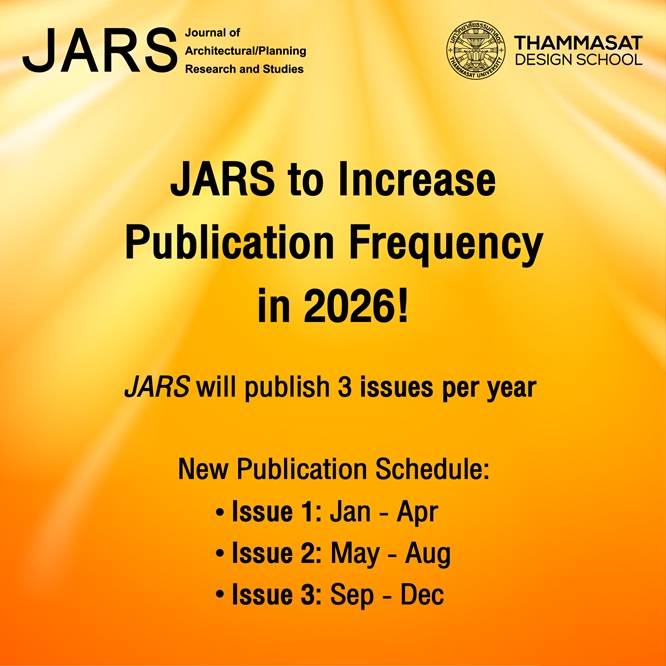
Starting in 2026, JARS will increase its publication frequency from two issues to three issues per year.
This strategic change reflects the journal’s continuous growth, an increasing number of high-quality submissions, and our commitment to disseminating scholarly research more frequently and effectively.

🗓️ New Publication Schedule (Starting 2026):

  • Issue 1: January – April
  • Issue 2: May – August
  • Issue 3: September – December

This expansion aims to better serve our authors, reviewers, and readers by improving publication timeliness and accommodating a wider range of topics within the fields of architecture, planning, urban studies, and related disciplines.

We thank you for your continued support and look forward to your future contributions!

A New Type of Manuscript: Commentaries

2025-03-29

The Journal of Architectural/Planning Research and Studies (JARS) is excited to announce a new category of manuscripts: Commentaries, which details are as follows.

Commentaries

Commentaries will provide reflections or discussion about a recent article published in the journal or an emerging topic related to journal aims and scope. In the case of reflections or discussion about a recently published article, the original author will be afforded an opportunity to provide a response to the Commentary. Commentaries are invited by a journal Editor from time to time; however, the manuscript will undergo the same peer review process as all other article categories. Commentaries (and responses) will be 2,000-3,000 words and may contain 1-2 figures.  

Page Number Format is now revised

2024-08-25

To increase visibility of the article, JARS has now applied a new format of page number by using article number generating by the ThaiJO system. With this new method, all articles will always begin with its article number following page number 1. This new format of page number will be firstly applied to the Volume 22 No. 1 (2025): January - June onwards.


Journal of Architectural/Planning Research and Studies (JARS) has been accepted for inclusion in Scopus

2023-12-13

The Journal of Architectural/Planning Research and Studies (JARS) has now been accepted for the Scopus database. JARS’s editorial team is deeply thankful to the Thai-Journal Citation Index (TCI), TCI-TSRI-Scopus Collaboration Project (Phase 3), and the local board for their suggestion for journal quality improvement. We are currently in the waiting process for a license agreement with Scopus for indexing. The editorial team will keep our authors updated when the indexing process is commenced. We'll continue to work hard to improve the journal's quality.

Citation Statistics of JARS Articles Cited by Articles in Scopus 2021-2023

2023-04-27

Top 7 most cited articles in Scopus 2021-2023 (Accessed October 14, 2023):

  • Srivanit, M., Hokao, K. (2012). Thermal Infrared Remote Sensing for Urban Climate and Environmental Studies: An Application for the City of Bangkok, Thailand. Journal of Architectural/Planning Research and Studies, 9 (1), pp. 83-100. https://doi.org/10.56261/jars.v9i1.168598 [SCOPUS Citations: 6]
  • Khumpaisal, S. (2011). A Classification of Risks in Real Estate Development Business. Journal of Architectural/Planning Research and Studies, 8 (2), pp. 1-8. https://doi.org/10.56261/jars.v8.168607 [SCOPUS Citations: 4]
  • Tantiyaswasdikul, K. (2019). A framework for design thinking outside the design profession: An analysis of design thinking implementations. Journal of Architectural/Planning Research and Studies, 16 (1), pp. 45-68. https://doi.org/10.56261/jars.v16i1.183316 [SCOPUS Citations: 3]
  • Chenvidyakarn, T. (2007). Review Article: Passive Design for Thermal Comfort in Hot Humid Climates. Journal of Architectural/Planning Research and Studies, 5 (1), pp. 1-28. https://doi.org/10.56261/jars.v5i1.169198 [SCOPUS Citations: 2]
  • Kamal, M.A. (2013). Le Corbusier’s solar shading strategy for tropical environment: A sustainable approach. Journal of Architectural/Planning Research and Studies, 10 (1), pp. 19-26. https://doi.org/10.56261/jars.v10i1.12915 [SCOPUS Citations: 2]
  • Natakun, B., O'Brien, D. (2009). Extending the House/Extending the Dream: Modifications to Government-built Housing in Bangkok Metropolitan Region. Journal of Architectural/Planning Research and Studies, 6 (3), pp. 47-64. https://doi.org/10.56261/jars.v6i3.168717 [SCOPUS Citations: 2]
  • Yimprayoon, C. (2016). Zero Energy Building. Journal of Architectural/Planning Research and Studies, 13 (2), pp. 1-30. https://doi.org/10.56261/jars.v13i2.81264 [SCOPUS Citations: 2]


The most downloaded articles in the last 3 years based on ThaiJO database (Accessed May 5, 2023):

  • Pattananurot, P. (2020). The Building Façade Renovation Guideline for Developing Urban Tourism in Old Town Nong Khai. Journal of Architectural/Planning Research and Studies, 17 (2), pp. 141-162. https://doi.org/10.56261/jars.v17i2.240203
  • Jarutach, T., Jiravanichkul, S. (2021). Design Guidelines: Museum and Learning Center for the Blind. Journal of Architectural/Planning Research and Studies, 18 (2), pp. 155-170. https://doi.org/10.56261/jars.v18i2.242852
  • Chaiyakul, Y. (2021). Simple Lumen Method Calculations for Louver Luminaire. Journal of Architectural/Planning Research and Studies, 18 (1), pp. 83-98. https://doi.org/10.56261/jars.v18i1.241087
  • Noisangiam, N., Wattanakij, S. (2021). A Study of the Guidelines for Designing the Landscape of Namtok Namkhem in Trang Province for Tourism by Public Participation. Journal of Architectural/Planning Research and Studies, 18 (1), pp. 65-81. https://doi.org/10.56261/jars.v18i1.239987
  • Sakulrattanakulchai, S., Sanguansintukul, K. (2021). A Study of Developing Gastronomy Tourism in the Areas of Different Contexts: Case Study of Nakhonpathom Province. Journal of Architectural/Planning Research and Studies, 18 (1), pp. 1-20. https://doi.org/10.56261/jars.v18i1.240005
  • O-ourd, N., Anantsuksomsri, S. (2021). The Development of Amusement Parks in Thailand. Journal of Architectural/Planning Research and Studies, 18 (2), pp. 195-215. https://doi.org/10.56261/jars.v18i2.240134
  • Prasitreak, D., Srivanit, M. (2022). The Effects of High-Rise Building on Urban Thermal Environments and Outdoor Thermal Comfort: A Case Study of Suburban Residential Development nearby the Rangsit Campus of Thammasat University. Journal of Architectural/Planning Research and Studies, 19 (1), pp. 41-64. https://doi.org/10.56261/jars.v19i1.243476
  • Jiravanichkul, S., Pongprasert, S., Jarutach, T. (2020). Universal Design Guidelines for Pontoon Pier : Moo-7 Pier (Kru Tew Pier),Ko Kret Island and Pak Kret Pier, Nonthaburi. Journal of Architectural/Planning Research and Studies, 17 (1), pp. 173-188. https://doi.org/10.56261/jars.v17i1.205396
  • Kongphunphin, C., Iamtrakul, P. (2020). A Classification of Thai Urban Public Spaces: A Case Study of Bangkok Metropolitan Area, Thailand. Journal of Architectural/Planning Research and Studies, 17 (2), pp. 41-58. https://doi.org/10.56261/jars.v17i2.220254
  • Atthakorn, S. (2021). Daylighting in Semi-open Atrium for Sustainability: Case Studies of Educational Buildings in Bangkok Suburbs. Journal of Architectural/Planning Research and Studies, 18 (1), pp. 153-169. https://doi.org/10.56261/jars.v18i1.240105