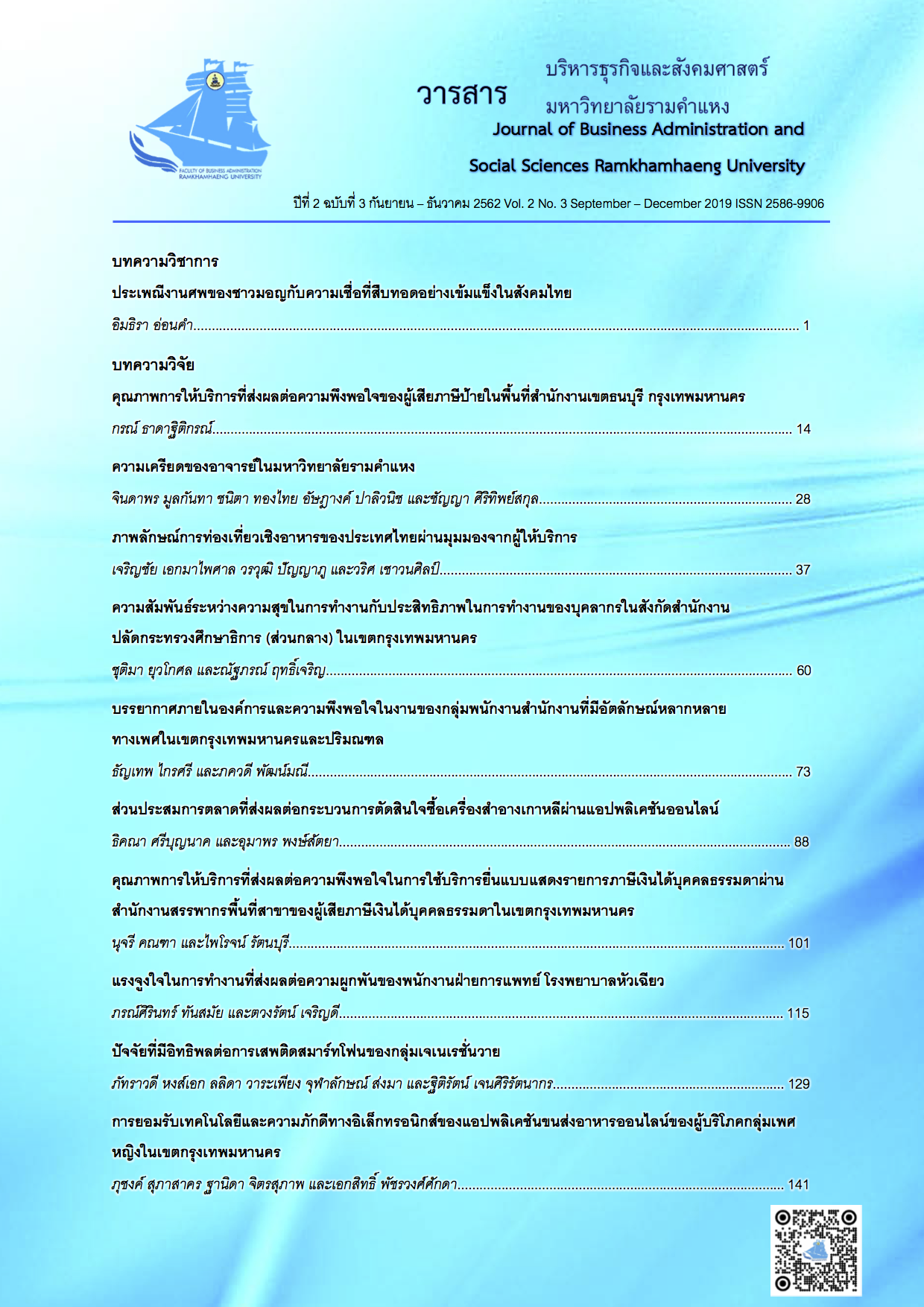
บรรยากาศภายในองค์การและความพึงพอใจในงานของกลุ่มพนักงานสำนักงานที่มีอัตลักษณ์หลากหลายทางเพศในเขตกรุงเทพมหานครและปริมณฑล
Article Sidebar
Main Article Content
บทคัดย่อ
การศึกษานี้มีวัตถุประสงค์เพื่อเปรียบเทียบความพึงพอใจในงานของกลุ่มพนักงานสำนักงานที่มีอัตลักษณ์หลากหลายทางเพศ (LGBT) ตามปัจจัยส่วนบุคคลที่แตกต่างกัน และศึกษาอิทธิพลของบรรยากาศภายในองค์การที่มีต่อความพึงพอใจในงานของพนักงานสำนักงานกลุ่ม LGBT พบว่า ผู้ตอบแบบสอบถามส่วนใหญ่เป็นกลุ่มเกย์ โสด อายุ 30 – 39 ปี นับถือศาสนาพุทธ การศึกษาระดับปริญญาตรี รายได้ 35,000 – 50,000 บาทต่อเดือน และมีประสบการณ์การทำงาน 5 – 8 ปี และพบว่า การรับรู้บรรยากาศภายในองค์การอยู่ในระดับมาก ค่าเฉลี่ย 3.46 และความพึงพอใจในงานอยู่ในระดับมาก ค่าเฉลี่ย 3.97 ผลการวิเคราะห์ถดถอยพหุพบว่า บรรยากาศภายในองค์การมีอิทธิพลต่อความพึงพอใจในงานอย่างมีนัยสำคัญทางสถิติที่ระดับ 0.05 โดยด้านการปฏิบัติ (Beta = 0.708) มีน้ำหนักมากกว่าด้านทัศนคติ (Beta = 0.405) ซึ่งค่าสัมประสิทธิ์มีทิศทางเดียวกันคือเป็นบวก
Article Details
เนื้อหาและข้อมูลในบทความที่ลงตีพิมพ์ในวารสารบริหารธุรกิจและสังคมศาสตร์ มหาวิทยาลัยรามคำแหง ถือเป็นข้อคิดเห็นและความรับผิดชอบของผู้เขียนบทความโดยตรง ซึ่งกองบรรณาธิการไม่จำเป็นต้องเห็นด้วย หรือร่วมรับผิดชอบใดๆ
บทความ ข้อมูล เนื้อหา รูปภาพ ฯลฯ ที่ได้รับการตีพิมพ์ในวารสารบริหารธุรกิจและสังคมศาสตร์ มหาวิทยาลัยรามคำแหง ถือเป็นลิขสิทธิ์ของวารสารบริหารธุรกิจและสังคมศาสตร์ มหาวิทยาลัยรามคำแหง หากบุคคลหรือหน่วยงานใดต้องการนำบทความทั้งหมดหรือส่วนหนึ่งส่วนใดไปเผยแพร่ต่อ หรือเพื่อกระทำการใดๆ จะต้องได้รับอนุญาตเป็นลายลักษณ์อักษรจากวารสารบริหารธุรกิจและสังคมศาสตร์ มหาวิทยาลัยรามคำแหง ก่อนเท่านั้น
เอกสารอ้างอิง
พิมลพรรณ อิศรภักดี. (2558). ต่างวัยต่างทัศนะต่อความหลากหลายทางเพศในสังคมไทย. สืบค้นเมื่อ 2 พฤศจิกายน 2562, จาก http://www.ms.ipsr.mahidol.ac.th/ConferenceXI/Download/Book/447-IPSR-Conference-A04-fulltext.pdf
ภาวิณี กาญจนาภา. (2559). พฤติกรรมผู้บริโภค. กรุงเทพฯ: สำนักพิมพ์มหาวิทยาลัยศิลปากร.
บุษกร สุริยสาร. (2557). อัตลักษณ์และวิถีทางเพศในประเทศไทย. กรุงเทพฯ: องค์การแรงงานระหว่างประเทศ.
สิรธันย์ วดีศิริศักดิ์. (2555). แนวทางในการพัฒนาความงามฉลาดทางวัฒนธรรมเพื่อสร้างภาวะผู้นำขององค์การธุรกิจชั้นนำของประเทศไทย. ดุษฎีนิพนธ์บัณฑิต, มหาวิทยาลัยราชภัฏวไลยอลงกรณ์ ในพระบรมราชูปถัมภ์.
อรสา ใจจินา และภิญญาพันธ์ ร่วมชาติ. (2556). อิทธิพลของปัจจัยส่วนบุคคลและการสนับสนุนทางสังคมต่อความเหนื่อยหน่ายในการปฏิบัติงานของบุคลากรสาธารณสุขผู้รับผิดชอบงานสุขภาพจิตและจิตเวช ในพื้นที่เครือข่ายบริการสุขภาพที่ 3. วารสารวิชาการศิลปศาสตร์ประยุกต์, 6(1), 2-7.
Allen, T. D. (2001). Family-supportive work environments: The role of organizational perceptions. Journal of Vocational Behavior, 58(3), 414-435.
Bartle, S. A., Dansby, M. R., Landis, D., & McIntyre, R. M. (2002). The effect of equal opportunity fairness attitudes on job satisfaction, organizational commitment, and perceived work group efficacy. Military Psychology, 14(4), 299-319.
Brown, W. B. & Moberg, D. J. (1980). Organization Theory and Management. New York: John Wiley and Sons.
Clark, A. E. (1996). Job satisfaction in Britain. British Journal of Industrial Relations, 34(2), 189-217.
Cochran, W. G. (1953). Sampling Techniques. Oxford: John Wiley and Sons.
Coomber, B. & Barriball, K. L. (2007). Impact of job satisfaction components on intent to leave and turnover for hospital-based nurses: A review of the research literature. International Journal of Nursing Studies, 44(2), 297-314.
Cooper, C. L. & Dewe, P. (2004). Stress: A Brief History. Malden, MA: Blackwell.
Cranny, C. J., Smith, P. C., & Stone, E. F. (1992). Job Satisfaction: How People Feel About Their Jobs and How It Affects Their Performance. New York: Lexington Books.
Cullen, M., & Smart, J. (1991). Issues of gay, lesbian and bisexual student affairs professionals. In N. J. Evans & V. A. Wall (Eds.), Beyond Tolerance: Gays, Lesbians, and Bisexuals on Campus (pp. 179-194). Lanham, MD: University Press.
Ellis, A. L. (1996). Sexual identity issues in the workplace: Past and present. In A. L. Ellis & E. D. B. Riggle (Eds.), Sexual Identity on the Job: Issues and Services (pp. 1-16). New York: Harrington Park Press.
Folger, R. & Konovsky, M. A. (1989). Effects and procedural and distributive justice on reactions to pay raise decisions. Academy of Management Journal, 32(3), 115-130.
Heaney, C. A. (1991). Enhancing social support at the workplace: Assessing the effects of the caregiver support program. Health Education Quarterly, 18(4), 477-494.
Hedges, J. N. (1983). Job commitment in America: Is it waxing or waning? Monthly Labor Review, 106(7), 17-25.
Jackson, P. (2000). An explosion of Thai identities: Global queering and re-imaging queer theory. Culture, Health & Sexuality, 2(4), 405-424.
Lee, C., Huan, S., & Zhao, C. (2011). A study of factors affecting turnover intention of hotel employees in Taiwan. Journal of Asian Economic and Financial Review, 2(7), 866 -875.
Liddle, B. J., Luzzo, D. A., Hauenstein, A. L., & Schuck, K. (2004). Construction and validation of the lesbian, gay, bisexual, and transgendered climate inventory. Journal of Career Assessment, 12(1), 33-50.
Litwin, G. H. & Stringer, R. A., Jr. (1968). Motivation and Organizational Climate. Boston: Harvard.
Maslow, A. H. (1954). Motivation and Personality. New York: HarperCollins.
Ojanen, T. (2009). Sexual/Gender Minorities in Thailand: Identities, Challenges, and Voluntary-Sector Counseling. Retrieved on October 26, 2019, from http://www.academia.edu/3120339/Sexual_gender_minorities_in_Thailand_Identities_challenges_and_voluntary-sector_counseling
Parker, R.J. & Kohlmeyer, J. M. (2005). Organizational justice and turnover in public accounting firms: A research note. Accounting, Organizations and Society, 30(4), 357-369.
Powers, B. (1996). The impact of gay, lesbian, and bisexual workplace issues on productivity. In A. L. Ellis & E. D. B. Riggle (Eds.), Sexual Identity on the Job: Issues and Services (pp. 79-89). New York: Harrington Park Press.
Robbins, S. P. (2003). Organizational Behavior. New Jersey: Pearson Education.
Sell, L. & Cleal, B. (2011). Job satisfaction, work environment, and rewards: Motivational theory revisited. Labour, 25(1), 1-23.
Singh, P. & Loncar, N. (2010). Pay satisfaction, job satisfaction and turnover intent. Relations Industrielles/Industrial Relations, 65(3), 470-490.
Steers, R. M. & Porter, L. W. (1979). Motivation and Work Behavior. New York: McGraw-Hill.
United Nations Development Program and U.S. Agency for International Development. (2014). Being LGBT in Asia: The Thailand Country Report. Bangkok.
Waldo, C. R. (1999). Working in a majority context: A structural model of heterosexism as minority stress in the workplace. Journal of Counseling Psychology, 46(2), 218-232.
