
Linguistic strategies in students’ reflective talk on team teaching in Thai upper secondary English classrooms: A pragmatic analysis
Article Sidebar
Main Article Content
Abstract
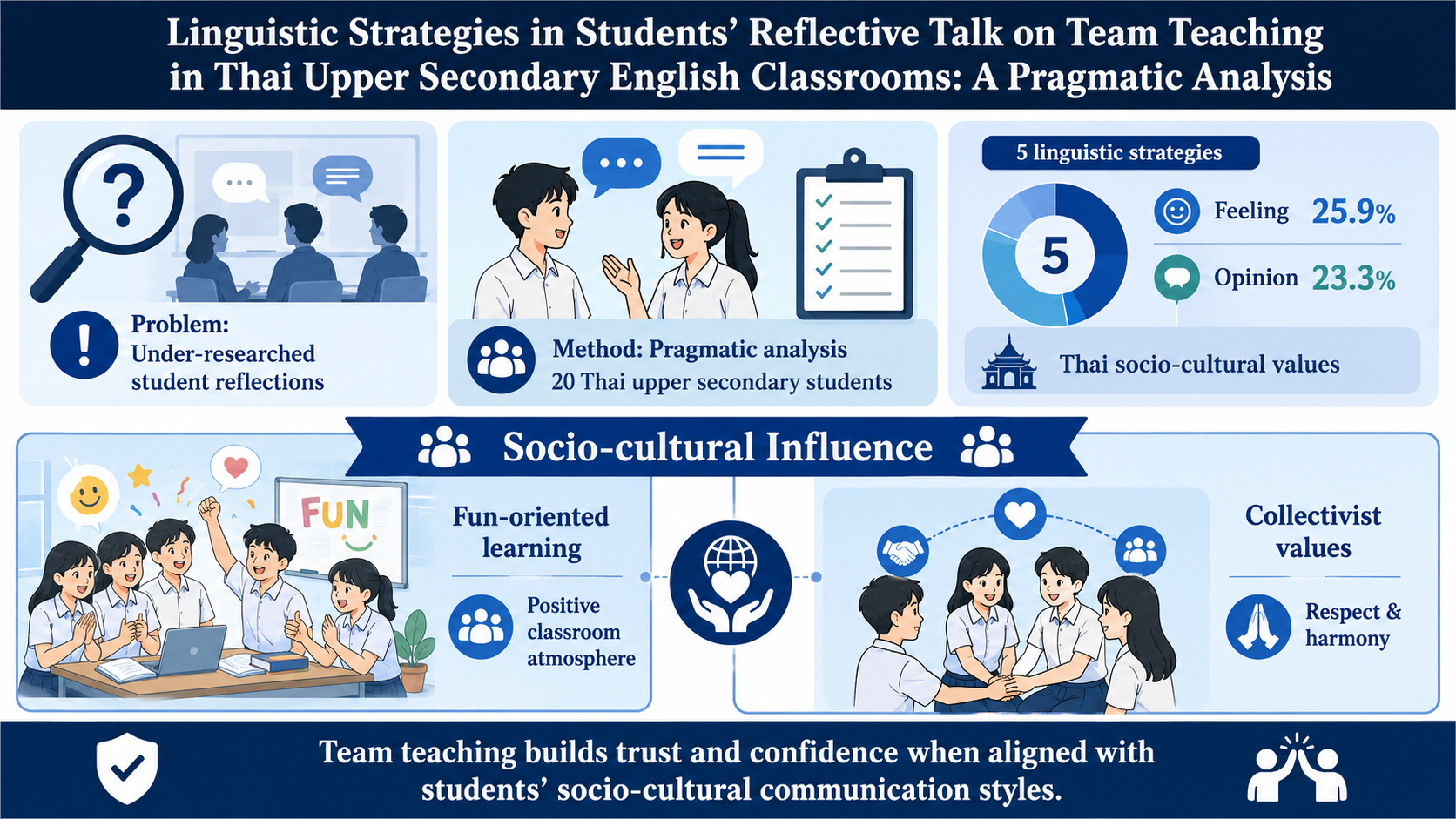
This study investigates the linguistic strategies used in students’ reflective talk on team teaching in English classrooms and examines how these strategies relate to students’ perceptions of team-teaching effectiveness in a Thai upper secondary school context. Drawing on pragmatic and emancipatory pragmatic frameworks, the study analyzes reflective conversational data obtained from semi-structured interviews with 20 upper secondary students who had experienced team teaching by Thai and foreign English teachers. The analysis identifies five main linguistic strategies used in students’ reflections: feeling-expressing language, opinion-expressing language, presupposition, explication, and hedging. Among these, feeling-expressing and opinion-expressing language occurred most frequently, indicating the central role of affective and evaluative meanings in students’ reflective processes. The findings show that students perceived team teaching as effective in six dimensions: understanding of teacher roles and instructional models, respect for teachers, responsiveness to feedback, emphasis on learning development rather than outcomes, a sense of trust and security in the classroom, and confidence in their ability to achieve learning goals. The results further demonstrate that students’ linguistic choices reflect Thai socio-cultural orientations characterized by interdependence, fun-oriented learning, and collectivist values, which shape how students express opinions, manage politeness, and construct relationships with teachers. By linking pragmatic analysis with classroom reflection and cultural perspectives, this study contributes to research on reflective practice in English language education. It highlights the importance of culturally informed team-teaching approaches in multilingual educational settings.
Downloads
Article Details

This work is licensed under a Creative Commons Attribution-NonCommercial-NoDerivatives 4.0 International License.
All rights reserved. Apart from citations for the purposes of research, private study, or criticism and review,no part of this publication may be reproduced, stored or transmitted in any other form without prior written permission by the publisher.
References
Canaran, Ö., & Mirici, İ. (2020). A new model of team teaching for teacher professional development: A case study of in-service English teachers. Education and Science, 45(201), 247–271. https://doi.org/10.15390/EB.2020.8430
Carless, D. (2006a). Collaborative EFL teaching in primary schools. ELT Journal, 60(4), 328–335. https://doi.org/10.1093/elt/ccl023
Carless, D. (2006b). Good practices in team teaching in Japan, South Korea and Hong Kong. System, 34(3), 341–351. https://doi.org/10.1016/j.system.2006.02.001
Carless, D., & Walker, E. (2006). Effective team teaching between local and native-speaking English teachers. Language and Education, 20(6), 463–477. https://doi.org/10.2167/le627.0
Conderman, G. (2011). Middle school co-teaching: Effective practices and student reflections. Middle School Journal, 42(4), 24–31. https://doi.org/10.1080/00940771.2011.11461771
Cook, L., & Friend, M. (1995). Co-teaching: Guidelines for creating effective practices. Focus on Exceptional Children, 28(3), 1–16. https://doi.org/10.17161/foec.v28i3.6852
Dewey, J. (1938). How we think: A restatement of the relation of reflective thinking to the educative process (2nd ed.). D.C. Heath.
Dugan, K., & Letterman, M. (2008). Student appraisals of collaborative teaching. College Teaching, 56(1), 11–15. https://doi.org/10.3200/CTCH.56.1.11-16
Farrell, T. S. C. (2007). Reflective language teaching: From research to practice. Continuum.
Farrell, T. S. C. (2013). Reflective practice in ESL teacher development groups: From practices to principles. Palgrave Macmillan.
Farrell, T. S. C. (2018). Reflective language teaching: Practical applications for TESOL teachers (2nd ed.). Bloomsbury Academic.
Friend, M., Cook, L., Hurley-Chamberlain, D., & Shamberger, C. (2010). Co-teaching: An illustration of the complexity of collaboration in special education. Journal of Educational and Psychological Consultation, 20(1), 9–27. https://doi.org/10.1080/10474410903535380
Grossman, R. (2009). Structures for facilitating student reflection. College Teaching, 57(1), 15–22.
Gu, Y. (1990). Politeness phenomena in modern Chinese. Journal of Pragmatics, 14(2), 237–257. https://doi.org/10.1016/0378-2166(90)90082-O
Hanks, W. F., Ide, S., & Katagiri, Y. (2009). Towards an emancipatory pragmatics. Journal of Pragmatics, 41(1), 1–9. https://doi.org/10.1016/j.pragma.2008.02.014
Hess, G. F. (1999). Principle 3: Good practice encourages active learning. Journal of Legal Education, 49(3), 401–417.
Hofstede, G., & Hofstede, G. J. (2005). Cultures and organizations: Software of the mind (2nd ed.). McGraw-Hill.
Hurford, J. R., & Heasley, B. (1983). Semantics: A coursebook. Cambridge University Press.
Komin, S. (1991). Psychology of the Thai people: Values and behavioral patterns. Research Center, National Institute of Development Administration.
Levinson, S. C. (1983). Pragmatics. Cambridge University Press.
Mann, S., & Walsh, S. (2017). Reflective practice in English language teaching: Research-based principles and practice. Routledge.
Marcus, H. R., & Kitayama, S. (1991). Culture and the self: Implications for cognition, emotion, and motivation. Psychological Review, 98(2), 224–253. https://doi.org/10.1037/0033-295X.98.2.224
Mey, J. L. (2001). Pragmatics: An introduction (2nd ed.). Blackwell.
Money, A., & Coughlan, J. (2016). Team-taught versus individually taught undergraduate education: A qualitative study of student experiences and preferences. Higher Education, 72, 797–811. https://doi.org/10.1007/s10734-015-9976-5
Moon, J. A. (2004). A handbook of reflective and experiential learning: Theory and practice. Routledge.
Panpothong, N., & Phakdeephasook, S. (2014). The wide use of mai-pen-rai ‘It’s not substantial’ in Thai interactions and its relationship to the Buddhist concept of Tri Laksana. Journal of Pragmatics, 69, 99–107. https://doi.org/10.1016/j.pragma.2012.03.006
Richards, J. C., & Farrell, T. S. C. (2005). Professional development for language teachers: Strategies for teacher learning. Cambridge University Press.
Sacks, H., Schegloff, E. A., & Jefferson, G. (1974). A simplest systematics for the organization of turn-taking for conversation. Language, 50(4), 696–735.
Saeed, J. I. (2009). Semantics (3rd ed.). Wiley-Blackwell.
Tannen, D. (1984). Conversational style: Analyzing talk among friends. Ablex.
Verschueren, J. (1999). Understanding pragmatics. Oxford University Press.
Wierzbicka, A. (2003). Cross-cultural pragmatics: The semantics of human interaction (2nd ed.). De Gruyter Mouton.
Yule, G. (1996). Pragmatics. Oxford University Press.
