
Exploring digital citizenship and its influence on adolescents’ mental health: A survey of school and parent roles
Article Sidebar
Main Article Content
Abstract
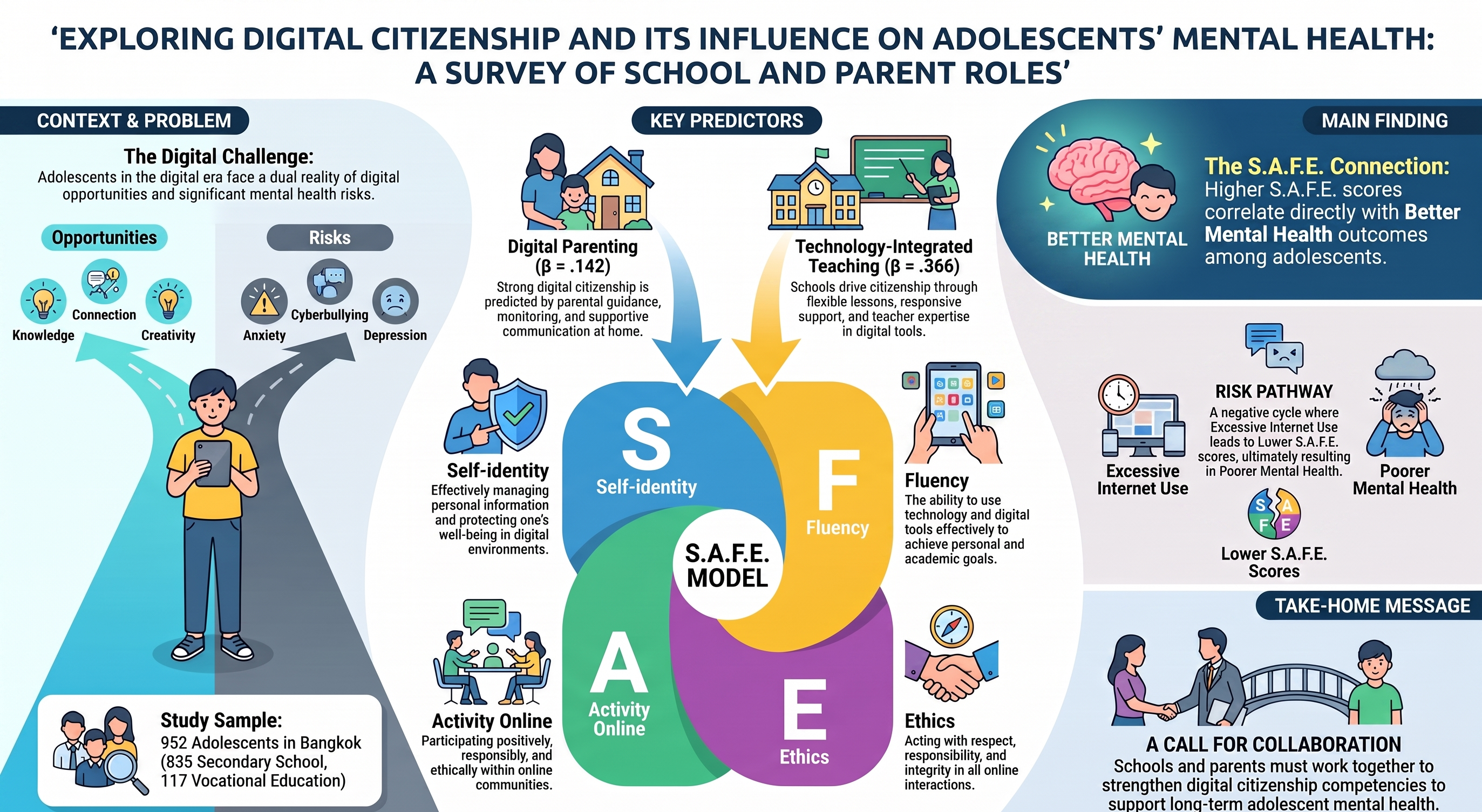
As global concern grows regarding the impact of digital technology on adolescents’ mental health, utilizing digital citizenship as a preventive tool is more crucial than ever. This study aimed to identify the personal, family, and school-related factors that influence the development of adolescents’ digital citizenship and to examine how distinct components of digital citizenship relate to adolescents’ mental health. Our study in Bangkok adopted a Digital Citizenship Scale called the S.A.F.E. model, the leading character of Self-identity in digital environment, Activity online, Fluency for digital tools, and Ethics for digital environment. These components enable individuals to navigate the digital world safely, respectfully, and knowledgeably. This study assessed digital citizenship and mental health among 952 secondary school and vocational students. The results show the relationship between digital citizenship and adolescents’ mental health, with significant findings consistently observed at a moderate level across all S.A.F.E. dimensions. The S.A.F.E. components contribute to the negative impact of excessive internet use, worsening student mental health. In addition, digital parenting (β, .142; 95% CI, 0.86–1.13) is a significant positive predictor of digital citizenship, showing a strong association with higher levels of digital citizenship. The intensity of teaching with technology use (β, .366; 95% CI, 8.85–10.55) also significantly predicts digital citizenship. Our findings highlight the critical roles of schools and parents in promoting digital citizenship, emphasizing the need for effective communication and cooperation between teachers and parents to support adolescents’ mental health and responsible digital engagement.
Downloads
Article Details

This work is licensed under a Creative Commons Attribution-NonCommercial-NoDerivatives 4.0 International License.
All rights reserved. Apart from citations for the purposes of research, private study, or criticism and review,no part of this publication may be reproduced, stored or transmitted in any other form without prior written permission by the publisher.
References
Almutairi, S. M., Al-Shehri, A. M., Al Qurashi, S. M., Alzahrani, R. A., Althobity, K. S. S., Alsufyani, M. W., Alsofyani, K. W., Althagafi, K. M., Aldowayan, N. A., Alhomidi, M. J., & Batool, R. (2023). Digital citizenship and mental and physical well-being of Saudi citizens. Journal of Positive Psychology and Wellbeing, 7(3), 108–120.
Baltezarević, V., Baltezarević, R., & Baltezarević, I. (2023). Cyber harassment of children with special reference to digital games. Temida, 26(2), 261–284.
Beldarrain, Y. (2006). Distance education trends: Integrating new technologies to foster student interaction and collaboration. Distance Education, 27(2), 139–153. https://doi.org/10.1080/01587910600789498
Berdi, D., Niyazova, G., Bayterekova, N., Koshanova, G., & Usembayeva, I. (2024). Digital hygiene skills and cyberbullying reduction: A study among teenagers in Kazakhstan. International Journal of Evaluation and Research in Education, 13(6), 4170–4188. http://doi.org/10.11591/ijere.v13i6.28418
Bezerra, A. de F. P., Marques, A. C. P., Santos, C. H. S., Oliveira, G. N. de, Sgrancio, J. R. V., Gonçalves, L. N. O., Guedes, M. S., Placides, N. S., Freitas, R. H. de, Rodrigues, S. R. M., Nacif, C. L., & Abreu, J. C. de (2024). Risky behaviors during children’s use of screens. Seven Editora, 78–85. https://sevenpublicacoes.com.br/editora/article/view/4838
Bronfenbrenner, U. (1994). Ecological models of human development. In T. N. Postlethwaite & T. Husen (Eds.), International encyclopedia of education (Vol. 3, 2nd ed., pp. 1643–1647). Elsevier.
Cao, X., & Liu, X. (2023). Understanding the role of parent-child relationships in conscientiousness and neuroticism development among chinese middle school students: A cross-lagged model. Behavioral Sciences, 13(10), Article 876. https://doi.org/10.3390/bs13100876
Cattell, R. B. (1966). The scree test for the number of factors. Multivariate Behavioral Research, 1(2), 245–276. https://doi.org/10.1207/s15327906mbr0102_10
Choi, M., Cristol, D., & Gimbert, B. (2018). Teachers as digital citizens: The influence of individual backgrounds, internet use and psychological characteristics on teachers’ levels of digital citizenship. Computers & education, 121, 143–161. https://doi.org/10.1016/j.compedu.2018.03.005
Crompton, H. (2023). Evidence of the ISTE Standards for Educators leading to learning gains. Journal of Digital Learning in Teacher Education, 39(4), 201–219. https://doi.org/10.1080/21532974.2023.2244089
Geographic Information Division. (2020). Schools under the Office of the Basic Education Commission in Bangkok. Digital Government Development Agency. https://data.go.th/dataset/bangkok001 [in Thai]
Hair, J. F., Jr., Black, W. C., Babin, B. J., & Anderson, R. E. (2010). Multivariate data analysis: A global perspective (7th ed.). Pearson Education.
Hazemba, A., Siziya, S., Muula, A. S., & Rudatsikira, E. (2008). Prevalence and correlates of being bullied among in-school adolescents in Beijing: Results from the 2003 Beijing Global School-Based Health Survey. Annaul of General Psychiatry, 7, Article 6. https://doi.org/10.1186/1744-859x-7-6
Hoferichter, F., Kulakow, S., & Hufenbach, M. C. (2021). Support from parents, peers, and teachers is differently associated with middle school students’ well-being. Frontiers in Psychology, 12, Article 758226. https://doi.org/10.3389/fpsyg.2021.758226
Information Technology and Vocational Manpower Center. (2022). Number of students (Academic Year 2021) from public and private sectors, categorized by institution, grade, and gender. Office of the Vocational Education Commission. https://ckan.vec.go.th/dataset/current_student/resource/2cd09bea-b0aa-46d7-a781-4cde1adb147d [in Thai]
International Society for Technology in Education. (2019). ISTE Standards. https://cdn.iste.org/www-root/PDF/ISTE%20Standards-One-Sheet_Combined_09-2021_vF3.pdf
Jones, L. M., & Mitchell, K. J. (2016). Defining and measuring youth digital citizenship. New Media & Society, 18(9), 2063–2079. https://doi.org/10.1177/1461444815577797
Kim, M., & Choi, D. (2018). Development of youth digital citizenship scale and implication for educational setting. Educational Technology & Society, 21(1), 155–171.
Krejcie, R. V., & Morgan, D. W. (1970). Determining sample size for research activities. Educational and Psychological Measurement, 30(3), 607–610. https://doi.org/10.1177/001316447003000308
Kuss, D. J., & Griffiths, M. D. (2017). Social networking sites and addiction: Ten lessons learned. International Journal of Environmental Research and Public Health, 14(3), Article 311. https://doi.org/10.3390/ijerph14030311
Kuss, D. J., Griffiths, M. D., & Binder, J. F. (2013). Internet addiction in students: Prevalence and risk factors. Computers in Human Behavior, 29(3), 959–966. https://doi.org/10.1016/j.chb.2012.12.024
Livingstone, S., & Helsper, E. (2010). Balancing opportunities and risks in teenagers’ use of the internet: The role of online skills and internet self-efficacy. New Media & Society.
Livingstone, S., & Smith, P. K. (2014). Annual research review: Harms experienced by child users of online and mobile technologies: the nature, prevalence and management of sexual and aggressive risks in the digital age. Journal of Child Psychology and Psychiatry, 55(6), 635–654. https://doi.org/10.1111/jcpp.12197
Louws, M. L., van Veen, K., Meirink, J. A., & van Driel, J. H. (2017). Teachers’ professional learning goals in relation to teaching experience. European Journal of Teacher Education, 40(4), 487–504. https://doi.org/10.1080/02619768.2017.1342241
Love, S. M., & Knott, T. (2018). Social support and relationships with family and friends. In M. R. Sanders & A. Morawska (Eds.), Handbook of parenting and child development across the lifespan (pp. 441–468). Springer. https://doi.org/10.1007/978-3-319-94598-9_19
Macharia, M., & Dunaway, M. (2025). Understanding the mediator and moderator role of digital citizenship on cyber harassment. Information Technology & People, 39(1), 569–596. https://doi.org/10.1108/ITP-05-2022-0376
Migliorini, C., Lam, D., & Harvey, C. (2022). Supporting family and friends of young people with mental health issues using online technology: A rapid scoping literature review. Early Intervention in Psychiatry, 16(9), 935–957. https://doi.org/10.1111/eip.13230
Miller, M. J. B. (2023). Children tell landscape-lore among perceptions of place: Relating ecocultural digital stories in a conscientizing/decolonizing exploration [Doctoral dissertation, Antioch University]. Antioch University Dissertations & Theses. https://aura.antioch.edu/etds/956/
Nakshine, V. S., Thute, P., Khatib, M. N., & Sarkar, B. (2022). Increased screen time as a cause of declining physical, psychological health, and sleep patterns: A literary review. Cureus, 14(10), Article e30051. https://doi.org/10.7759/cureus.30051
National Statistical Office. (2022). The 2021 household survey on the use of information and communication technology (fourth quarter). Ministry of Digital Economy and Society Bangkok.
Obodo, A. C., Animercy, I., & Okolo, P. C. (2021). Effect of digital technology on students achievement and interest in basic science and technology. Journal of the Nigerian Council of Educational Psychologists, 14(1), 203–214.
Ostic, D., Qalati, S. A., Barbosa, B., Shah, S. M. M., Galvan Vela, E., Herzallah, A. M., & Liu, F. (2021). Effects of social media use on psychological well-being: A mediated model. Frontiers in Psychology, 12, Article 678766. https://doi.org/10.3389/fpsyg.2021.678766
Park, Y. (2016, September 6). 8 Digital life skills all children need – and a plan for teaching them. World Economic Forum. https://www.weforum.org/agenda/2016/09/8-digital-life-skills-all-children-need-and-a-plan-for-teaching-them/
Patchin, J. W., & Hinduja, S. (2010). Cyberbullying and self‐esteem. Journal of School Health, 80(12), 614–621. https://doi.org/10.1111/j.1746-1561.2010.00548.x
Patton, D. U., Eschmann, R. D., & Butler, D. A. (2013). Internet banging: New trends in social media, gang violence, masculinity and hip hop. Computers in Human Behavior Journal, 29(5), A54–A59. https://doi.org/10.1016/j.chb.2012.12.035
Pengpid, S., & Peltzer, K. (2016). Parental involvement, health behaviors and mental health among school-going adolescents in six asian countries. ASR: Chiang Mai University Journal of Social Sciences and Humanities, 3(2).
Phornprasert, W. (2019). The development of students digital citizenship scale and norms in higher education institutions [Doctoral dissertation, Naresuan University]. Faculty of Education Naresuan University. http://www.edu.nu.ac.th/th/news/docs/download/2019_11_03_12_07_38.pdf [in Thai]
Ribble, M. (2011). Digital citizenship in schools. International Society for Technology in Education.
Ribble, M. (2015). Digital citizenship in schools: Nine elements all students should know (3rd ed.). International Society for Technology in Education.
Rudatsikira, E., Mataya, R. H., Siziya, S., & Muula, A. S. (2008). Association between bullying victimization and physical fighting among Filipino adolescents: Results from the Global School-Based Health Survey. The Indian Journal of Pediatrics, 75(12), 1243–1247. https://doi.org/10.1007/s12098-008-0244-x
Sain, Z. H. (2024). Enhancing teachers’ emotional well-being through parental involvement: Strategies and implications for educational policy. PEDAGOGIK: Jurnal Pendidikan, 11(2), 212–228. https://doi.org/10.33650/pjp.v11i2.9288
Subrahmanyam, K., & Greenfield, P. (2008). Online communication and adolescent relationships. The Future of Children, 18(1), 119–146. https://doi.org/10.1353/foc.0.0006
Suram, P., & Suram, M. K. (2024). Guiding through the technological era: Understanding and addressing modern challenges in child psychology. International Education and Research Journal, 10(4). https://doi.org/10.21276/IERJ24176147894715
Taber, K. S. (2018). The use of Cronbach’s alpha when developing and reporting research instruments in science education. Research in Science Education, 48(6), 1273–1296. https://doi.org/10.1007/s11165-016-9602-2
Third, A., Bellerose, D., De Oliveira, J. D., Lala, G., & Theakstone, G. (2017). Young and online: Children’s perspectives on life in the digital age (The state of the world’s children 2017 companion report). Western Sydney University.
Turan, S. G. (2024). Cyberbullying: Problematic internet behaviors among children and youths. In V. Benson (Ed.), Handbook of social media use online relationships, security, privacy, and society (Vol. 2, pp. 37–50). Academic Press. https://doi.org/10.1016/B978-0-443-28804-3.00004-1
Twenge, J. M., Joiner, T. E., Rogers, M. L., & Martin, G. N. (2018). Increases in depressive symptoms, suicide-related outcomes, and suicide rates among U.S. adolescents after 2010 and links to increased new media screen time. Clinical Psychological Science, 6(1), 3–17. https://doi.org/10.1177/2167702617723376
van Deursen, A. J., & Helsper, E. J. (2015). The third-level digital divide: Who benefits most from being online? In L. Robinson, S. R. Cotton, J. Schulz, T. M. Hale, & A. Williams (Eds.), Communication and information technologies annual (Vol. 10, pp. 29–52). Emerald Group.
Vickery, J. (2022). “Check your facts, fetus”:# GenZ vs.# Millennials and the role of TikTok in the generationing process. 2022 AoIR Selected Papers of Internet Research. https://doi.org/10.5210/spir.v2022i0.13103
Ware, J. E., Jr., & Sherbourne, C. D. (1992). The MOS 36-item short-form health survey (SF-36). I. Conceptual framework and item selection. Medical Care, 30(6), 473–483.
Wijaya, T. T., Rahmadi, I. F., Chotimah, S., Jailani, J., & Wutsqa, D. U. (2022). A case study of factors that affect secondary school mathematics achievement: Teacher-parent support, stress levels, and students’ well-being. International Journal of Environmental Research and Public Health, 19(23), Article 16247. https://doi.org/10.3390/ijerph192316247
Zikmund-Fisher, B. J., Couper, M. P., Singer, E., Levin, C. A., Fowler, F. J., Jr., Ziniel, S., Ubel, P. A., & Fagerlin, A. (2010). The DECISIONS study: A nationwide survey of United States adults regarding 9 common medical decisions. Medical Decision Making, 30(5_Suppl), 20–34. https://doi.org/10.1177/0272989X09353792
