
When digital literacy meets negative bias: Understanding the adoption of online information and sentiment on X
Article Sidebar
Main Article Content
Abstract
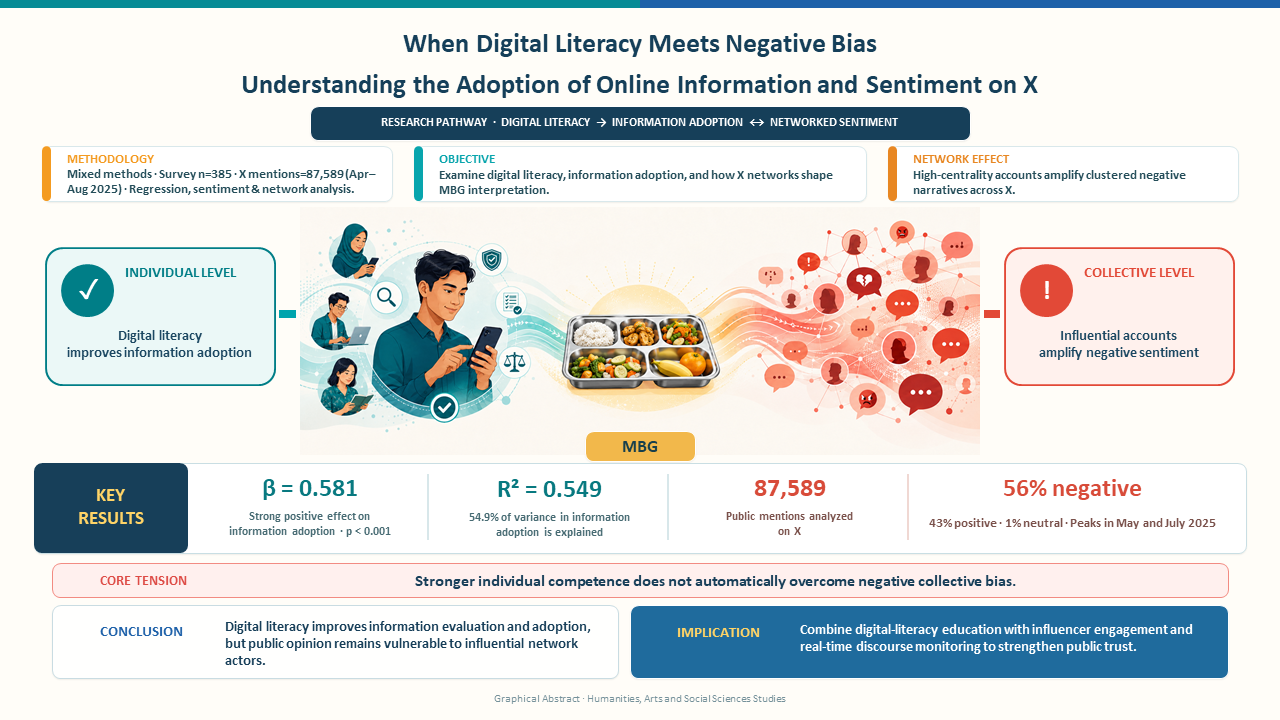
Digital platforms increasingly mediate how citizens engage with public policy, shaping not only access to information but also the formation of collective interpretations and sentiments. In the context of Indonesia’s Free Nutritious Meal (Makan Bergizi Gratis: MBG) program, this study examines the relationship between individual digital literacy and online information adoption, while simultaneously mapping public sentiment and discourse dynamics on X. Employing a concurrent mixed-methods design, the study combines an online survey of 385 social media users drawing on the DigComp 2.2 framework and the Information Adoption Model with large-scale social media analysis of 87,589 MBG-related mentions on X collected between April and August 2025 using Drone Emprit. Regression analysis revealed that digital literacy significantly predicts information adoption regarding the MBG program (β = 0.581, R² = 0.549, p < 0.001), indicating that digital literacy explains 54.9% of the variance in information adoption and substantially enhances individuals’ capacity to evaluate and accept policy-related information. While digital literacy supports information adoption at the individual level, the overall online discourse surrounding MBG remained predominantly negative, suggesting a disconnect between individual informational competence and collective sentiment formation. Sentiment analysis further revealed that public discourse was predominantly negative (56%), compared with positive (43%) and neutral (1%) expressions, with significant surges observed in May and July 2025. Network analysis additionally revealed that negative sentiment is concentrated around accounts with high centrality and influence, thereby amplifying critical narratives through networked interactions. These findings highlight a structural tension between individual informational competence and collective sentiment formation in digital communication environments. This research contributes to the existing body of work on digital communication and public policy by illustrating that initiatives aimed at improving digital literacy should be complemented by network-aware communication strategies, such as influencer engagement and real-time discourse monitoring, to bolster public trust and legitimacy in extensive policy interventions.
Downloads
Article Details

This work is licensed under a Creative Commons Attribution-NonCommercial-NoDerivatives 4.0 International License.
All rights reserved. Apart from citations for the purposes of research, private study, or criticism and review,no part of this publication may be reproduced, stored or transmitted in any other form without prior written permission by the publisher.
References
Almashjari, S., & Ismail, H. (2024). Intelligent food recommendation framework based on social media behavioral data. In Proceedings of the Cognitive Models and Artificial Intelligence Conference, Turkey (pp. 124–129). Association for Computing Machinery. https://doi.org/10.1145/3660853.3660883
Atobishi, T., & Mansur, H. (2025). Bridging digital divides: Validating government ICT investments accelerating sustainable development goals. Sustainability, 17(5), Article 2191. https://doi.org/10.3390/su17052191
Ayolov, P. (2026). Moral outrage networks: The sociology of digital anger. SSRN. https://doi.org/10.2139/ssrn.5998714
Balog‐Way, D., & McComas, K. (2025). Unpacking the risk of misinformation: A communication‐based critique. Risk Analysis, 45(12), 4097–4109. https://doi.org/10.1111/risa.70093
Baragwanath, T. (2021, January 14). Digital opportunities for demand-side policies to improve consumer health and the sustainability of food systems (OECD Food, Agriculture and Fisheries Papers No. 148). OECD Publishing. http://dx.doi.org/10.1787/bec87135-en
Bayiz, Y. E., & Topcu, U. (2023). Prebunking design as a defense mechanism against misinformation propagation on social networks. arXiv. https://doi.org/10.48550/arXiv.2311.14200
Bertschi, I., & Levin-Zamir, D. (2020). Der Umgang mit Gesundheitsbotschaften aus traditionellen und digitalen Medien – Media Health Literacy und digitale Gesundheitskompetenz [Dealing with health messages from traditional and digital media: Media health literacy and digital health literacy]. In T. M. Bollweg, J. Bröder, & P. Pinheiro (Eds.), Health Literacy im Kindes- und Jugendalter: Ein- und Ausblicke (pp. 225–238). Springer VS. https://doi.org/10.1007/978-3-658-29816-6_13 [in German]
Boonprachoom, S., Sirirat, P., & Manorom, A. (2025). Digital media guidelines for sustainable tourism: A case study of historical tourism in Baan Khamkerm-Nong Saeng, Nakhon Phanom province, Thailand. Humanities, Arts and Social Sciences Studies, 25(3), 684–698. https://doi.org/10.69598/hasss.25.3.279083
Boschi, G., Young, A. P., Joglekar, S., Cammarota, C., & Sastry, N. (2021). Who has the last word? Understanding how to sample online discussions. ACM Transactions on the Web, 15(3), Article 12. https://doi.org/10.1145/3452936
Buchori, A. (2018). Pentingnya literasi digital untuk meningkatkan partisipasi masyarakat dalam sosialisasi pembangunan melalui media social [The importance of digital literacy in increasing public participation in disseminating development information through social media]. OMNICOM: Jurnal Ilmu Komunikasi, 4(1), 11–16. [in Indonesian]
Cram, I. (2022). Liberal democracy, law and the citizen speaker: Regulating online speech. Bloomsbury Publishing.
Derstroff, M., Härtling, V. E., Hölttä, W., Traub, M. H., van der Linden, L. A. P. J., & Thomas, J. C. (2023). Stemming the tide of disinformation in public health. South Eastern European Journal of Public Health, 1, 132–146. https://doi.org/10.56801/seejph.vi.374
Dillahunt, T. R., Shedden, K., Filipof, M. E., Lee, S., Naseem, M., Toyama, K., & Hui, J. (2025). The development of a new measure of collective digital literacy. Proceedings of the ACM on Human-Computer Interaction, 9(2), Article CSCW186. https://doi.org/10.1145/3711084
Dissen, A. (2023). A critical issue: Assessing the critical thinking skills and dispositions of undergraduate health science students. Discover Education, 2(1), Article 21. https://doi.org/10.1007/s44217-023-00044-z
Duan, X., Ho, C.-J., & Yin, M. (2020). Does exposure to diverse perspectives mitigate biases in crowdwork? An explorative study. Proceedings of the Eighth AAAI Conference on Human Computation and Crowdsourcing, 8(1), 155–158. https://doi.org/10.1609/hcomp.v8i1.7474
Evenstein Sigalov, S., & Tsybulsky, D. (2026). Critical ignoring reimagined: Insights from STEM digital curation on Wikimedia platforms. Smart Learning Environments, 13(1), Article 4. https://doi.org/10.1186/s40561-026-00432-6
Farias, D. I. H., & Rosso, P. (2017). Irony, sarcasm, and sentiment analysis. In F. A. Pozzi, E. Fersini, E. Messina, & B. Liu (Eds.), Sentiment analysis in social networks (pp. 113–128). Morgan Kaufmann. http://dx.doi.org/10.1016/B978-0-12-804412-4.00007-3
García-León, R. A., & Teichert, T. (2024). Food and social media: A research stream analysis. Management Review Quarterly, 74(2), 1145–1183. https://doi.org/10.1007/s11301-023-00330-y
Guath, M., & Nygren, T. (2022). Civic online reasoning among adults: An empirical evaluation of a prescriptive theory and its correlates. Frontiers in Education, 7, Article 721731. https://doi.org/10.3389/feduc.2022.721731
Hamadeh, S. (2024). Smart food and sports policies in the digital age: Re-defining nutrition economic, education designs, and governance. In A. Salman & A. Tharwat (Eds.), Informatics for digital education (pp. 49–61). Springer. https://doi.org/10.1007/978-3-031-49393-5_7
Hari, Y., Yanggah, M. E., & Budiman, A. (2026). Model integration of information technology in optimizing the food supply chain of the Free Nutritious Meal (MBG) program to reduce food waste. Journal of Applied Data Sciences, 7(1), 438–457. https://doi.org/10.47738/jads.v7i1.1039
Hongngam, K., Jitsupa, J., Skunhom, V., Yanuchit, C., & Meeusah, N. (2025). Digital Interactive Storytelling to promote Thai language vocabulary learning for children with dyslexia. Humanities, Arts and Social Sciences Studies, 25(3), 620–630. https://doi.org/10.69598/hasss.25.3.274432
Jaroenpool, J., Suwanbamrung, C., Sukkaew, N., & Dadras, M. (2023). Students’ reflections on an integrated research subject using a research-based learning online model during the COVID-19 pandemic: A qualitative study in Thailand. Humanities, Arts and Social Sciences Studies, 23(3), 695–707. https://doi.org/10.14456/hasss.2023.59
Jennings, W., Stoker, G., Bunting, H., Valgarðsson, V. O., Gaskell, J., Devine, D., McKay, L., & Mills, M. C. (2021). Lack of trust, conspiracy beliefs, and social media use predict COVID-19 vaccine hesitancy. Vaccines, 9(6), Article 593. https://doi.org/10.3390/vaccines9060593
Johnson, D. R. (2024). Health communications matter: A comparative case study of best practices to combat misinformation and disinformation during the COVID-19 pandemic [Doctoral dissertation, The University of North Carolina at Chapel Hill]. ProQuest Dissertations & Theses Global. https://www.proquest.com/docview/3056981572
Kozyreva, A., Lorenz-Spreen, P., Herzog, S. M, Ecker, U. K., Lewandowsky, S., Hertwig, R., Ali, A., Bak-Coleman, J., Barzilai, S., Basol, M., Berinsky, A. J., Betsch, C., Cook, J., Fazio, L. K., Geers, M., Guess, A. M., Huang, H., Larreguy, H., Maertens, R., . . . Wineburg, S. (2022). Toolbox of interventions against online misinformation. PsyArXiv. https://doi.org/10.31234/osf.io/x8ejt
Lukáč, J., Kudlová, Z., Kopčáková, J., & Gallo, P. (2025). Impact of socio-economic factors on digital literacy and security. TEM Journal, 14(1), 925–932. https://doi.org/10.18421/TEM141-81
Minihold, S., Lecheler, S., Gibson, R., de Vreese, C., & Kruikemeier, S. (2025). Understanding digital campaign competence: Conceptualizing data-driven political advertising literacy. Mass Communication and Society, 28(5), 852–878. https://doi.org/10.1080/15205436.2024.2312202
Ortega Bueno, R. (2025). New avenues in computational irony detection in social media [Doctoral dissertation, Universitat Politècnica de València]. Repositorio Riunet.
Pennycook, G., & Rand, D. G. (2021). The psychology of fake news. Trends in Cognitive Sciences, 25(5), 388–402. https://doi.org/10.1016/j.tics.2021.02.007
Perera, P., Selvanathan, S., Selvanathan, S., Su, J.-J., & Jayasinghe, M. (2026). From digital inequality to income inequality: Exploring the multifaceted impact of digital literacy on income. Digital Policy, Regulation and Governance, 28(2), 173–189. https://doi.org/10.1108/DPRG-11-2024-0278
Poria, S., Hazarika, D., Majumder, N., & Mihalcea, R. (2023). Beneath the tip of the iceberg: Current challenges and new directions in sentiment analysis research. IEEE Transactions on Affective Computing, 14(1), 108–132. https://doi.org/10.1109/TAFFC.2020.3038167
Pushsapavardhana, N. (2025). Social media usage and cyberbullying: Experiences and coping strategies among secondary school students in Surat Thani, Thailand. Humanities, Arts and Social Sciences Studies, 25(3), 550–566. https://doi.org/10.69598/hasss.25.3.278093
Robertson, C. E., Pröllochs, N., Schwarzenegger, K., Pärnamets, P., Van Bavel, J. J., & Feuerriegel, S. (2023). Negativity drives online news consumption. Nature Human Behaviour, 7, 812–822. https://doi.org/10.1038/s41562-023-01538-4
Roozenbeek, J., Culloty, E., & Suiter, J. (2023). Countering misinformation. European Psychologist, 28(3), 189–205. https://doi.org/10.1027/1016-9040/a000492
Silva, P., Araújo, R., Lopes, F., & Ray, S. (2023). Nutrition and food literacy: Framing the challenges to health communication. Nutrients, 15(22), Article 4708. https://doi.org/10.3390/nu15224708
Soroka, S., Fournier, P., & Nir, L. (2019). Cross-national evidence of a negativity bias in psychophysiological reactions to news. Proceedings of the National Academy of Sciences of the United States of America, 116(38), 18888–18892. https://doi.org/10.1073/pnas.1908369116
Steinfeld, N. (2023). How do users examine online messages to determine if they are credible? An eye-tracking study of digital literacy, visual attention to metadata, and success in misinformation identification. Social Media + Society, 9(3). https://doi.org/10.1177/20563051231196871
Sun, Y., Wang, N., Shen, X.-L., & Zhang, X. (2019). Bias effects, synergistic effects, and information contingency effects: Developing and testing an extended information adoption model in social Q&A. Journal of the Association for Information Science and Technology, 70(12), 1368–1382. https://doi.org/10.1002/asi.24228
Suwan, S., & Sithsungnoen, C. (2025). The effects of a learning management model using design thinking and community-based learning to enhance local visual art design in line with the creative economy concept among high school students. Humanities, Arts and Social Sciences Studies, 25(2), 485–497. https://doi.org/10.69598/hasss.25.2.273333
Tay, L. Q., Hurlstone, M., Kurz, T., & Ecker, U. K. H. (2024). Do prebunking and debunking protect against novel misinformation? PsyArXiv. https://doi.org/10.31234/osf.io/w7gja
Ullah, A., Din, S. U., Khan, N., Mawuli, C. B., & Shao, J. (2024). Towards investigating influencers in complex social networks using electric potential concept from a centrality perspective. Information Fusion, 109, Article 102439. https://doi.org/10.1016/j.inffus.2024.102439
van der Meer, T., & Hakhverdian, A. (2017). Political trust as the evaluation of process and performance: A cross-national study of 42 European countries. Political Studies, 65(1), 81–102. https://doi.org/10.1177/0032321715607514
van der Velden, M. A. C. G., Casapa, N. U., & Pipal, C. (2025). Sentiment analysis. In A. Nai, M. Grömping, & D. Wirz (Eds.), Elgar encyclopedia of political communication (Vol. 3, pp. 477–480). Edward Elgar Publishing. https://doi.org/10.4337/9781035301447.vol3.00116
Yaboonthong, Y., Damrongpanit, S., Rupavijetra, P., & Phothi, S. (2025). An integrated active learning model focused on learning outcomes for schools in Thailand. Humanities, Arts and Social Sciences Studies, 25(3), 567–580. https://doi.org/10.69598/hasss.25.3.277595
Yıldırım, M. S. (2024). The relationship between digital literacy and health literacy in individuals aged 18–65. Balıkesir Sağlık Bilimleri Dergisi, 13(3), 721–727. https://doi.org/10.53424/balikesirsbd.1544000
Younis, B. K. (2025). From digital literacy to action: The impact of digital mental health literacy and critical thinking on mental health behaviors in university populations. Current Psychology, 44(11), 10851–10864. https://doi.org/10.1007/s12144-025-07930-9
Yuen, E., Winter, N., Savira, F., Huggins, C. E., Nguyen, L., Cooper, P., Peeters, A., Anderson, K., Bhoyroo, R., Crowe, S., & Ugalde, A. (2024). Digital health literacy and its association with sociodemographic characteristics, health resource use, and health outcomes: Rapid review. Interactive Journal of Medical Research, 13, Article e46888. https://doi.org/10.2196/46888