
AI dependency and its impact on critical thinking and writing skills in the context of GfL: A cross-national perspective
Article Sidebar
Main Article Content
Abstract
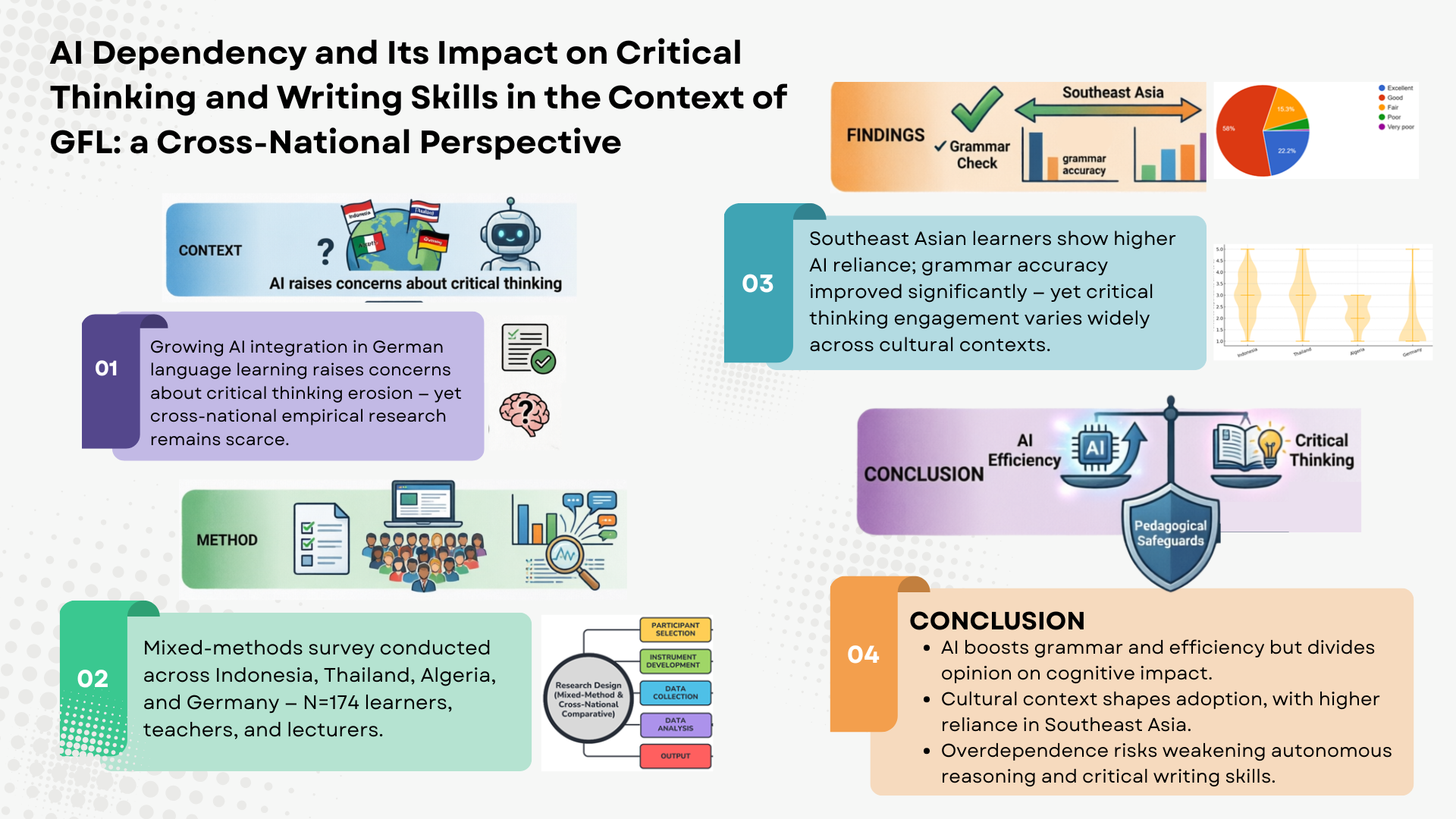
The application of artificial intelligence (AI) in learning and writing German has been expanding rapidly. Although AI has been increasingly employed to assist in writing tasks, concerns have emerged regarding its potential impact on users’ ability for critical thinking and writing independence. Moreover, examples of comparative research between educational and cultural context are limited. This research investigates learners’, teachers’ and lecturers’ perceptions regarding the influence of AI dependency on critical thinking and German writing in Indonesia, Thailand, Algeria, and Germany. The research design is a cross-national descriptive survey, utilizing both qualitative and quantitative data. A web-based questionnaire consisting of closed- and open-ended questions was used for data collection. A total of 174 participants were recruited. Quantitative data were tested using non-parametric tests, and qualitative responses were thematically analyzed. The findings reveal significant differences in people’s perceived reliance on AI across countries. Participants from Indonesia and Thailand reported higher AI use than those from Germany, while respondents from Algeria indicated a moderate level. For all countries, AI was perceived as helpful in increasing grammar precision and structuring ideas in German writing. Meanwhile, there were mixed opinions on critical thinking. Some participants felt that AI assisted in critical thinking, while others were concerned that frequent use reduced the ability to reason independently when writing. In conclusion, AI seems to play a significant complex role in the writing process. Although it can improve writing efficiency, care must be taken to ensure that critical thinking and writing skills are not weakened.
Downloads
Article Details

This work is licensed under a Creative Commons Attribution-NonCommercial-NoDerivatives 4.0 International License.
All rights reserved. Apart from citations for the purposes of research, private study, or criticism and review,no part of this publication may be reproduced, stored or transmitted in any other form without prior written permission by the publisher.
References
Aboura, B. (2024). Neue Perspektiven in der universitären Sprachbildung: Integration von Künstlicher Intelligenz ins DaF-Curriculum der Universität Oran 2 [New perspectives in university language education: Integrating artificial intelligence into the GfL (German as a Foreign Language) program at the university of Oran 2]. Langues & Cultures, 5(1), 230–249. https://doi.org/10.62339/jlc.v5i01.239 [in German]
Alharbi, W. (2023). AI in the foreign language classroom: A pedagogical overview of automated writing assistance tools. Education Research International, 2023(1), Article 4253331. https://doi.org/10.1155/2023/4253331
Alkhalifah, J. M., Bedaiwi, A. M., Shaikh, N., Seddiq, W., & Meo, S. A. (2024). Existential anxiety about artificial intelligence (AI) - is it the end of humanity era or a new chapter in the human revolution: Questionnaire-based observational study. Frontiers in Psychiatry, 15, Article 1368122. https://doi.org/10.3389/fpsyt.2024.1368122
Alzahrani, A. (2025). The acceptability and validity of AI-generated psycholinguistic stimuli. Heliyon, 11(2), Article e42083. https://doi.org/10.1016/j.heliyon.2025.e42083
Asparouhov, T. (2006). General multi-level modeling with sampling weights. Communications in Statistics - Theory and Methods, 35(3), 439–460. https://doi.org/10.1080/03610920500476598
Benek, K. (2025). EFL learners’ and teachers’ perceptions of AI-powered language learning technologies: Benefits and challenges. International Journal of Instruction, 18(2), 103–120. https://doi.org/10.29333/iji.2025.1827a
Boggs, J. A. (2019). Effects of teacher-scaffolded and self-scaffolded corrective feedback compared to direct corrective feedback on grammatical accuracy in English L2 writing. Journal of Second Language Writing, 46, Article 100671. https://doi.org/10.1016/j.jslw.2019.100671
Braun, V., & Clarke, V. (2006). Using thematic analysis in psychology. Qualitative Research in Psychology, 3(2), 77–101. https://doi.org/10.1191/1478088706qp063oa
Cave, S., Coughlan, K., & Dihal, K. (2019). “Scary Robots”: Examining public responses to AI. In Proceedings of the 2019 AAAI/ACM Conference on AI, Ethics, and Society (AIES’19) (pp. 331–337). Association for Computing Machinery. https://doi.org/10.1145/3306618.3314232
Chahrour, N. (2025). KI im Schreibprozess: Chancen und Risiken für Germanistikstudierende an der Universität Oran 2 [AI in the Writing Process: Opportunities and Risks for German Studies Students at the University of Oran 2]. Passerelle, 14(1), 475–492. [in German]
Council of the European Union. (2025, May 23). Council calls for an inclusive, ethical, sustainable and human-centric strategy for the uptake of AI in science. Consilium. https://www.consilium.europa.eu/en/press/press-releases/2025/05/23/council-calls-for-an-inclusive-ethical-sustainable-and-human-centric-strategy-for-the-uptake-of-ai-in-science/?utm_source=chatgpt.com
Deane, P., Odendahl, N., Quinlan, T., Fowles, M., Welsh, C., & Bivens-Tatum, J. (2008). Cognitive models of writing: Writing proficiency as a complex integrated skill. ETS Research Report Series, 2008(2), i–36. https://doi.org/10.1002/j.2333-8504.2008.tb02141.x
Duensing, A., & Baumann, U. (Eds.). (2006). Developing writing skills in German. Routledge. https://doi.org/10.4324/9780203088821
Frenkenberg, A., & Hochman, G. (2025). It’s scary to use it, it’s scary to refuse it: The psychological dimensions of AI adoption—anxiety, motives, and dependency. Systems, 13(2), Article 82. https://doi.org/10.3390/systems13020082
Gambrill, E. (2006). Critical thinking in clinical practice: Improving the quality of judgments and decisions. John Wiley & Sons.
Gamez-Djokic, M., Waytz, A., & Kouchaki, M. (2025). Poets over quants: Automation and AI threats increase the value people place on creativity. Personality and Social Psychology Bulletin, Article 01461672251337126. https://doi.org/10.1177/01461672251337126
George, A. S. (2023). Preparing students for an AI-driven world: Rethinking curriculum and pedagogy in the age of Artificial Intelligence. Partners Universal Innovative Research Publication, 1(2), 112–136. https://doi.org/10.5281/zenodo.10245675
Hacioglu, N., Leva, M. C., & Lee, H. (2025, April 26). AI that makes you think: Designing systems for guided reasoning and reflection [Poster presentation]. ACM CHI 2025 Workshop: Human-AI Interaction for Augmented Reasoning, Yokohama, Japan. https://doras.dcu.ie/31492/
Hestiningsih, W. (2016). The effects of grammar mastery and vocabulary mastery towards students argumentative writing. Deiksis, 8(2), 208–216.
Hunter, D. A. (2014). A practical guide to critical thinking: Deciding what to do and believe. John Wiley & Sons.
Ironsi, C. S., & Ironsi, S. S. (2025). Experimental evidence for the efficacy of generative AI in improving students’ writing skills. Quality Assurance in Education, 33(2), 237–252. https://doi.org/10.1108/QAE-04-2024-0065
Jayasuriya, R., Selvanayaki, S., Deepa, N., Muruganandhi, D., & Kalpana, M. (2025). Assessing the impact of GPTs on critical thinking, creativity and independent problem solving in academic learning of students. Research Square. https://doi.org/10.21203/rs.3.rs-6367830/v1
Jia, X.-H., & Tu, J.-C. (2024). Towards a new conceptual model of AI-enhanced learning for college students: The roles of artificial intelligence capabilities, general self-efficacy, learning motivation, and critical thinking awareness. Systems, 12(3), Article 74. https://doi.org/10.3390/systems12030074
Khalifa, O. (2024). A guidebook for mastering critical thinking skills: Sharpen your mind. Othman Omran Khalifa.
Kharis, M. (2024). Crafting AI-Driven Open Educational Resources (OER) videos for enhanced German language learning. In 2024 IEEE International Symposium on Consumer Technology (ISCT) (pp. 137–141). IEEE. https://doi.org/10.1109/ISCT62336.2024.10791276
Kharis, M., Ediyanto, Wijaya, D. N., Yafie, E., Waluyo, B., & Resultay, R. G. (2024). The impact of AI usage on transforming student learning culture in Indonesia in alignment with SDG 4. Journal of Ecohumanism, 3(8), 1651–1661. https://doi.org/10.62754/joe.v3i8.4845
Kim, M. K., Kim, N. J., & Heidari, A. (2022). Learner experience in artificial intelligence-scaffolded argumentation. Assessment & Evaluation in Higher Education, 47(8), 1301–1316. https://doi.org/10.1080/02602938.2022.2042792
Kuddus, K. (2022). Artificial intelligence in language learning: Practices and prospects. In A. Mire, S. Malik, & A. K. Tyagi (Eds.), Advanced analytics and deep learning models (pp. 1–17). Wiley-Scrivener. https://doi.org/10.1002/9781119792437.ch1
Kuek, T., & Choul, M. (2010). Developing critical thinking skills through integrative teaching of reading and writing in the L2 writing classroom [Doctoral dissertation, Newcastle University]. Newcastle University Theses. http://hdl.handle.net/10443/1063
Li, M., & Wilson, J. (2025). AI-integrated scaffolding to enhance agency and creativity in K-12 English language learners: A systematic review. Information, 16(7), Article 519. https://doi.org/10.3390/info16070519
Li, Z., Dhruv, A., & Jain, V. (2024). Ethical considerations in the use of AI for higher education: A comprehensive guide. In 2024 IEEE 18th International Conference on Semantic Computing (ICSC) (pp. 218–223). IEEE. https://doi.org/10.1109/ICSC59802.2024.00041
Metwally, A. A., Busabaa, N. A., & Mohammed, H. A. N. (2025). University students’ diverse perspectives on Google translate: Enhancing EFL writing skills or hindering progress? An-Najah University Journal for Research - B (Humanities), 39(10), 841–858. https://doi.org/10.35552/0247.39.10.2450
Oberste-Berghaus, N. (2024). The role of teaching foreign languages in developing intercultural competence. Revista Românească pentru Educaţie Multidimensională, 16(1), 1–15. https://doi.org/10.18662/rrem/16.1/808
Pandeeka, P., & Maneekul, J. (2019). Instructional models of social studies teachers to the development of critical thinking skills for living in the 21st century. Humanities, Arts and Social Sciences Studies, 19(2), 314–339. https://doi.org/10.14456/hasss.2019.12
Payadnya, I. P. A. A., Putri, G. A. M. A., Suwija, I. K., Saelee, S., & Jayantika, I. G. A. N. T. (2025). Cultural integration in AI-enhanced mathematics education: Insights from Southeast Asian educators. Journal for Multicultural Education, 19(1), 58–72. https://doi.org/10.1108/JME-09-2024-0119
Phosa, S. (2024). The study of EFL students’ attitudes and behavior toward using ChatGPT in English language learning. Journal of English Language and Linguistics, 5(3), 332–344. https://doi.org/10.62819/jel.2024.656
Pokrivcakova, S. (2019). Preparing teachers for the application of AI-powered technologies in foreign language education. Journal of Language and Cultural Education, 7(3), 135–153. https://doi.org/10.2478/jolace-2019-0025
Rexhepi, S., & Suka, Ç. (2025). The criteria and challenges in evaluating the performance of the writing skills of German language students. Journal of Language Teaching and Research, 16(1), 13–22. https://doi.org/10.17507/jltr.1601.02
Schönegger, P., & Wagner, J. (2019). The moral behavior of ethics professors: A replication-extension in German-speaking countries. Philosophical Psychology, 32(4), 532–559. https://doi.org/10.1080/09515089.2019.1587912
Schulz, K. F., & Grimes, D. A. (2002). Unequal group sizes in randomised trials: Guarding against guessing. The Lancet, 359(9310), 966–970. https://doi.org/10.1016/S0140-6736(02)08029-7
Seferti, B. (2025). Künstliche Intelligenz und Schreibförderung: Der Einsatz von KI-Schreibtools im algerischen DaF-Unterricht [Artificial intelligence and the promotion of writing skills: The use of AI writing tools in Algerian GFL instruction]. Afkar wa Affak Journal, 13(2), 291–312. https://asjp.cerist.dz/en/article/278003 [in German]
Sethy, S. S. (2012). Cognitive skills: A modest way of learning through technology. Turkish Online Journal of Distance Education, 13(3), 260–274. https://izlik.org/JA38PN47AM
Sira, N., Decker, M., Lemke, C., Winkens, A., Leicht-Scholten, C., & Groß, D. (2025). Teaching scientific integrity in academia: What and how students want to learn? Journal of Academic Ethics, 23(1), 5–24. https://doi.org/10.1007/s10805-024-09527-6
Songsiengchai, S. (2025). Implementation of Artificial Intelligence (AI): Chat GPT for effective English language learning among Thai students in higher education. International Journal of Education and Literacy Studies, 13(1), 302–312. https://doi.org/10.7575/aiac.ijels.v.13n.1p.302
Squires, V. (2023). Thematic analysis. In J. M. Okoko, S. Tunison, & K. D. Walker (Eds.), Varieties of Qualitative Research Methods: Selected Contextual Perspectives (pp. 463–468). Springer. https://doi.org/10.1007/978-3-031-04394-9_72
Tatzl, D., Hassler, W., Messnarz, B., & Flühr, H. (2012). The development of a project-based collaborative technical writing model founded on learner feedback in a tertiary aeronautical engineering program. Journal of Technical Writing and Communication, 42(3), 279–304. https://doi.org/10.2190/TW.42.3.f
Thayer-Bacon, B. (1998). Transforming and redescribing critical thinking: Constructive thinking. Studies in Philosophy and Education, 17(2), 123–148. https://doi.org/10.1023/A:1005166416808
Tongco, M. D. C. (2007). Purposive sampling as a tool for informant selection. Ethnobotany Research and Applications, 5, 147–158. https://doi.org/10.17348/era.5.0.147-158
Wale, B. D., & Kassahun, Y. F. (2024). The transformative power of AI writing technologies: Enhancing EFL writing instruction through the integrative use of writerly and Google Docs. Human Behavior and Emerging Technologies, 2024(1), Article 9221377. https://doi.org/10.1155/2024/9221377
Wong, L.-H., & Looi, C.-K. (2024). Advancing the generative AI in education research agenda: Insights from the Asia-Pacific region. Asia Pacific Journal of Education, 44(1), 1–7. https://doi.org/10.1080/02188791.2024.2315704
Zhao, D. (2025). The impact of AI-enhanced natural language processing tools on writing proficiency: An analysis of language precision, content summarization, and creative writing facilitation. Education and Information Technologies, 30(6), 8055–8086. https://doi.org/10.1007/s10639-024-13145-5
Ziar, P. Q. (2025). Impact of AI-based tools on writing skills. Journal of Research in Education, 1(1), 97–112. https://doi.org/10.3126/jore.v1i1.78725
