
Recycling silk scraps into sustainable fashion textiles under the circular economy concept
Article Sidebar
Main Article Content
Abstract
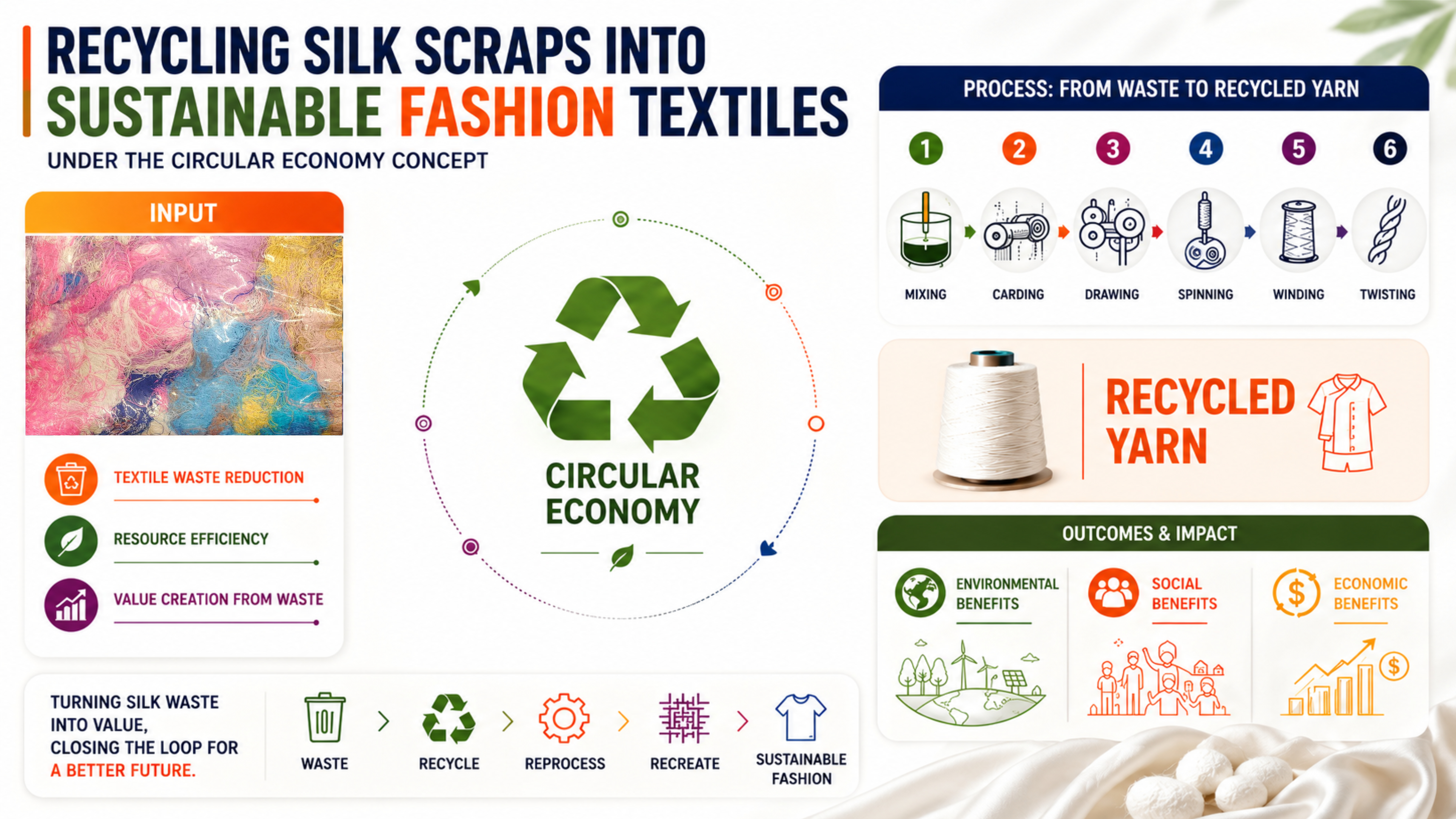
This study aimed to investigate the utilization of Thai silk scraps in sustainable textile production. The objectives of this study were to examine approaches for reducing raw material use in the fashion textile industry and to design and develop sustainable fashion textiles from recycled silk scraps using the circular economy concept as a key framework. The research was conducted in two stages: (1) a preliminary study using literature review and focus group discussions with 10 participants, and (2) material development and prototype design evaluated by three textile experts. Research instruments included focus group guidelines and expert evaluation forms. The findings showed that the use of virgin raw materials in the fashion textile industry was significantly reduced by combining 20% recycled silk scraps with 50% virgin cotton and 30% recycled polyester fiber. Fibers made from recycled materials were strong, flexible, and suitable for spinning and weaving into fabrics, resulting in a significant reduction in resource utilization and waste generated during the manufacturing process. Furthermore, weaving the resulting fibers utilizing traditional Thai textile handicraft techniques together with contemporary design concepts resulted in woven fabrics with cultural value and styles in line with contemporary fashion trends. Expert involvement in both stages helped ensure the reliability and validity of the research process and outcomes. Ten fashion lifestyle product prototypes were developed from these materials, demonstrating the potential for commercial application of recycled materials and supporting the concept of sustainable fashion within the Thai cultural context and the broader creative industry.
Downloads
Article Details

This work is licensed under a Creative Commons Attribution-NonCommercial-NoDerivatives 4.0 International License.
All rights reserved. Apart from citations for the purposes of research, private study, or criticism and review,no part of this publication may be reproduced, stored or transmitted in any other form without prior written permission by the publisher.
References
Al Nassaj. (2023, October 8). The definitive guide to silk fabric: Types, uses, and care. https://alnassaj.com/the-definitive-guide-to-silk-fabric-types-uses-and-care/
ARCH Team. (2024, October 30). The role of design in sustainable fashion. Arch College of Design & Business. https://www.archedu.org/blog/the-role-of-design-in-sustainable-fashion/
Bakker, C. A., Mugge, R., Boks, C., & Oguchi, M. (2021). Understanding and managing product lifetimes in support of a circular economy. Journal of Cleaner Production, 279, Article 123764. https://doi.org/10.1016/j.jclepro.2020.123764
Cimatti, B., Campana, G., & Carluccio, L. (2017). Eco design and sustainable manufacturing in fashion: A case study in the luxury personal accessories industry. Procedia Manufacturing, 8, 393–400. https://doi.org/10.1016/j.promfg.2017.02.050
Community Development Department. (2024). Annual report 2024. Ministry of Interior. https://aced-content.nacc.go.th/upload/Book/10360/book.pdf [in Thai]
Ellen MacArthur Foundation. (2017). A new textiles economy: Redesigning fashion’s future. https://content.ellenmacarthurfoundation.org/m/6d5071bb8a5f05a2/original/A-New-Textiles-Economy-Redesigning-fashions-future.pdfs
European Commission. (2020, March 3). Protecting the environment – Eurobarometer survey. https://ec.europa.eu/commission/presscorner/detail/en/qanda_20_330
Fashion for Good. (n.d.). What is chemical recycling? https://www.fashionforgood.com/our_news/what-is-chemical-recycling/
Gupta, R., Kushwaha, A., Dave, D., & Mahanta, D. N. (2022). Waste management in fashion and textile industry: Recent advances and trends, life-cycle assessment, and circular economy. In C. M. Hussain, S. Singh, & L. Goswami (Eds.), Emerging trends to approaching zero waste (pp. 215–242). Elsevier. https://doi.org/10.1016/B978-0-323-85403-0.00004-9
Hawley, J. M. (2006). Textile recycling: A system perspective. In Y. Wang (Ed.), Recycling in textiles (pp. 7–24). Woodhead Publishing. https://doi.org/10.1533/9781845691424.1.7
Industrial Information Center, Thailand Textile Institute. (2023, January 19). Sustainable garment production: A key opportunity for the fashion industry. Thailand Textile Institute. https://www.thaitextile.org/th/insign/detail.3354.1.0.html [in Thai]
Jair_NBS. (2023, July 5). Sustainable fashion: A strong and inevitable trend, look stylish while caring for the planet. Notebookspec. https://notebookspec.com/web/709200-sustainable-fashiondell [in Thai]
Kalmykova, Y., Sadagopan, M., & Rosado, L. (2018). Circular economy – From review of theories and practices to development of implementation tools. Resources, Conservation and Recycling, 135, 190–201. https://doi.org/10.1016/j.resconrec.2017.10.034
Katchwattana, P. (2023, March 15). Opportunities and challenges of the recycled clothing industry in the EEC. Salika. https://www.salika.co/2023/03/15/recycled-clothing-industry-in-eec/ [in Thai]
Kwok-pan, F. C., Huifeng, Z., & Woo, P. (2019). Sustainable fashion: A survey on global perspectives. KPMG. https://assets.kpmg.com/content/dam/kpmg/cn/pdf/en/2019/01/sustainable-fashion.pdf
McKinsey & Company. (2022). Closing the loop: Increasing fashion circularity in California. https://www.mckinsey.com/industries/retail/our-insights/closing-the-loop-increasing-fashion-circularity-in-california
McKinsey & Company. (2025). The state of fashion 2025. https://www.mckinsey.com/~/media/mckinsey/industries/retail/our%20insights/state%20of%20fashion/2025/the-state-of-fashion-2025-v2.pdf
Outmaster. (2019). This is the way out! Circular economy: An environmentally friendly lifestyle and economic system. Express Plaspack. https://www.expressplaspack.com/th/นี่คือทางรอด-circular-economy-วิถีชีวิ/ [in Thai]
Phrakhruphraphatsuthadham. (2017). Conservation and development of silk weaving wisdom of Bandunanongphai silk weaving group, Nanongphai sub-district, Chumphonburi district, Surin province [Master’s thesis, Mahachulalongkornrajavidyalaya University]. Mahachulalongkornrajavidyalaya University. http://oldweb.mcu.ac.th/userfiles/file/วิทยานิพนธ์/ปริญญาโท/การพัฒนาสังคม/2560/MCU600201006.pdf [in Thai]
Post Today. (2023, January 26). From waste to eco-fashion trend. https://www.posttoday.com/post-next/be-greener/689985 [in Thai]
Quantis. (2018). Measuring fashion: Environmental impact of the global apparel and footwear industries – Full report and methodological considerations. https://media-pro.refashion.fr/2025/10/measuring-fashion-environmental-impact-of-the-global-apparel-and-footwear-industries-study.pdf
Shamsuzzaman, M., Hossain, I., Saha, T., Roy, A., Das, D., Ahmed, M. T., & Podder, S. K. (2023). Waste management in textile industry. In M. M. Rahman, M. Mashud, & M. M. Rahman (Eds.), Advanced technology in textiles (pp. 279–299). Springer. https://doi.org/10.1007/978-981-99-2142-3_10
The SUPPORT Arts and Crafts International Centre of Thailand (Public Organization). (2018). The charm of Thai fabrics: Four regions. https://cms.sacit.or.th/cms/projects/attachments/f7e6c85504ce6e82442c770f7c8606f0/_a53f04e526ccb5624dcfaaf0c45ab3be.pdf [in Thai]
United Nations Framework Convention on Climate Change. (2021, November 5). Fashion industry charter for climate action. United Nations. https://unfccc.int/sites/default/files/resource/Fashion%20Industry%20Charter%20for%20Climate%20Action.pdf
Wongsaravit, P. (2018, June 5). Circular economy. Prachachat Business. https://www.prachachat.net/columns/news-169313 [in Thai]
Yarbpara, P. (2018, July 6). Circular economy – New opportunities for sustainable business. Salforest. https://salforest.com/blog/circular_economy [in Thai]
Yuan, Y., Nasri, M., Manayi, A., Zhang, J., Wu, C., Jeon, T.-J., & Kang, L. (2024). Sericin coats of silk fibres, a degumming waste or future material? Materials Today Bio, 29, Article 101306. https://doi.org/10.1016/j.mtbio.2024.101306
Zhu, Q., Geng, Y., & Lai, K.-H. (2010). Circular economy practices among Chinese manufacturers varying in environmental-oriented supply chain cooperation and the performance implications. Journal of Environmental Management, 91(6), 1324–1331. https://doi.org/10.1016/j.jenvman.2010.02.013
