
Bangkok’s (sub)urban gates: Transformation of housing estates to gated communities in Bangkok and its vicinity
Article Sidebar
Main Article Content
Abstract
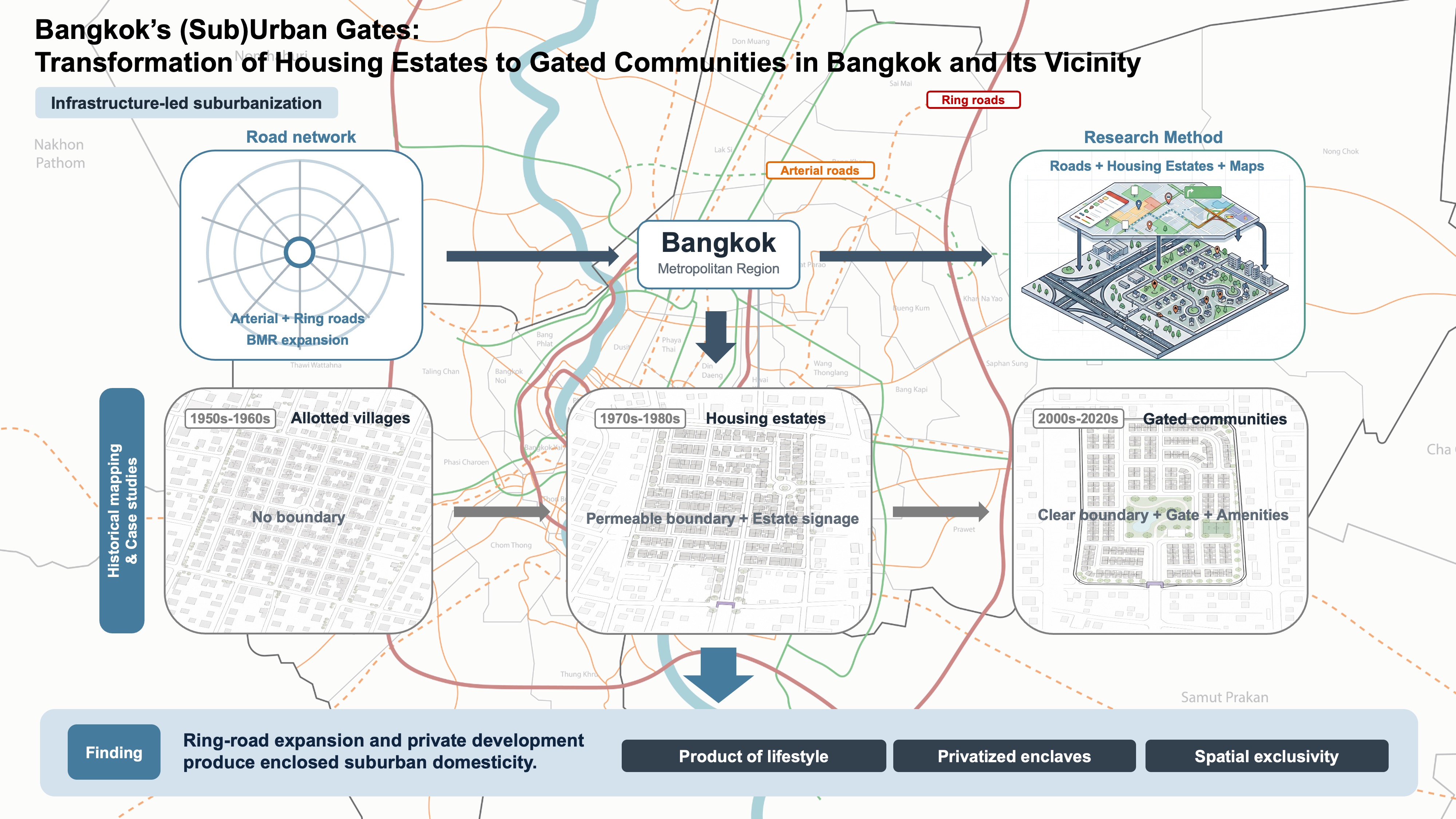
This study examines how Bangkok’s arterial and ring-road infrastructure has shaped the emergence and spatial distribution of private gated communities in the metropolitan periphery. Focusing on middle- and high-income, private-sector housing developments, rather than low-income, informal, or state-subsidized housing, the research defines its scope around suburban residential estates where detached houses and controlled-access environments have become dominant models of urban living. A qualitative historical and spatial case-study approach is adopted, drawing on archival materials, road-development records, housing-estate planning, field observations, and surveys of selected housing estates. Four housing-estate types are analyzed as representative stages in Bangkok’s suburban residential transformation: allotted villages, non-gated housing estates, gated housing estates, and gated communities with enclosed common facilities. The findings show that road networks have not merely supported urban expansion but also actively structured the location, accessibility, and spatial characteristics of private housing estates. The study contributes to urban research by positioning gated suburban housing in Bangkok as an infrastructure-led urban form, demonstrating how roads have shaped both metropolitan expansion and the everyday architecture of middle-class domestic life.
Downloads
Article Details

This work is licensed under a Creative Commons Attribution-NonCommercial-NoDerivatives 4.0 International License.
All rights reserved. Apart from citations for the purposes of research, private study, or criticism and review,no part of this publication may be reproduced, stored or transmitted in any other form without prior written permission by the publisher.
References
Askew, M. (2002). Bangkok: Place, practice and representation. Routledge.
Atkinson, R., & Blandy, S. (2006). Introduction: International perspectives on the new enclaves and the rise of gated communities. In R. Atkinson & S. Blandy (Eds.), Gated communities (pp. vii–xvi). Routledge.
Bagaeen, S., & Uduku, O. (Eds.). (2010). Gated communities: Social sustainability in contemporary and historical gated developments. Earthscan.
Blakely, E. J., & Snyder, M. G. (1997). Fortress America: Gated communities in the United States. Brookings Institution Press.
Bourdieu, P. (1986). The forms of capital. In J. Richardson (Ed.), Handbook of theory and research for the sociology of education (pp. 241–258). Greenwood Press.
Braun, M. (2011). Bangkok public transport accessibility levels [Master’s thesis, Erasmus University Rotterdam]. Institute for Housing and Urban Development Studies (IHS). https://thesis.eur.nl/pub/10295/MA-thesis%20M.%20Braun_334312.pdf
Burgess, E. W. (2019). The growth of the city: An introduction to a research project. In R. E. Park & E. W. Burgess (Eds.), The city (pp. 47–62). University of Chicago Press. (Original work published 1925)
Caldeira, T. P. (2000). City of walls: Crime, segregation and citizenship in São Paulo. University of California Press.
Carmona, M., Heath, T., Oc, T., & Tiesdell, S. (2003). Public places, urban spaces: The dimensions of urban design. Architectural Press.
Caselli, I. (2016, February 5). Why gated communities are still booming in Buenos Aires. Bloomberg CityLab. https://www.bloomberg.com/news/articles/2016-02-05/the-gated-communities-of-buenos-aires-argentina
Chandhoke, N. (1995). State and civil society. Sage.
Dick, H. W., & Rimmer, P. J. (1998). Beyond the Third World City: The new urban geography of South-East Asia. Urban Studies, 35(12), 2303–2321. https://doi.org/10.1080/0042098983890
Douglass, M., Ho, K. C., & Ooi, G. L. (Eds.). (2008). Globalization, the city and civil society in Pacific Asia: The social production of civic spaces. Routledge.
Federal Housing Administration. (2024). The structure and growth of residential neighborhoods in American cities (Reprint ed.). Forgotten Books. (Original work published 1939)
Harris, C. D., & Ullman, E. L. (1945). The nature of cities. The ANNALS of the American Academy of Political and Social Science, 242(1), 7–17. https://doi.org/10.1177/000271624524200103
Hillier, B., Yang, T., & Turner, A. (2012). Normalising least angle choice in Depthmap and how it opens up new perspectives on the global and local analysis of city space. The Journal of Space Syntax, 3(2), 155–193.
Jirapapaisal, V. (2024, August 4). “Pibul Ves village”, the first housing estate named after “P. Phibunsongkhram”. SILPA-MAG. https://www.silpa-mag.com/history/article_115138 [in Thai]
Karnchanaporn, N., & Kasemsook, A. (2008). ‘World-class’ living? In M. Jenks, D. Kozak & P. Takkanon (Eds.), World cities and urban form: Fragmented, polycentric, sustainable? (pp. 293–302). Routledge.
Kasemsook, A., & Boonchaiyapruek, P. (2015). Towards spatial network multiplicity. In A. Turner (Ed.), Proceedings of the 10th International Space Syntax Symposium (pp. 52:1–52:15). University College London.
Kasemsook, A., & Karnchanaporn, N. (2013). The property billboards: Re-envisioning the Bangkok urban edge. In D. Radovic (Ed.), Mn’M Workbook 1: Intensities in ten cities, measuring the non-measurable 03 (pp. 10–17). International Keio Institute and Flick Studio.
Krungsri Research. (2022, November 22). Economic Outlook 2023. Krungsri. https://www.krungsri.com/en/research/macroeconomic/economic-outlook/economic-outlook-2023
Low, S. (2003). Behind the gates: Life, security, and the pursuit of happiness in Fortress America. Routledge.
Marketeer Team. (2019, December 20). Top real estate brands and what kind of car they’d be. Marketeer Online. https://marketeeronline.co/archives/137337 [in Thai]
National Housing Authority. (n.d.). National Housing Authority Information. Ministry of Social Development and Human Security. https://www.nha.co.th/information/nha-information/ [in Thai]
Neate, R. (2025, May 6). Kings of the Hill: Behind the UK’s gated enclave for the rich and famous. Spear’s Property. https://spearswms.com/property/st-georges-hill-billonaires-gated-enclave-surrey/
Newman, O. (1972). Defensible space: Crime prevention through urban design. Macmillan.
Potjanalawan, P. (2023). Highway hegemony: The power of roads and the dynamics of transportation in Thailand. The Princess Maha Chakri Sirindhorn Anthropology Centre. [in Thai]
Pow, C. P. (2009). Gated Communities in China: Class, privilege and the moral politics of the good life. Routledge.
Real Estate Information Center. (2022). Annual report 2022: Data can achieve sustainable real estate. https://www.reic.or.th/Upload/AnnualReportREIC2022compressed_753_1692263083_98698.pdf [in Thai]
Reid, J., & Pozdnyakova, G. (2025). Mapping the world’s prices 2025. Deutsche Bank Research. https://www.dbresearch.com/PROD/RI-PROD/PDFVIEWER.calias?pdfViewerPdfUrl=PROD0000000000592089
Royal Decree: Highway and Bridge Names. (1950, December 12). Royal Thai Government Gazette. No. 67 Section 67 pp. 6377–6389. [in Thai]
Sassen, S. (2010). Urban gating: One instance of a larger development. In S. Bagaeen & O. Uduku (Eds.), Gated communities: Social sustainability in contemporary and historical gated developments (pp. xi–xii). Earthscan.
Sevikul, P. (2011, December 9). Yesterday and today at Setthakit Village. Kom Chad Luek. https://www.komchadluek.net/news/117218 [in Thai]
Thammasat University Research and Consultancy Institute. (2018). Housing development virtual museum website. http://housingvm.nha.co.th/index.html [in Thai]
The Australian-Thai Chamber of Commerce. (2022, November 7). Optimistic outlook for houses priced from 10 million baht and up, with demand in suburban areas continuing to rise. https://www.austchamthailand.com/resources/advance-blog/optimistic-outlook-houses-priced-10-million-baht-and-demand-suburban-areas
Venturi, R., Scott Brown, D., & Izenour, S. (1977). Learning from Las Vegas: The forgotten symbolism of architectural form (Rev. ed.). MIT Press.
