
Tangible realism: Mattie Do’s filmmaking style in contemporary Lao genre cinema
Article Sidebar
Main Article Content
Abstract
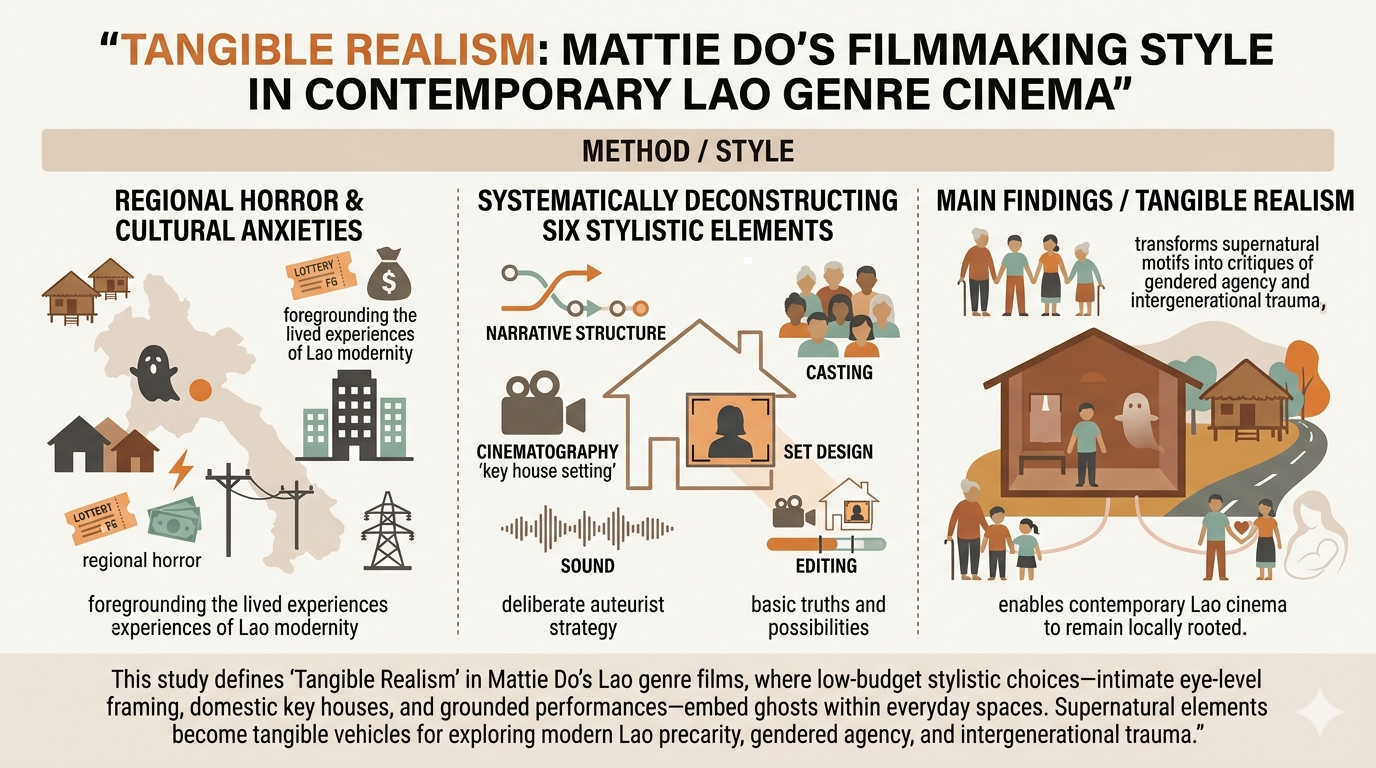
This research closely examines the filmmaking style of Mattie Do, Laos’s first female director. Despite the constraints of a nascent industry and the absence of formal film-school training, her work marks a significant development in Southeast Asian genre cinema. While regional horror often channels cultural anxieties, Do’s films reconfigure these tropes into what this study conceptualizes as Tangible Realism, foregrounding the lived experiences of Lao modernity. Drawing on textual analysis of Chanthaly (2012), Dearest Sister (2016), and The Long Walk (2019), together with insights from a personal communication with the director and an in-depth interview with her long-time collaborator, Voravaj Varazatiravatt, this study systematically deconstructs the films based on six stylistic elements: narrative structure, casting, cinematography, set design, sound, and editing. The analysis reveals that Do’s aesthetic is a deliberate auteurist strategy grounded in a philosophy of “basic truths and possibilities.” Unlike conventional horror, she prioritizes internal psychological conflict and ambiguous resolutions. Her distinct style—marked by naturalistic repertory casting, intimate eye-level cinematography, and domestic “key house” settings—transforms supernatural motifs into critiques of gendered agency and intergenerational trauma. By highlighting how an outsider’s perspective can reshape cinematic conventions, the article argues that this aesthetic mode enables contemporary Lao cinema to remain locally rooted while resonating with global audiences. These findings have implications for how alternative modes of authorship in low-budget industries are understood and for regional film policy that seeks to balance local authenticity with global circulation.
Downloads
Article Details

This work is licensed under a Creative Commons Attribution-NonCommercial-NoDerivatives 4.0 International License.
All rights reserved. Apart from citations for the purposes of research, private study, or criticism and review,no part of this publication may be reproduced, stored or transmitted in any other form without prior written permission by the publisher.
References
Boggs, J. M., & Petrie, D. W. (2008). The art of watching films (7th ed.). McGraw Hill.
Boon-arch, S. (2024). Analysis of the filmmaking style of Mattie Do [Research report]. Faculty of Liberal Arts, Ubon Ratchathani University. [in Thai]
Chinwanno, C. (1988). World systems: The new concept framework. Research Center, Faculty of Political Science, Thammasat University. [in Thai]
Do, M. (Director). (2012). Chanthaly [Film]. Lao Art Media.
Do, M. (Director). (2016). Dearest Sister [Film]. Lao Art Media.
Do, M. (Director). (2019). The Long Walk [Film]. Lao Art Media.
Giannetti, L. (2001). Understanding movies (9th ed.). Pearson College Div.
Jamsai, N. (2015). The development of Lao film industry and the filmmaking style of Lao New Wave Cinema (LNWC) [Master’s thesis, Thammasat University]. TU Digital Collections. https://digital.library.tu.ac.th/tu_dc/frontend/Info/item/dc:303631 [in Thai]
Kachentarapun, P. (2011). Sound in film: Art of photography and cinematography. Sukhothai Thammathirat Open University. [in Thai]
Kaewkrajang, T. (2021). The image creation process making Beer Lao a national identity [Undergraduate thesis, Thammasat University]. TU Digital Collections. https://digital.library.tu.ac.th/tu_dc/frontend/Info/item/dc:299522 [in Thai]
Kaewprasert, O. (2013). Transnational cinema in Southeast Asia: Case studies of Sabaidee Luang Prabang, The Emotion Factory, and Hello Stranger [Research report]. University of the Thai Chamber of Commerce. [in Thai]
Laorchan, K. (2013). A study of reflection and ideological thoughts of Lao people through the film analysis of “At The Horizon” [Master’s thesis, Thammasat University]. TU Digital Collections. https://digital.library.tu.ac.th/tu_dc/frontend/Info/item/dc:182535 [in Thai]
Lertpaiboonsiri, S. (2011). However, we are friends: A collection of articles on ASEAN cinema. Thammasat University Press. [in Thai]
Lim, B. C. (2009). Translating time: Cinema, the fantastic, and temporal critique. Duke University Press.
Louiyapong, K. (2004). Southeast Asian cinema: A cultural studies approach. Thammasat University Press. [in Thai]
Maneephong, T. (2022). Isan gambling: Perceiving through cultural beliefs and cultural politics, a case of Sisaket Province [Research report]. Center for Gambling Studies, Chulalongkorn University. https://www.gamblingstudy-th.org/imgadmins/research_file/ebook-2565-05-3-thawach.pdf [in Thai]
Manorom, K. (2022). Isan gambling: Perceiving through cultural beliefs and cultural politics [Research report]. Center for Gambling Studies, Chulalongkorn University. https://www.gamblingstudy-th.org/imgadmins/research_file/ebook-2565-05-1-kanokwan.pdf [in Thai].
Phoovatis, W. (2017). Cultural industry and the encouragement of building common ASEAN identities: A comparison between Thai and Lao film [Special issue]. Humanities and Social Sciences Journal, 8, 108–133. https://www.ubu.ac.th/web/files_up/08f2017122817305816.pdf [in Thai]
Phuchomsri, P., & Sroikudrua, T. (2018). The relationship between terms of address and construction of Lao women’s identity in Thai musical discourse. KKU International Journal of Humanities and Social Sciences, 8(2), 73–88. [in Thai]
Pokaudomsup, C. (2023, April 27). A Mattie Do film: The joyous life of Mattie Do, Laos’s only female director. The Cloud. https://readthecloud.co/mattie-do [in Thai]
Poster, P. (2016). More than just “Action!”. Thai Film Archive (Public Organization). [in Thai]
Praphanturakit, S. (2008). Entertainment media and the relationship between Thailand and Laos: A construction of Lao identity in the film “Lucky loser” [Doctoral dissertation, Thammasat University]. TU Digital Collections. https://digital.library.tu.ac.th/tu_dc/frontend/Info/item/dc:110303 [in Thai]
Srisammacheep, N. (2012). Action and cut. Eastern Printing. [in Thai]
Wongpongkham, N., & Sriraksa, K. (2017). Local cultural identity of Lao PDR towards the creation of the film “Khru Khong Khoi”. In Proceedings of the 3rd National Academic Conference on Fine Arts and Applied Arts Research: Creative Economy under Thailand 4.0 (pp. 693–705). Faculty of Fine and Applied Arts, Khon Kaen University. [in Thai]
Wood, R. (2003). Hollywood from Vietnam to Reagan... and beyond. Columbia University Press.
Yamcharoen, N. (2013). Lao cinema: A survey of directors, films, cinemas, and audiences in the entertainment industry era 2008–2012 [Research report]. Kasem Bundit University. [in Thai]
