
The Lily Festival in Bangkok: The interplay of Yuri/Girls Love, book culture, and sapphic literary communities
Article Sidebar
Main Article Content
Abstract
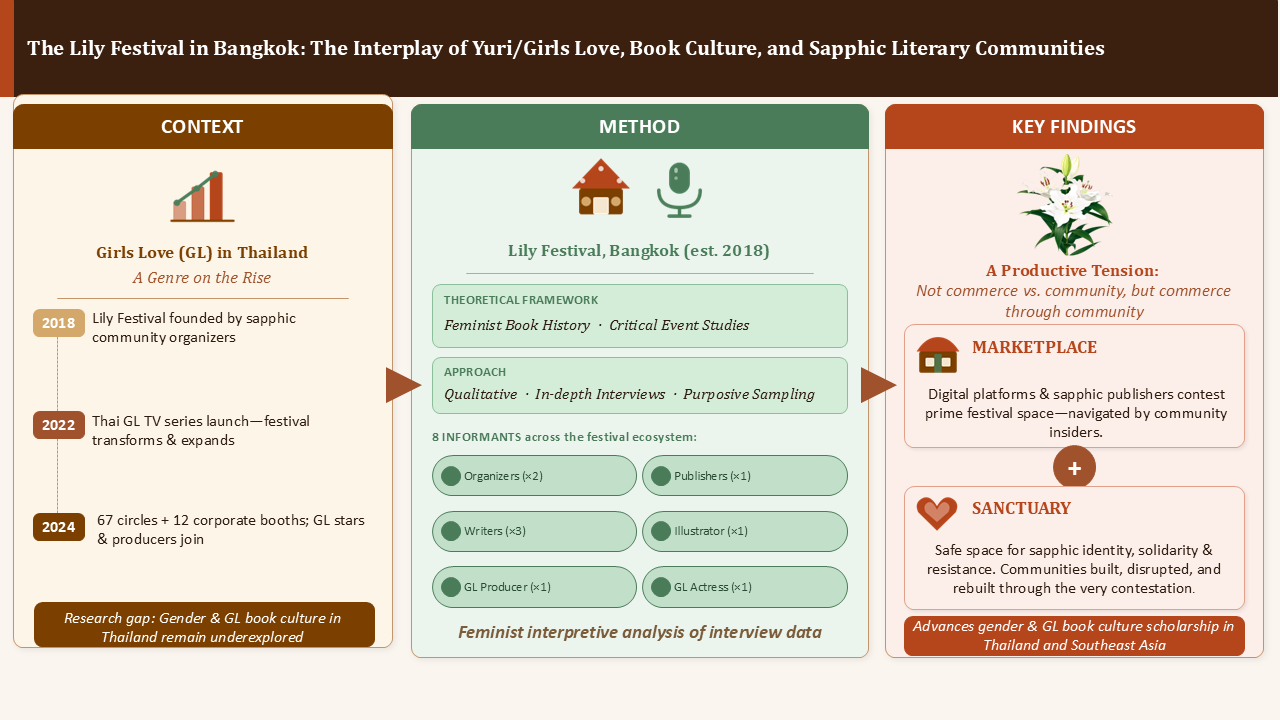
Since the late 2010s, the female homoerotic romance genre known as Yuri or Girls Love (hereafter GL), which originated in Japan, has been experiencing significant growth in Thailand and the broader Asian region. Despite this expansion, the role of literary festivals in sustaining GL’s cultural and community dimensions remains underexplored. This research examines the Lily Festival in Bangkok, which has run since 2018, as a contested terrain where the economic imperatives of digital platforms and commercial publishers intersect with gender-as-agenda driven by sapphic organizers, writers, and publishers. Drawing on feminist book history and critical event studies, and employing in-depth interviews with festival organizers, publishers, writers, illustrators, GL series production company representatives, and stars, this study traces the festival’s evolution from a subcultural Comic Market-style event into a literary festival. The findings demonstrate that this transformation is not merely commercial but ideological: the festival functions as both a marketplace and a sanctuary, where sapphic literary communities are built and sustained through the very contestation between capitalist platforms and queer publishers. This study contributes to the underrepresented scholarship on gender and contemporary book culture in Southeast Asia, highlighting the Lily Festival as a dynamic site where literary production, queer activism, and the Thai GL ecosystem are intertwined.
Downloads
Article Details

This work is licensed under a Creative Commons Attribution-NonCommercial-NoDerivatives 4.0 International License.
All rights reserved. Apart from citations for the purposes of research, private study, or criticism and review,no part of this publication may be reproduced, stored or transmitted in any other form without prior written permission by the publisher.
References
Aida, M. (2016). The contemporary comic market: A study of subculture. Journal of Fandom Studies, 4(1), 55–70. https://doi.org/10.1386/jfs.4.1.55_1
Comic Avenue. (2025). Comic Avenue official website. https://comicavenueth.wordpress.com
Darnton, R. (1982). What is the history of books? Daedalus, 111(3), 65–83.
Driscoll, B. (2015). Sentiment analysis and the literary festival audience. Continuum, 29(6), 861–873. https://doi.org/10.1080/10304312.2015.1040729
Friedman, E. (2022). By your side: The first 100 years of Yuri anime and manga. Journey Press.
Grabher, B. (2022). Doing gender in events: Feminist perspectives in critical event studies. Routledge.
Hiranprasertsuk, K. (2022, March 15). Senthang pan Meb khong song phuean si dek witsawa jut natphop chueam khon an lae khon khian [On the journey of Meb by two best friends from engineering school: A meeting point of readers and writers]. Thairath Money. https://www.thairath.co.th/money/economics/thai_economics/2339852 [in Thai]
Howsam, L. (1998). In my view: Women and book history. SHARP News, 7(4), 1–2.
Howsam, L. (2006). Old books and new histories: An orientation to studies in books and print culture. University of Toronto Press.
Huang, F. (2021). Reflections of Thai society in Thai national book fair award novels during 2017–2019 [Master’s thesis, Huachiew Chalermprakiet University]. Huachiew Archiving System. https://has.hcu.ac.th/jspui/handle/123456789/143 [in Thai]
Johanson, K., & Freeman, R. (2012). The reader as audience: The appeal of the writers’ festival to the contemporary audience. Continuum, 26(2), 303–314. https://doi.org/10.1080/10304312.2011.590575
Kanchanakit, B. (2021, February 14). The Kloset: phuenthi sabai jai khong community ying rak ying [The Kloset: A space of comfort for the women-loving-women community]. A Day Magazine. https://adaymagazine.com/the-kloset-yuri-space [in Thai]
Khantama, T. (2002). An analysis of award-winning pre-adolescent fiction at national book week from 1978 to 2001 [Master’s thesis, Chulalongkorn University]. Chula DigiVerse. https://doi.org/10.58837/CHULA.THE.2002.1814 [in Thai]
Kittisurin, S. (2023, January 12). Where flowers bloom. Continue Reading. https://cont-reading.com/thinking/lily-house [in Thai]
Klein, U. L. (2021). Sapphic crossings: Cross-dressing women in eighteenth-century British literature. University of Virginia Press.
Ladys & Moonscape. (2025). Ladys & Moonscape books. https://ladysmoonscape.weebly.com [in Thai]
Lamerichs, N. (2014). Embodied fantasy: The affective space of anime conventions. In L. Duits, K. Zwaan, & S. Reijnders (Eds.), The Ashgate research companion to fan culture (pp. 263–274). Ashgate.
Lertwichayaroj, N. (2017). Huajai Y [The heart of Y]. Bun Books. [in Thai]
Levy, M. (2014). Do women have a book history? Studies in Romanticism, 53(3), 297–317. https://doi.org/10.1353/srm.2014.0001
Li, E. C.-Y., & Pang, K.-W. (2025). Queer media from the global south: The emerging Girls Love (GL) media industry of Southeast Asia. Feminist Media Studies, 25(5), 1327–1333. https://doi.org/10.1080/14680777.2024.2433564
Lily Fest: Girls Love Only Event. (2019, May 5). Circle plan of the second festival in 2019 [Image attached] [Status update]. Facebook. https://www.facebook.com/photo/?fbid=408908089667684&set=a.404980116727148 [in Thai]
Lily Fest: Girls Love Only Event. (2021, May 6). Rules for circles [Notes]. Facebook. https://www.facebook.com/notes/345744716845458 [in Thai]
Lily Festival. (2025). Lily festival kheu ngan kiaw kap arai [What is Lily Festival all about?]. Lily Festival TH. https://sites.google.com/view/lily-festival [in Thai]
McKerrow, G. (2021). Saving Gay’s the word: the campaign to protect a bookshop and the right to import queer literature. In L. Kassir & R. Espley (Eds.), Queer between the covers: Histories of queer publishing and publishing queer voices (pp. 91–123). University of London Press.
Meb Corporation. (2025). About us. meb. https://www.meb.co.th/who-we-are/about-us [in Thai]
Media Rocket Lab. (2025, February 13). 10 pi series y: jakkrawan haeng kan jin su kan pen soft power Thai [A decade of BL series: Transitioning from a realm of imaginary coupling to the rise of Thai soft power]. https://rocketmedialab.co/10-years-thai-bl-evolution [in Thai]
Phumithammarat, N., & Prasannam, N. (2025). Thai Yuri/Girls Love novels as popular fiction: A case study of 23.5 When the Earth Spinning Around. Journal of Arts and Thai Studies, 47(1), Article E4008. https://so08.tci-thaijo.org/index.php/artssu/article/view/4008 [in Thai]
Prachachat. (2024, September 20). Niyai y-yuri to 2,000 lan to yot sinkha-likhasit tukjai jin kaoli yipun [Boys love and yuri novels grow to 2 billion, expanding products and licenses. Popular in China, Korea, and Japan]. Prachachat Business. https://www.prachachat.net/hilight-prachachat/news-1656661 [in Thai]
Prasannam, N. (2025). Revisiting queer shame in Boys Love/Y novels and queer literary culture in Thailand. Journal of Arts and Thai Studies, 47(3), Article E5250. https://doi.org/10.69598/artssu.2025.5250
Radway, J. A. (1991). Reading the romance: Women, patriarchy, and popular literature. The University of North Carolina Press.
Ruengvej, P. (2025, January 30). Wa duai khwam samret: bot sonthana wa duai niyam khong ‘khwam samret’ kap LADYS nakkhian nawaniyai queer thalu krop song phet thi dai khao ching SEA Write sam lem [On success: A conversation on the definition of ‘success’ with LADYS, a radical queer author whose works got shortlisted by the SEA Write award]. The Cloud. https://readthecloud.com/interview/talk-of-the-cloud/ladys [in Thai]
Spracklen, K., & Lamond, I. R. (2016). Critical event studies. Routledge.
Taylor, H. (2019). Why women read fiction: The stories of our lives. Oxford University Press.
The Matter Culture. (2021, May 23). 16 pi hetkan ‘lumdam’ prawattisat batphlae khong utsahakam cartoon Thai [16th year of the ‘Black Hole’ incident: A wounded history of the Thai comics industry]. The Matter. https://thematter.co/social/manga-darkera/143926 [in Thai]
Vinitphol, R. (2023). Cultural hybridity in the context of Boys’ Love culture: The history of Thai Boys’ Love reimported to Japan. The Journal of Thai Studies, 23(1), 3–17. https://doi.org/10.60302/thaikenkyu.23.1_3 [in Japanese]
Weber, M. (2018). Literary festivals and contemporary book culture. Palgrave Macmillan.
Wilson, N. (2025). Feminist bibliography: Aki Hayashi, literary assistant. In E. J. Hogg & C. J. Fabricius (Eds.), Feminized work and the labor of literature: New literary perspectives on the times, spaces and forms of women’s work (pp. 31–46). Edinburgh University Press.
Working Group on the History of Publishing in Thailand. (2006). Siam phimphakan: prawattisat kanphim nai prathet Thai [Printing Siam: The publishing history of Thailand]. Matichon. [in Thai]
Yan, H. (2015). Writing techniques and themes of award-winning short stories at Thai national book fair 2013–2014. [Master’s thesis, Huachiew Chalermprakiet University]. Huachiew Archiving System. https://has.hcu.ac.th/jspui/handle/123456789/664 [in Thai]
