
Exploring musical hybridity in fusions of lukthung and Thai pop
Article Sidebar
Main Article Content
Abstract
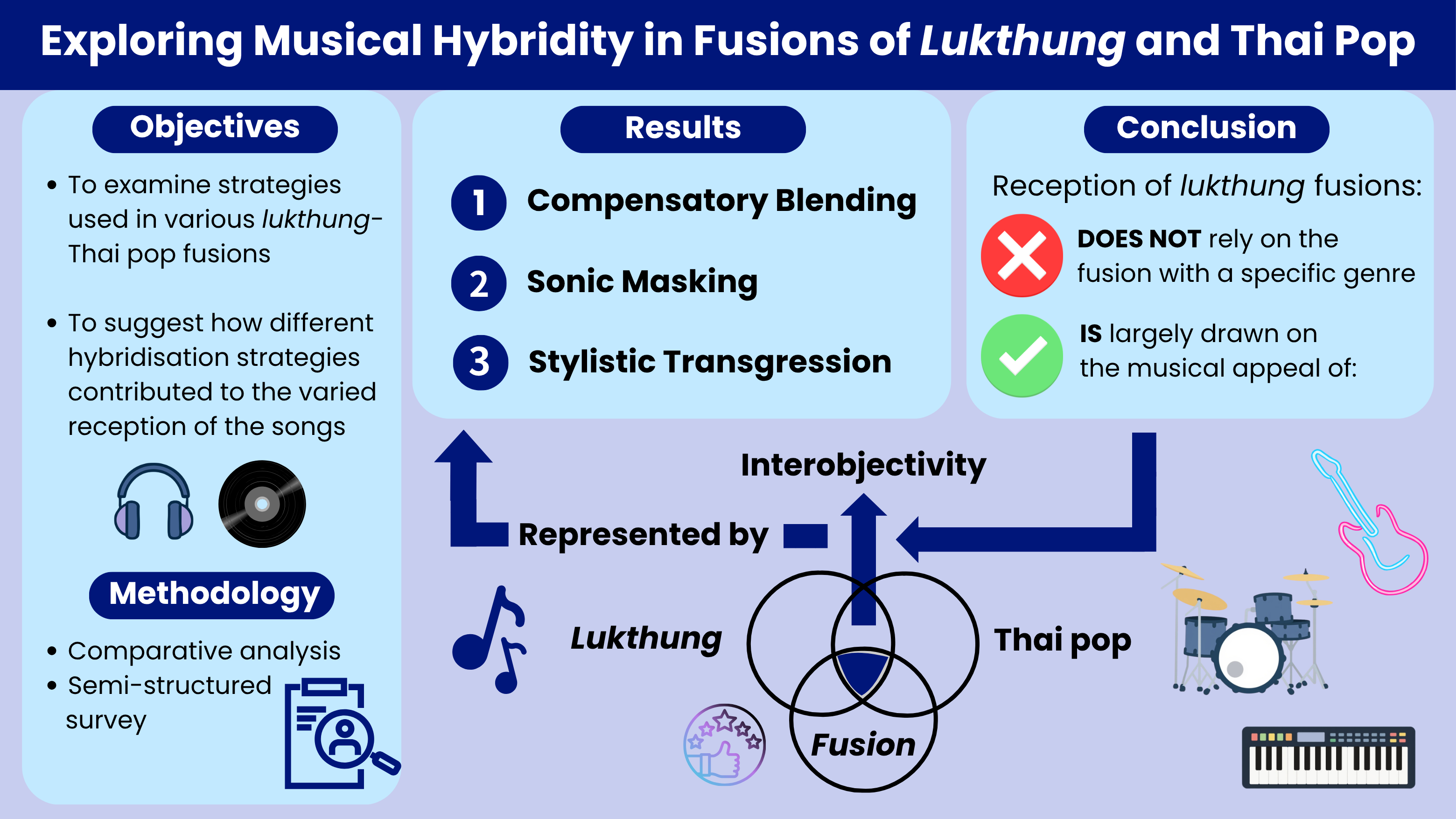
While both belong to popular music in Thailand, lukthung and Thai pop represent distinct types of songs in the eyes of contemporary Thai music audiences. This article explores the potential to enhance the impact of Thai popular music in the increasingly competitive global music market by fusing lukthung with Thai pop to reach a broader audience. Based on a case study of the JOOX 100×100 project, this study employs a mixed-methods approach that combines comparative analysis of selected lukthung fusion songs with a semi-structured questionnaire that examines participants’ preconceptions of lukthung and their responses to the selected songs. By evaluating the relationship between the reception and features of hybrids of lukthung and Thai pop, it proposes three hybridisation strategies that can be observed in lukthung fusions, namely Compensatory Blending, Sonic Masking, and Stylistic Transgression, arguing that the perception of the hybrid depends on the appeal of the interobjectivity within the hybrid and the genres involved. Ultimately, this article suggests how musical hybridity may effectively refashion lukthung, attracting more diverse attention to the genre and generating new interest in Thai popular music. In addition to providing directions for creating successful lukthung fusions, the findings are expected to enrich discussions on musical hybridity, which more often concern hybrids between musical styles from different countries or within Western genres.
Downloads
Article Details

This work is licensed under a Creative Commons Attribution-NonCommercial-NoDerivatives 4.0 International License.
All rights reserved. Apart from citations for the purposes of research, private study, or criticism and review,no part of this publication may be reproduced, stored or transmitted in any other form without prior written permission by the publisher.
References
Chetpatanavanich, K. (2008). Constructing the third identities through modern northern country songs (Pleng Lukthung Kam Mueang): A social history of modernity in rural Chiang Mai. Journal of Population and Social Studies, 17(1), 43–76.
Clewley, J. (2000). Thailand: Songs for living. In S. Broughton & M. Ellingham (Eds.), World music: The rough guide vol. 2, Latin, North America, Caribbean, India, Asia and Pacific (pp. 241–253). Rough Guides.
Corbett, J. (2000). Experimental oriental: New music and other others. In G. Born & D. Hesmondhalgh (Eds.), Western music and its others: Difference, representation, and appropriation in music (pp. 163–186). University of California Press.
Feld, S. (2000). A sweet lullaby for world music. Public Culture, 12(1), 145–171. https://doi.org/10.1215/08992363-12-1-145
Fellezs, K. (2011). Birds of fire: Jazz, rock, funk, and the creation of fusion. Duke University Press.
Gauvin, H. L. (2018). Drawing listener attention in popular music: Testing five musical features arising from the theory of attention economy. Musicae Scientiae, 22(3), 291–304. https://doi.org/10.1177/1029864917698010
Haanstad, E. J. (2016). Urban simulations and soundscapes of a Thai Beatles tribute band. Rock Music Studies, 3(3), 281–299. https://doi.org/10.1080/19401159.2015.1115311
Hayes, M. (2004). Capitalism and cultural relativity: The Thai pop industry, capitalism and Western cultural values. In A. Chun, N. Rossiter, & B. Shoesmith (Eds.), Refashioning pop music in Asia: Cosmopolitan flows, political tempos, and aesthetic industries (pp. 17–31). Routledge.
Holt, F. (2007). Genre in popular music. University of Chicago Press.
Jirattikorn, A. (2006). Lukthung: Authenticity and modernity in Thai country music. Asian Music, 37(1), 24–50. https://doi.org/10.1353/amu.2006.0004
JOOX. (2019, May 29). JOOX Original Album 100×100. https://www.joox.com/th/article/2920 [in Thai]
JOOX Thailand. (2019, November 22). Andap 6 Hai Nan Kwa Thi Khoei - Klear, Phai Phongsathorn [Ranked number 6, “Longer than ever” – Klear, Phai Phongsathorn] [Video]. YouTube. https://www.youtube.com/watch?v=Mw2mCGqTN4s [in Thai]
Lockard, C. A. (1998). Dance of life: Popular music and politics in southeast Asia. Silkworm books.
Miller, T. (1985). Traditional music of the Lao: Kaen playing and mawlum singing in Northeast Thailand. Praeger.
Miller, T. E. (2005). From country hick to rural hip: A new identity through music for Northeast Thailand. Asian Music, 36(2), 96–106. https://doi.org/10.1353/amu.2005.0014
Mitchell, J. (2011). Red and yellow songs: A historical analysis of the use of music by the United Front for Democracy against Dictatorship (UDD) and the People’s Alliance for Democracy (PAD) in Thailand. South East Asia Research, 19(3), 457–494. https://doi.org/10.5367/sear.2011.0058
Mitchell, J. L. (2015). Lukthung: The culture and politics of Thailand’s most popular music. Silkworm Books.
Moore, A. F. (2012). Song means: Analysing and interpreting recorded popular song. Routledge.
Myers-Moro, P. (1993). Thai music and musicians in contemporary Bangkok. Center for South & Southeast.
O’Flynn, J. (2007). National identity and music in transition: Issues of authenticity in a global setting. In I. Biddle & V. Knights (Eds.), Music, national identity and the politics of location: Between the global and the local (pp. 19–38). Ashgate Publishing.
Ordanini, A., Nunes, J. C., & Nanni, A. (2018). The featuring phenomenon in music: How combining artists of different genres increases a song’s popularity. Marketing Letters, 29, 485–499. https://doi.org/10.1007/s11002-018-9476-3
Siriyuvasak, U. (1990). Commercialising the sound of the people: Pleng Luktoong and the Thai pop music industry. Popular Music, 9(1), 61–77. https://doi.org/10.1017/s0261143000003731
Siriyuvasak, U. (1998). Thai pop music and cultural negotiation in everyday politics. In K.-H. Chen (Ed.), Trajectories: Inter-Asia cultural studies (pp. 206–227). Routledge.
Tagg, P. (2012). Music’s meanings: A modern musicology for non-musos. Mass Media Music Scholars’ Press.
Tausig, B. (2019). Bangkok is ringing: Sound, protest, and constraint. Oxford University Press.
Taylor, T. D. (2007). Beyond exoticism: Western music and the world. Duke University Press.
