
AI and digital Buddhist sculpture: Performance, roles, and technology acceptance based on the TAM framework in the context of Thai arts and culture
Article Sidebar
Main Article Content
Abstract
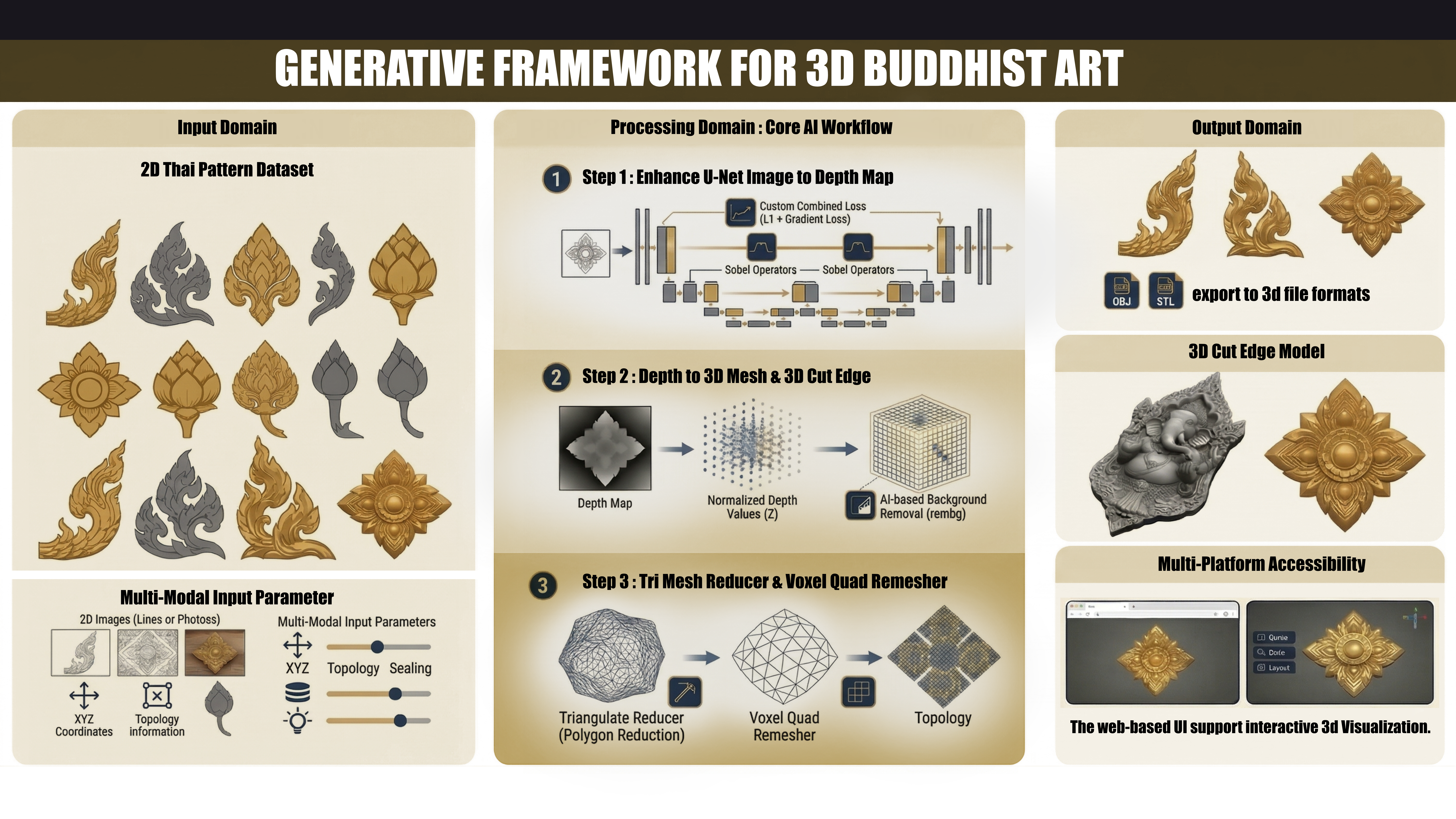
The objectives of this study are to: 1) assess the efficiency of an AI system created for producing digital Buddhist sculptures; 2) investigate the role of AI in the context of Thai art and culture; and 3) assess the acceptance of AI technology by digital sculpture designers. A total of 180 undergraduate students (novice designers) and 30 professional digital Buddha sculptors were surveyed using quantitative methods. In addition to the surveys, a qualitative assessment was performed through interviews with nine subject matter experts. The results of the efficiency assessment indicate that the AI system has high accuracy, produces designs quickly, and provides support for designers in creating complex designs. The findings in relation to the Technology Acceptance Model (TAM) demonstrate that perceived usefulness and perceived ease of use will have a significant impact on users’ intention to adopt the technology. Results of the qualitative assessments demonstrate that the AI system is able to create sculptures that adhere to Thai Buddhist artistic codes and symbols to some degree; however, expert guidance is necessary to maintain the spiritual significance and semantic meaning of the artwork. Thus, when applying AI in Thai art and culture, it is recommended that collaborations be established between the developers of AI systems and experts in the field of Thai art and culture to ensure the integrity of the culture. AI should be utilized as a complementary tool to augment designers’ creative process in a sustainable manner.
Downloads
Article Details

This work is licensed under a Creative Commons Attribution-NonCommercial-NoDerivatives 4.0 International License.
All rights reserved. Apart from citations for the purposes of research, private study, or criticism and review,no part of this publication may be reproduced, stored or transmitted in any other form without prior written permission by the publisher.
References
Adeoye-Olatunde, O. A., & Olenik, N. L. (2021). Research and scholarly methods: Semi-structured interviews. Journal of the American College of Clinical Pharmacy, 4(10), 1358–1367. https://doi.org/10.1002/jac5.1441
Alshammari, M. M., & Al-Mamary, Y. H. (2025). User acceptance of AI-powered training: Extending the technology acceptance model (TAM). Future Business Journal, 11, Article 239. https://doi.org/10.1186/s43093-025-00665-w
Aneklap, S., Tanaborworpanid, N., & Kalakasetkorn, P. (2025). The use of innovation and artificial intelligence for learning preservation and promotion of the performing arts of Likay. Journal of Social Science for Local Development Rajabhat Mahasarakham University, 9(2), 743–755. https://so02.tci-thaijo.org/index.php/soc-rmu/article/view/278288 [in Thai]
Arochasiri, N. (2024). The value of AI artificial intelligence intelligent mechanical brain to create limitless works of art. Journal of Fine Arts Research and Applied Arts, 11(2), 65–79. https://doi.org/10.60101/faraa.2024.270060 [in Thai]
Bonacchi, C., & Krzyzanska, M. (2019). Digital heritage research re-theorised: Ontologies and epistemologies in a world of big data. International Journal of Heritage Studies, 25(12), 1235–1247. https://doi.org/10.1080/13527258.2019.1578989
Braun, V., & Clarke, V. (2019). Reflecting on reflexive thematic analysis. Qualitative Research in Sport, Exercise and Health, 11(4), 589–597. https://doi.org/10.1080/2159676X.2019.1628806
Elgammal, A., Liu, B., Kim, D., Elhoseiny, M., & Mazzone, M. (2018). The shape of art history in the eyes of the machine. Proceedings of the AAAI Conference on Artificial Intelligence, 32(1), 2183–2191. https://doi.org/10.1609/aaai.v32i1.11894
Floridi, L., & Cowls, J. (2022). A unified framework of five principles for AI in society. In S. Carta (Ed.), Machine learning and the city: Applications in architecture and urban design (pp. 535–545). John Wiley & Sons.
Harisanty, D., Obille, K. L. B., Anna, N. E. V., Purwanti, E., & Retrialisca, F. (2024). Cultural heritage preservation in the digital age, harnessing artificial intelligence for the future: A bibliometric analysis. Digital Library Perspectives, 40(4), 609–630. https://doi.org/10.1108/dlp-01-2024-0018
Inkong, P. (2023). Cultural symbols: Buddhist symbols and job creation in a changing social and cultural context. ManuSangkhomSart: Journal of Humanities and Social Sciences, 1(2), 21–32. https://he04.tci-thaijo.org/index.php/MSKJ/article/view/445 [in Thai]
Jinshun, L., & Jun, H. (2021). Cultural semiotics and the related interpretation. In C. Kahl & N. Fatima (Eds.), Proceedings of the 2021 International Conference on Public Relations and Social Sciences (ICPRSS 2021) (pp. 1268–1272). Atlantis Press. https://doi.org/10.2991/assehr.k.211020.340
Jitta, P. (2020). The use of technology and innovation to preserve the Thai script. Journal of Modern Approach in Education Research, 1(2), 21–34. https://so10.tci-thaijo.org/index.php/jott/article/view/2272 [in Thai]
Jones, S. (2010). Negotiating authentic objects and authentic selves: Beyond the deconstruction of authenticity. Journal of Material Culture, 15(2), 181–203. https://doi.org/10.1177/1359183510364074
Kobbun, P. (2018). The value and roles of Thai Buddhist literature in Thai society. Humanities, Arts and Social Sciences Studies, 18(2), 377–397. https://doi.org/10.14456/hasss.2018.23
Liyanage, M. M., Induka, L. P. D. P., Dissanayake, P. P., Wijewickrama, W. K. D. A., & Kulathilake, K. A. S. H. (2025, April 3). Virtually restoring headless Buddha statues using Deep Learning Techniques [Conference session]. 2025 International Research Conference on Smart Computing and Systems Engineering (SCSE), Colombo, Sri Lanka. https://doi.org/10.1109/SCSE65633.2025.11031007
Pansoni, S., Tiribelli, S., Paolanti, M., Di Stefano, F., Frontoni, E., Malinverni, E. S., & Giovanola, B. (2023). Artificial intelligence and cultural heritage: Design and assessment of an ethical framework. The International Archives of the Photogrammetry, Remote Sensing and Spatial Information Sciences, 48, 1149–1155. https://doi.org/10.5194/isprs-archives-XLVIII-M-2-2023-1149-2023
Parker, C., Scott, S., & Geddes, A. (2019). Snowball sampling. Sage. https://doi.org/10.4135/9781526421036831710
Phetsamai, S. (2025). The signification of contemporary Buddhist art: Interpreting Buddhist Dharma through digital art. Journal of Language and Culture Studies, 1(1), 17–22. https://so11.tci-thaijo.org/index.php/jlcs/article/view/1716 [in Thai]
Saijai, K. (2018). Buddhism art and knowledge management. Journal of Humanities and Social Sciences, Rajapruk University, 3(1), 1–10. https://so03.tci-thaijo.org/index.php/rpu/article/view/112524 [in Thai]
Sakhong, P., Chanthaprom, C., Sumudhuko, P. T., Khamkhan, C., & Suksomboon, W. (2024). Buddhist art in history: Creativity and religious expression. Journal of Mani Chettha Ram Wat Chommani, 7(6), 1420–1438. https://so07.tci-thaijo.org/index.php/JMCR/article/view/6155 [in Thai]
Sherefetdinova, E. R. (2024). In intercultural contexts, social norms, beliefs, and values play a significant role in shaping interpretations and interactions. Yoshlar va tadbirkorlikni qo‘llab-quvvatlash – mamlakatimizda amalga oshirilayotgan islohotlarning muhim omili, 112–123. https://scholar.kokanduni.uz/index.php/rb/article/view/297 [in Uzbek]
Singhasonthi, S., & Purisuttamo, P. M. (2020). Buddha images: Hermeneutics of Buddhist symbolic. Journal of MCU Buddhist Review, 4(1), 88–98. https://so06.tci-thaijo.org/index.php/jmb/article/view/242778 [in Thai]
Srisontisuk, S., & Norkaew, Y. (2024). Belief system and cultural ways of life: State of knowledge of cultural research in the Northeast. Journal of Public Administration Chiang Rai Rajabhat University, 7(2), 81–100. https://so16.tci-thaijo.org/index.php/POPACRRU/article/view/961 [in Thai]
Stanco, F., Battiato, S., & Gallo, G. (Eds.). (2011). Digital imaging for cultural heritage preservation. CRC press.
Susen, S. (2024). The interpretation of cultures: Geertz is still in town. Sociologica, 18(1), 25–63. https://doi.org/https://doi.org/10.6092/issn.1971-8853/18664
Taherdoost, H. (2019). What is the best response scale for survey and questionnaire design; Review of different lengths of rating scale/attitude scale/likert scale. International Journal of Academic Research in Management (IJARM), 8(1), Article hal-02557308. https://hal.science/hal-02557308
Thammawatsiri, P. A., Kotsupho, P., Rittem, P., Kochakan, P. W., Tatnormjit, T., & Makaew, L. (2024). The digital arts creation in the modern world’s innovation. Lanna Journal of Buddhist Studies and Cultures, 6(1), 906–926. https://www.firstojs.com/index.php/LJBSC/article/view/1511
Thitasabho, P. S., Chaiworamankul, Y., & Tumthong, K. (2023). Analyzing the ethical values found in the Buddhist arts of Wat Suvarnabhumi Buddhajayanti, Bang Sao Thong District, Samut Prakan Province. The Journal of Institute of Trainer Monk Development, 6(2), 192–201. https://so06.tci-thaijo.org/index.php/tmd/article/view/262794 [in Thai]
Timans, R., Wouters, P., & Heilbron, J. (2019). Mixed methods research: What it is and what it could be. Theory and Society, 48, 193–216. https://doi.org/10.1007/s11186-019-09345-5
Xing, J., Ren, W., Lei, D., Zhao, L., Qin, X., Shao, H., Li, W., Han, Y., Yu, Z., Xu, Z., Yin, R., Yuan, J., Wang, J., Chen, W., Xu, J., Zhou, X., Yang, C., Zhou, W., & Zhou, B. (2025). Multimodal AI for Yuan Buddhist sculpture chronology and style. npj Heritage Science, 13, Article 443. https://doi.org/10.1038/s40494-025-01994-3
Yanthong, T. (2024). The influencer of values between the Buddhist arts on mental and the wisdom development in Thai society. Journal of MCU Suphanburi Review, 3(1), 28–42. https://so08.tci-thaijo.org/index.php/mcusr/article/view/2868 [in Thai]
