
Edo-period biographies of the Buddha and their illustrations reconfigure Gotamī (Kyōdonmi) from devoted sister to jealous adversary
Article Sidebar
Main Article Content
Abstract
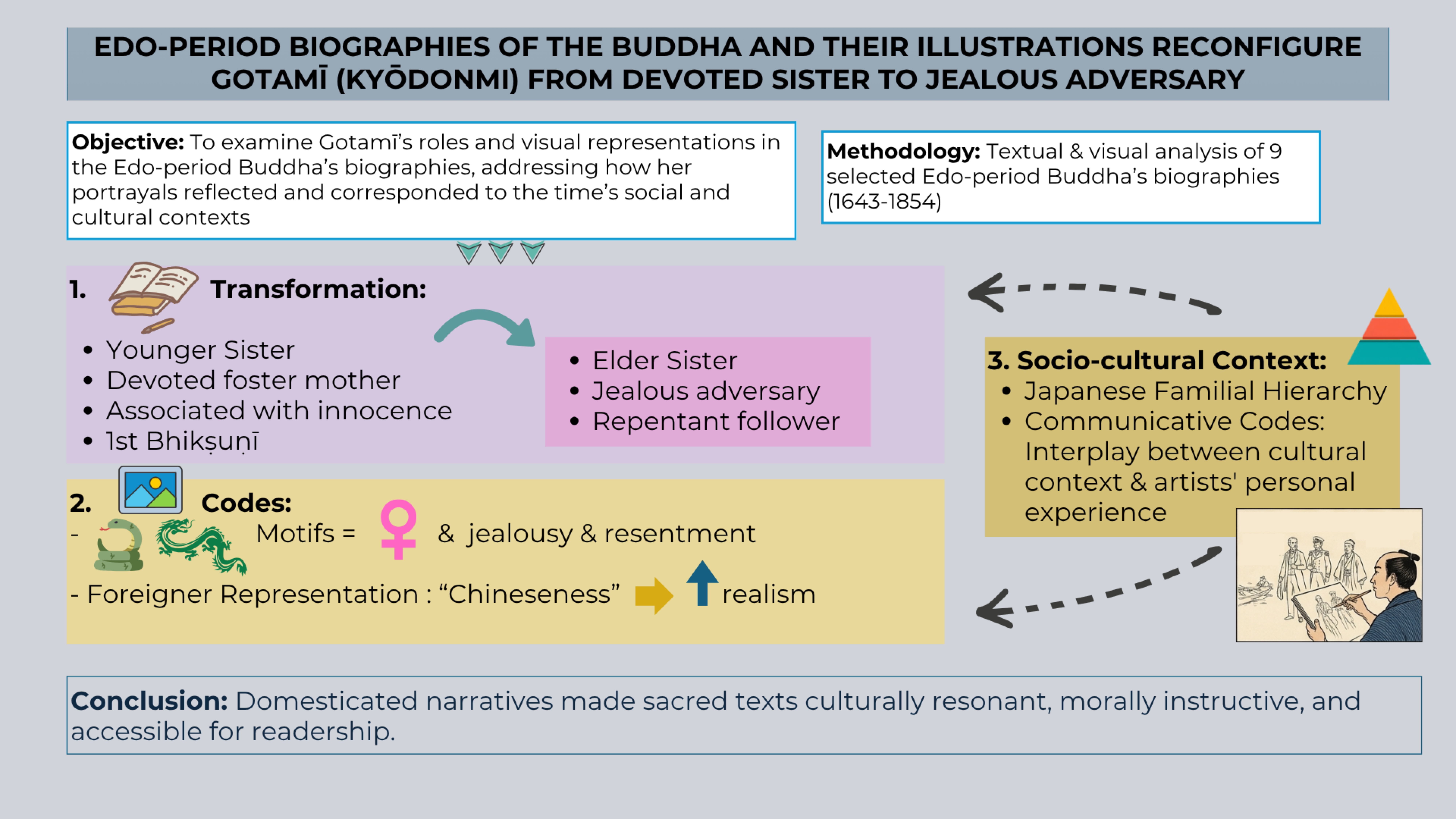
This study examines Edo-period biographies of the Buddha to analyze Gotamī’s (Kyōdonmi’s) roles and visual representations, focusing on how they reflect contemporary social contexts. Nine Edo-period biographies of the Buddha were included: (1) Shaka no honji (1643); (2) Shakahassōmonogatari (1666); (3) Shakahassōki tsuketari butsumomayafujin (Kateibunko version, 1669); (4) Shaka ichidaidenki kusui (1692); (5) Shaka goichidaiki eshō (1797); (6) Shaka ōkeryaku genge (1805); (7) Shaka goichidaiki zue (1845); (8) Shaka hassō yamato bunko (1845–1871); and (9) Hasshūkigen shakajitsuroku (1854). Based on analyzing these works, focusing on episodes in which Gotamī harbors malice toward Maya, this study identifies two narrative models: (1) the traditional depiction of Gotamī as the devoted younger sister who cared for Prince Siddhartha and eventually became the first bhikṣuṇī; and (2) the jealous elder sister plotting against her younger, more favored sister Maya, the Buddha’s mother, before ultimately repenting. The latter model, which emerged in the mid-17th century and persisted into the 19th, aligns with general Japanese notions of sibling hierarchy (and rivalry), wherein elder daughters traditionally held authority. Some biographies have expressed Gotamī’s envy symbolically through the imagery of a serpent, a commonly used motif in Edo society. In time, Gotamī’s visual representations have shifted from conventional “Chinese codes” to more realistic portrayals, paralleling the broader transformation of depictions of foreigners in 19th-century Japan, reflecting social change and artists’ encounters with foreigners.
Downloads
Article Details

This work is licensed under a Creative Commons Attribution-NonCommercial-NoDerivatives 4.0 International License.
All rights reserved. Apart from citations for the purposes of research, private study, or criticism and review,no part of this publication may be reproduced, stored or transmitted in any other form without prior written permission by the publisher.
References
Auerback, M. L. (2016). A storied sage: Canon and creation in the making of a Japanese Buddha. University of Chicago Press. https://doi.org/10.7208/chicago/9780226286419.001.0001
Baiu, S. (1689). Fujin yashinai gusa [Common knowledge for women] [Digitized book]. Nagoya University Library (DIG-NAGO-00087). Union Catalogue Database of Japanese Texts, Tokyo, Japan. https://doi.org/10.20730/100240846 [in Japanese]
Fujita Museum. (n.d.). Genjōsanzō-e, Vol. 6 [The illustrated biography of Xuanzang, Vol. 6] [Photograph]. https://fujita-museum.or.jp/topics/2020/03/27/726 [in Japanese]
Hashimoto, G. (Ed. & Illus.). (1862–1865). Yokohama bunko roppen [Yokohama library, Vol 6] [Digitized book]. Rare Books and Old Materials (201-54). National Diet Library Digital Collections, Tokyo, Japan. https://dl.ndl.go.jp/pid/2559374 [in Japanese]
Kaewrithidej, L. (2003). Shakanyoraitanjōkai: Jōruriteki shukō niyoru shakadenki no henyō [Shakanyoraitanjōkai: Transformations of biography of the Buddha through Jōruri stylistic conventions]. Kokugo Kokubun, 72(2), 161–183. [in Japanese]
Kanazawa, Y. (2009).【Shohyōronbun】Yanagiya Keiko “Kinsei no josei sōzoku to kaigo” Yoshikawakobunkan 2007 nen [[Book review] “The succession of woman and the care in early-modern Japan”, Yanagiya, Keiko 2007, Yoshikawakobunkan]. Chibadaigaku Jinbunshakaikagaku Kenkyū, 18, 176–190. https://opac.ll.chiba-u.jp/da/curator/900051756 [in Japanese]
Kinsei shōdōbungei kenkyūkai. (2023). Representation of animals in the Ruizōshū. Annual of the Institute for Comprehensive Studies of Buddhism, Taisho University, 45, 1–34. https://tais.repo.nii.ac.jp/records/2000106 [in Japanese]
Komine, K. (1991). Shinpukujizō “Shakanyorai hassōshidai” nitsute: Chūseibutsuden no shinshiryō [On the Shinpuku-ji temple’s Shakanyorai hassōshidai: A new source for medieval Buddha’s biographies]. The Bulletin of the National Institute of Japanese Literature, 17, 107–128. [in Japanese]
Komine, K. (2012). Higashi ajia no butsuden bungaku-buddha no monogatari to kaiga wo yomu: nihon no “Shaka no honji” to chūgoku no “Shakushigenryū” wo chūshin ni [Reading Buddha’s biographies’ narratives and pictorial presentations in East Asia: Focusing on Japan’s Shaka no honji and China’s Shishi Yuanliu ]. Ronsō-Kokugokyōikugaku, 13, 120–128. https://hiroshima.repo.nii.ac.jp/records/2037231 [in Japanese]
Komine, K. (2017). to nyonin: Monogatari no genten toshite [Biographies of the Buddha and women: Toward the origins of the narrative]. Intriguing Asia, 207, 43–59. [in Japanese]
Kurobe, M. (1992). Nihon butsuden bungaku no kenkyū: Nihon niokeru butsudenbungaku no henyō nitsute [A study of Japanese Buddha’s biographies: On the transformations of Buddha’s biographies in Japan] [Doctoral dissertation, Nagoya University]. National Diet Library Digital Collection. [in Japanese]
Mantei, O., Utagawa Toyokuni III, Utagawa Kunisada II, & Kawanabe, K. (1845–1871). Shakahassouyamatobunko [Eight scenes of Buddha’s life] [Digitized book]. Collection of National Institute of Japanese Literature (Na 4-42-1~27). Union Catalogue Database of Japanese Texts, Tokyo, Japan. https://doi.org/10.20730/200003981 [in Japanese]
Nomura, I. (2008). Ōhime/Otohime kō: Chūsei no ane to imōto sorezore no yakuwari to jinsei [On Ōhime and Otohime: The roles and lives of elder and younger sisters in medieval Japan]. Jenda Shigaku, 4, 17–29. https://doi.org/10.11365/genderhistory.4.17 [in Japanese]
Reitei, K., & Hashimoto, G. (1854). Hasshuukigenshakajitsuroku [The true record of Shakyamuni and the origins of the eight sects] [Digitized book]. Collection of National Institute of Japanese Literature (Na 4-757-1~5). Union Catalogue Database of Japanese Texts, Tokyo, Japan. https://doi.org/10.20730/200014083 [in Japanese]
Shimazu, Y. (2013). Kinsei kōki niokeru buke no ie sonzokusenryaku: Inseki, enseki kinō wo chūshin ni [Continuance of samurai’s family in the later early modern times in Japan]. Journal of Comparative Family History, 27, 76–102. https://doi.org/10.11442/jscfh.27.76 [in Japanese]
Sueki, F. (2022). Kinsei kōki no butsuden: Budda no nihonka womegutte [Buddha’s biographies in late early modern Japan: On the Japanization of the Buddha]. Journal of Buddhist Culture, 61, 52–80. [in Japanese]
Sueki, F. (2024). Kaisetsu butsuden to kyōgaku no tenkai [On the development of Buddha’s biographies and doctrinal studies]. In F. Sueki & K. Maegawa (Eds.), Kinsei bukkyō shiryō sōsho dai ni kan butsuden to kyōgaku (pp. 3–31). Rinsen shoten. [in Japanese]
Sueki, F., & Maegawa, K. (Eds.). (2024). Kinsei bukkyō shiryō sōsho dai ni kan butsuden to kyōgaku [Series of early modern Buddhist materials volume 2: Buddha’s biographies and doctrinal studies]. Rinsen shoten. [in Japanese]
Tantisuk, N. (2023). Sacred mountains and disguising sutras in Shaka no honji: Japanese narratives of the life of the Buddha. Journal of Letters, 52(1), 104–123. https://so03.tci-thaijo.org/index.php/jletters/article/view/265959 [in Thai]
Toyokuni III, & Kunihisa. (1858). Gotenyama [Woodblock print]. Rare Books and Old Materials (Kibetsu 2-7-2-4). National Diet Library Digital Collections, Tokyo, Japan. https://dl.ndl.go.jp/pid/1311368
Tsukioka, Y. (1892). Shinkeisanjūrokkaisen: Yotsuya kaidan [New forms of thirty-six ghosts: The ghost story of Yotsuya] [Woodblock print]. Rare Books and Old Materials (Kibetsu 2-2-2-3). National Diet Library Digital Collections, Tokyo, Japan. https://dl.ndl.go.jp/pid/1306464
Tsutsumi, K. (2006). Nyoninjatai: Henai no edo kaidanshi [Women with serpentine bodies: A history of Edo Kaidan of obsessive affection]. Kadokawa gakugei shuppan. [in Japanese]
Wang, L. (2011). Chūsei setsuwa niokeru ja kannen [The symbolism of snakes in medieval narratives]. Tōhoku Shūkyōgaku, 7, 119–154. https://tohoku.repo.nii.ac.jp/records/2047 [in Japanese]
Xiang, W. (2024). Shaka Goichidaiki Zue: Vernacularization and visualization of Buddha’s biography in nineteenth-century Japan. Religions, 15(1), Article 99. https://doi.org/10.3390/rel15010099
Yamada, I., & Katsushika, H. (1845). Shakagoichidaizue [The life of Shakyamuni illustrated] [Digitized book]. Collection of Nagoya University Library (DIG-NAGO-00456). Union Catalogue Database of Japanese Texts, Tokyo, Japan. https://doi.org/10.20730/100272744 [in Japanese]