
The homeless portraits project: Art as a tool for social healing and transformation
Article Sidebar
Main Article Content
Abstract
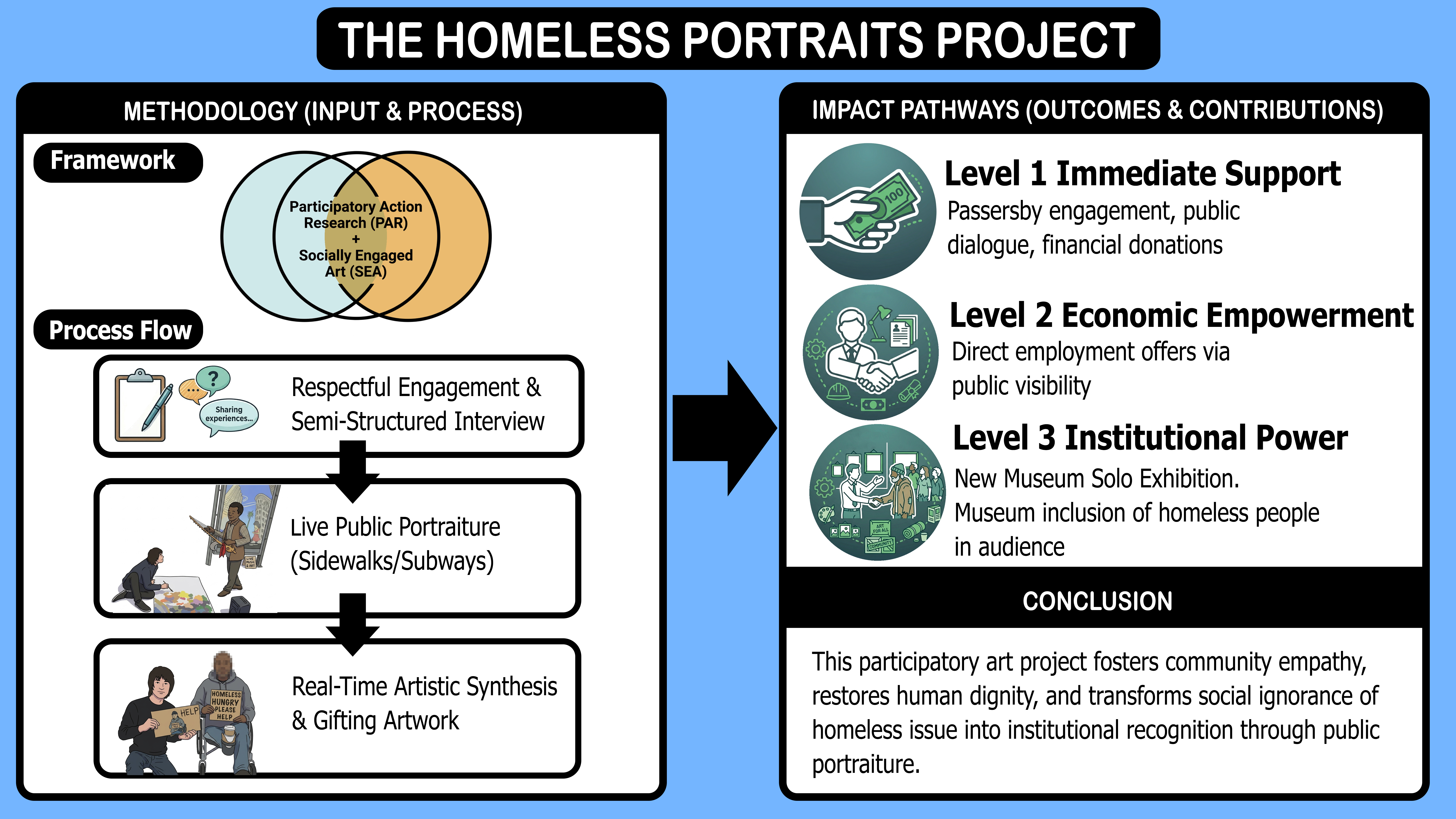
Homelessness is a growing social issue in many countries. People often view such a problem as abstract, resulting in ignorance of the matter. It is a complex problem, requiring public acknowledgement and empathy to foster understanding and support for effective solutions. Art is a medium that can be used to raise awareness regarding this issue. The project employed a practice-based methodology, using Socially Engaged Art (SEA) and Participatory Action Research (PAR) frameworks. The study follows an artist whose personal experience of witnessing a homeless person endure brutal physical abuse inspired the project. Utilizing the PAR framework, the artist painted pictures of homeless people in public places in San Francisco and New York and gave them to those who modeled for him. The project serves not only as a way to use art activities for social engagement but also to affirm human values in the subjects. Initially, the canvases for the works were acquired from nearby materials, such as cardboard boxes, pizza boxes, and even receipt papers. As the project expanded over time, the canvas materials were changed to better-quality papers and art paper rolls. The activity became a participatory social-art project when he used a social media platform to invite anyone to join. Over the course of six years, he produced numerous artworks and gained public awareness. As a result, an art museum recognized the project’s social value and engagement, hosting a unique art exhibition that displayed the portraits of homeless individuals and included the homeless models as part of the audience. The project also caused a few positive changes; in some instances, homeless people received job offers from audience members who saw potential in them. The project showed that art activities can be a means to tackle social issues and even redeem human dignity.
Downloads
Article Details

This work is licensed under a Creative Commons Attribution-NonCommercial-NoDerivatives 4.0 International License.
All rights reserved. Apart from citations for the purposes of research, private study, or criticism and review,no part of this publication may be reproduced, stored or transmitted in any other form without prior written permission by the publisher.
References
Amy, S. K. E. (2017). The art of participation: The case of creative communities in Indonesia [Special issue]. Community Development Journal, 52(1), 171–185. https://www.jstor.org/stable/26165109
Bourriaud, N. (2025). Relational aesthetics. Sternberg Press.
Gingrich, O., Havsteen-Franklin, D., Grant, C., Renaud, A., & Hignell-Tully, D. (2024). Participatory presence – social connectedness through collaborative art practices. International Journal of Performance Arts and Digital Media, 20(2), 296–320. https://doi.org/10.1080/14794713.2024.2340418
Gledhill, J. (2024, November 15). Homelessness and rough-sleeping, social and behavioural: ‘Our brains dehumanise homeless people’. The British Psychological Society. https://www.bps.org.uk/psychologist/our-brains-dehumanise-homeless-people
Gor, P. (2016, April 26). The positivity scrolls. I Support Street Art. https://www.isupportstreetart.com/the-positivity-scrolls/
Hamayon-Alfaro, H. (2011). Sustaining social inclusion through the Arts: The case of Northern Ireland [Special issue]. The Canadian Journal of Irish Studies, 37(1/2), 120–137. http://www.jstor.org/stable/41955742
Homeless Hub. (2024). What are the causes of homelessness? https://homelesshub.ca/collection/homelessness-101/what-are-the-causes-of-homelessness/
Lu, P.-Y. (2015). Towards “art/society”: Study on socially engaged art practices. National Culture and Arts Foundation (NCAF).
Mackay, S., Klaebe, H., Hancox, D., & Gattenhof, S. (2021). Understanding the value of the creative arts: Place-based perspectives from regional Australia. Cultural Trends, 30(5), 391–408. https://doi.org/10.1080/09548963.2021.1889343
Merriam-Webster. (n.d.). Homeless. In Merriam-Webster.com dictionary. Retrieved May 4, 2026, from https://www.merriam-webster.com/dictionary/homeless
Nikchevska, S., Andrevska, I., & Sebik, M. (2017, December 6). The homeless – invisible, their lives – worthless (II). Civica Mobilitas. https://civicamobilitas.mk/en/stories/the-homeless-invisible-their-lives-worthless-ii/
Padwa, H., Chien, J., Henwood, B. F., Cousins, S. J., Zakher, E., & Kuhn, R. (2024). Homelessness, discrimination, and violent victimization in Los Angeles county. American Journal of Preventive Medicine, 67(5), 666–675. https://doi.org/10.1016/j.amepre.2024.06.016
Simoniti, V. (2018). Assessing socially engaged art. The Journal of Aesthetics and Art Criticism, 76(1), 71–82. http://www.jstor.org/stable/45210901
Substance Abuse and Mental Health Services Administration. (2018, January). Definitions of Homelessness. SOAR Works! Retrieved April 5, 2025, from https://soarworks.samhsa.gov/article/definitions-of-homelessness
UNESCO. (2023, May 31). Art & human dignity: Human rights and healing arts for a culture of peace. https://www.unesco.org/en/articles/art-human-dignity-human-rights-and-healing-arts-culture-peace
United Nations Economic and Social Commission for Western Asia. (n.d.). Homeless. https://www.unescwa.org/sd-glossary/homeless
van der Vaart, G., van Hoven, B., & Huigen, P. P. P. (2019). ‘It is not only an artist village, but it is also much more than that’. The binding and dividing effects of the arts on a community. Community Development Journal, 54(3), 446–462. https://www.jstor.org/stable/26733192
