
Active learning across proficiency levels in Thai as a foreign language conversation courses: Undergraduate students’ perceptions and experiences in Taiwan
Article Sidebar
Main Article Content
Abstract
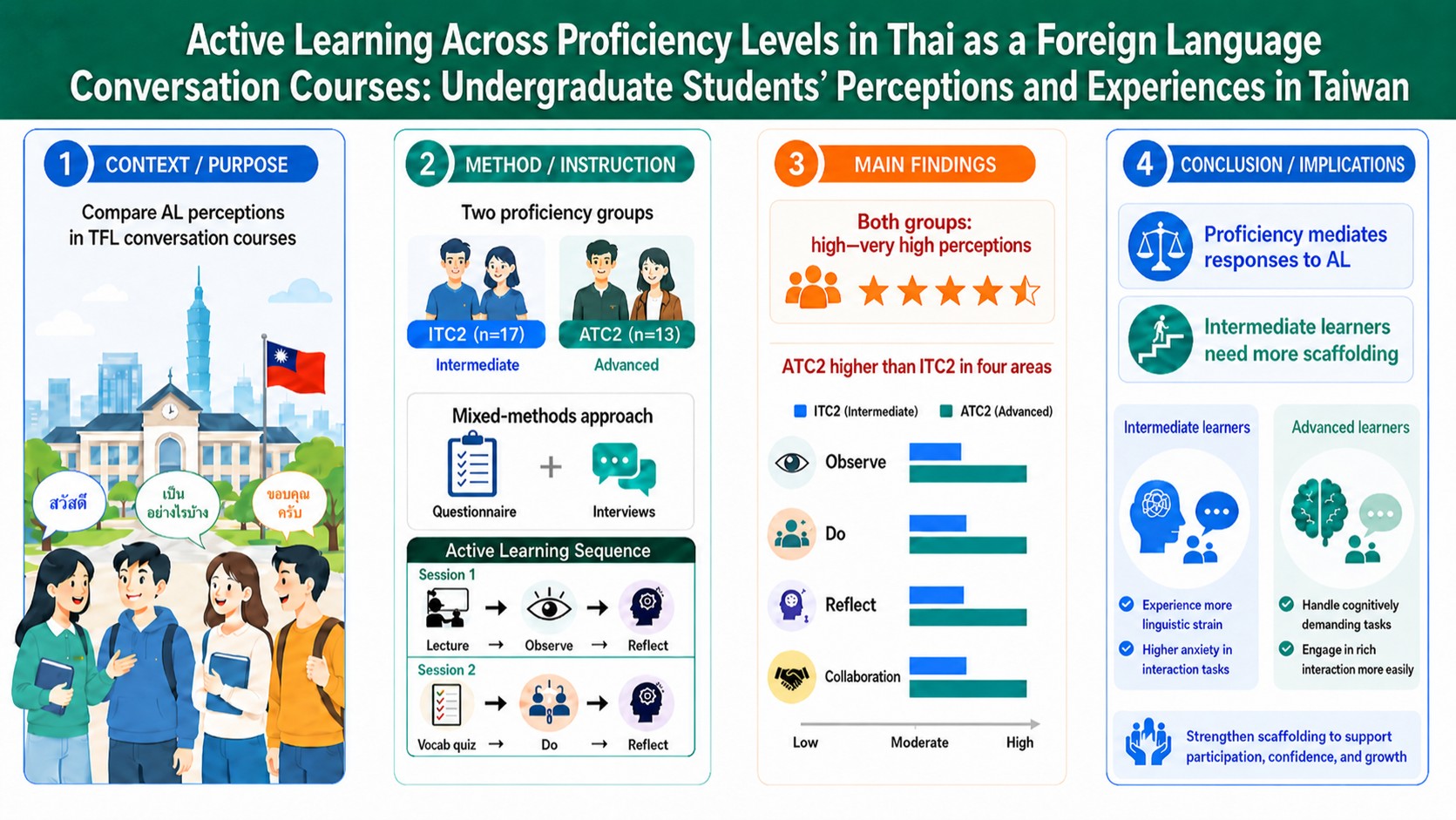
Active learning (AL) has been widely recognized as an effective pedagogical approach in higher education; however, limited research has examined how language proficiency shapes students’ perception of AL in Thai as a foreign language (TFL) conversation courses, particularly in international contexts such as Taiwan. This mixed-methods comparative study investigated undergraduate students’ perceptions of AL implementation in Intermediate Thai Conversation 2 (ITC2) and Advanced Thai Conversation 2 (ATC2) at a public university in Taiwan, with particular attention to proficiency-related differences. Quantitative data were collected through an online questionnaire completed by 30 students (17 from ITC2 and 13 from ATC2) and analyzed using non-parametric procedures, including descriptive statistics (median and interquartile range), the Mann-Whitney U test, and rank-biserial correlation. Qualitative insights were obtained from semi-structured interviews and examined through thematic analysis. The findings indicate that students in both courses reported consistently high to very high levels of positive perceptions across all instructional steps and key dimensions of the instruction. Yet, statistically significant differences emerged in the instructional steps of Experiencing by Observing, Experiencing by Doing, and Reflection, as well as in the key dimension of collaboration and interaction, with advanced learners demonstrating higher positive perceptions. Qualitative evidence suggests that higher-proficiency students were better equipped to engage with cognitively demanding and interaction-intensive tasks, whereas intermediate learners experienced greater linguistic strain, task-related anxiety, and reliance on scaffolding. These findings suggest that language proficiency functions as a mediating factor in learners’ cognitive and affective responses to AL structures in conversation classrooms.
Downloads
Article Details

This work is licensed under a Creative Commons Attribution-NonCommercial-NoDerivatives 4.0 International License.
All rights reserved. Apart from citations for the purposes of research, private study, or criticism and review,no part of this publication may be reproduced, stored or transmitted in any other form without prior written permission by the publisher.
References
Anfara, V. A., Jr., Brown, K. M., & Mangione, T. L. (2002). Qualitative analysis on stage: Making the research process more public. Educational Researcher, 31(7), 28–38. https://doi.org/10.3102/0013189X031007028
Bacon, D. R. (2016). Reporting actual and perceived student learning in education research. Journal of Marketing Education, 38(1), 3–6. https://doi.org/10.1177/0273475316636732
Bonwell, C. C., & Eison, J. A. (1991). Active learning: Creating excitement in the classroom. School of Education and Human Development, The George Washington University.
Braun, V., & Clarke, V. (2006). Using thematic analysis in psychology. Qualitative Research in Psychology, 3(2), 77–101. https://doi.org/10.1191/1478088706qp063oa
Brown, A. V. (2009). Students’ and teachers’ perceptions of effective language teaching: A comparison of ideals. The Modern Language Journal, 93(1), 46–60. https://doi.org/10.1111/j.1540-4781.2009.00827.x
Caine, N. A. (2020). Integrating active learning into EFL course design: A case study. Nagasaki University Repository, 53(4), 23–39.
Chang, F. (2011). The causes of learners’ reticence and passivity in English classrooms in Taiwan. The Journal of Asia TEFL, 8(1), 1–22.
Cheng, X. (2000). Asian students’ reticence revisited. System, 28(3), 435–446. https://doi.org/10.1016/S0346-251X(00)00015-4
Chickering, A. W., & Gamson, Z. F. (1987). Seven principles for good practice in undergraduate education. The Wingspread Journal, 9, 1–10.
Cohen, J. (1988). Statistical power analysis for the behavioral sciences (2nd ed.). Lawrence Erlbaum Associates.
Cortazzi, M., & Jin, L. (1996). Cultures of learning: Language classrooms in China. In H. Coleman (Ed.), Society and the language classroom (pp. 169–206). Cambridge University Press.
Cronbach, L. J. (1957). The two disciplines of scientific psychology. American Psychologist, 12(11), 671–684. https://doi.org/10.1037/h0043943
Donaldson, M. (2023). Student mistakes in elite school classrooms: Teacher reflections and reported instructional strategies. Journal of Educational Research & Practice, 13(1), 203–218. https://doi.org/10.5590/JERAP.2023.13.1.15
Doolittle, P., Wojdak, K., & Walters, A. (2023). Defining active learning: A restricted systematic review. Teaching and Learning Inquiry, 11. https://doi.org/10.20343/teachlearninqu.11.25
Dörnyei, Z. (2001). Motivational strategies in the language classroom. Cambridge University Press.
Dörnyei, Z., & Murphey, T. (2003). Group dynamics in the language classroom. Cambridge University Press.
Ellis, R. (2003). Task-based language learning and teaching. Oxford University Press.
Ellis, R. (2015). Understanding second language acquisition (2nd ed.). Oxford University Press.
Fetters, M. D., & Freshwater, D. (2015). Publishing a methodological mixed methods research article. Journal of Mixed Methods Research, 9(3), 203–213. https://doi.org/10.1177/1558689815594687
Fiel Peres, F. (2026). Effect sizes for nonparametric tests. Biochemia Medica, 36(1), Article 010101. https://doi.org/10.11613/BM.2026.010101
Fink, L. D. (2003). Creating significant learning experiences: An integrated approach to designing college courses. Jossey-Bass.
Formosa Television. (2023, September 14). Thai language teacher attracts students fascinated by Thai movies and TV. Formosa News. https://english.ftvnews.com.tw/news/2023914W02EA
Fredricks, J. A., Blumenfeld, P. C., & Paris, A. H. (2004). School engagement: Potential of the concept, state of the evidence. Review of Educational Research, 74(1), 59–109. https://doi.org/10.3102/00346543074001059
Freeman, S., Eddy, S. L., McDonough, M., Smith, M. K., Okoroafor, N., Jordt, H., & Wenderoth, M. P. (2014). Active learning increases student performance in science, engineering, and mathematics. Proceedings of the National Academy of Sciences, 111(23), 8410–8415. https://doi.org/10.1073/pnas.1319030111
Fullan, M. (2007). The new meaning of educational change (4th ed.). Teachers College Press.
Ghezzi-Haeft, J. L., & Dowling, C. B. (2019). Debates: Incorporating active learning into an agricultural course. North American Colleges and Teachers of Agriculture Journal, 64, 436–447. https://www.jstor.org/stable/27157818
Gillies, R. M. (2016). Cooperative learning: Review of research and practice. Australian Journal of Teacher Education, 41(3), Article 3. https://doi.org/10.14221/ajte.2016v41n3.3
Goodwin, J. R. (2024). What’s the difference? A comparison of student-centered teaching methods. Education Sciences, 14(7), Article 736. https://doi.org/10.3390/educsci14070736
Guttikonda, R. R., & Coco, C. M. (2013). Incorporating Fink’s significant learning experience model in the re-designing of the flagship accounting course. Journal of Accounting and Finance, 13(5), 116–124.
Hannok, S., Khunmathurot, S., Pansri, O., & Ketpan, J. (2024). Obstacles to success: Problems in Thai language communication in speaking and listening of Chinese students studying Thai as a foreign language. Journal of Humanities and Social Sciences Nakhon Phanom University, 14(3), 360–369. https://so03.tci-thaijo.org/index.php/npuj/article/view/280407 [in Thai]
Ho, H. X., Nguyen, C. T., & Dinh, D. T. (2023). EFL teachers’ perceptions about implementing active learning techniques in teaching speaking. European Journal of Education Studies, 10(5), 40–55. https://doi.org/10.46827/ejes.v10i5.4773
Jackson, J. (2002). Reticence in second language case discussions: Anxiety and aspirations. System, 30(1), 65–84. https://doi.org/10.1016/S0346-251X(01)00051-3
Johnson, D. W., & Johnson, R. T. (1999). Making cooperative learning work. Theory into Practice, 38(2), 67–73. https://doi.org/10.1080/00405849909543834
Jones, J. (1999). From silence to talk: Cross-cultural ideas on students’ participation in academic group discussion. English for Specific Purposes, 18(3), 243–259. https://doi.org/10.1016/S0889-4906(97)00059-8
Kuh, G. D. (2009). What student affairs professionals need to know about student engagement. Journal of College Student Development, 50(6), 683–706. https://doi.org/10.1353/csd.0.0099
Latsanyphone, S., & Bouangeune, S. (2009). Using L1 in teaching vocabulary to low English proficiency level students: A case study at the National University of Laos. English Language Teaching, 2(3), 186–193.
Liang, F. (2013). Construction of basic Thai language conversation handbook for Chinese students learning Thai as a foreign language [Master’s thesis, Chiang Mai University]. Chiang Mai University Digital Collection (CMUDC). https://cmudc.library.cmu.ac.th/frontend/Info/item/dc:120659 [in Thai]
Liu, N., & Carless, D. (2006). Peer feedback: The learning element of peer assessment. Teaching in Higher Education, 11(3), 279–290. https://doi.org/10.1080/13562510600680582
Long, M. H. (1996). The role of the linguistic environment in second language acquisition. In W. C. Ritchie & T. K. Bhatia (Eds.), Handbook of second language acquisition (pp. 413–468). Academic Press.
Lu, B. D., & Watanapokakul, S. (2025). How active is ‘active’? Overcoming misconceptions and optimizing pedagogical practices of active learning in EFL classrooms. rEFLections, 32(1), 595–612. https://doi.org/10.61508/refl.v32i1.280462
Moloney, R., & Ross, S. (2010, November 28–December 2). Native speaker assistants in the foreign language classrooms: A study of seven schools [Paper Presentation]. AARE Annual Conference 2010, Melbourne, Australia. https://www.aare.edu.au/publications/aare-conference-papers/show/6068/the-native-speaker-assistant-as-a-resource-in-language-classrooms-a-study-of-seven-schools
Monteiro, V., Carvalho, C., & Santos, N. N. (2021). Creating a supportive classroom environment through effective feedback: Effects on students’ school identification and behavioural engagement. Frontiers in Education, 6, Article 661736. https://doi.org/10.3389/feduc.2021.661736
Na-prang, Y. (2011). The interaction strategies in teaching and learning Thai language between Thai language teachers and Chinese students at the center of Thai language training for foreigners, Chiang Rai Rajabhat University [Unpublished master’s thesis]. Chiang Rai Rajabhat University. [in Thai]
Nguyen, T. T., & Trimarchi, A. (2010). Active learning in introductory economics: Do MyEconLab and Aplia make any difference? International Journal for the Scholarship of Teaching and Learning, 4(1), Article 10. https://doi.org/10.20429/ijsotl.2010.040110
Noels, K. A., Clément, R., & Pelletier, L. G. (1999). Perceptions of teachers’ communicative style and students’ intrinsic and extrinsic motivation. The Modern Language Journal, 83(1), 23–34. http://dx.doi.org/10.1111/0026-7902.00003
Pfaff, E., & Huddleston, P. (2003). Does it matter if I hate teamwork? What impacts student attitudes toward teamwork. Journal of Marketing Education, 25(1), 37–45. https://doi.org/10.1177/0273475302250571
Pornumpaisakul, N., & Yenbutra, P. (2018). Synthesis of researches in teaching Thai as a foreign language. KKU International Journal of Humanities and Social Sciences, 8(2), 109–151. https://so04.tci-thaijo.org/index.php/KKUIJ/article/view/106651 [in Thai]
Prince, M. (2004). Does active learning work? A review of the research. Journal of Engineering Education, 93(3), 223–231. https://doi.org/10.1002/j.2168-9830.2004.tb00809.x
Rogers, E. M. (2003). Diffusion of innovations (5th ed.). Free Press.
Rosen, M. A., Salas, E., Wilson, K. A., King, H. B., Salisbury, M., Augenstein, J. S., Robinson, D. W., & Birnbach, D. J. (2008). Measuring team performance in simulation-based training: Adopting best practices for healthcare. Society for Simulation in Healthcare, 3(1), 33–41. http://doi.org/10.1097/SIH.0b013e3181626276
Rovinelli, R. J., & Hambleton, R. K. (1977). On the use of content specialists in the assessment of criterion-referenced test item validity. Tijdschrift Voor Onderwijs Research, 2, 49–60.
Seemanath, P., & Watanapokakul, S. (2024). Active learning in English at work: Assessing effectiveness and EFL undergraduate student attitudes. LEARN Journal: Language Education and Acquisition Research Network, 17(1), 538–571. https://so04.tci-thaijo.org/index.php/LEARN/article/view/270426
Shaddad, A. R. E., & Jember, B. (2024). A step toward effective language learning: An insight into the impacts of feedback‑supported tasks and peer‑work activities on learners’ engagement, self‑esteem, and language growth. Asian-Pacific Journal of Second and Foreign Language Education, 9, Article 39. https://doi.org/10.1186/s40862-024-00261-5
Slavin, R. E. (2014). Cooperative learning and academic achievement: Why does groupwork work? Anales de Psicología, 30(3), 785–791. https://doi.org/10.6018/analesps.30.3.201201
Sriputthatham, C. (2005). A development of Thai language lessons for Chinese students by using cromonym technique [Master’s thesis, Silpakorn University]. Silpakorn University Repository. https://sure.su.ac.th/xmlui/handle/123456789/8432 [in Thai]
Tse, L. (2000). Student perceptions of foreign language study: A qualitative analysis of foreign language autobiographies. The Modern Language Journal, 84(1), 69–84. https://www.jstor.org/stable/330450
Turner, R. C., & Carlson, L. (2003). Indexes of item-objective congruence for multidimensional items. International Journal of Testing, 3(2), 163–171. https://doi.org/10.1207/S15327574IJT0302_5
Vygotsky, L. S. (1978). Mind in society: The development of higher psychological processes. Harvard University Press.
Watanapokakul, S. (2024). Enhancing active grammar learning in a synchronous online EFL undergraduate classroom: Development and assessment of the LPCR online instructional model. rEFLections, 31(3), 990–1022. https://doi.org/10.61508/refl.v31i3.276044
Webb, N. M. (2009). The teacher’s role in promoting collaborative dialogue in the classroom. British Journal of Educational Psychology, 79(1), 1–28. https://doi.org/10.1348/000709908X380772
Wiboolyasarin, W., Kamolsawad, R., & Wiboolyasarin, K. (2018). Enhancing listening and speaking skills to foreign learners: Using the blended TFL instructional model. Journal of Educational System, 2(1), 9–19. https://doi.org/10.22259/2637-5877.0201002
Wood, D., Bruner, J. S., & Ross, G. (1976). The role of tutoring in problem solving. Journal of Child Psychiatry and Psychology, 17(2), 89–100. http://dx.doi.org/10.1111/j.1469-7610.1976.tb00381.x
Yunita, W., & Maisarah, I. (2020). Students’ perception on learning language at the graduate program of English education amids the COVID 19 pandemic. Linguists: Journal of Linguistics and Language Teaching, 6(2), 107–120. https://doi.org/10.54855/ijte.222110
Yusuk, S. (2021). An implementation of active learning in Thai university students’ English language classroom. Journal of Liberal Arts, Maejo University, 9(1), 112–135. http://so03.tci-thaijo.org/index.php/liberalartsjournal/article/view/242806
Zhao, K., & Boonyaprakob, K. (2022). A case study of Chinese students learning Thai as a foreign language: Flanders interaction analysis category system. International Journal of TESOL & Education, 2(1), 145–169. https://doi.org/10.54855/ijte.222110
