
Cultural artefacts and nationalism: A comparative multimodal analysis of Indonesian and Vietnamese elementary English textbooks
Article Sidebar
Main Article Content
Abstract
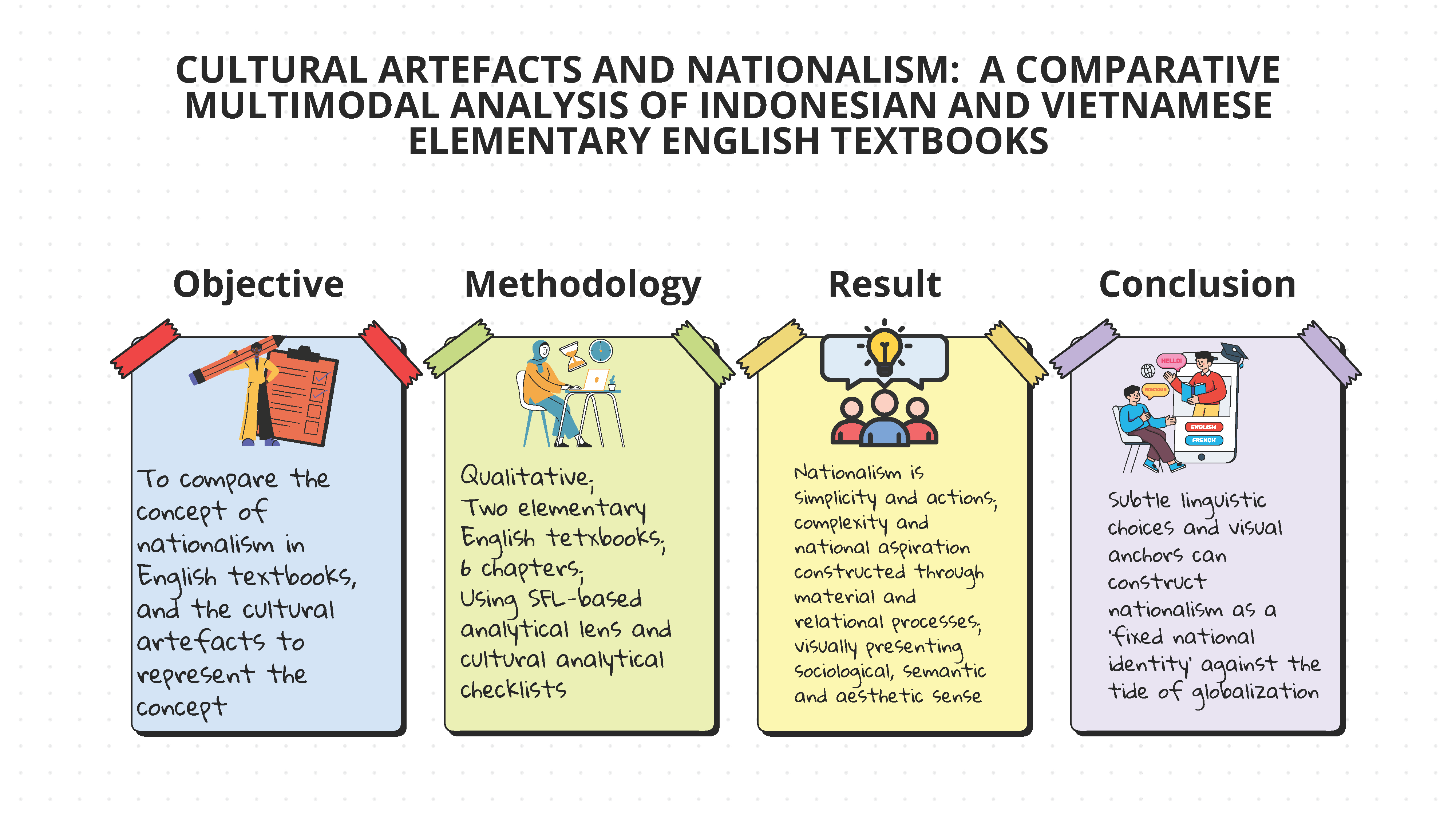
This study explores how the concept of nationalism is represented through cultural artefacts, which can permeate through different media. The study focuses specifically on English textbooks, which can represent the Source, Target, and International Target cultures (Cortazzi & Jin, 1999) and can take the form of Aesthetic, Sociological, Semantic, and Pragmatic/Sociolinguistic senses (Adaskou et al., 1990), both visually and verbally. Regarding its verbal representation, cultural artefacts can also be manifested within the reading texts with the help of authors’ linguistic choices, which contain an experience of the real world, such as nationalism. This understanding is grounded in Halliday and Matthiessen’s description of the phenomenon as the Ideational metafunction of language. In light of this, the present study investigates, using those three theoretical frameworks, how the concept of nationalism is represented in the English textbooks as seen in the reading texts, and which cultural artefacts are the most salient in representing this concept, both through illustrations and captions. The study is descriptive qualitative in nature, and it employs inductive and deductive content analysis. Elements of quantitative analysis have also been used to record the frequency of occurrences of the selected data in numbers, percentages, and totals. The data for this study were collected from one elementary English textbook used in Indonesia and one used in Vietnam, as per their latest educational curriculum. The study finds that the construction of the reading texts between the Indonesian and Vietnamese textbooks represents different concepts of nationalism, particularly in perceiving education and values that represent the concept of nationalism. The most salient cultural artefacts are predominantly presented through the Source cultures in the Sociological sense, followed by the Semantic sense, and the Aesthetic sense.
Downloads
Article Details

This work is licensed under a Creative Commons Attribution-NonCommercial-NoDerivatives 4.0 International License.
All rights reserved. Apart from citations for the purposes of research, private study, or criticism and review,no part of this publication may be reproduced, stored or transmitted in any other form without prior written permission by the publisher.
References
Adaskou, K., Britten, D., & Fahsi, B. (1990). Design decisions on the cultural content of a secondary English course for Morocco. ELT Journal, 44(1), 3–10. https://doi.org/10.1093/elt/44.1.3
Anderson, B. (2006). Imagined communities: Reflections on the origin and spread of nationalism (Rev. ed.). Verso.
Aoumeur, H., & Ziani, M. (2022). Representation of culture in EFL textbooks: A linguistic and content analysis of My Book of English. Arab World English Journal, 13(2), 282–296. https://doi.org/10.24093/awej/vol13no2.19
Barthes, R. (1977). Image, Music, Text (S. Heath, Trans.). Fontana Press.
Billig, M. (1995). Banal nationalism. Sage.
Butt, D., Fahey, R., Feez, S., Spinks, S., & Yallop, C. (2000). Using functional grammar: An explorer’s guide (2nd ed.). National Centre for English Language Teaching and Research, Macquarie University.
Canale, G. (2016). (Re)Searching culture in foreign language textbooks, or the politics of hide and seek. Language Culture and Curriculum, 29(2), 225–243. https://doi.org/10.1080/07908318.2016.1144764
Carrier, P. (2018). The nation, nationhood, and nationalism in textbook research from 1951 to 2017. In E. Fuchs & A. Bock (Eds.), The Palgrave handbook of textbook studies (pp. 181–198). Palgrave Macmillan. https://doi.org/10.1057/978-1-137-53142-1_13
Chandler, D. (2022). Semiotics: The basics (4th ed.). Routledge. https://doi.org/10.4324/9781003155744
Cortazzi, M., & Jin, L. (1999). Cultural mirrors: Materials and methods in the EFL classroom. In E. Hinkel (Ed.), Culture in second language teaching and learning (pp. 196–244). Cambridge University Press.
Creswell, J. W., & Creswell, J. D. (2018). Research design: Qualitative, quantitative, and mixed methods approaches (5th ed.). Sage.
Dahmardeh, M., & Kim, S.-D. (2021). An analysis of the representation of cultural content in English coursebooks. Journal of Applied Research in Higher Education, 13(5), 1388–1407. https://doi.org/10.1108/jarhe-09-2020-0290
Dugis, V. M. A. (1999). Defining nationalism in the era of globalization. Masyarakat Kebudayaan dan Politik (MKP), 12(2), 52–56. https://journal.unair.ac.id/download-fullpapers-11-DUGIS.pdf
Dumitrica, D. (2019). The ideological work of the daily visual representations of nations. Nations and Nationalism, 25(3), 910–934. https://doi.org/10.1111/nana.12520
Emilia, E., Moecharam, N. Y., & Syifa, I. L. (2017). Gender in EFL classroom: Transitivity analysis in English textbook for Indonesian students. Indonesian Journal of Applied Linguistics, 7(1), 206–214. https://doi.org/10.17509/ijal.v7i1.6877
Engelmann, S. (2023). Nationalist new education: A Wallersteinian approach to education in the world-system. In F. Jacob (Ed.), Wallerstein 2.0: Thinking and applying world-systems theory in the 21st century (pp. 155–175). transcript Verlag. https://doi.org/10.1515/9783839460443
Faris, I. N. I. (2014). Cultural content analysis of an English textbook for senior high school grade three in Cianjur, West Java. Journal of English and Education, 2(2), 14–25. https://ejournal.upi.edu/index.php/L-E/article/view/4599/3200
Forster, P. G. (1994). Culture, nationalism, and the invention of tradition in Malawi. The Journal of Modern African Studies, 32(3), 477–497. https://doi.org/10.1017/s0022278x00015196
Geertz, C. (1973). The interpretation of cultures. Basic Books.
Gerot, L., & Wignell, P. (1994). Making sense of functional grammar: An introductory workbook. Antipodean Educational Enterprises.
Gungwu, W. (1973). Nationalism in Asia. In E. Kamenka (Ed.), Nationalism: The nature and evolution of an idea (pp. 82–98). Australian National University Press.
Haas, E. B. (1986). What is nationalism and why should we study it? International Organization, 40(3), 707–744. https://doi.org/10.1017/s0020818300027326
Halliday, M. A. K. (1978). Language as social semiotic: The social interpretation of language and meaning. Edward Arnold.
Halliday, M. A. K. (1994). An introduction to functional grammar (2nd ed.). Edward Arnold.
Halliday, M. A. K., & Matthiessen, C. M. I. M. (2004). An introduction to functional grammar (3rd ed.). Hodder Education Publishers.
Hein, L., & Selden, M. (1998). Learning citizenship from the past: Textbook nationalism, global context, and social change. Bulletin of Concerned Asian Scholars, 30(2), 3–15. https://doi.org/10.1080/14672715.1998.10411038
Hermawan, B., & Noerkhasanah, L. (2012). Traces of cultures in English textbooks for primary education. Indonesian Journal of Applied Linguistics, 1(2), 49–61.
Hino, N. (1988). Nationalism and English as an international language: The history of English textbooks in Japan. World Englishes, 7(3), 309–314. https://doi.org/10.1111/j.1467-971x.1988.tb00240.x
Hodkinson, A., Ghajarieh, A., & Salami, A. (2016). An analysis of the cultural representation of disability in school textbooks in Iran and England. Education 3–13: International Journal of Primary, Elementary and Early Years Education, 46(1), 27–36. https://doi.org/10.1080/03004279.2016.1168861
Hoyo, H. (2010). Posting nationalism: Postage stamps as carriers of nationalist messages. In J. Burbick & W. Glass (Eds.), Beyond imagined uniqueness: Nationalisms in contemporary perspectives (pp. 67–92). Cambridge Scholars Publishing.
Ichijo, A. (2020). Food and nationalism: Gastronationalism revisited [Special issue]. Nationalities Papers, 48(2), 215–223. https://doi.org/10.1017/nps.2019.104
Jones, W. J. (2014). Political semiotics of national campaign posters and pictorial representation: Thailand’s 2011 general elections. Semiotica, 2014(199), 269–296. https://doi.org/10.1515/sem-2013-0128
Kecmanovic, D. (1996). The mass psychology of ethnonationalism. Springer. https://doi.org/10.1007/978-1-4899-0188-0
Kim, S.-H., & Lee, H. (2023). Asserting Koreanness in South Korean middle school English textbooks. World Englishes, 42(3), 544–561. https://doi.org/10.1111/weng.12548
Knapp, P., & Watkins, M. (2005). Genre, text, grammar: Technologies for teaching and assessing writing. University of New South Wales Press.
Kohn, H. (2005). The idea of nationalism: A study in its origins and background. Routledge. https://doi.org/10.4324/9781315132556
Kusumawardani, A., & Faturochman. (2004). Nasionalisme [Nationalism]. Buletin Psikologi, 12(2), 61–72. https://journal.ugm.ac.id/buletinpsikologi/article/download/7469/5808 [in Indonesian]
Kyriazi, A., & vom Hau, M. (2020). Textbooks, postcards, and the public consolidation of nationalism in Latin America. Qualitative Sociology, 43, 515–542. https://doi.org/10.1007/s11133-020-09467-8
Lawrence, P. M. (2005). Nationalism: History and theory. Routledge. https://doi.org/10.4324/9781315837499
Lee, K.-Y. (2009). Treating culture: What 11 high school EFL conversation textbooks in South Korea. English Teaching: Practice and Critique, 8(1), 76–96.
Lerch, J. C., Russell, S. G., & Ramirez, F. O. (2017). Wither the nation-state? A comparative analysis of nationalism in textbooks. Social Forces, 96(1), 153–180. https://doi.org/10.1093/sf/sox049
Littlejohn, A., & Windeatt, S. (1989). Beyond language learning: Perspectives on materials design. In R. K. Johnson (Ed.), The second language curriculum (pp. 155–175). Cambridge University Press. https://doi.org/10.1017/cbo9781139524520.012
Mayangsari, L., Nurkamto, J., & Supriyadi, S. (2018). Cultural content: An analysis of EFL textbook in Indonesia. International Journal of Scientific and Research Publications, 8(11), 192–199. https://doi.org/10.29322/ijsrp.8.11.2018.p8325
Miles, M. B., Huberman, A. M., & Saldaña, J. (2014). Qualitative data analysis: A methods sourcebook (3rd ed.). Sage.
Muhtarom, T. (2020). The comparison of nationalism and civic education value between Indonesian and Malaysian elementary school textbook. Elementary Education Online, 19(3), 1185–1199. https://ilkogretim-online.org/index.php/pub/article/view/7471
Özkırımlı, U. (2017). Theories of nationalism: A critical introduction (3rd ed.). Palgrave Macmillan.
Plamenatz, J. (1973). Two types of nationalism. In E. Kamenka (Ed.), Nationalism: The nature and evolution of an idea (pp. 22–36). ANU Press.
Prastiwi, Y. (2013). Transmitting local cultural knowledge through English as Foreign Language (EFL) learning as a means of fostering “Unity in Diversity.” Academic Journal of Interdisciplinary Studies, 2(3), 507–513. https://doi.org/10.5901/ajis.2013.v2n3p507
Sakrikar, S. S. (2019). M.A.K Halliday’s transitivity-an overview. International Journal of English Language, Literature in Humanities, 7(1), 59–80. https://ijellh.com/index.php/OJS/article/view/6277/5279
Schneer, D. (2007). (Inter)nationalism and English Textbooks Endorsed by the Ministry of Education in Japan. TESOL Quarterly, 41(3), 600–607. https://doi.org/10.1002/j.1545-7249.2007.tb00092.x
Segal, D., & Handler, R. (2006). Cultural approaches to nationalism. In G. Delanty & K. Kumar (Eds.), The SAGE handbook of nations and nationalism (pp. 57–65). Sage. https://doi.org/10.4135/9781848608061.n6
Setyono, B., & Widodo, H. P. (2019). The representation of multicultural values in the Indonesian Ministry of Education and Culture-endorsed EFL textbook: A critical discourse analysis. Intercultural Education, 30(4), 383–397. https://doi.org/10.1080/14675986.2019.1548102
Sigley, G. (2015). Tea and China’s rise: Tea, nationalism and culture in the 21st century. International Communication of Chinese Culture, 2, 319–341. https://doi.org/10.1007/s40636-015-0037-7
Toledo-Sandoval, F. (2020). Local culture and locally produced ELT textbooks: How do teachers bridge the gap? System, 95, Article 102362. https://doi.org/10.1016/j.system.2020.102362
Tomalin, B., & Stempleski, S. (1993). Cultural awareness. Oxford University Press.
van Dijk, T. A. (2004). Racism, discourse and textbooks: The coverage of immigration in Spanish textbooks [Paper presentation]. Symposium on Human Rights in Textbooks, Istanbul, Turkey. https://discourses.org/wp-content/uploads/2022/07/Teun-A.-van-Dijk-2010-Racism-discourse-and-textbooks.pdf
Weninger, C., & Kiss, T. (2013). Culture in English as a Foreign Language (EFL) textbooks: A semiotic approach. TESOL Quarterly, 47(4), 694–716. https://doi.org/10.1002/tesq.87
Widodo, H. P. (2018). A critical micro-semiotic analysis of values depicted in the Indonesian Ministry of National Education-endorsed secondary school English textbook. In H. P. Widodo, M. R. Perfecto, L. V. Canh, & A. Buripakdi (Eds.), Situating moral and cultural values in ELT materials: The Southeast Asian context (pp. 131–152). Springer. https://doi.org/10.1007/978-3-319-63677-1_8
Woods, E. T. (2016). Cultural nationalism. In D. Inglis & A.-M. Almila (Eds.), The SAGE handbook of cultural sociology (pp. 429–441). Sage. https://doi.org/10.4135/9781473957886.n31
Yoshino, K. (2003). English and nationalism in Japan: The role of the intercultural-communication industry. In S. Wilson (Ed.), Nation and nationalism in Japan (pp. 135–145). Routledge.
