
From boba to bore-up: Sexual metaphors as slanguage on TikTok in Indonesia
Article Sidebar
Main Article Content
Abstract
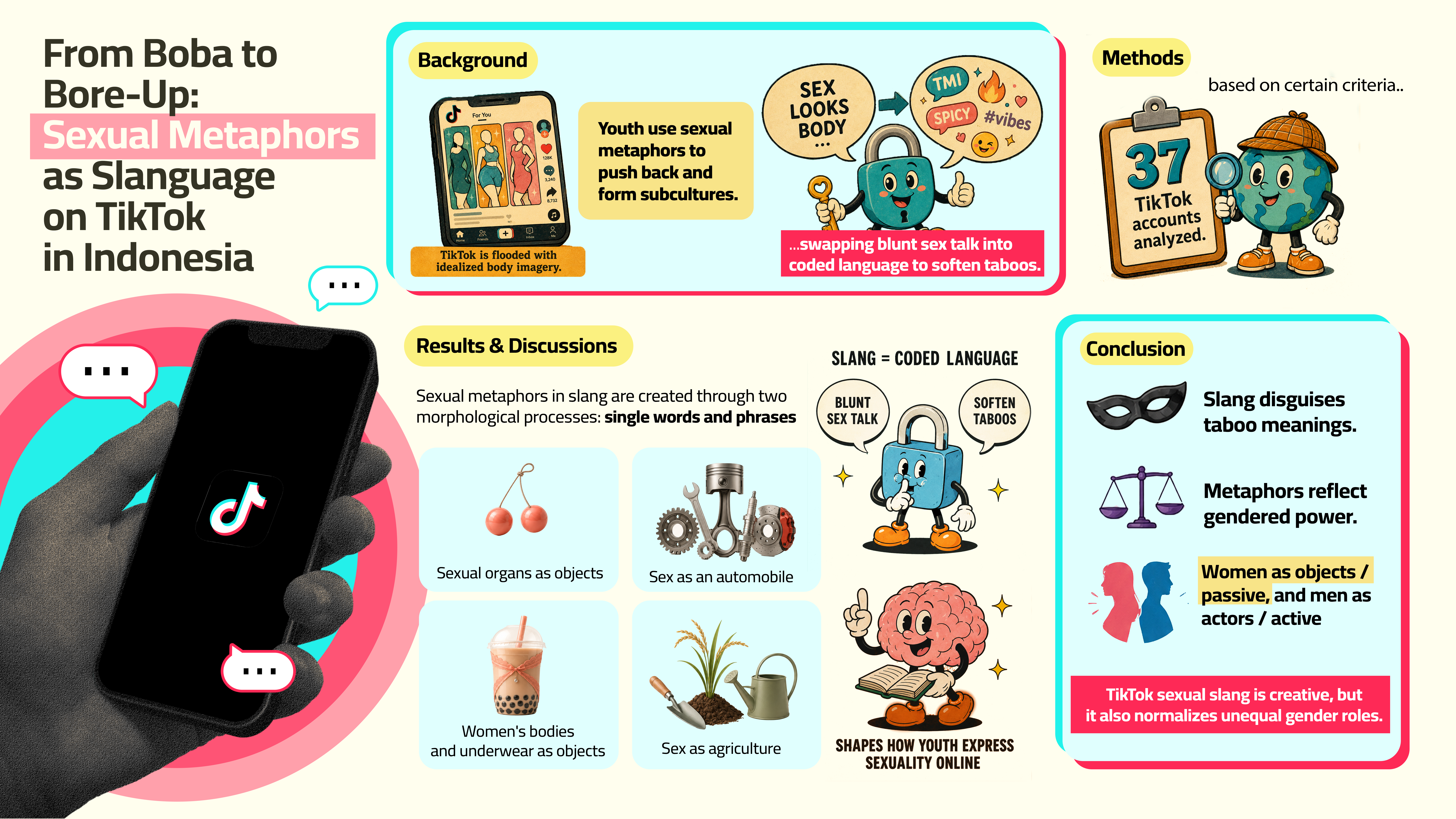
This study explores the use of sexual metaphors in slang generated by Indonesian youth on TikTok, emphasizing the cultural and gendered meanings embedded within linguistic creativity. It is grounded in the conceptual metaphor theory of Lakoff and Johnson (1981) and Kövecses (2006) and informed by a sociolinguistic lens. It analyzes forty-five metaphorical terms derived from thirty-seven viral TikTok accounts. The data reveal four dominant metaphor domains: sexual organs, female body parts, automotive mechanics, and agriculture. Morphological strategies, including blending, reduplication, and acronyms, are employed to encode sexual cues in playful and euphemistic forms. The findings demonstrate a persistent objectification of the female body, frequently depicted as passive and susceptible to consumption, exemplified by concepts such as “boba,” “fields,” and “milk.” Conversely, male sexual agency is portrayed as active and mechanized, as illustrated by terms such as “mechanic” and “bore-up engine.” These metaphorical choices contribute to the perpetuation of heteronormative gender ideologies within the Indonesian youth culture. This article explores the function of sexual language in digital youth spaces, which emphasizes its role as both slang and a discourse surrounding desire, identity, and power. The implications for media literacy and cultural discourse awareness are discussed.
Downloads
Article Details

This work is licensed under a Creative Commons Attribution-NonCommercial-NoDerivatives 4.0 International License.
All rights reserved. Apart from citations for the purposes of research, private study, or criticism and review,no part of this publication may be reproduced, stored or transmitted in any other form without prior written permission by the publisher.
References
Alisyahbana, S. T. (1953). Tata Bahasa Baru Bahasa Indonesia II [The new grammatical rule of Indonesian language II]. Pustaka Rakyat. [in Indonesian]
Allen, I. L. (1993). The city in slang: New York life and popular speech. Oxford University Press.
Andajani, K., Pratiwi, Y., Roekhan, Malik, A. R., Prastio, B., Maulidina, A., & Marzuki. (2023). Exploring terminology of the beauty Jamu and the beauty metaphor of East Java women-Indonesia: An eco-linguistics study. Cogent Arts & Humanities, 10(2), Article 2268387. https://doi.org/10.1080/23311983.2023.2268387
Batan, C. (2005). Texting as style: Preliminary observations on cellular phone use among Filipino college students. In H. Helve & G. Holm (Eds.), Contemporary youth research: Local expressions and global connections (pp. 77–87). Ashgate.
Blackburn, M. R., & Hogg, R. C. (2024). #ForYou? the impact of pro-ana TikTok content on body image dissatisfaction and internalisation of societal beauty standards. PLoS ONE, 19(8), Article e0307597. https://doi.org/10.1371/journal.pone.0307597
Cenderamata, R. C., & Sofyan, A. N. (2019). Abreviasi dalam Percakapan Sehari-hari di Media Sosial: Suatu Kajian Morfologi [Abbreviation in social media daily language: A morphological analysis]. Prasasti: Journal of Linguistics, 4(1), 69–71. https://doi.org/10.20961/prasasti.v4i1.24166 [in Indonesian]
Chamizo Domı́nguez, P. J., & Nerlich, B. (2002). False friends: Their origin and semantics in some selected languages. Journal of Pragmatics, 34(12), 1833–1849. https://doi.org/10.1016/S0378-2166(02)00024-3
Charteris-Black, J. (2004). Corpus approaches to critical metaphor analysis. Palgrave Macmillan. https://doi.org/10.1057/9780230000612
Charteris-Black, J. (2014). Analysing political speeches: Rhetoric, discourse and metaphor. Palgrave Macmillan.
Crespo-Fernández, E. (2015). Sex in language: Euphemistic and dysphemistic metaphors in internet forum. Bloomsbury Academic.
Dawson, H. C., Hernandez, A., & Shain, C. (Eds.). (2022). Language files materials for an introduction to language and linguistics (13th ed.). The Ohio State University Press.
Eble, C. (1996). Slang and sociability: In-group language among college students. The University of North Carolina Press.
Eckert, P., & McConnell-Ginet, S. (2013). Language and gender (2nd ed.). Cambridge University Press.
Emanatian, M. (1996). Everyday metaphors of lust and sex in Chagga. Ethos, 24(2), 195–236. https://doi.org/10.1525/eth.1996.24.2.02a00010
Fachrani, J. I. A. A. (2015). Manifestasi wanita dalam budaya patriarki: ideologi dalam Serat Candraning Wanita dan refleksi pada iklan era modern [Women manifestation in patriarchal culture: Ideology in Serat Candraning Wanita and reflection in a modern advertisement]. Jurnal Linguistik Terapan, 5(1), 1–14. [in Indonesian]
Fariha, I., & Choiron, N. F. (2017). Female liberation in Javanese legend “Jaka Tarub.” KnE Social Sciences, 1(3), Article 438. https://doi.org/10.18502/kss.v1i3.766
Fatimah, N., Royhanaty, I., & Sawitry, S. (2017). Pengaruh Pendidikan Kesehatan Metode Peer Group tentang Menstruasi terhadap Kesiapan Menghadapi Menarche Pada Siswi SD Kelas V di SD Pundenarum I Kecamatan Karangawen Kabupaten Demak [The effect of peer group health education on menstruation on readiness to face menarche in fifth grade elementary school students at Pundenarum I elementary school, Karangawen district, Demak Regency]. Interest: Jurnal Terpadu Ilmu Kesehatan, 6(1), 46–50. [in Indonesian]
Fauzia, I. R. R. (2020). Penerimaan Pengguna Instagram terhadap Analogi Visual Seksualitas dengan Makanan oleh Influencer Instagram [Instagram users’ reception of visual analogies of sexuality to food by Instagram influencers]. Jurnal Media Dan Komunikasi, 1(1), 1–11. https://doi.org/10.20473/medkom.v1i1.22924 [in Indonesian]
Frownfelter, A. (2010). Flower symbolism as female sexual metaphor [Undergraduate honors thesis, Eastern Michigan University]. DigitalCommons@EMU. https://commons.emich.edu/honors/238
Gibbs, J. R. W. (2017). Metaphor wars. Cambridge University Press. https://doi.org/10.1017/9781107762350
Kapranov, O. (2017). The use of metonymy and metaphor in descriptive essays by intermediate and advanced EFL students. Linguistics Beyond and Within, 3(1), 87–101. https://doi.org/10.31743/lingbaw.5652
Kaufman, S. (2020, July 19). Young women on how TikTok has warped their body image during COVID pandemic. NBC News. https://www.nbcnews.com/tech/tech-news/it-s-not-worth-it-young-women-how-tiktok-has-n1234193
Kemp, S. (2025, February 25). Digital 2025: Indonesia. Data Reportal. https://datareportal.com/reports/digital-2025-indonesia
Keraf, G. (1980). Tatabahasa Indonesia [The grammar of the Indonesian language]. Nusa Indah. [in Indonesian]
Keraf, G. (1991). Tata Bahasa Rujukan Bahasa Indonesia [Indonesian reference grammar]. Grasindo. [in Indonesian]
Khattab, M. (2020). Synching and performing: Body (re)- presentation in the short video app TikTok. WiderScreen, 22(1–2). http://widerscreen.fi/numerot/2019-1-2/synching-and-performing-body-re-presentation-in-the-short-video-app-tiktok/
Kövecses, Z. (2006). Language, mind, and culture: A practical introduction. Oxford University Press.
Lakoff, G., & Johnson, M. (1981). Metaphors we live by. University of Chicago Press. https://doi.org/10.7208/chicago/9780226470993.001.0001
Lakoff, G., & Turner, M. (1989). More than cool reason: A field guide to poetic metaphor. University of Chicago Press.
Mensah, E., & Nkamigbo, L. (2016). All I want is your waist: Sexual metaphors as youth slanguage in Nigeria. Sociolinguistic Studies, 10(1–2), 177–198. https://doi.org/10.1558/sols.v10i1-2.27809
Mensah, E., Nsebot, U., Umukoro, G., & Ushuple, L. (2024). Smash her Calabash! The metaphoric construction of phallic masculinity in the marketing of herbal aphrodisiacs in Nigeria. The Journal of Men’s Studies, 33(1), 86–107. https://doi.org/10.1177/10608265241257395
Meyerhoff, M., & Ehrlich, S. (2019). Language, gender, and sexuality. Annual Review of Linguistics, 5, 455–475. https://doi.org/10.1146/annurev-linguistics-052418-094326
Ng, C. J. W. (2018). Metaphor. In J. Flowerdew & J. Richardson (Eds.), The Routledge handbook of critical discourse studies (pp. 215–227). Routledge.
Ottenheimer, H. J., & Pine, J. M. (2018). The anthropology of language: An introduction to linguistic anthropology (4th ed.). Cengage Learning.
Parera, J. D. (1988). Morfologi [Morphology]. PT Gramedia. [in Indonesian]
Pederson, T. (2007). The use of slang in British English: A study of the slang used in Football Factory and Little Britain [Master’s thesis, University of Kalmar]. Digitala Vetenskapliga Arkivet. https://www.diva-portal.org/smash/get/diva2:234593/fulltext01.pdfCachedA
Poerwandari, E. K., Utami, C. P., & Primasari, I. (2021). Ambivalent sexism and sexual objectification of women as predictors of rape myth acceptance among male college students in Greater Jakarta. Current Psychology, 40, 5909–5918. https://doi.org/10.1007/s12144-019-00500-w
Potkin, F. (2018, July 4). Indonesia bans Chinese video app TikTok for ‘inappropriate content.’ Reuters. https://www.reuters.com/article/technology/indonesia-bans-chinese-video-app-tik-tok-for-inappropriate-content-idUSKBN1JU0L2/
Ramlan, M. (1979). Morfologi [Morphology]. UP Karyono. [in Indonesian]
Samsuri. (1980). Analisis Bahasa [Language analysis]. Erlangga. [in Indonesian]
Semino, E., & Steen, G. (2008). Metaphor in literature. In R. W. Gibbs Jr. (Ed.), The Cambridge handbook of metaphor and thought (pp. 232–246). Cambridge University Press. https://doi.org/10.1017/CBO9780511816802.015
Smith, R. E. (2011). Urban dictionary: Youth slanguage and the redefining of definition. English Today, 27(4), 43–48. https://doi.org/10.1017/S0266078411000526
Sudarno. (1990). Morfofonemik bahasa Indonesia [Morphophonemics in the Indonesian language]. Arikha Media Cipta. [in Indonesian]
Sullivan, K. (2017). Conceptual metaphor. In B. Dancygier (Ed.), The Cambridge handbook of cognitive linguistics (pp. 385–406). Cambridge University Press. https://doi.org/10.1017/9781316339732.025
Sunardi. (1993). Arjuna Wiwaha. Balai Pustaka. [in Old Javanese]
Thibodeau, P. H., & Boroditsky, L. (2011). Metaphors we think with: The role of metaphor in reasoning. PLoS ONE, 6(2), Article e16782. https://doi.org/10.1371/journal.pone.0016782
Vancauwenbergh, M., & Franco, K. (2024). Women, blood, and dangerous things: Socio-cultural variation in the conceptualization of menstruation. Language and Cognition, 16(2), 505–535. https://doi.org/10.1017/langcog.2023.45
Verhaar, J. (2004). Asas-asas linguistik umum [The principles of general linguistics]. Gadjah Mada University Press. [in Indonesian]
Wijana, I. D. P. (2019). The use of English for metaphorical expressions in Indonesian slang. Education, Sustainability and Society, 2(4), 8–10. https://doi.org/10.26480/ess.04.2019.08.10
Wulandari, D., & Desstya, A. (2022). Studi Eksplorasi pada Kebudayaan Lokal Menstruasi di Kabupaten Grobogan dan Integrasinya dalam Pembelajaran IPA di Sekolah Dasar [An exploratory study on local menstrual culture in Grobogan regency and its integration into science learning in elementary schools]. Jurnal Basicedu, 6(3), 3757–3765. https://doi.org/10.31004/basicedu.v6i3.2718 [in Indonesian]
Zaim, M. (2015). Pergeseran Sistem Pembentukan Kata Bahasa Indonesia: Kajian Akronim, Blending, dan Kliping [Shifts in the Indonesian word formation system: A study of acronyms, blending, and clippings]. Linguistik Indonesia, 33(2), 173–192. https://doi.org/10.26499/li.v33i2.36 [in Indonesian]
Zukhrufin, I. R., Mumtaz, R., & Al Jannah, I. N. (2023). Tindak Ilokusi Sarkasme Pada Reproduksi Tuturan Pengguna TikTok Kelas 4–6 Sekolah Dasar di Surabaya [Illocutionary acts of sarcasm in the speech reproduction of TikTok users in grades 4–6 of elementary schools in Surabaya]. Etnolingual, 7(1), 41–66. https://doi.org/10.20473/etno.v7i1.43539 [in Indonesian]
