
Tourist perceptions and service design for sustainable community forests
Article Sidebar
Main Article Content
Abstract
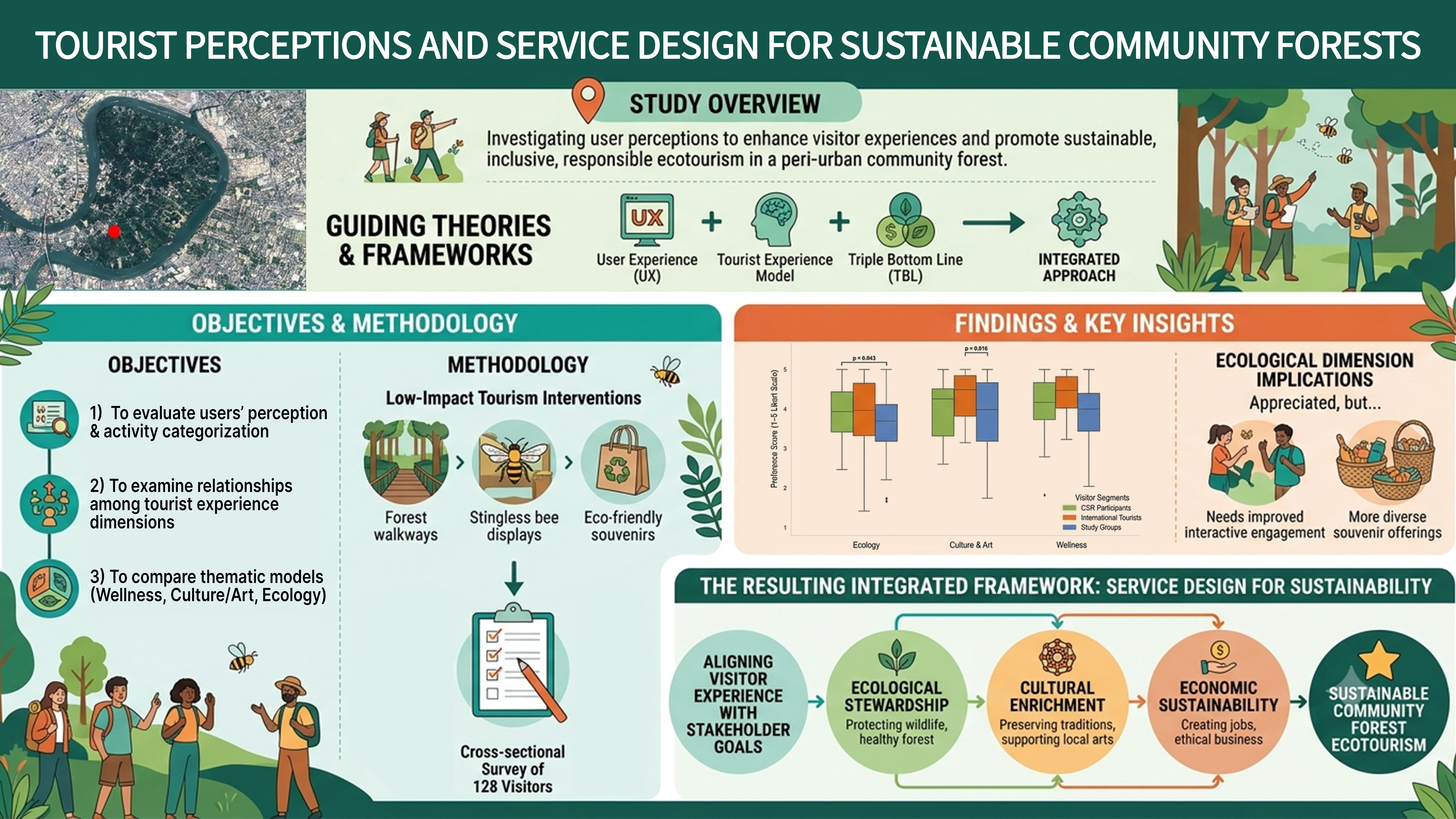
This study investigates tourist perceptions and service design at Suan Pa Ket Nom Klao, a peri-urban community forest in Samut Prakan, Thailand. The research aims to enhance visitor experiences while promoting sustainable tourism, inclusive access to green spaces, and responsible consumption. Guided by User Experience (UX) theory, the Tourist Experience Model, and the Triple Bottom Line (TBL) framework, the study adopts a multidimensional approach to ecotourism development. Three key objectives were pursued: (1) to evaluate visitors’ perception and activity categorization, (2) to examine relationships among tourist experience dimensions, and (3) to compare three thematic models—ecology, culture and art, and wellness—based on visitor preferences. Following the implementation of low-impact tourism interventions, including forest walkways, stingless bee displays, and eco-friendly souvenir services, a cross-sectional survey was conducted with 128 visitors. Findings reveal that visitors reported higher satisfaction with wellness and cultural activities than with ecological ones. Learning opportunities and perceived service quality were strongly linked to overall satisfaction. Although ecological activities were appreciated, they require improved interactive engagement and more diverse souvenir offerings. The resulting integrated framework offers a practical guide for aligning service design with ecological stewardship, cultural enrichment, and economic sustainability.
Downloads
Article Details

This work is licensed under a Creative Commons Attribution-NonCommercial-NoDerivatives 4.0 International License.
All rights reserved. Apart from citations for the purposes of research, private study, or criticism and review,no part of this publication may be reproduced, stored or transmitted in any other form without prior written permission by the publisher.
References
Ajzen, I. (1991). The theory of planned behavior. Organizational Behavior and Human Decision Processes, 50(2), 179–211. https://doi.org/10.1016/0749-5978(91)90020-T
Ap, J., & Wong, K. K. F. (2001). Case study on tour guiding: Professionalism, issues and problems. Tourism Management, 22(5), 551–563. https://doi.org/10.1016/S0261-5177(01)00013-9
Bruce, J. W. (1989). Community forestry: Rapid appraisal of tree and land tenure (Community forestry note 5). Food and Agriculture Organization of the United Nations. https://www.fao.org/4/t7540e/t7540e00.htm
Chaipattana Foundation. (n.d.). Chaipattana Foundation. Retrieved May 30, 2025, from https://www.chaipat.or.th/eng/
Chang, A. Y.-P., & Hung, K.-P. (2021). Development and validation of a tourist experience scale for cultural and creative industries parks. Journal of Destination Marketing & Management, 20, Article 100560. https://doi.org/10.1016/j.jdmm.2021.100560
Constantin, C. P., Ispas, A., & Candrea, A. N. (2022). Examining the relationships between visitors profile, satisfaction and revisit intentions: Evidence from Romanian ecotourism destinations. Land, 11(2), Article 186. https://doi.org/10.3390/land11020186
Darcy, S., & Dickson, T. J. (2009). A whole-of-life approach to tourism: The case for accessible tourism experiences. Journal of Hospitality and Tourism Management, 16(1), 32–44. https://doi.org/10.1375/jhtm.16.1.32
du Cros, H., & Salazar, N. B. (2012). Tourism and intangible cultural heritage. United Nations World Tourism Organization. https://doi.org/10.18111/9789284414796
Elkington, J. (1997). Cannibals with forks: The triple bottom line of 21st century business. Capstone.
French, K. E. (2021). Crafting Wounaan landscapes: Identity, art, and environmental governance in Panama’s Darién (By Julie Velásquez Runk. 2017. University of Arizona Press, Tucson, AZ. 313 pp.). Ethnobiology Letters, 12(1), 19–20. https://doi.org/10.14237/ebl.12.1.2021.1727
Genc, V., & Gulertekin Genc, S. (2023). The effect of perceived authenticity in cultural heritage sites on tourist satisfaction: The moderating role of aesthetic experience. Journal of Hospitality and Tourism Insights, 6(2), 530–548. https://doi.org/10.1108/JHTI-08-2021-0218
Global Wellness Institute. (n.d.). What is wellness tourism? https://globalwellnessinstitute.org/what-is-wellness/what-is-wellness-tourism/
Google. (n.d.). Map of Suan Pa Ket Nom Klao, Samut Prakan, Thailand [Map]. Google Maps. Retrieved September 17, 2026, from https://www.google.com/maps/
Hassenzahl, M. (2010). Experience design: Technology for all the right reasons. Springer. https://doi.org/10.1007/978-3-031-02191-6
Ito, A., Sato, Y., Nakayama, H., Hiramatsu, Y., Hasegawa, M., Ueda, K., & Harada, Y. (2023). Visualization of the effects of forest bathing: Comparison between Japan and Thailand. Proceedings of International Conference for ICT (ICICT), Zambia, 5(1), 19–24.
Kontogeorgopoulos, N. (2005). Community-based ecotourism in Phuket and Ao Phangnga, Thailand: Partial victories and bittersweet remedies. Journal of Sustainable Tourism, 13(1), 4–23. https://doi.org/10.1080/17501220508668470
Nguyen Huu, T., Nguyen Ngoc, H., Nguyen Dai, L., Nguyen Thi Thu, D., Truc, L. N., & Nguyen Trong, L. (2024). Effect of tourist satisfaction on revisit intention in Can Tho City, Vietnam. Cogent Business & Management, 11(1), Article 2322779. https://doi.org/10.1080/23311975.2024.2322779
Norman, D. A. (2005). Emotional design: Why we love (or hate) everyday things. Basic Books.
Park, B. J., Tsunetsugu, Y., Kasetani, T., Kagawa, T., & Miyazaki, Y. (2010). The physiological effects of Shinrin-yoku (taking in the forest atmosphere or forest bathing): Evidence from field experiments in 24 forests across Japan. Environmental Health and Preventive Medicine, 15(1), 18–26. https://doi.org/10.1007/s12199-009-0086-9
Pragtong, K., & Thomas, D. E. (1990). Evolving management systems in Thailand. In M. Poffenberger (Ed.), Keepers of the forest: Land management alternatives in Southeast Asia (pp. 167–186). Kumarian Press.
RECOFTC. (2021). Thailand’s community forest act: Analysis of the legal framework and recommendations. https://www.recoftc.org/publications/thailands-community-forest-act-analysis-legal-framework-and-recommendations
Rodtook, P., Simpattanawong, D., Ruenbanthoeng, T., & Na Nongkhai, K. (2024). Forest bathing activity as a tool to promote wellness tourism in Thailand. Humanities, Arts and Social Sciences Studies, 24(2), 428–440. https://doi.org/10.69598/hasss.24.2.265134
Sattayapanich, T., Janmaimool, P., & Chontanawat, J. (2022). Factors affecting community participation in environmental corporate social responsibility projects: Evidence from mangrove forest management project. Journal of Open Innovation: Technology, Market, and Complexity, 8(4), Article 209. https://doi.org/10.3390/joitmc8040209
Si, X., & Tang, Z. (2024). Assessment of low-carbon tourism development from multi-aspect analysis: A case study of the Yellow River Basin, China. Scientific Reports, 14, Article 4600. https://doi.org/10.1038/s41598-024-55112-7
Suksri, C., Phongkhieo, N. T., & Emphandhu, D. (2021). Environmental perception and learning experience in nature trail of national park visitors. Kasetsart Journal of Social Sciences, 42(2), 339–344. https://so04.tci-thaijo.org/index.php/kjss/article/view/251213
Swanson, K. K., & Timothy, D. J. (2012). Souvenirs: Icons of meaning, commercialization and commoditization. Tourism Management, 33(3), 489–499. https://doi.org/10.1016/j.tourman.2011.10.007
Wanitchakorn, T., & Muangasame, K. (2021). The identity change of rural–urban transformational tourism development in Chiang Mai heritage city: Local residents’ perspectives. International Journal of Tourism Cities, 7(4), 1008–1028. https://doi.org/10.1108/IJTC-08-2020-0169
Wisesratana, C., & Nicrothanont, C. (2021). The lesson learned from process for community-based tourism management to be developed as community-based tourism model prototype: A case study of Ban Pa-Miang, Tambol Jae Son, Amphur Muang-Pan, Lampang province. Suan Dusit Graduate School Academic Journal, 17(3), 225–241. https://so19.tci-thaijo.org/index.php/SDUGSAJ/article/view/368 [in Thai]
