
Heritage-led gentrification in Southeast Asian historic cities: A comparative analysis of Chiang Mai Old City and Hue Citadel
Article Sidebar
Main Article Content
Abstract
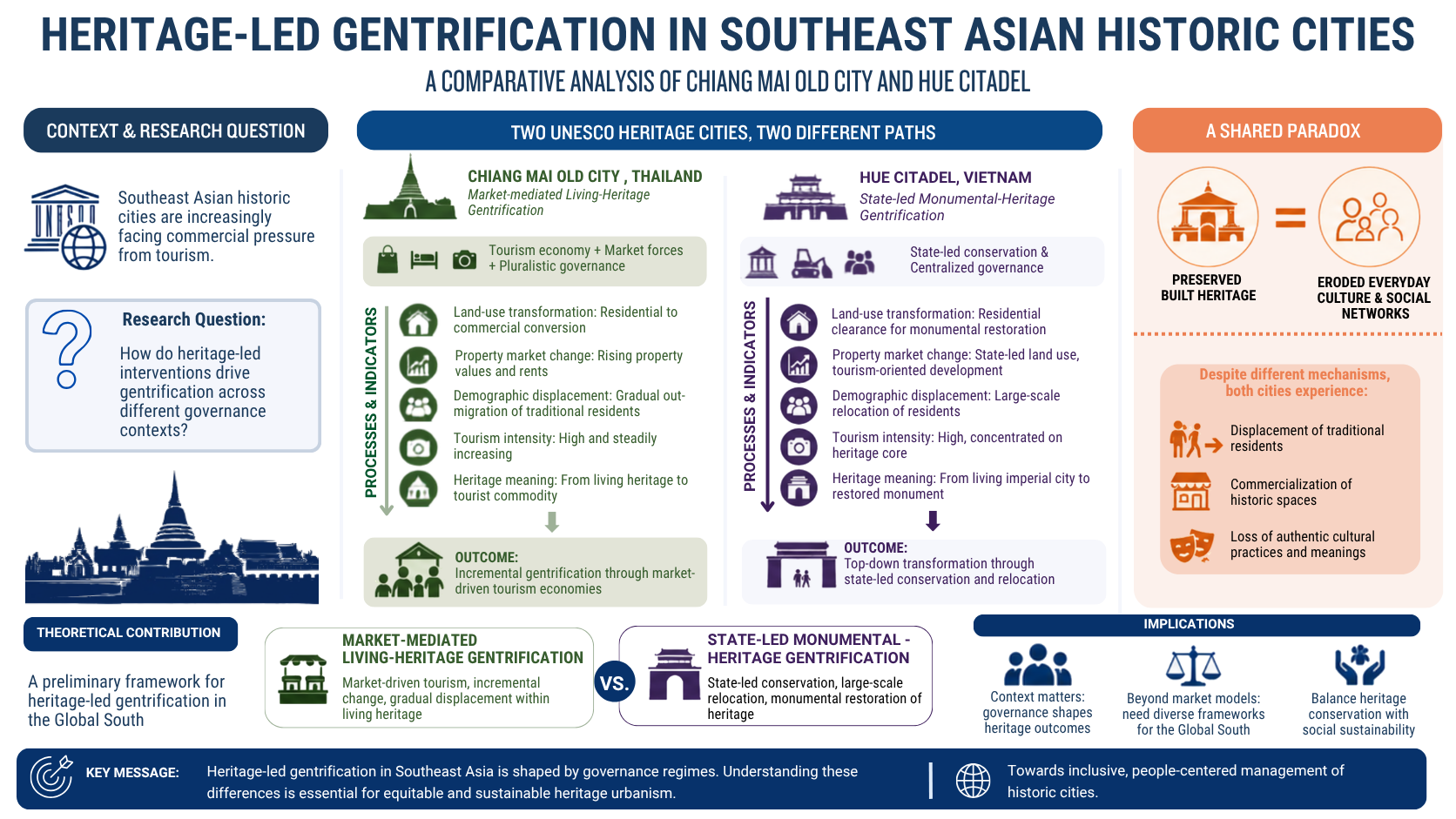
This article examines heritage-led gentrification in Southeast Asia through a comparative analysis of two historic cities: Chiang Mai Old City in Thailand and Hue Citadel in Vietnam. While both cities are UNESCO-recognized heritage environments and major tourism destinations, they are shaped by contrasting governance regimes and development logics. The study examines how different political and institutional contexts influence the processes, indicators, and outcomes of heritage-led gentrification. Methodologically, the research adopts a comparative case study approach, drawing on secondary data from planning documents, spatial studies, policy reports, and scholarly literature. A consistent set of indicators—land-use transformation, property market change, demographic displacement, tourism intensity, and heritage meaning—is applied to both cases. The findings reveal two distinct trajectories. In Chiang Mai, gentrification unfolds incrementally through market-driven tourism economies, resulting in commercial conversion, rising property values, and gradual cultural displacement within a living-heritage environment. In Hue, transformation is driven primarily by state-led conservation policies, with large-scale relocation programs clearing residential areas to create a monumental imperial landscape. Despite these different mechanisms, each case demonstrates a shared paradox: the preservation of built heritage often coincides with the erosion of everyday cultural practices and social networks. Based on this comparison, the article proposes a preliminary theoretical framework distinguishing between market-mediated living-heritage gentrification and state-led monumental-heritage gentrification. This typology contributes to emerging debates on Global South urbanism by highlighting how governance regimes shape heritage transformation beyond classical Euro-American gentrification models.
Downloads
Article Details

This work is licensed under a Creative Commons Attribution-NonCommercial-NoDerivatives 4.0 International License.
All rights reserved. Apart from citations for the purposes of research, private study, or criticism and review,no part of this publication may be reproduced, stored or transmitted in any other form without prior written permission by the publisher.
References
Askew, M. (2002). Bangkok: Place, practice and representation. Routledge.
Chen, P., & Kong, X. (2021). Tourism-led commodification of place and rural transformation development: A Case study of Xixinan Village, Huangshan, China. Land, 10(7), Article 694. https://doi.org/10.3390/land10070694
Correia, P. (2025). From virtual to reality: Enhancing cultural tourism through AI, VR, and the Metaverse. Proceedings of the 8th International Conference on Tourism Research, Finland, 8(1), 47–55. https://doi.org/10.34190/ictr.8.1.3460
De Cesari, C., & Dimova, R. (2019). Heritage, gentrification, participation: Remaking urban landscapes in the name of culture and historic preservation. International Journal of Heritage Studies, 25(9), 863–869. https://doi.org/10.1080/13527258.2018.1512515
Dinh, T. D., & Pham, V. M. (2020). Studying urban expansion and landscape surrounding monuments for conservation the World Cultural Heritage in Hue City—view from GIS and remote sensing. In L. T. T. Huong & G. M. Pomeroy (Eds.), Advances in 21st century human settlements (pp. 317–331). Springer. https://doi.org/10.1007/978-981-15-5608-1_25
Foo, R., & Krishnapillai, G. (2019). Preserving the intangible living heritage in the George Town World Heritage Site, Malaysia. Journal of Heritage Tourism, 14(4), 358–370. https://doi.org/10.1080/1743873x.2018.1549054
Gant, A. C. (2016). Holiday rentals: The new gentrification battlefront. Sociological Research Online, 21(3), 112–120. https://doi.org/10.5153/sro.4071
Gant, A. C. (2023). Place-based displacement: Touristification and neighborhood change. Geoforum, 138, Article 103665. https://doi.org/10.1016/j.geoforum.2022.103665
González Martínez, P. (2016). Authenticity as a challenge in the transformation of Beijing’s urban heritage: The commercial gentrification of the Guozijian historic area. Cities, 59, 48–56. https://doi.org/10.1016/j.cities.2016.05.026
Gotham, K. F. (2005). Tourism gentrification: The case of New Orleans’ Vieux Carré (French Quarter). Urban Studies, 42(7), 1099–1121. https://doi.org/10.1080/00420980500120881
Gravari-Barbas, M., & Guinand, S. (2017). Introduction: Addressing tourism-gentrification processes in contemporary metropolises. In M. Gravari-Barbas & S. Guinand (Eds.), Tourism and gentrification in contemporary metropolises: International perspectives (pp. 1–21). Routledge.
Gustafsson, C., & Ripp, M. (2022). Urban transformation and related conflicts at UNESCO World Heritage Sites. In M.-T. Albert, R. Bernecker, C. Cave, A. C. Prodan, & M. Ripp (Eds.), 50 Years World Heritage Convention: Shared responsibility – conflict & reconciliation (pp. 85–97). Springer. https://doi.org/10.1007/978-3-031-05660-4_7
Hayes, M. (2020). The coloniality of UNESCO’s heritage urban landscapes: Heritage process and transnational gentrification in Cuenca, Ecuador. Urban Studies, 57(15), 3060–3077. https://doi.org/10.1177/0042098019888441
Hung, P. M. (2024). Gentrification in a World Heritage Site: The strategy for preserving the Hue Citadel in Vietnam. ASR: Chiang Mai University Journal of Social Sciences and Humanities, 11(1), Article e2024010. https://doi.org/10.12982/CMUJASR.2024.010
Jaimakaew, Y., & Charoentrakulpeeti, W. (2024). Gentrification of communities surrounding Chedi Luang Worawiharn Temple, Sri Phum subdistrict, Muang district, Chiang Mai province. Asian Creative Architecture, Art and Design, 37(1), 1–21. https://doi.org/10.55003/acaad.2024.269554
Jessa, S., & Rogerson, J. M. (2025). Tourism gentrification in Cape Town’s Bo-Kaap: Socio-economic transformations and displacement. Bulletin of Geography. Socio-economic Series, 69, 129–143. https://doi.org/10.12775/bgss-2025-0032
Jover, J., & Díaz-Parra, I. (2019). Gentrification, transnational gentrification and touristification in Seville, Spain. Urban Studies, 57(15), 3044–3059. https://doi.org/10.1177/0042098019857585
Langfield, M., Logan, W., & Craith, M. N. (Eds.). (2009). Cultural diversity, heritage and human rights: Intersections in theory and practice. Routledge. https://doi.org/10.4324/9780203863015
Lees, L., Shin, H. B., & López-Morales, E. (2016). Planetary gentrification. Polity.
Ley, D. (1996). The new middle class and the remaking of the central city. Oxford University Press.
Linh, N. H. K., Pham, T. G., Pham, T. H., Tran, C. T. M., Nguyen, T. Q., Ha, N. T., & Ngoc, N. B. (2024). Land-use and land-cover changes and urban expansion in Central Vietnam: A case study in Hue City. Urban Science, 8(4), Article 242. https://doi.org/10.3390/urbansci8040242
Logan, W. (2012). Cultural diversity, cultural heritage and human rights: Towards heritage management as human rights-based cultural practice. International Journal of Heritage Studies, 18(3), 231–244. https://doi.org/10.1080/13527258.2011.637573
Lu, S., Zhang, Z., Crabbe, M. J. C., & Suntichaikul, P. (2024). Effects of urban land-use planning on housing prices in Chiang Mai, Thailand. Land, 13(8), Article 1136. https://doi.org/10.3390/land13081136
Mascaro, G. (2024). Heritagization as an authoritarian urban practice in China: Insights from Lijiang. International Journal of Urban and Regional Research, 48(4), 708–720. https://doi.org/10.1111/1468-2427.13238
Navarrete Escobedo, D. (2020). Foreigners as gentrifiers and tourists in a Mexican historic district. Urban Studies, 57(15), 3151–3168. https://doi.org/10.1177/0042098019896532
Nguyen, D. V. A. (2023). Impacts of information and communication technologies infrastructure development on economic growth: An empirical study of Southeast Asian countries. VNUHCM Journal of Economics, Business and Law, 7(2), 4331–4340. https://doi.org/10.32508/stdjelm.v7i2.1178
Nititerapad, C., & Tochaiwat, K. (2023). The impact of gentrification phenomena in Thailand. Social Sciences, 12(12), Article 647. https://doi.org/10.3390/socsci12120647
Nixon, B. (2020). Assessing the environmental impacts of informal settlements in Vietnam: The case study of the Hue Citadel UNESCO World Heritage Site. International Journal of Environmental Impacts, 3(3), 189–206. https://doi.org/10.2495/EI-V3-N3-189-206
Pham, V.-M., Nghiem, S. V., Bui, Q.-T., Pham, T. M., & Pham, C. V. (2019). Quantitative assessment of urbanization and impacts in the complex of Huế Monuments, Vietnam. Applied Geography, 112, Article 102096. https://doi.org/10.1016/j.apgeog.2019.102096
Pham, V.-M., Nghiem, S. V., Pham, C. V., Luu, M. P. T., & Bui, Q.-T. (2021). Urbanization impact on landscape patterns in cultural heritage preservation sites: A case study of the complex of Huế Monuments, Vietnam. Landscape Ecology, 36(4), 1235–1260. https://doi.org/10.1007/s10980-020-01189-0
Phetsuriya, N., & Heath, T. (2021). Defining the distinctiveness of urban heritage identity: Chiang Mai Old City, Thailand. Social Sciences, 10(3), Article 101. https://doi.org/10.3390/socsci10030101
Robinson, J. (2006). Ordinary cities: Between modernity and development. Routledge.
Roy, A. (2009). The 21st-century metropolis: New geographies of theory. Regional Studies, 43(6), 819–830. https://doi.org/10.1080/00343400701809665
Shatkin, G. (2008). The city and the bottom line: Urban megaprojects and the privatization of planning in Southeast Asia. Environment and Planning A: Economy and Space, 40(2), 383–401. https://doi.org/10.1068/a38439
Shatkin, G. (2016). The real estate turns in policy and planning: Land monetization and the political economy of peri-urbanization in Asia. Cities, 53, 141–149. https://doi.org/10.1016/j.cities.2015.11.015
Smith, N. (1979). Toward a theory of gentrification: A back to the city movement by capital not people. Journal of the American Planning Association, 45(4), 538–548. https://doi.org/10.1080/01944367908977002
Sözen, B., & Kılıç, S. E. (2025). Tourism-led rural gentrification in multi-conservation rural settlements: Yazıköy/Datça case. Sustainability, 17(18), Article 8439. https://doi.org/10.3390/su17188439
Taylor, K. W. (2013). A history of the Vietnamese. Cambridge University Press.
Thaisuntad, T. (2022a). Conflicts in managing Chiang Mai’s abandoned monasteries. Nakhara: Journal of Environmental Design and Planning, 21(1), Article 204. https://doi.org/10.54028/NJ202221204
Thaisuntad, T. (2022b). Role of the National Office of Buddhism (NOB) in managing the abandoned monasteries of Chiang Mai. Journal of Architectural/Planning Research and Studies, 20(1), 21–36. https://doi.org/10.56261/jars.v20i1.248344
Thanh, V. (2018, October 15). 15,000 People live an ‘imperial’ life in Hue slum. VnExpress International. https://e.vnexpress.net/news/news/15-000-people-live-an-imperial-life-in-hue-slum-3823991.html
Tsang, C., & Hsu, L.-F. (2022). Beneath the appearance of state-led gentrification: The case of the Kwun Tong Town Centre redevelopment in Hong Kong. Land Use Policy, 116, Article 106054. https://doi.org/10.1016/j.landusepol.2022.106054
UNESCO World Heritage Centre. (n.d.). Complex of Hué Monuments. UNESCO World Heritage Convention. https://whc.unesco.org/en/list/678/
UN-Habitat. (2021). Cities and pandemics: Towards a more just, green and healthy future. https://unhabitat.org/sites/default/files/2021/03/cities_and_pandemics-towards_a_more_just_green_and_healthy_future_un-habitat_2021.pdf
Yasmeen, G. (2006). Bangkok’s foodscape: Public eating, gender relations, and urban change. White Lotus Press.
Yung, E. H., & Sun, Y. (2020). Power relationships and coalitions in urban renewal and heritage conservation: The Nga Tsin Wai Village in Hong Kong. Land Use Policy, 99, Article 104811. https://doi.org/10.1016/j.landusepol.2020.104811
Zhao, Y., Ponzini, D., & Zhang, R. (2020). The policy networks of heritage-led development in Chinese historic cities: The case of Xi’an’s Big Wild Goose Pagoda area. Habitat International, 96, Article 102106. https://doi.org/10.1016/j.habitatint.2019.102106
Zhu, Y., & González Martínez, P. (2022). Heritage, values and gentrification: The redevelopment of historic areas in China. International Journal of Heritage Studies, 28(4), 476–494. https://doi.org/10.1080/13527258.2021.2010791
Zukin, S. (2010). Naked city: The death and life of authentic urban places. Oxford University Press.
Zuo, D., Li, C., Lin, M., Chen, P., & Kong, X. (2022). Tourism, residents agent practice and traditional residential landscapes at a cultural heritage site: The case study of Hongcun Village, China. Sustainability, 14(8), Article 4423. https://doi.org/10.3390/su14084423
