
User-Centered Design (UCD) and graphic novel approach to fostering LGBTQ+ understanding in Thailand
Article Sidebar
Main Article Content
Abstract
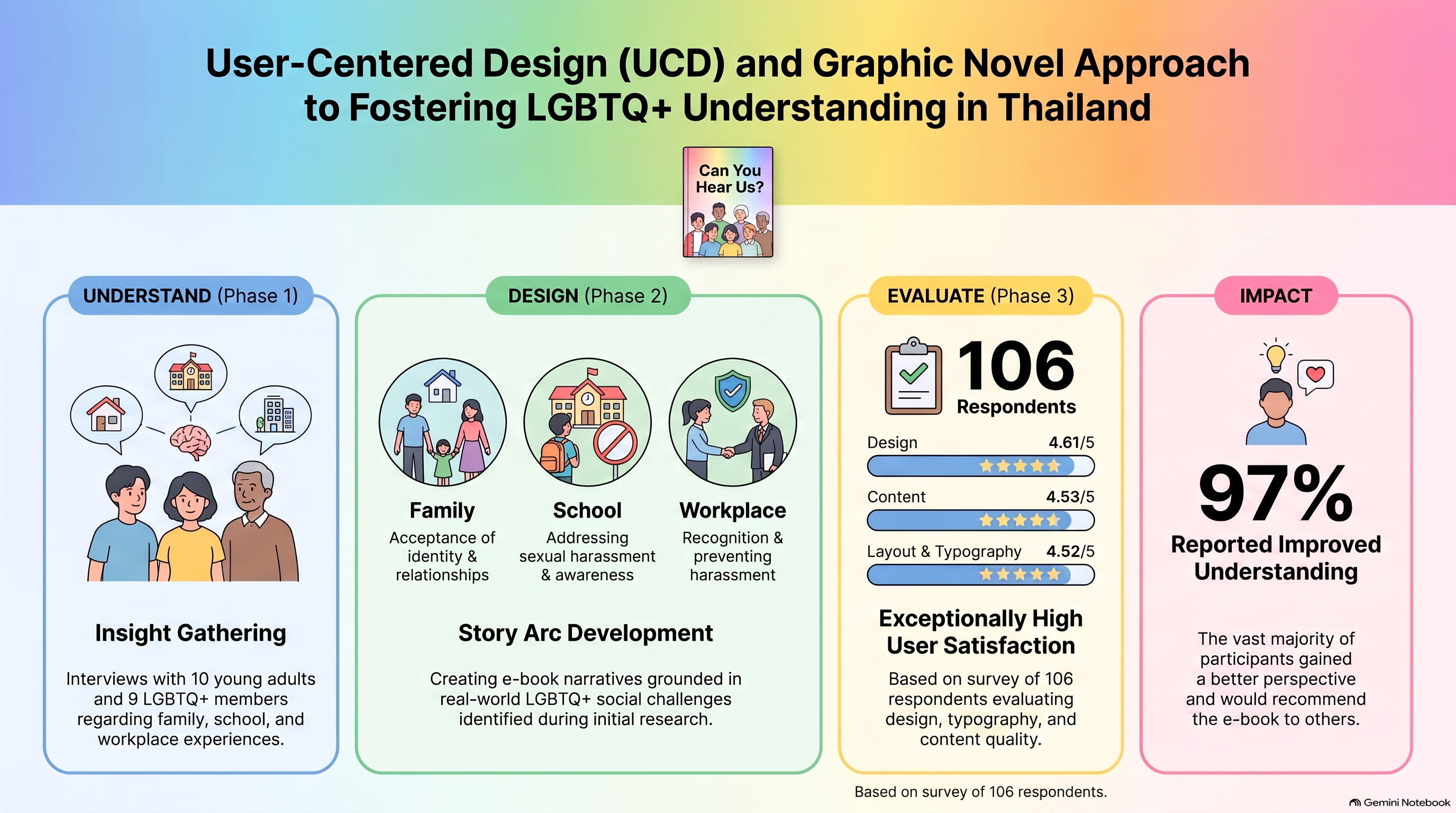
This research investigates discrimination arising from limited knowledge and understanding of LGBTQ+ people within families, schools, and workplaces in Thailand. The aim of this study is to design, develop, and evaluate an illustrated e-book that effectively addresses gender equality concerns among young adults aged 18–24 in Thai society. The researchers applied a User-Centered Design (UCD) framework, taking user needs and goals into consideration throughout the development process. This research adopts graphic novels as instructional tools to design educational materials that promote positive attitudes toward LGBTQ+ people. A three-phase mixed-methods approach, aligned with UCD principles, was used. The study recruited 10 members of the target audience and nine LGBTQ+ people to identify user interests and preferences, developed an illustrated e-book based on their insights, and then quantitatively evaluated it through a survey of 100 young adults. Participants rated the e-book positively, reporting mean scores of 4.61/5 for design, 4.52/5 for layout and typography, and 4.53/5 for content. Furthermore, 97% of participants reported a better understanding of the LGBTQ+ community and indicated that they would recommend the e-book to others. This research contributes to existing scholarship by developing an illustrated e-book for LGBTQ+ education in Thailand that targets young adults through UCD. The design process, which involved members of the LGBTQ+ community, demonstrates how user engagement can help address sensitive social issues.
Downloads
Article Details

This work is licensed under a Creative Commons Attribution-NonCommercial-NoDerivatives 4.0 International License.
All rights reserved. Apart from citations for the purposes of research, private study, or criticism and review,no part of this publication may be reproduced, stored or transmitted in any other form without prior written permission by the publisher.
References
Alqudah, D., Bidin, A. B., & Md Hussin, M. A. H. B. (2019). The impact of educational infographic on students’ interaction and perception in Jordanian higher education: Experimental study. International Journal of Instruction, 12(4), 669–688. https://doi.org/10.29333/iji.2019.12443a
Azlan, A. (2019). A study on illustration for traditional Malay poem book layout design [Undergraduate honors thesis, Universiti Teknologi MARA]. Perpustakaan Tun Abdul Razak. https://ir.uitm.edu.my/id/eprint/28389
Baams, L., Grossman, A. H., & Russell, S. T. (2015). Minority stress and mechanisms of risk for depression and suicidal ideation among lesbian, gay, and bisexual youth. Developmental Psychology, 51(5), 688–696. https://doi.org/10.1037/a0038994
Badgett, M. L., & Sell, R. (2018). A set of proposed indicators for the LGBTI inclusion index. World Bank. https://documents.worldbank.org/en/publication/documents-reports/documentdetail/608921536847788293/
Cardoso, F. L. (2009). Recalled sex-typed behavior in childhood and sports’ preferences in adulthood of heterosexual, bisexual, and homosexual men from Brazil, Turkey, and Thailand. Archives of Sexual Behavior, 38, 726–736. https://doi.org/10.1007/s10508-008-9312-6
Carter, J. B. (2007). Transforming English with graphic novels: Moving toward our “Optimus Prime”. The English Journal, 97(2), 49–53. https://www.jstor.org/stable/30046788
Cheung, D. H., Boonmongkon, P., Ojanen, T. T., Damri, T., Samoh, N., Cholratana, M., Ratchadapunnathikul, C., Gilman, S. E., Sass, J., & Guadamuz, T. E. (2020). Peer victimisation and depression among gender conforming and non-conforming Thai adolescents. Culture, Health & Sexuality, 22(7), 808–821. https://doi.org/10.1080/13691058.2020.1737235
Davis, J. D., Miles, G. M., & Quinley III, J. H. (2019). “Same same, but different”: A baseline study on the vulnerabilities of transgender sex workers in the sex industry in Bangkok, Thailand. International Journal of Sociology and Social Policy, 39(7–8), 550–573. https://doi.org/10.1108/IJSSP-01-2019-0022
Directorate-General for Justice and Consumers. (2017). List of actions by the Commission to advance LGBTI equality. European Commission. https://commission.europa.eu/document/download/c307e4dd-43b6-4970-9f45-03e07d8aae98_en?filename=lgbti-actionlist-dg-just_en.pdf
Eisner, W. (1985). Comics & sequential art. Poorhouse Press.
Gorman, M., & Smith, J. (2003). Getting graphic! Using graphic novels to promote literacy with preteens and teens. Linworth.
Guadamuz, T. E., Goldsamt, L. A., & Boonmongkon, P. (2015). Consent challenges for participation of young men who have sex with men in HIV prevention research in Thailand. Ethics & Behavior, 25(2), 180–195. https://doi.org/10.1080/10508422.2014.949721
Hill, R. M., Rooney, E. E., Mooney, M. A., & Kaplow, J. B. (2017). Links between social support, thwarted belongingness, and suicide ideation among lesbian, gay, and bisexual college students. Journal of Family Strengths, 17(2), Article 6. https://doi.org/10.58464/2168-670X.1350
Kasemsarn, K. (2022). Creating a cultural youth tourism eBook guidelines with four design factors. The International Journal of Visual Design, 16(2), 31–51. https://doi.org/10.18848/2325-1581/CGP/v16i02/31-51
Kasemsarn, K. (2024). Applying classic literature to facilitate cultural heritage tourism for youth through multimedia e-book. Heritage, 7(9), 5148–5173. https://doi.org/10.3390/heritage7090243
Kasemsarn, K., & Nickpour, F. (2017). Inclusive digital storytelling to understand audiences’ behaviours. The International Journal of Visual Design, 11(4), 35–51. https://doi.org/10.18848/2325-1581/CGP/v11i04/35-51
Kasemsarn, K., & Sawadsri, A. (2024). Universal design for learning (UDL) in heritage education: A multimedia approach to ‘Phra Aphai Mani’. Heritage, 7(10), 5907–5931. https://doi.org/10.3390/heritage7100277
Kobayashi, S. (1987). A book of colors: Matching colors, combining colors, color designing, color decorating. Kodansha International.
Logie, C. H., Newman, P. A., Weaver, J., Roungkraphon, S., & Tepjan, S. (2016). HIV-related stigma and HIV prevention uptake among young men who have sex with men and transgender women in Thailand. AIDS Patient Care and STDs, 30(2), 92–100. https://doi.org/10.1089/apc.2015.0197
McGinley, C. G. (2012). Supporting people-centred design through information and empathy [Doctoral dissertation, Brunel University]. Brunel University Research Archive (BURA). http://bura.brunel.ac.uk/handle/2438/7591
Meyer, I. H. (2003). Prejudice, social stress, and mental health in lesbian, gay, and bisexual populations: Conceptual issues and research evidence. Psychological Bulletin, 129(5), 674–697. https://doi.org/10.1037/0033-2909.129.5.674
Morrison, T. G., Bryan, G., & Chilcoat, G. W. (2002). Using student-generated comic books in the classroom. Journal of Adolescent & Adult Literacy, 45(8), 758–767. https://www.jstor.org/stable/40012828
Mustanski, B., Andrews, R., Herrick, A., Stall, R., & Schnarrs, P. W. (2014). A syndemic of psychosocial health disparities and associations with risk for attempting suicide among young sexual minority men. American Journal of Public Health, 104(2), 287–294. https://doi.org/10.2105/AJPH.2013.301744
National Statistical Office. (n.d.). Statistical data. Ministry of Digital Economy and Society. https://www.nso.go.th/nsoweb/index?set_lang=en#gsc.tab=0/
Nemoto, T., Iwamoto, M., Perngparn, U., Areesantichai, C., Kamitani, E., & Sakata, M. (2012). HIV-related risk behaviors among kathoey (male-to-female transgender) sex workers in Bangkok, Thailand. AIDS Care, 24(2), 210–219. https://doi.org/10.1080/09540121.2011.597709
Newman, P. A., Reid, L., Tepjan, S., & Akkakanjanasupar, P. (2021). LGBT+ inclusion and human rights in Thailand: A scoping review of the literature. BMC Public Health, 21(1), Article 1816. https://doi.org/10.1186/s12889-021-11798-2
Norman, D. A. (1986). Cognitive engineering. In D. A. Norman & S. W. Draper (Eds.), User centered system design: New perspectives on human-computer interaction (pp. 31–61). CRC Press.
Norman, D. A. (2017). User centered system design: New perspectives on human-computer interaction. CRC Press.
Paternotte, D. (2016). The NGOization of LGBT activism: ILGA-Europe and the Treaty of Amsterdam. Social Movement Studies, 15(4), 388–402. https://doi.org/10.1080/14742837.2015.1077111
Pedri, N., & Velentzas, I. (2020). Sexuality and mental illness in comics: Notes towards an introduction. Journal of Graphic Novels and Comics, 11(4), 357–372. https://doi.org/10.1080/21504857.2020.1773885
Sapsirisavat, V., Phanuphak, N., Keadpudsa, S., Egan, J. E., Pussadee, K., Klaytong, P., Friedman, M. R., van Griensven, F., Stall, R., & The FAITH Study Team. (2016). Psychosocial and behavioral characteristics of high-risk Men Who Have Sex with Men (MSM) of unknown HIV positive serostatus in Bangkok, Thailand. AIDS and Behavior, 20, 386–397. https://doi.org/10.1007/s10461-016-1519-2
Smiciklas, M. (2012). The power of infographics: Using pictures to communicate and connect with your audiences. Que Publishing.
Stein, M. (2004). Encyclopedia of lesbian, gay, bisexual, and transgender history in America. Thomson Gale.
Tongsubanan, S., & Kasemsarn, K. (2025). Developing a design guideline for a user-friendly home energy-saving application that aligns with User-Centered Design (UCD) principles. International Journal of Human–Computer Interaction, 41(12), 7424–7446. https://doi.org/10.1080/10447318.2024.2398324
United Nations. (2013). Free and equal campaigns. https://www.unfe.org/
United Nations Development Programme. (2019). Tolerance but not inclusion: A national survey on experiences of discrimination and social attitudes towards LGBT people in Thailand. United Nations. https://www.undp.org/publications/tolerance-not-inclusion/
Weber, S. (2015). Daring to marry: Marriage equality activism after Proposition 8 as challenge to the assimilationist/radical binary in queer studies. Journal of Homosexuality, 62(9), 1147–1173. https://doi.org/10.1080/00918369.2015.1037127
World Bank. (2018, March 26). Economic inclusion of LGBTI groups in Thailand. https://www.worldbank.org/en/country/thailand/publication/economic-inclusion-of-lgbti-groups-in-thailand/
Yamane, T. (1967). Elementary sampling theory. Prentice Hall.
