
Stakeholders’ conflicts in tourism setting: The role of community involvement, perceived benefit, and perceived cost
Article Sidebar
Main Article Content
Abstract
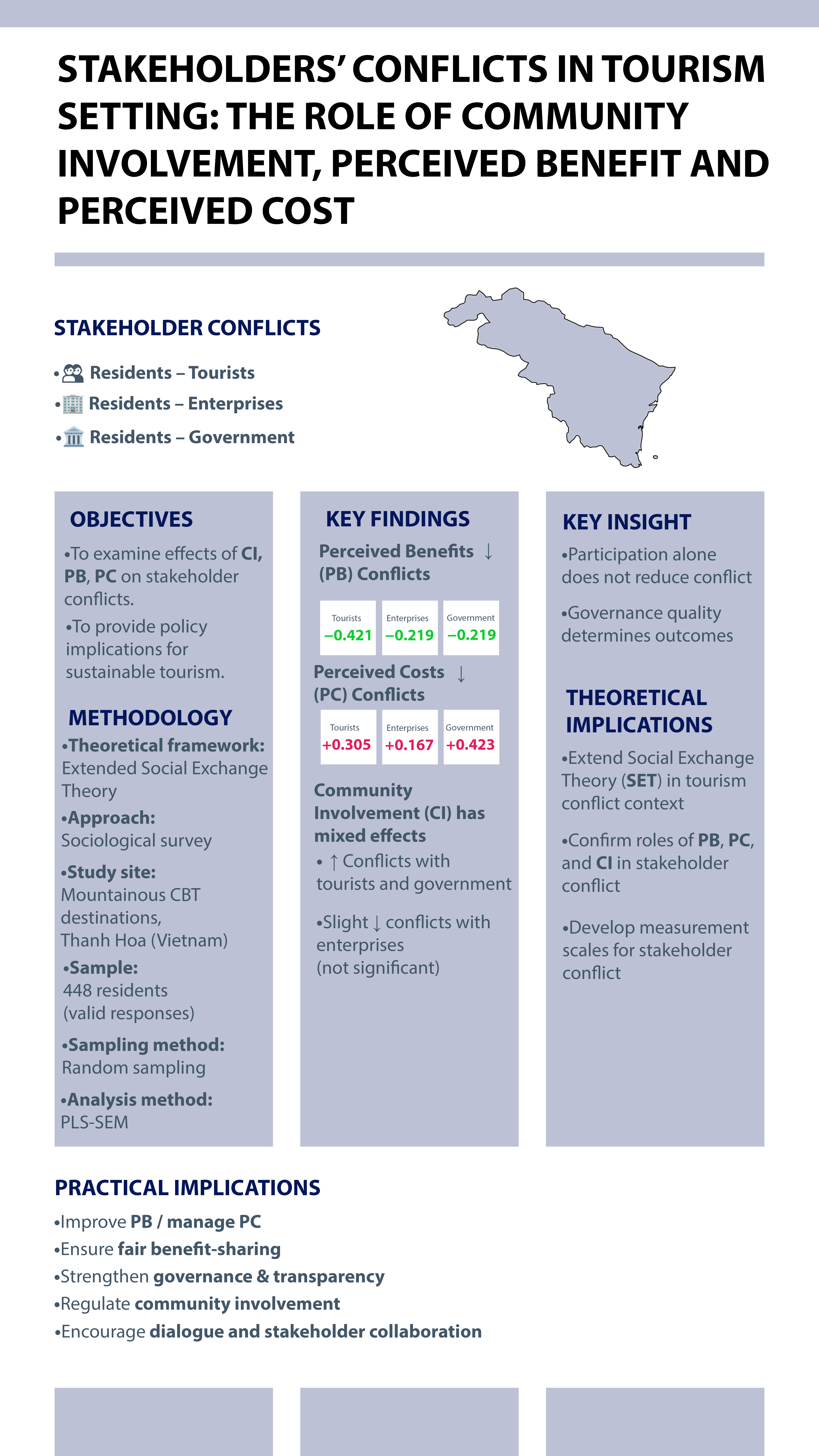
Conflict is an inherent aspect of social interactions that can lead to antagonistic behaviors and actions. In this study, the authors applied the theory of Extended Social Exchange and suggested a framework to examine factors affecting residents’ tension with other tourism stakeholders. The authors employed a random sampling method to engage with 448 indigenous inhabitants residing in community-based tourism destinations in Vietnam. The findings illustrate that residents’ perceptions of benefits and costs directly influence their conflicts with other groups. In addition, the community’s involvement, to an extent, may affect residents’ assessment of benefits and costs, thereby helping to manage conflicts. Nevertheless, resident involvement in tourism can result in conflicts with tourists due to differences in lifestyle, culture, and resource strain. Also, during their participation, residents may face tensions with local authorities due to overlapping responsibilities, lack of transparency, ineffective governance, and inconvenient administrative processes. The research supplements the theoretical understanding of conflict in a tourism context. Furthermore, this study provides local tourism practitioners with a comprehensive insight into stakeholders’ tension, thereby promoting a reasonable orientation in tourism development strategy.
Downloads
Article Details

This work is licensed under a Creative Commons Attribution-NonCommercial-NoDerivatives 4.0 International License.
All rights reserved. Apart from citations for the purposes of research, private study, or criticism and review,no part of this publication may be reproduced, stored or transmitted in any other form without prior written permission by the publisher.
References
Aas, C., Ladkin, A., & Fletcher, J. (2005). Stakeholder collaboration and heritage management. Annals of Tourism Research, 32(1), 28–48. https://doi.org/10.1016/j.annals.2004.04.005
Andereck, K. L., Valentine, K. M., Knopf, R. C., & Vogt, C. A. (2005). Residents’ perceptions of community tourism impacts. Annals of Tourism Research, 32(4), 1056–1076. https://doi.org/10.1016/j.annals.2005.03.001
Apostolidis, C., & Brown, J. (2022). Sharing is caring? Conflict and value codestruction in the case of sharing economy accommodation. Journal of Hospitality & Tourism Research, 46(5), 1027–1055. https://doi.org/10.1177/1096348020986853
Archabald, K., & Naughton-Treves, L. (2001). Tourism revenue-sharing around national parks in Western Uganda: Early efforts to identify and reward local communities. Environmental Conservation, 28(2), 135–149. https://doi.org/10.1017/S0376892901000145
Ashley, C., & Jones, B. (2001). Joint ventures between communities and tourism investors: Experience in southern Africa. International Journal of Tourism Research, 3(5), 407–423. https://doi.org/10.1002/jtr.347
Bello, F. G., Lovelock, B., & Carr, N. (2017). Constraints of community participation in protected area-based tourism planning: The case of Malawi. Journal of Ecotourism, 16(2), 131–151. https://doi.org/10.1080/14724049.2016.1251444
Bhalla, P., Coghlan, A., & Bhattacharya, P. (2016). Homestays’ contribution to community-based ecotourism in the Himalayan region of India. Tourism Recreation Research, 41(2), 213–228. https://doi.org/10.1080/02508281.2016.1178474
Burgoyne, C., Kelso, C., & Mearns, K. (2017). The impact of stakeholder relations on the Mnemba Island marine conservation area, Zanzibar, Tanzania. Tourism in Marine Environments, 12(3–4), 239–252. https://doi.org/10.3727/154427317X15022384101342
Butler, R. W. (1980). The concept of a tourist area cycle of evolution: Implications for management of resources. Canadian Geographer, 24(1), 5–12. https://doi.org/10.1111/j.1541-0064.1980.tb00970.x
Canavan, B. (2017). Tourism stakeholder exclusion and conflict in a small island. Leisure Studies, 36(3), 409–422. https://doi.org/10.1080/02614367.2016.1141975
Castro, A. P., & Nielsen, E. (2001). Indigenous people and co-management: Implications for conflict management. Environmental Science and Policy, 4(4–5), 229–239. https://doi.org/10.1016/S14629011(01)00022-3
Chin, W. W. (1998). The partial least squares approach to structural equation modeling. In A. M. George (Ed.), Modern methods for business research (pp. 295–336). Lawrence Erlbaum Associates.
Chin, W. W. (2010). How to write up and report PLS analyses. In V. Esposito Vinzi, W. W. Chin, J. Henseler, & H. Wang (Eds.), Handbook of partial least squares (pp. 655–690). Springer.
Choi, H. C., & Murray, I. (2010). Resident attitudes toward sustainable community tourism. Journal of Sustainable Tourism, 18(4), 575–594. https://doi.org/10.1080/09669580903524852
Choi, H. C., & Sirakaya, E. (2005). Measuring residents’ attitude toward sustainable tourism: Development of sustainable tourism attitude scale. Journal of Travel Research, 43(4), 380–394. https://doi.org/10.1177/0047287505274651
Churchill, G. A. (1979). A paradigm for developing better measures of marketing constructs. Journal of Marketing Research, 16(1), 64–73. https://doi.org/10.1177/002224377901600110
Connor, C., & Gyan, P. N. (2022). Connecting landscape-scale ecological restoration and tourism: Stakeholder perspectives in the great plains of North America. Journal of Sustainable Tourism, 30(11), 2595–2613. https://doi.org/10.1080/09669582.2020.1801698
Dredge, D. (2010). Place change and tourism development conflict: Evaluating public interest. Tourism Management, 31(1), 104–112. https://doi.org/10.1016/j.tourman.2009.01.004
Ebrahimi, S., & Khalifah, Z. (2014). Community supporting attitude toward community-based tourism development; non-participants perspective. Asian Social Science, 10(17), 29–35. https://doi.org/10.5539/ass.v10n17p29
Engström, C., & Boluk, K. A. (2012). The battlefield of the mountain: Exploring the conflict of tourism development on the three peaks in Idre, Sweden. Tourism Planning & Development, 9(4), 411–427. https://doi.org/10.1080/21568316.2012.726261
Ernawati, N. M., Voda, M., Sudhana, I. F. P., & Sudarmin, N. M. (2018). Forest environment supports for community-based tourism development. Journal of Environmental Management and Tourism, 9(8), 1635–1641. https://journals.aserspublishing.eu/jemt/article/view/2979
Fan, D. X., Liu, A., & Qiu, R. T. (2019). Revisiting the relationship between host attitudes and tourism development: A utility maximization approach. Tourism Economics, 25(2), 171–188. https://doi.org/10.1177/1354816618794088
Feng, X., & Li, Q. (2020). Poverty alleviation, community participation, and the issue of scale in ethnic tourism in China. Asian Anthropology, 19(4), 233–256. https://doi.org/10.1080/1683478X.2020.1778154
Feti, F., Hadi, S. P., Purnaweni, H., & Sudarno. (2020). Does the intervention of regional authorities contribute to sustainable mangrove ecotourism? Case study on mangrove management at Karansong, West Java, Indonesia. Ecological Questions, 31(3), 7–14. https://doi.org/10.12775/EQ.2020.017
Fornell, C., & Larcker, D. F. (1981). Evaluating structural equation models with unobservable variables and measurement error. Journal of Marketing Research, 18(1), 39–50. https://doi.org/10.2307/3151312
Freeman, R. E. (1984). Strategic management: A stakeholder approach. Pitman.
Gan, J.-E. (2020). Uncovering the environmental and social conflicts behind residents’ perception of CBT: A case of Perak, Malaysia. Tourism Planning & Development, 17(6), 674–692. https://doi.org/10.1080/21568316.2020.1749121
Guo, H., & Jordan, E. J. (2021). Social exclusion and conflict in a rural tourism community: A case study from Likeng Village, China. Tourist Studies, 22(1), 42–60. https://doi.org/10.1177/14687976211039067
Gursoy, D., & Rutherford, D. G. (2004). Host attitudes toward tourism: An improved structural model. Annals of Tourism Research, 31(3), 495–516. https://doi.org/10.1016/j.annals.2003.08.008
Hair, J. F., Matthews, L. M., Matthews, R. L., & Sarstedt, M. (2017). PLS-SEM or CB-SEM: Updated guidelines on which method to use. International Journal of Multivariate Data Analysis, 1(2), 107–123. https://doi.org/10.1504/IJMDA.2017.087624
Hardy, A., Beeton, R. J. S., & Pearson, L. (2002). Sustainable tourism: An overview of the concept and its position in relation to conceptualisations of tourism. Journal of Sustainable Tourism, 10(6), 475–496. https://doi.org/10.1080/09669580208667183
Henseler, J., Ringle, C. M., & Sinkovics, R. R. (2009). The use of partial least squares path modeling in international marketing. In R. R. Sinkovics & P. N. Ghauri (Eds.), New challenges to international marketing. Emerald Group Publishing.
Hlengwa, D. C., & Mazibuko, S. K. (2018). Community leaders around Inanda Dam, Kwazulu Natal, and issues of community participation in tourism development initiatives. African Journal of Hospitality, Tourism and Leisure, 7(1), 1–17.
Hoa, T. T. M. (2013). Hoàn thiện mối quan hệ giữa các bên liên quan nhằm phát triển hoạt động du lịch tại Việt Nam [Improving the relationship between stakeholders to develop tourism activities in Vietnam]. VNU Journal of Science: Social Sciences and Humanities, 29(3), 19–28. [in Vietnamese]
Jamal, T. B., & Getz, D. (1995). Collaboration theory and community tourism planning. Annals of Tourism Research, 22(1), 186–204. https://doi.org/10.1016/0160-7383(94)00067-3
Jamal, T., & Getz, D. (1999). Community roundtables for tourism-related conflicts: The dialectics of consensus and process structures. Journal of Sustainable Tourism, 7(3–4), 290–313. https://doi.org/10.1080/09669589908667341
Jehn, K. A. (1995). A multimethod examination of the benefits and detriments of intragroup conflict. Administrative Science Quarterly, 40(2), 256–282. https://doi.org/10.2307/2393638
Jurowski, C., & Gursoy, D. (2004). Distance effects on residents’ attitudes toward tourism. Annals of Tourism Research, 31(2), 296–312. https://doi.org/10.1016/j.annals.2003.12.005
Khartishvili, L., Mitrofanenko, T., Muhar, A., & Penker, M. (2020). Issues with applying the concept of community-based tourism in the Caucasus. Mountain Research and Development, 40(1), R11–R20. https://doi.org/10.1659/MRD-JOURNAL-D-19-00071.1
Kim, S., & Kang, Y. (2020). Why do residents in an overtourism destination develop anti-tourist attitudes? An exploration of residents’ experience through the lens of the community-based tourism. Asia Pacific Journal of Tourism Research, 25(8), 858–876. https://doi.org/10.1080/10941665.2020.1768129
Kinseng, R. A., Nasdian, F. T., Fatchiya, A., Mahmud, A., & Stanford, R. J. (2018). Marine-tourism development on a small island in Indonesia: blessing or curse? Asia Pacific Journal of Tourism Research, 23(11), 1062–1072. https://doi.org/10.1080/10941665.2018.1515781
Ko, D.-W., & Stewart, W. P. (2002). A structural equation model of residents’ attitudes for tourism development. Tourism Management, 23(5), 521–530. https://doi.org/10.1016/S0261-5177(02)00006-7
Kreiner, N. C., Shmueli, D. F., & Ben Gal, M. (2015). Understanding conflicts at religious-tourism sites: The Baha’i World Center, Israel. Tourism Management Perspectives, 16, 228–236. https://doi.org/10.1016/j.tmp.2015.04.001
Lee, T. H. (2013). Influence analysis of community resident support for sustainable tourism development. Tourism Management, 34, 37–46. https://doi.org/10.1016/j.tourman.2012.03.007
Liu, Q., Yang, Z., & Wang, F. (2017). Conservation policy-community conflicts: A case study from Bogda Nature Reserve, China. Sustainability, 9(8), Article 1291. https://doi.org/10.3390/su9081291
Lo, Y.-C., & Janta, P. (2020). Resident’s perspective on developing community-based tourism – A qualitative study of Muen Ngoen Kong community, Chiang Mai, Thailand. Frontiers in Psychology, 11, Article 1493. https://doi.org/10.3389/fpsyg.2020.01493
Mannon, S. E., & Glass-Coffin, B. (2019). Will the real rural community please stand up? Staging rural community-based tourism in Costa Rica. Journal of Rural and Community Development, 14(4), 71–93. https://journals.brandonu.ca/jrcd/article/view/1649
McCool, S. F. (2009). Constructing partnerships for protected area tourism planning in an era of change and messiness. Journal of Sustainable Tourism, 17(2), 133–148. https://doi.org/10.1080/09669580802495733
Minh Hai. (2017, May 28). Khu du lịch gây ô nhiễm tại Pù Luông bị tạm dừng xây dựng và kinh doanh [A tourist construction and business in Pu Luong nature reserve has been suspended due to Pollution]. Thanh Nien Newspaper. https://thanhnien.vn/khu-du-lich-gay-o-nhiem-tai-pu-luong-bi-tam-dung-xay-dung-va-kinh-doanh-185667789.htm [in Vietnamese]
Moore, C. W. (2003). The mediation process: Practical strategies for resolving conflict (3rd ed.). Jossey-Bass.
Needham, M. D., Szuster, B. W., Mora, C., Lesar, L., & Anders, E. (2017). Manta ray tourism: Interpersonal and social values conflicts, sanctions, and management. Journal of Sustainable Tourism, 25(10), 1367–1384. https://doi.org/10.1080/09669582.2016.1274319
Neuman, W. L. (2014). Social research methods: Qualitative and quantitative approaches (7th ed.). Pearson Education.
Nicholas, L. N., Thapa, B., & Ko, Y. J. (2009). Residents’ perspectives of a world heritage site: The Pitons management area, St. Lucia. Annals of Tourism Research, 36(3), 390–412. https://doi.org/10.1016/j.annals.2009.03.005
Nugroho, P., & Numata, S. (2020). Resident support of community-based tourism development: Evidence from Gunung Ciremai National Park, Indonesia. Journal of Sustainable Tourism, 30(11), 2510–2525. https://doi.org/10.1080/09669582.2020.1755675
Nunkoo, R., & So, K. K. F. (2016). Residents’ support for tourism: Testing alternative structural models. Journal of Travel Research, 55(7), 847–861. https://doi.org/10.1177/0047287515592972
Okazaki, E. (2008). A community-based tourism model: Its conception and use. Journal of Sustainable Tourism, 16(5), 511–529. https://doi.org/10.2167/jost782.0
Prosser, R. (1994). Societal change and the growth in alternative tourism. In E. Cater & G. Lowman (Eds.), Ecotourism: A sustainable option? (pp. 19–37). John Wiley & Sons.
Rasoolimanesh, S. M., Jaafar, M., Kock, N., & Ramayah, T. (2015). A revised framework of social exchange theory to investigate the factors influencing residents’ perceptions. Tourism Management Perspectives, 16, 335–345. https://doi.org/10.1016/j.tmp.2015.10.001
Rubin, J. Z. (1994). Models of conflict management. Journal of Social Issues, 50(1), 33–45. https://doi.org/10.1111/j.1540-4560.1994.tb02396.x
Schnegg, M., & Kiaka, R. D. (2018). Subsidized elephants: Community-based resource governance and environmental (in)justice in Namibia. Geoforum, 93, 105–115. https://doi.org/10.1016/j.geoforum.2018.05.010
Sharpley, R. (2014). Host perceptions of tourism: A review of the research. Tourism Management, 42, 37–49. https://doi.org/10.1016/j.tourman.2013.10.007
Shen, H., Li, X., Luo, J. M., & Chau, K. Y. (2017). One country, two strata: Implications of social and cultural conflicts of Chinese outbound tourism to Hong Kong. Journal of Destination Marketing & Management, 6(3), 166–169. https://doi.org/10.1016/j.jdmm.2016.10.003
Simmons, D. G. (1994). Community participation in tourism planning. Tourism Management, 15(2), 98–108. https://doi.org/10.1016/0261-5177(94)90003-5
Sitikarn, B. (2008). Ecotourism SMTEs opportunities in northern Thailand: A solution to community development and resource conservation. Tourism Recreation Research, 33(3), 303–311. https://doi.org/10.1080/02508281.2008.11081553
Susskind, L., & Thomas-Larmer, J. (1999). Conducting a conflict assessment. In L. Susskind, S. McKearnan, & J. Thomas-Larmer (Eds.), The consensus building handbook: A comprehensive guide to reaching agreement (pp. 99–136). Sage. https://doi.org/10.4135/9781452231389.n3
Thanh, D. T., Long, H. P., & Huong, L. V. (2022). Introduction to tourism. Vietnam National University Hanoi. [in Vietnamese]
Thanh Hoa Provincial Statistics Office. (2020). Niên giám thống kê tỉnh Thanh Hoá 2020 [Statistical yearbook of Thanh Hoa province 2020]. Statistical Publishing House. [in Vietnamese]
Thomas, K. W. (1976). Conflict and conflict management. In M. D. Dunnette (Ed.), Handbook of industrial and organizational psychology (pp. 889–935). Rand McNally.
Tosun, C. (2006). Expected nature of community participation in tourism development. Tourism Management, 27(3), 493–504. https://doi.org/10.1016/j.tourman.2004.12.004
Tsaur, S.-H., Yen, C.-H., & Teng, H.-Y. (2018). Tourist–resident conflict: A scale development and empirical study. Journal of Destination Marketing & Management, 10, 152–163. https://doi.org/10.1016/j.jdmm.2018.09.002
Vu Lan. (2022). Pù Luông dưới góc nhìn bảo vệ môi trường [Pu Luong from the perspective of environmental protection]. Vietnam Environment Magazine. https://moitruongvanongnghiep.vn/phat-trien-ben-vung-24/pu-luong-duoi-goc-nhin-bao-ve-moi-truong-26879 [in Vietnamese]
Wang, L. (2021). Causal analysis of conflict in tourism in rural China: The peasant perspective. Tourism Management Perspectives, 39, Article 100863. https://doi.org/10.1016/j.tmp.2021.100863
Wang, L., & Yotsumoto, Y. (2019). Conflict in tourism development in rural China. Tourism Management, 70, 188–200. https://doi.org/10.1016/j.tourman.2018.08.012
Xue, L., & Kerstetter, D. (2018). Discourse and power relations in community tourism. Journal of Travel Research, 57(6), 757–768. https://doi.org/10.1177/0047287517714908
Yamane, T. (1967). Statistics: An introductory analysis (2nd ed.). Harper & Row.
Yang, J., Ryan, C., & Zhang, L. (2013). Social conflict in communities impacted by tourism. Tourism Management, 35, 82–93. https://doi.org/10.1016/j.tourman.2012.06.002
Zhang, C., Fyall, A., & Zheng, Y. (2015). Heritage and tourism conflict within world heritage sites in China: A longitudinal study. Current Issues in Tourism, 18(2), 110–136. https://doi.org/10.1080/13683500.2014.912204
Zhu, J., & Siriphon, A. (2019). Community-based tourism stakeholder conflicts and the co-creation approach: A case study of Longji Terrace Fields, PRC. Journal of Mekong Societies, 15(2), 37–54. https://so03.tci-thaijo.org/index.php/mekongjournal/article/view/171768
Zielinski, S., Jeong, Y., & Milanés, C. B. (2021). Factors that influence community-based tourism (CBT) in developing and developed countries. Tourism Geographies, 23(5–6), 1040–1072. https://doi.org/10.1080/14616688.2020.1786156
