
Evaluating distance learning: Cultural meanings and educational resilience in Kazakhstan
Article Sidebar
Main Article Content
Abstract
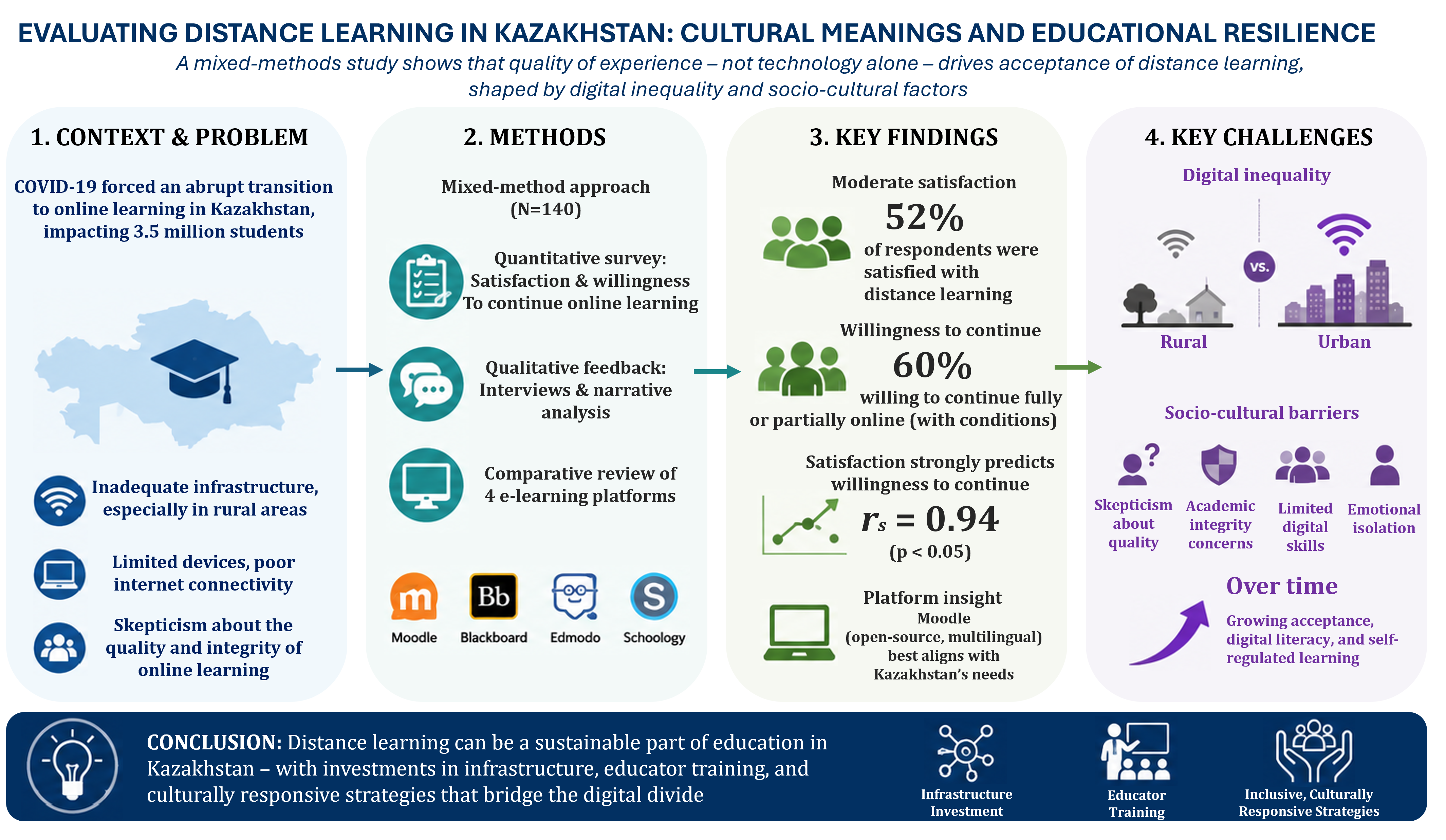
This study aims to evaluate the effectiveness of Kazakhstan’s abrupt transition to distance learning during the COVID-19 pandemic, focusing on learner and teacher satisfaction, the performance of e-learning platforms, and socio-cultural factors influencing the experience. A mixed-methods approach was adopted, combining a quantitative survey (n = 140) with qualitative feedback and a comparative review of four major e-learning platforms (Moodle, Blackboard, Edmodo, Schoology). Survey data were analyzed using descriptive statistics and Spearman’s rank correlation to examine the relationship between satisfaction and willingness to continue online learning. Qualitative responses and expert commentary contextualized the numerical trends, and platform features were assessed via literature review and technical criteria. Results indicate moderate overall satisfaction with distance learning (approximately 52% of respondents reported satisfaction) and a cautiously optimistic outlook regarding its continuation (approximately 60% were willing to continue fully or partially online, with conditions). A strong positive correlation (rs = 0.94, p < 0.05) was identified between satisfaction and willingness to continue, underscoring that improving online learning quality is key to its future adoption. However, significant challenges emerged: digital inequalities (especially between urban and rural areas) and socio-cultural barriers (limited digital skills, initial skepticism about online education) impeded equitable outcomes. Participants from well-connected, resource-rich settings reported better experiences than those facing poor internet access, and some educators and parents doubted the integrity of online instruction initially. The platform comparison found that open-source, multilingual LMS solutions (Moodle) offer strong alignment with Kazakhstan’s needs, whereas costly proprietary systems (Blackboard) may hinder wide implementation despite rich features. In conclusion, Kazakhstan’s experience during the pandemic demonstrates that distance learning can be a sustainable component of education moving forward, provided that investments are made in infrastructure, educator training, and culturally responsive strategies to bridge the digital divide.
Downloads
Article Details

This work is licensed under a Creative Commons Attribution-NonCommercial-NoDerivatives 4.0 International License.
All rights reserved. Apart from citations for the purposes of research, private study, or criticism and review,no part of this publication may be reproduced, stored or transmitted in any other form without prior written permission by the publisher.
References
Ahadin, Safiah, I., Yunus, M., Suartama, I. K., Solehudin, M., & Hastuti, W. D. (2023). Different domiciles in online learning during the COVID-19 pandemic. Journal of Education and e-Learning Research, 10(3), 380–388. https://doi.org/10.20448/jeelr.v10i3.4725
Alismaiel, O. A., Cifuentes-Faura, J., & Al-Rahmi, W. M. (2022). Online learning, mobile learning, and social media technologies: An empirical study on constructivism theory during the COVID-19 pandemic. Sustainability, 14(18), Article 11134. https://doi.org/10.3390/su141811134
Alqahtani, A. S. (2019). The use of Edmodo: Its impact on learning and students’ attitudes toward it. Journal of Information Technology Education: Research, 18, 319–330. https://doi.org/10.28945/4389
Aruleba, K., & Jere, N. (2022). Exploring digital transforming challenges in rural areas of South Africa through a systematic review of empirical studies. Scientific African, 16, Article e01190. https://doi.org/10.1016/j.sciaf.2022.e01190
Baran, E., & AlZoubi, D. (2020). Affordances, challenges, and impact of open pedagogy: Examining students’ voices. Distance Education, 41(2), 230–244. https://doi.org/10.1080/01587919.2020.1757409
Baytak, A. (2022). The health students’ perception of online education amid the COVID-19 pandemic. Research in Social Sciences and Technology, 7(2), 49–65. https://doi.org/10.46303/ressat.2022.9
Beisenbaev, S., Kovyazina, K., & Dzhaksylykov, S. (2020). Obrazovanie navynos: Kak uchitelya i ucheniki adaptiruyutsya k distantsionnomu obucheniyu? [Education to go: How are teachers and students adapting to distance learning?] [Video]. Paperlab. https://paperlab.kz/obrazovanie-navynos [in Russian]
Bokayev, B., Torebekova, Z., Abdykalikova, M., & Davletbayeva, Z. (2021). Exposing policy gaps: The experience of Kazakhstan in implementing distance learning during the COVID-19 pandemic. Transforming Government: People, Process and Policy, 15(2), 275–290. https://doi.org/10.1108/TG-07-2020-0147
Burakanova, G. M., Orazgaliyeva, A. G., & Pinaev, S. M. (2021). Psychological, pedagogical, and digital aspects of distance learning in Kazakhstan in the context of the COVID-19 pandemic. SHS Web of Conferences, 113, Article 00021. https://doi.org/10.1051/shsconf/202111300021
Chaddock, R. E. (1925). Principles and methods of statistics. Houghton Mifflin.
Chatelier, G., & Voicu, L. (2018, March 18). E-learning within the framework of UNESCO [Paper presentation]. The fourteenth International Conference on eLearning for Knowledge-Based Society, Bangkok, Thailand.
Costa, S. A., Kavouras, I., Cohen, N., & Huang, T. T. K. (2021). Moving education online during the COVID-19 pandemic: Thinking back and looking ahead. Frontiers in Public Health, 9, Article 751685. https://doi.org/10.3389/fpubh.2021.751685
Creswell, J. W., & Clark, V. L. P. (2017). Designing and conducting mixed methods research (3rd ed.). Sage.
Davis, F. D. (1989). Perceived usefulness, perceived ease of use, and user acceptance of information technology. MIS Quarterly, 13(3), 319–340. https://doi.org/10.2307/249008
Durrani, N., Qanay, G., Mir, G., Helmer, J., Polat, F., Karimova, N., & Temirbekova, A. (2023). Achieving SDG 4, equitable quality education after COVID-19: Global evidence and a case study of Kazakhstan. Sustainability, 15(20), Article 14725. https://doi.org/10.3390/su152014725
Ferdianto, F., & Dwiniasih. (2019). Learning Management System (LMS) schoology: Why it’s important and what it looks like. Journal of Physics: Conference Series, 1360, Article 012034. https://doi.org/10.1088/1742-6596/1360/1/012034
Gamage, S. H. P. W., Ayres, J. R., & Behrend, M. B. (2022). A systematic review on trends in using Moodle for teaching and learning. International Journal of STEM Education, 9, Article 9. https://doi.org/10.1186/s40594-021-00323-x
Gherheș, V., Stoian, C. E., Fărcașiu, M. A., & Stanici, M. (2021). E-learning vs. face-to-face learning: Analyzing students’ preferences and behaviors. Sustainability, 13(8), Article 4381. https://doi.org/10.3390/su13084381
Graham, C. R. (2018). Current research in blended learning. In M. G. Moore & W. C. Diehl (Eds.), Handbook of distance education (4th ed., pp. 173–188). Routledge.
Hove, B., & Dube, B. (2021). Covid-19 and the entrenchment of a virtual Elite private school: Rethinking education policies in Zimbabwe. Journal of Culture and Values in Education, 4(2), 84–94. https://doi.org/10.46303/jcve.2021.5
Kinash, S., Brand, J., & Mathew, T. (2012). Challenging mobile learning discourse through research: Student perceptions of Blackboard Mobile Learn and iPads. Australasian Journal of Educational Technology, 28(4), 639–655. https://doi.org/10.14742/ajet.832
Kirillova, I. (2000). Prospects of distance learning in Kazakhstan and Central Asia. Bulletin of the American Society for Information Science and Technology, 26(4), 14–16. https://doi.org/10.1002/bult.160
Lalima, & Dangwal, K. L. (2017). Blended learning: An innovative approach. Universal Journal of Educational Research, 5(1), 129–136. https://doi.org/10.13189/ujer.2017.050116
Martin, F. (2008). Blackboard as the learning management system of a computer literacy course. Journal of Online Learning and Teaching, 4(2), 138–145. https://jolt.merlot.org/vol4no2/martin0608.pdf
Mathrani, A., Umer, R., Sarvesh, T., & Adhikari, J. (2023). Rural–urban, gender, and digital divides during the COVID-19 lockdown: A multi-layered study. Societies, 13(5), Article 122. https://doi.org/10.3390/soc13050122
Miao, F., Huang, R., Liu, D., & Zhuang, R. (2022). Ensuring effective distance learning during COVID-19 disruption: Guidance for teachers. United Nations Educational, Scientific and Cultural Organization. https://unesdoc.unesco.org/ark:/48223/pf0000375116
Moorhouse, B. L., & Yan, L. (2023). Use of digital tools by English language schoolteachers. Education Sciences, 13(3), Article 226. https://doi.org/10.3390/educsci13030226
Nurgaliyeva, S., Bolatov, A., Abildina, S., Zeinolla, S., Kurbonova, B., & Kyyakbayeva, U. (2024). COVID-19 online learning challenges: Kazakhstan secondary schools case study. Frontiers in Education, 9, Article 1448594. https://doi.org/10.3389/feduc.2024.1448594
Oyedotun, T. D. (2020). Sudden change of pedagogy in education driven by COVID-19: Perspectives and evaluation from a developing country. Research in Globalization, 2, Article 100029. https://doi.org/10.1016/j.resglo.2020.100029
Sedgwick, P. (2014). Spearman’s rank correlation coefficient. BMJ, 349, Article g7327. https://doi.org/10.1136/bmj.g7327
Seilkhan, A., Abdrassulova, Z., Erkaebaeva, M., Soltan, R., Makhambetov, M., & Ydyrys, A. (2022). Problems of distance education in Kazakhstan during the COVID-19 pandemic. World Journal on Educational Technology: Current Issues, 14(2), 380–389. https://doi.org/10.18844/wjet.v14i2.6913
Sikhangezile, N., & Modise, M. A. (2020). Social distancing, cultural and psychological effects on learners in a rural setting in Zimbabwe. Journal of Ethnic and Cultural Studies, 7(3), 200–209. https://www.jstor.org/stable/48710266
Terras, M. M., & Ramsay, J. (2015). Massive Open Online Courses (MOOCs): Insights and challenges from a psychological perspective. British Journal of Educational Technology, 46(3), 472–487. https://doi.org/10.1111/bjet.12274
Turnbull, D., Chugh, R., & Luck, J. (2021). Transitioning to E-Learning during the COVID-19 pandemic: How have Higher Education Institutions responded to the challenge? Education and Information Technologies, 26, 6401–6419. https://doi.org/10.1007/s10639-021-10633-w
UNICEF & The International Telecommunication Union. (2020). How many children and young people have internet access at home? Estimating digital connectivity during the COVID-19 pandemic. UNICEF. https://www.unicef.org/reports/how-many-children-and-young-people-have-internet-access-home-2020
van Deursen, A. J., & van Dijk, J. A. (2019). The first-level digital divide shifts from inequalities in physical access to inequalities in material access. New Media & Society, 21(2), 354–375. https://doi.org/10.1177/1461444818797082
van Dijk, J. A. (2005). The deepening divide: Inequality in the information society. Sage. https://doi.org/10.4135/9781452229812
Yelubayeva, P., Tashkyn, E., & Berkinbayeva, G. (2023). Addressing challenges in Kazakh education for sustainable development. Sustainability, 15(19), Article 14311. https://doi.org/10.3390/su151914311
