
Social media and the Catholic Church: A scoping review
Article Sidebar
Main Article Content
Abstract
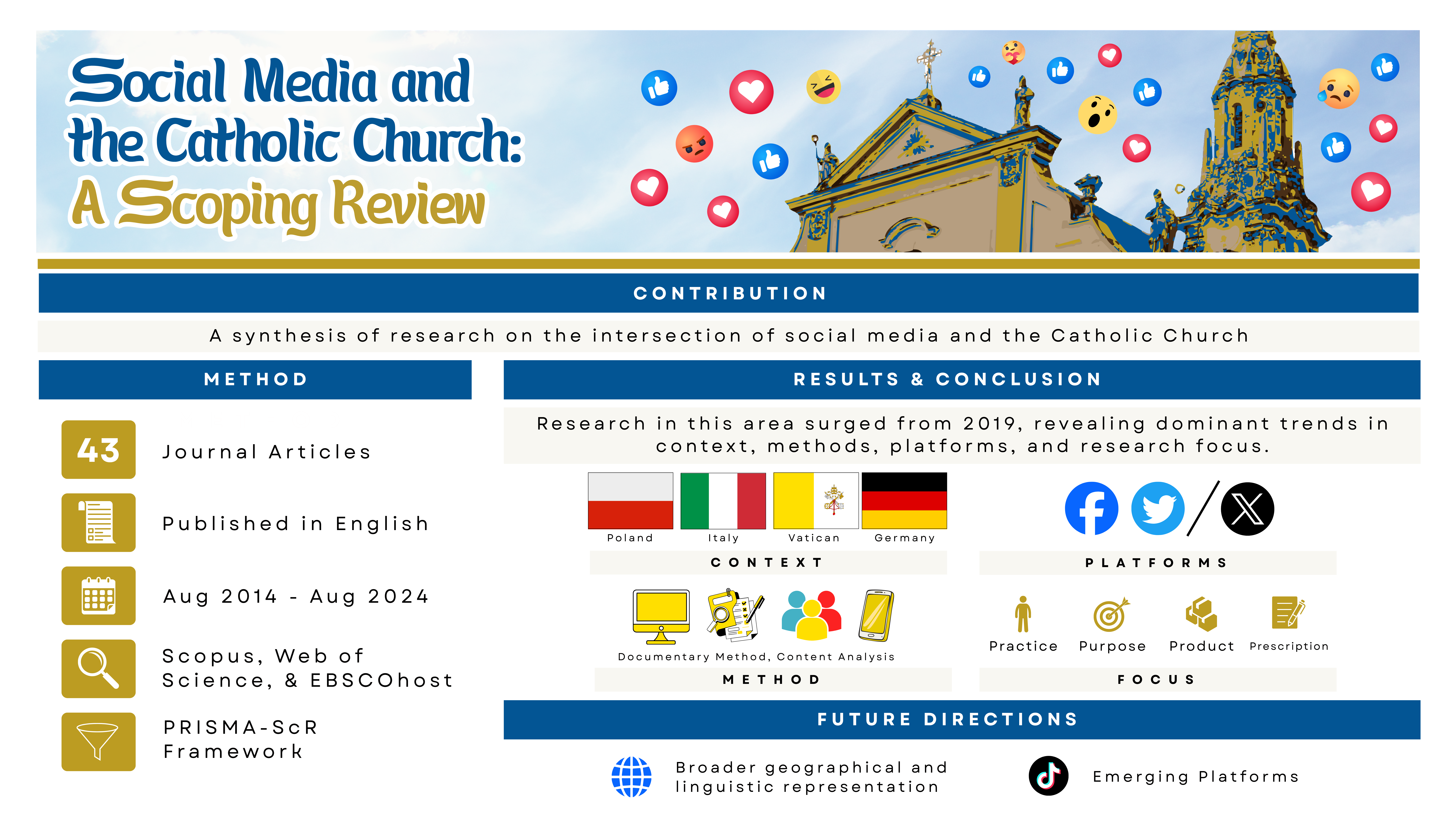
The growing presence of Catholic priests and nuns on social media reflects the increasing importance of this social practice, which has interdisciplinary implications in religion, media communication, and education. To help determine new research directions to aid in deepening the understanding of this phenomenon, this scoping review explores what is known so far about the intersections of social media and the Catholic Church’s evangelical mission. Adopting the PRISMA-ScR reporting framework, 43 English-language journal articles published in selected research databases from 2014 to 2024 were systematically selected and reviewed. The research questions, contexts, frameworks, methods, data and social media platform sources, and key findings were extracted in an Excel matrix to map patterns in the literature, major evidence gaps, and future research directions. Findings show that studies are predominantly situated in European contexts, focus on Facebook and Twitter, use qualitative modes of analysis, and examine practices, purposes, products, and prescriptions of the Catholic Church in relation to social media. To broaden scholarship, future research can explore contexts outside Europe and emerging social media platforms like TikTok, employ mixed method approaches, and probe various critical issues arising from prevailing social media practices. Extending research in these directions is essential to deepen understanding of the complex discourse on religion within the digital sphere.
Downloads
Article Details

This work is licensed under a Creative Commons Attribution-NonCommercial-NoDerivatives 4.0 International License.
All rights reserved. Apart from citations for the purposes of research, private study, or criticism and review,no part of this publication may be reproduced, stored or transmitted in any other form without prior written permission by the publisher.
References
Arksey, H., & O’Malley, L. (2005). Scoping studies: Towards a methodological framework. International Journal of Social Research Methodology, 8(1), 19–32. https://doi.org/10.1080/1364557032000119616
Ballano, V. (2021). COVID-19 pandemic, telepresence, and online masses: Redefining Catholic sacramental theology. The International Journal of Interdisciplinary Global Studies, 16(1), 41–53. https://doi.org/10.18848/2324-755X/CGP/v16i01/41-53
Banaszak, A. (2022). Evangelization through social media — opportunities and threats to the religious life of an individual and community. KOŚCIÓŁ I PRAWO, 11(24), 45–62. https://doi.org/10.18290/kip22112.3
Baraybar-Fernández, A., Arrufat-Martín, S., & Rubira-García, R. (2020). Religion and social media: Communication strategies by the Spanish Episcopal Conference. Religions, 11(5), Article 239. https://doi.org/10.3390/rel11050239
Bartolome, R. E. M. (2022). Communication leading to communion: Social communications in the digital culture through the Catholic Church’s engagement in social media during the COVID-19 pandemic. Religion and Social Communication, 20(2), 369–396.
Brubaker, P. J., & Haigh, M. M. (2017). The religious Facebook experience: Uses and gratifications of faith-based content. Social Media + Society, 3(2). https://doi.org/10.1177/2056305117703723
Campbell, H. A., & Vitullo, A. (2019). Popes in digital era: Reflecting on the rise of the digital papacy. Problemi dell'informazione, 3, 419–442. https://www.rivisteweb.it/doi/10.1445/95658
Cardoso, L., & Barraco, S. (2019). Media and society: The private and public sphere in social networks – analysis of the communication of Pope Francis in Instagram. International Journal of Trend in Scientific Research and Development, 3(5), 777–782.
Chmielewski, M. J. (2020a). Media education and the new evangelization. Part one: Media components and challenges. Verbum Vitae, 37(2), 407–425. https://doi.org/10.31743/vv.8346
Chmielewski, M. J. (2020b). Media education and the new evangelization. Part two: Pastoral postulates and educational proposals. Verbum Vitae, 38(2), 649–671. https://doi.org/10.31743/vv.11526
Egere, I. K. (2015). Social media and mission-based marketing approach for new evangelization in the digital age. AMECEA Gaba Publication, 57(3), 186–205.
Gauxachs, A. S., Aiguabella, J. M. A., & Bosch, M. D. (2021). Coronavirus-driven digitalization of in-person communities: Analysis of the Catholic Church online response in Spain during the pandemic. Religions, 12(5), Article 311. https://doi.org/10.3390/rel12050311
Gaweł, A., Mańdziuk, M., Żmudziński, M., Gosek, M., Krawczyk-Suszek, M., Pisarski, M., Adamski, A., & Cyganik, W. (2021). Effects of Pope Francis’ religious authority and media coverage on Twitter user’s attitudes toward COVID-19 vaccination. Vaccines, 9(12), Article 1487. https://doi.org/10.3390/vaccines9121487
Genovese, F. (2019). Politics @Pontifex: International crises and political patterns of papal tweets. Political Science & Politics, 52(1), 7–13. https://doi.org/10.1017/S1049096518001038
Giorgi, A. (2019). Mediatized Catholicism—Minority voices and religious authority in the digital sphere. Religion, 10(8), Article 463. https://doi.org/10.3390/rel10080463
Golan, O., & Martini, M. (2019). Religious live-streaming: Constructing the authentic in real time. Information, Communication & Society, 22(3), 437–454. https://doi.org/10.1080/1369118X.2017.1395472
Golan, O., & Martini, M. (2020). The making of contemporary papacy: Manufactured charisma and Instagram. Information, Communication & Society, 23(9), 1368–1385. https://doi.org/10.1080/1369118X.2019.1567803
Gralczyk, A. (2020). Social media as an effective pastoral tool. Forum Teologiczne, 21, 237–248. https://doi.org/10.31648/ft.6099
Guzek, D. (2015). Discovering the digital authority: Twitter as reporting tool for papal activities. Heidelberg Journal of Religions on the Internet, 9, 63–80. https://doi.org/10.11588/rel.2015.0.26251
Hunt, J. G. (2019). The digital way: Re-imagining digital discipleship in the age of social media. Journal of Youth and Theology, 18(2), 91–112. https://doi.org/10.1163/24055093-01802003
Isetti, G., Stawinoga, E. A., & Pechlaner, H. (2021). Pastoral care at the time of lockdown: An exploratory study of the Catholic Church in South Tyrol (Italy). Journal of Religion, Media and Digital Culture, 10(3), 355–381. https://doi.org/10.1163/21659214-bja10054
Johnson, S. K. (2020). Online communion, Christian community, and receptive ecumenism: A holy week ethnography during COVID-19. Studia Liturgica, 50(2), 188–210. https://doi.org/10.1177/0039320720946030
Jupowicz-Ginalska, A., Leonowicz-Bukała, I., & Adamski, A. (2020). Polish nationwide Catholic opinion-forming weeklies on Facebook—A Marketing perspective. Religions, 11(5), Article 246. https://doi.org/10.3390/rel11050246
Kasowski, R., Kloch, J., & Przybysz, M. (2022). Media education in the formation of candidates for priesthood in the context of the new “Ratio Fundamentalis” and Polish seminaries. Theological Quarterly, 82(1), 185–202. https://doi.org/10.34291/BV2022/01/Kasowski
Kołodziejska, M., & Neumaier, A. (2017). Between individualisation and tradition: Transforming religious authority on German and Polish Christian online discussion forums. Religion, 47(2), 228–255. https://doi.org/10.1080/0048721X.2016.1219882
Koszembar-Wiklik, M., & Osika, G. (2024). The use of social media in a religious communication strategy: A case study on the example of Poland. Scientific Papers of Silesian University of Technology Organization and Management Series, 196, 241–255. https://doi.org/10.29119/1641-3466.2024.196.16
Kratochvíl, P. (2021). Geopolitics of Catholic pilgrimage: On the double materiality of (religious) politics in the virtual age. Religions, 12(6), Article 443. https://doi.org/10.3390/rel12060443
Leonowicz-Bukała, I., Adamski, A., & Jupowicz-Ginalska, A. (2021). Twitter in marketing practice of the religious media. An empirical study on Catholic weeklies in Poland. Religions, 12(6), Article 421. https://doi.org/10.3390/rel12060421
Mandes, S. (2015). The internet as a challenge for traditional churches: The case of the Catholic Church in Poland. In D. Enstedt, G. Larsson, & E. Pace (Eds.), Annual review of the sociology of religion, Volume 6 (pp. 114–130). Brill. https://doi.org/10.1163/9789004302549_009
McCashin, D., & Murphy, C. M. (2023). Using TikTok for public and youth mental health—A systematic review and content analysis. Clinical Child Psychology and Psychiatry, 28(1), 279–306. https://doi.org/10.1177/13591045221106608
Mikuláš, P., & Chalányová, O. (2017). Celebritization of religious leaders in contemporary culture. European Journal of Science and Theology, 13(6), 43–52.
Müllerová, V., & Franc, J. (2023). What is changing in papal communication with the rise of social media? Church, Communication and Culture, 8(2), 205–226. https://doi.org/10.1080/23753234.2023.2244011
Mutangala, M.-M., & Cantoni, L. (2023). Managing digital media during the lockdown: The case of sanctuaries in Lazio, Italy. International Journal of Religious Tourism and Pilgrimage, 11(4), Article 6. https://doi.org/10.21427/W060-XQ65
Nabożny, M. (2022). The Catholic Church and media: Promoting the Church’s presence in social media. Teologia i Człowiek, 59(3), 63–78. https://apcz.umk.pl/TiCz/article/view/38297
Nduka, E.-L., & McGuire, J. (2017). The effective use of new media in disseminating evangelical messages among Catholic college students. Journal of Media and Religion, 16(3), 93–103. https://doi.org/10.1080/15348423.2017.1361707
Page, M. J., McKenzie, J. E., Bossuyt, P. M., Boutron, I., Hoffmann, T. C., Mulrow, C. D., Shamseer, L., Tetzlaff, J. M., Akl, E. A., Brennan, S. E., Chou, R., Glanville, J., Grimshaw, J. M., Hróbjartsson, A., Lalu, M. M., Li, T., Loder, E. W., Mayo-Wilson, E., McDonald, S., . . . Moher, D. (2021). The PRISMA 2020 statement: An updated guideline for reporting systematic reviews. BMJ, 372, Article n71. http://dx.doi.org/10.1136/bmj.n71
Parish, H. (2020). The absence of presence and the presence of absence: Social distancing, sacraments, and the virtual religious community during the COVID-19 pandemic. Religions, 11(6), Article 276. https://doi.org/10.3390/rel11060276
Pham, M. T., Rajić, A., Greig, J. D., Sargeant, J. M., Papadopoulos, A., & McEwen, S. A. (2014). A scoping review of scoping reviews: Advancing the approach and enhancing the consistency. Research Synthesis Methods, 5(4), 371–385. https://doi.org/10.1002/jrsm.1123
Przywara, B., Adamski, A., Kiciński, A., Szewczyk, M., & Jupowicz-Ginalska, A. (2021). Online live-stream broadcasting of the holy mass during the COVID-19 pandemic in Poland as an example of the mediatisation of religion: Empirical studies in the field of mass media studies and pastoral theology. Religions, 12(4), Article 261. https://doi.org/10.3390/rel12040261
Rodger, D., Admani, A., & Thomas, M. (2024). What is a scoping review? Evidence Based Nursing, 27(3), 84–85. https://doi.org/10.1136/ebnurs-2024-103969
Sánchez-Camacho, J. (2022). The approach of Pope Benedict XVI to media and digital culture in Catholic social thought. Church, Communication and Culture, 7(2), 391–414. https://doi.org/10.1080/23753234.2022.2111974
Sbardelotto, M. (2016). “And the word became network”: An analysis of the circulation of the “Catholic” in online communicational networks. Heidelberg Journal of Religions on the Internet, 11, 229–253. https://doi.org/10.17885/heiup.rel.2016.0.23633
Stanislaus, I. (2022). Forming digital shepherds of the Church: Evaluating participation and satisfaction of blended learning course on communication theology. Interactive Technology and Smart Education, 19(1), 58–74. https://doi.org/10.1108/ITSE-10-2020-0217
Stępniak, K. (2020). Advertising in communication of the Catholic Church. The case of Poland. Central European Journal of Communication, 13(27), 409–425. https://doi.org/10.51480/1899-5101.13.3(27).6
Tricco, A. C., Lillie, E., Zarin, W., O’Brien, K., Colquhoun, H., Kastner, M., Levac, D., Ng, C., Sharpe, J. P., Wilson, K., Kenny, M., Warren, R., Wilson, C., Stelfox, H. T., & Straus, S. E. (2016). A scoping review on the conduct and reporting of scoping reviews. BMC Medical Research Methodology, 16, Article 15. https://doi.org/10.1186/s12874-016-0116-4
Tricco, A. C., Lillie, E., Zarin, W., O’Brien, K. K., Colquhoun, H., Levac, D., Moher, D., Peters, M. D. J., Horsley, T., Weeks, L., Hempel, S., Akl, E. A., Chang, C., McGowan, J., Stewart, L., Hartling, L., Aldcroft, A., Wilson, M. G., Garritty, C., . . . Straus, S. E. (2018). PRISMA extension for Scoping Reviews (PRISMA-ScR): Checklist and explanation. Annals of Internal Medicine, 169(7), 467–473. https://doi.org/10.7326/M18-0850
Turchyn, Y., & Zdoroveha, M. (2020). The new evangelization of the Catholic Church in the context of modern socio-cultural changes. Studia Warmińskie, 57, 283–293. https://doi.org/10.31648/sw.4986
Vitullo, A., & Mastrofini, F. (2023). Catholic Church’s communication in the era of Bergoglio: Balancing tradition and a new leadership. Religions, 14(2), Article 194. https://doi.org/10.3390/rel14020194
Wiesenberg, M. (2020). Authentic church membership communication in times of religious transformation and mediatisation. Public Relations Review, 46(1), Article 101817. https://doi.org/10.1016/j.pubrev.2019.101817
Wyrostkiewicz, M., Petro, M., Wciseł, W., & Rebizant, G. (2024). The Catholic Church in the digital age: Theory - practice - perspectives. Journal for the Study of Religions and Ideologies, 23(67), 44–58.
Wyrostkiewicz, M., Sosnowska, J., & Wójciszyn-Wasil, A. (2022). The Catholic influencer as a challenge for spiritual leadership in the age of social media. Journal for the Study of Religions and Ideologies, 21(61), 81–96.
Zavadilová, T. (2022). Catholic media in the hands of Laics: Case study of Vatican communication chiefs’ Twitter activities. Journalism and Media, 3(1), 198–211. https://doi.org/10.3390/journalmedia3010015
