
Are family values and traditions predisposing factors for individual development among literate emerging adults?
Article Sidebar
Main Article Content
Abstract
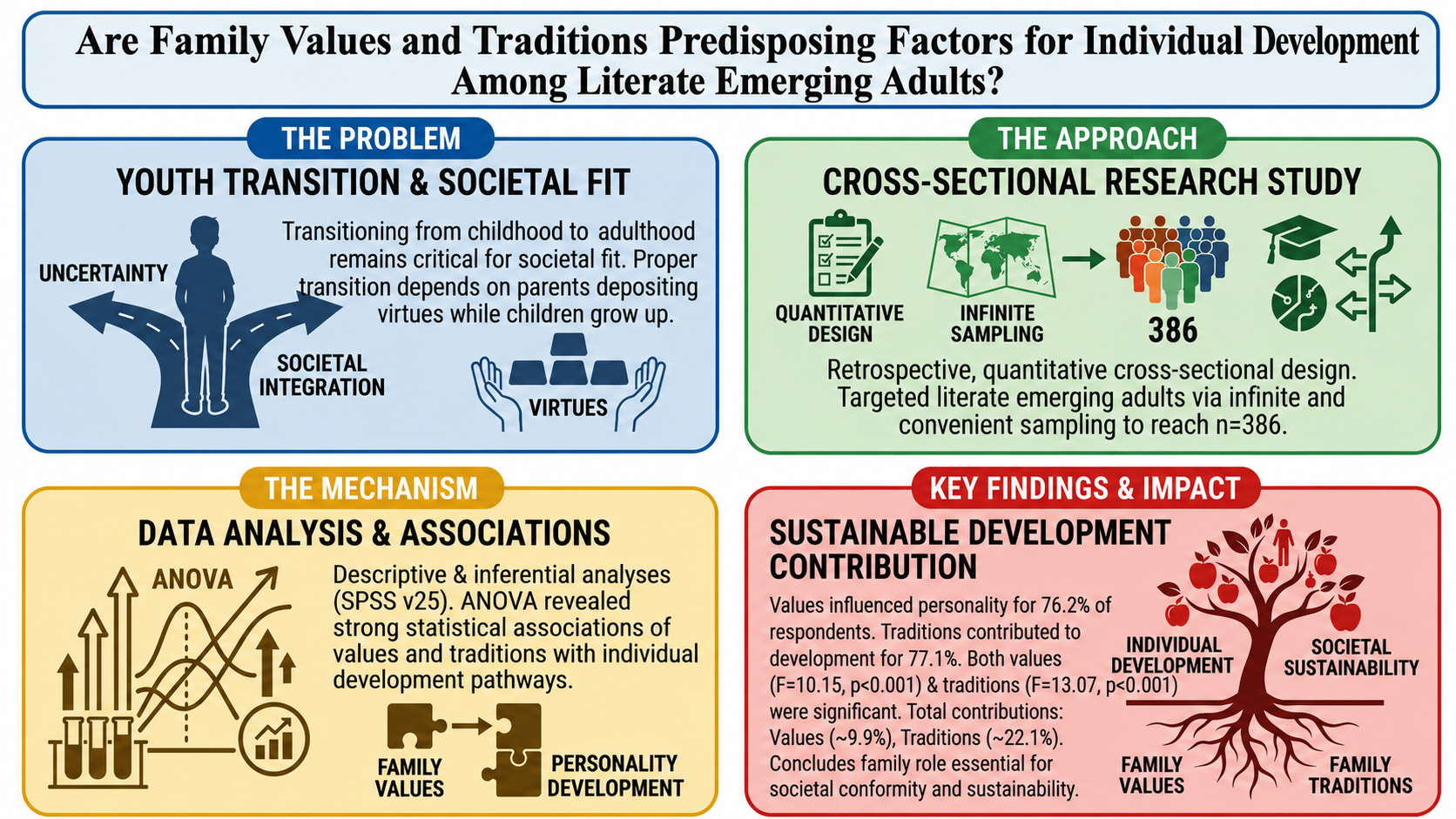
The impact of family formation or systems remains critical to the proper transition from childhood to adulthood. In fact, the extent to which a youth will fit into their immediate society largely depends on the values and virtues instilled in them by their parents while growing up. The study was retrospective and adopted a quantitative cross-sectional research design to investigate the influence of family values and traditions on individual development. Using the infinite sampling method, a total sample size of 386 was derived. The convenience sampling method was used until the target sample size was reached. The outcome variable was individual development, which was measured on the basis of whether the respondents conformed to family values and traditions in their choice of career path, societal norms, and values. The explanatory variables were contextualized into family values and family traditions. The descriptive and inferential analyses were performed using SPSS version 25. The results revealed that 76.2% of the educated emerging adults admitted that their family values influenced their personality development. Additionally, 77.1% of the respondents reported that family traditions contributed to their individual development. The results of the ANOVA revealed that family values (F = 10.15; p < 0.001; F = 3.26; p < 0.05; F = 5.34; p < 0.05) and family traditions (F = 13.07; p < 0.001; F = 14.85; p < 0.001; F = 14.68; p < 0.001) were significantly associated with individual development. The results further revealed that family values and family traditions contributed approximately 9.9% and 22.1%, respectively, to personality development among the respondents. The study concluded that the family plays a significant role in raising of children who grow into adults, which not only conform to the norms and values of society but also contribute positively to the sustainability of societal development in general.
Downloads
Article Details

This work is licensed under a Creative Commons Attribution-NonCommercial-NoDerivatives 4.0 International License.
All rights reserved. Apart from citations for the purposes of research, private study, or criticism and review,no part of this publication may be reproduced, stored or transmitted in any other form without prior written permission by the publisher.
References
Adamsons, K., & Johnson, S. K. (2013). An updated and expanded meta-analysis of non-resident fathering and child well-being. Journal of Family Psychology, 27(4), 589–599. https://doi.org/10.1037/a0033786
Adamsons, K., & Pasley, K. (2013). Refining identity theory to better account for relationship and context: Application to fathering. Journal of Family Theory & Review, 5(3), 159–175. https://doi.org/10.1111/jftr.12014
Adamsons, K., & Pasley, K. (2016). Parents’ fathering identity standards and later father involvement. Journal of Family Issues, 37(2), 221–244. https://doi.org/10.1177/0192513X13514407
Alesina, A. F., & Giuliano, P. (2007). The power of the family (Harvard Institute of Economic Research Discussion Paper No. 2132). SSRN. https://doi.org/10.2139/ssrn.980948
Amato, P. R. (2005). The impact of family formation change on the cognitive, social, and emotional wellbeing of the next generation. Journal of Future of Children, 15(2), 75–96. https://doi.org/10.1353/foc.2005.0012
Anggraini, S., Simatupang, R., Purba, E., & Turnip, H. (2024). Perkembangan Individu Prinsip Dasar Perkembangan Individu [Individual development basic principles of individual development]. Jurnal Trust Pentakosta, 1(1). https://jurnal.institutrenatus.ac.id/index.php/jtp/article/view/312 [in Indonesian]
Bandura, A. (1977). Self-efficacy: Toward a unifying theory of behavioural change. Psychological Review, 84(2), 191–215. https://doi.org/10.1037/0033-295X.84.2.191
Bandura, A. (1999). A social cognitive theory of personality. In L. Pervin & O. John (Eds.), Handbook of personality (2nd ed., pp. 154–196). Guilford Publications.
Banyard, P., & Grayson, A. (2000). Introducing psychological research (2nd rev. ed.). Palgrave Macmillan.
Benson, P. L., Scales, P. C., Hamilton, S. F., & Sesma, A. (2006). Positive youth development: Theory, research and applications. In R. M. Lerner & W. Damon (Eds.), Handbook of child psychology: Theoretical models of human development (6th ed., pp. 894–941). John Wiley & Sons.
Bojar, H. (2005). Family values from the parental perspective. Polish Sociological Review, 151, 281–290. https://www.jstor.org/stable/41274932
Bussey, K., & Bandura, A. (1999). Social cognitive theory of gender development and differentiation. Psychological Review, 106(4), 676–713. https://doi.org/10.1037/0033-295X.106.4.676
Conger, R. D., Conger, K. J., & Martin, M. J. (2010). Socioeconomic status, family processes, and individual development. Journal of Marriage and Family, 72(3), 685–704. https://doi.org/10.1111/j.1741-3737.2010.00725.x
Crocetti, E. (2026). Adolescent identity development processes, implications and interventions. Nature Reviews Psychology, 5, 441–457. https://doi.org/10.1038/s44159-026-00569-8
Doğanülkü, H. A., Duru, H., Pakpour, A. H., & Griffiths, M. D. (2026). A longitudinal mediation model of career self-efficacy, decidedness, and proactive behavior. Scientific Reports, 16, Article 21075. https://doi.org/10.1038/s41598-026-51171-0
Friedrich, T. S., & Schütz, A. (2025). Self-esteem change during career entry. Journal of Adult Development. https://doi.org/10.1007/s10804-025-09541-x
Geldhof, G., Bowers, E. P., Boyd, M. J., Mueller, M. K., Napolitano, C. M., Schmid, K. L., Lerner, J. V., & Lerner, R. M. (2014). Creation of short and very short measures of the five Cs of positive youth development. Journal of Research on Adolescence, 24(1), 163–176. https://doi.org/10.1111/jora.12039
Green, M. G., & Piel, J. A. (2010). Theories of human development: A comparative approach (2nd ed.). Psychology Press. https://doi.org/10.4324/9781315662466
Grusec, J. E., & Davidov, M. (2007). Socialization in the family: The roles of parents. In J. E. Grusec & P. D. Hastings (Eds.), Handbook of socialization: Theory and research (pp. 284–308). Guilford Press.
Hung, M.-T., Wu J., Hung, L.-C., Smith, C. S., & Hung L.-S. (2026). Parental emotional warmth and career choice anxiety: A chain-mediation study in China. Frontiers in Psychology, 17, Article 1813789. https://doi.org/10.3389/fpsyg.2026.1813789
Jessee, V., & Adamsons, K. (2018). Father involvement and father-child relationship quality: An intergenerational perspective. Parenting, 18(1), 24–44. https://www.tandfonline.com/doi/full/10.1080/15295192.2018.1405700
Jeynes, W. (2002). Divorce, family structure, and the academic success of children. Routledge.
Lamanna, M. A., Riedmann, A., & Strahm, A. (2012). Marriages, families, and relationships: Making choices in a diverse society (11th ed.). Cengage Learning; Wadsworth.
Larson, R. W. (2000). Toward a psychology of positive youth development. American Psychologist, 55(1), 170–183. https://doi.org/10.1037/0003-066X.55.1.170
Mackova, J., Dankulincova Veselska, Z., Filakovska Bobakova, D., Madarasova Geckova, A., van Dijk, J. P., & Reijneveld, S. A. (2019). Crisis in the family and positive youth development: The role of family functioning. International Journal of Environmental Research and Public Health, 16(10), Article 1678. https://doi.org/10.3390/ijerph16101678
McLeod, S. (2025, October 16). Albert Bandura’s social learning theory. Simply Psychology. https://www.simplypsychology.org/bandura.html
Palkovitz, R., Trask, B. S., & Adamsons, K. (2014). Essential differences in the meaning and processes of mothering and fathering: Family systems, feminist and qualitative perspective [Special issue]. Journal of Family Theory & Review, 6(4), 406–420. https://doi.org/10.1111/jftr.12048
Rohner, R. P., Putnick, D. L., Molaver, A. D., Ali, S., Butt, M. M., Ibrahim, D. M., Aurino, C., Blom, M. J., Darwesh, F. H., Auricchio, S., Radha, A. H., Miranda, M. C., Adamsons, K., & Senese, V. P. (2020). Psychological maladjustment mediates the link between remembrance of parental rejection in childhood and loneliness in adulthood: A cross‐cultural comparative study. International Journal of Psychology, 55(4), 590–600. https://doi.org/10.1002/ijop.12621
Shehata, M. A., & Zaki, N. M. (2024). Relations between parental acceptance-rejection and forgiveness/ vengeance as mediated by psychological adjustment among Egyptian adults. The Journal of Genetic Psychology, 185(3), 181–193. https://doi.org/10.1080/00221325.2023.2292728
Shirzad, K., Allison, P., & Agans, J. (2026). Integrating purpose, hope, and critical consciousness with the 7C model of positive youth development: A holistic approach to understanding contribution. Frontiers in Developmental Psychology, 4, Article 1735122. https://doi.org/10.3389/fdpys.2026.1735122
Theunissen, M. H., Velderman, M. K., Cloostermans, A. P., & Reijneveld, S. A. (2017). Emotional and behavioural problems in young children with divorced parents. European Journal of Public Health, 27(5), 840–845. https://doi.org/10.1093/eurpub/ckx056
Tomcíková, Z., Veselská, Z. D., Gecková, A. M., van Dijk, J. P., & Reijneveld, S. A. (2015). Adolescents’ drinking and drunkenness more likely in one-parent families and due to poor communication with mother. Central European Journal of Public Health, 23(1), 54–58. http://dx.doi.org/10.21101/cejph.a3951
UK Essays. (2017, May 12). The sociological definition of family. https://www.ukessays.com/essays/sociology/the-definition-of-family-sociology-essay.php?vref=1
Zambelli, M., Tse, D. C. K., Cowden, R. G., Höltge, J., Johnson, B. R., Padgett, R. N., & VanderWeele, T. J. (2025). The psychometric network of individual flourishing across nationally representative samples from 22 countries. Scientific Reports, 15, Article 30206. https://doi.org/10.1038/s41598-025-15016-6
Zittoun, T., & Gillespie, A. (2025). Theorising human development in adult life: A complex, multidimensional, dynamic, situated model. Integrative Psychological and Behavioural Science, 59, Article 77. https://doi.org/10.1007/s12124-025-09946-z
