
Local and universal principles of cultural heritage at Candi Borobudur and Wat Phra Mahathat Woramahawihan
Article Sidebar
Main Article Content
Abstract
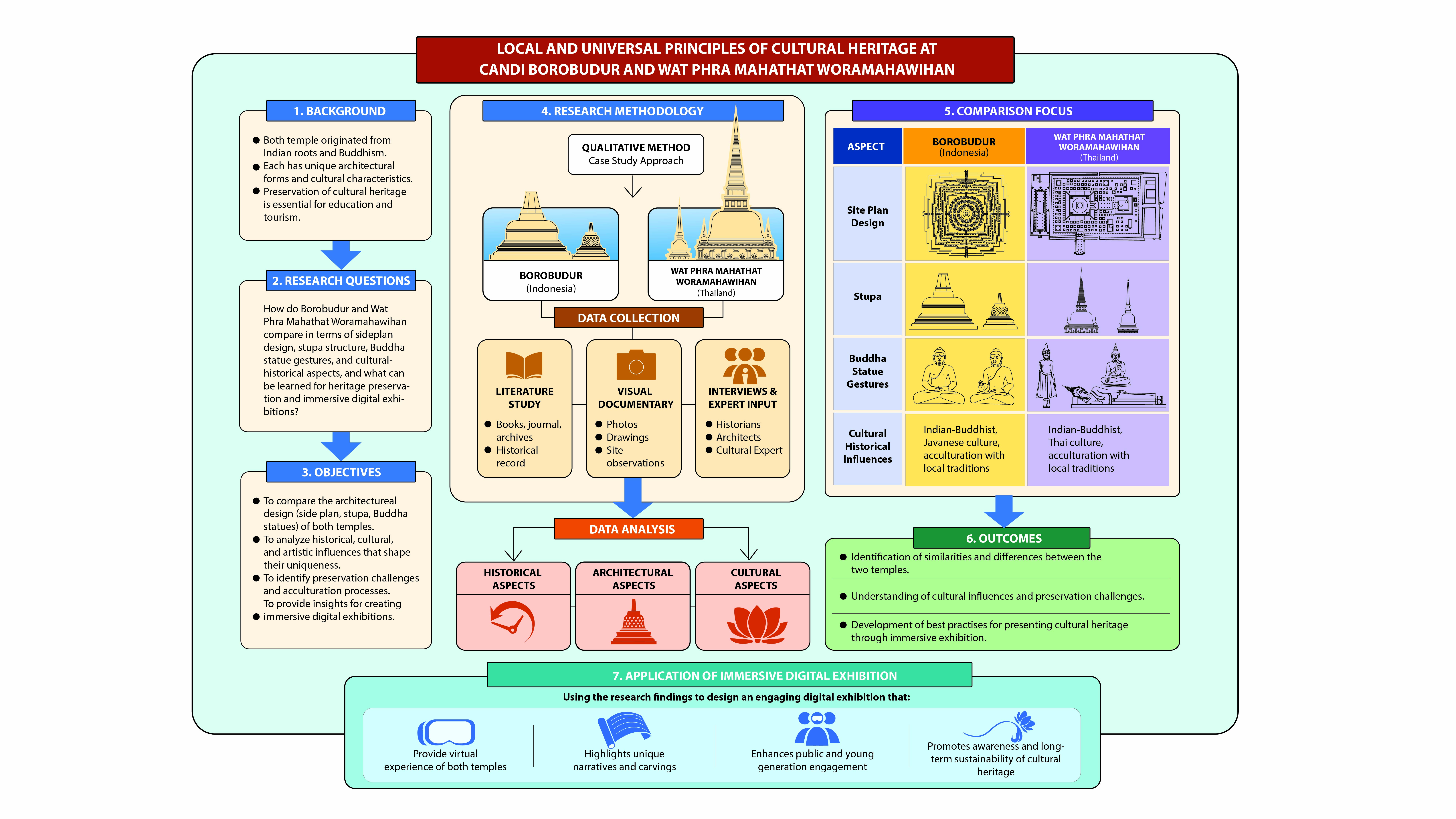
This study explores the preservation of cultural heritage through a qualitative comparative case study of two iconic Buddhist temples: Candi Borobudur in Indonesia and Wat Phra Mahathat Woramahawihan in Thailand. Although both temples have reflected Buddhist traditions originating in India and serve similar religious functions, each temple reflects distinct architectural forms, spatial organization and cultural characteristics shaped by local contexts. The main research question of this study is how these two temples compare in terms of cultural, historical, and architectural elements, and what these differences reveal about their preservation and cultural significance. Using a qualitative approach, this research examines the overall site plans and key architectural components of both temples, including stupas, overall site plan designs, structural layout and the mudrā represented in Buddha statues. The analysis highlights how processes of acculturation, local adaptation, and foreign cultural influences have shaped the development of each temple. While Borobudur temple demonstrates a monumental mandala-based structure influenced by Javanese cosmology and Indian Buddhist philosophy, Wat Phra Mahathat Woramahawihan reflects Thailand’s architectural traditions and regional interpretations of Buddhist symbolism. The study reveals shared histories of acculturation influenced by local and foreign cultures, thereby shedding light on their respective cultural contexts and preservation challenges. By comparing these two heritage sites, this study contributes to a deeper understanding of cultural heritage preservation in Southeast Asia and provides insights into the challenges of maintaining religious monuments while respecting their historical and cultural identities.
Downloads
Article Details

This work is licensed under a Creative Commons Attribution-NonCommercial-NoDerivatives 4.0 International License.
All rights reserved. Apart from citations for the purposes of research, private study, or criticism and review,no part of this publication may be reproduced, stored or transmitted in any other form without prior written permission by the publisher.
References
Arporn, V. (2021). Strategies employed by the locals in the process of nominating Wat Phra Mahathat Woramahawihan temple to be inscribed on the world heritage list. Asian Journal of Arts and Culture, 21(1), 70–82. https://doi.org/10.48048/ajac.2021.248959
Creswell, J. W., & Creswell, J. D. (2018). Research design: Qualitative, quantitative, and mixed methods approaches (5th ed.). Sage.
Gifford, J. A. (2011). Buddhist practice and visual culture: The visual rhetoric of Borobudur. Routledge. https://doi.org/10.4324/9780203829813
Groslier, P. B. (2007). Indocina, Persilangan Kebudayaan [Indochina, a crossroads of cultures]. Popular Literature Gramedia. [in Indonesian]
Harari, Y. N. (2018). Adab untuk Abad ke 21 [Manners for the 21st century]. Global Indo Creative. [in Indonesian]
Isrow, Z. (2017). Defining art and its future. Journal of Arts & Humanities, 6(6), 84–94. https://doi.org/10.18533/journal.v6i6.1207
Kirdsiri, K. (2012). The Buddhism architectural heritage of Wat Phra Mahathat Woramahawihan, Nakhon Si Thammarat. Learning Architectural Heritage. [in Thai]
Mondloch, K. (2022). The influencers: Van Gogh immersive experiences and the attention-experience economy. Arts, 11(5), Article 90. https://doi.org/10.3390/arts11050090
Nabila, K., Surya, P. D., Wirawan, M. S. A., Nisa, R. K., & Nugrahani, D. S. (2022). Relief Dan Struktur Stupa Candi Borobudur Ditinjau Secara Arkeoastronomi [The relief and structure of the stupa of Borobudur temple from an archaeoastronomical perspective]. Journal of Archaeological Research and Development, 40(2), 145–160. https://doi.org/10.55981/amt.2022.42 [in Indonesian]
Patnukao, A., Cheewinsiriwat, P., Bamrungkhul, S., & Vannametee, E. (2024). Tracing human settlements: Analyzing the spatio-temporal distribution of Buddhist temples in Nakhon Si Thammarat, Thailand. GeoJournal, 89, Article 60. https://doi.org/10.1007/s10708-024-11056-z
Perkins, M. (2024, August 29). Buddha statues: Meaning of postures and poses. Learn Religions. https://www.learnreligions.com/buddha-statues-meaning-of-postures-and-poses-4781351
Pickvance, C. G. (2001). Four varieties of comparative analysis. Journal of Housing and the Built Environment, 16, 7–28. https://doi.org/10.1023/A:1011533211521
Piplani, N., & Brar, T. S. (2020). Maṇḍala in architecture: Symbolism and significance for contemporary design education in India. Journal of Education: Studies in Education, 8(4), 171–191. https://doi.org/10.22492/ije.8.4.10
Puspitasari, D. E., Setyawan, H., & Rini, W. D. P. (2018). The Architecture of Borobudur Temple. Balai Konservasi Borobudur.
Putra, G. A., & Yuliati, Y. (2021). Menilik diplomasi pendidikan Agama Buddha oleh Kerajaan Sriwijaya dalam Prasasti Nalanda abad ke-9 M [Examining the educational diplomacy of Buddishm by the Sriwijaya kingdom in the 9th century AD Nalanda inscription]. Historiography: Journal of Indonesian History and Education, 1(3), 343–351. https://doi.org/10.17977/um081v1i32021p343-351 [in Indonesian]
Soekmono, R. (1976). Chandi Borobudur: A monument of mankind. The Unesco Press.
Soekmono, R. (2005). The restoration Borobudur (World Heritage Series). UNESCO Publishing.
Suebsantiwongse, S. (2022). Cosmos encapsulated: The Maṇḍala-stūpa of Borobudur–its polysemic form and functions. Journal of the SEAMEO Regional Centre for Archaeology and Fine Arts, 6. https://doi.org/10.26721/spafajournal.us2f62doi4
Tanudirjo, D. A. (2013). Changing perspective on the relationship between heritage, landscape and local communities: A lesson from Borobudur. In S. Brockwell, S. O’Connor, & D. Byrne (Eds.), Transcending the culture–nature divide in cultural heritage: Views from the Asia–Pacific region (pp. 65–82). ANU Press.
Thailand Tourism Directory. (2021). Wat Phra Mahathat Wora Mahawihan. Ministry of Tourism and Sports. https://thailandtourismdirectory.go.th/en/attraction/21136
Thinnakorn, W. (2021). The urban image conservation and development of Nakhon Si Thammarat’s old town community in Thailand. Journal of Environmental Design and Planning, 20(3), Article 120. https://doi.org/10.54028/NJ202120120
UNESCO. (2012). Wat Phra Mahathat Woramahawihan, Nakhon Si Thammarat. UNESCO World Heritage Convention. https://whc.unesco.org/en/tentativelists/5752/
Yazir, M., & Heraty, T. (1991). Borobudur. Djambatan. [in Indonesian]
