
Artificial intelligence precision: Understanding Islamic profit-and-loss sharing contracts for early learners
Article Sidebar
Main Article Content
Abstract
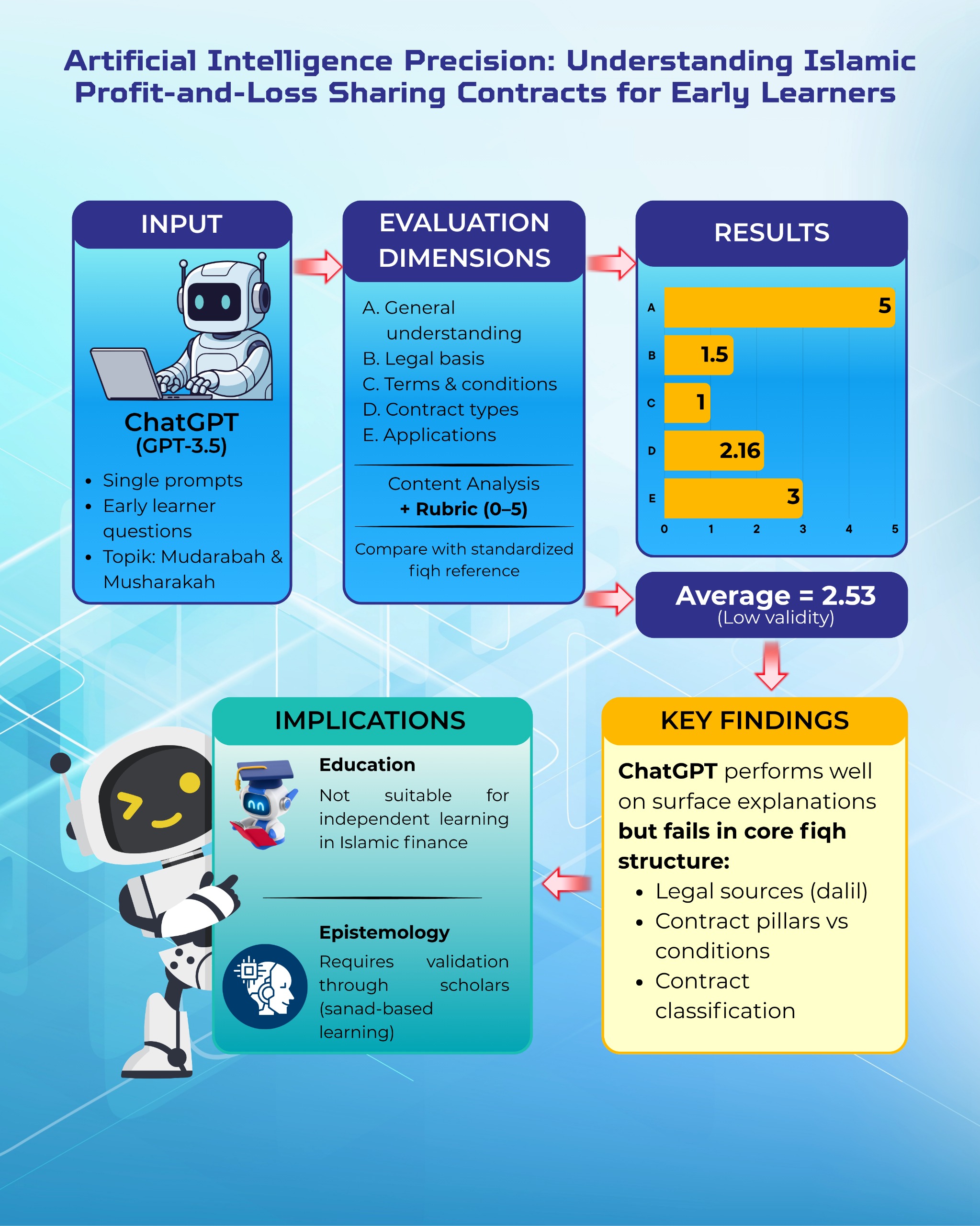
As artificial intelligence increasingly serves as an educational shortcut for learners navigating complex subjects, this study evaluates whether the practical efficacy of these platforms aligns with current expectations. Specifically, we examine the capacity of ChatGPT to accurately explicate Mudarabah and Musharakah, the foundational profit and loss sharing contracts in Islamic finance. To assess this systematically, the core knowledge of these contracts was categorised into five critical dimensions: general comprehension, legal basis, specific terms and conditions, contract typologies, and practical industry applications. In January 2024, structured prompts were submitted to the free public version of ChatGPT, specifically GPT version 3.5, and the generated responses were rigorously evaluated on a scale from 0 to 5. These outputs were benchmarked against the standardised reference texts used for certifying Shari’ah supervisors. The results reveal significant limitations in the factual accuracy of the model. Most notably, the terms and conditions dimension, a critical component of Islamic financial compliance, yielded a validity score of less than 2. With an overall average validity score of just 2.53, the findings indicate that ChatGPT is currently too unreliable to serve as an independent foundational learning tool in this domain. Ultimately, while artificial intelligence offers compelling educational potential, this study underscores the necessity of exercising strict caution when relying on autonomous tools to navigate highly specialised, deeply nuanced intersections of religion and finance.
Downloads
Article Details

This work is licensed under a Creative Commons Attribution-NonCommercial-NoDerivatives 4.0 International License.
All rights reserved. Apart from citations for the purposes of research, private study, or criticism and review,no part of this publication may be reproduced, stored or transmitted in any other form without prior written permission by the publisher.
References
Abusharbeh, M. T. (2014). Credit risks and profitability of Islamic banks: Evidence from Indonesia. World Review of Business Research, 4(3), 136–147.
Agbi, A., & Yuangsoi, P. (2022). Enhancement of critical thinking skills in students using mobile-blended learning with a collaborative inquiry-based approach. Humanities, Arts and Social Sciences Studies, 22(1), 9–20. https://doi.org/10.14456/hasss.2022.2
Alam, A., Ratnasari, R. T., Qolbi, F. ‘A., & Athief, F. H. N. (2022). Efficiency studies of the sharia insurance industry: A systematic literature review. Insurance Markets and Companies, 13(1), 90–101. http://dx.doi.org/10.21511/ins.13(1).2022.08
Alawida, M., Mejri, S., Mehmood, A., Chikhaoui, B., & Abiodun, O. I. (2023). A comprehensive study of ChatGPT: Advancements, limitations, and ethical considerations in natural language processing and cybersecurity. Information, 14(8), Article 462. https://doi.org/10.3390/info14080462
Amaro, I., Della Greca, A., Francese, R., Tortora, G., & Tucci, C. (2023). AI unreliable answers: A case study on ChatGPT. In H. Degen, & S. Ntoa (Eds.), Artificial intelligence in HCI (pp. 23–40). Springer. https://doi.org/10.1007/978-3-031-35894-4_2
Antwi, S. K., & Kasim, H. (2015). Qualitative and quantitative research paradigms in business research: A philosophical reflection. European Journal of Business and Management, 7(3), 217–225.
Athief, F. H. N. (2019). Konsep ‘Urf Sebagai Variabel Produk Hukum [The concept of ‘Urf as a variable in legal products]. Suhuf: International Journal of Islamic Studies, 31(1), 40–57. https://journals.ums.ac.id/index.php/suhuf/article/view/9004 [in Indonesian]
Athief, F. H. N., Ma’ruf, A., & Zakiy, F. S. (2022). Surviving amidst pandemic: Indonesian Islamic microfinance experience. International Journal of Advanced and Applied Sciences, 10(3), 119–129. https://doi.org/10.21833/ijaas.2023.03.016
Athief, F. H. N., Mawardi, I., Assholihah, K., Mukhlis, F., & Apriantoro, M. S. (2025). Artificial intelligence and Islamic law in finance: Assessing ChatGPT’s responses to public doubts on Riba. Manchester Journal of Transnational Islamic Law and Practice, 21(4), 92–107. https://www.electronicpublications.org/stuff/1298
Ayu, D. (2019). Muḍāraba Fund of Bank Jateng Syariah Cabang Surakarta (BJSCS) according to Dewan Syariah National-Majelis Ulama Indonesia (DSN-MUI). Journal of Islamic Economic Laws, 2(1), 1–29. https://doi.org/10.23917/jisel.v2i1.6129
Bengtsson, M. (2016). How to plan and perform a qualitative study using content analysis. NursingPlus Open, 2, 8–14. https://doi.org/10.1016/j.npls.2016.01.001
Buchanan, J., Hill, S., & Shapoval, O. (2024). ChatGPT hallucinates non-existent citations: Evidence from economics. The American Economist, 69(1), 80–87. https://doi.org/10.1177/05694345231218454
Buldur, M., & Sezer, B. (2023). Can artificial intelligence effectively respond to frequently asked questions about fluoride usage and effects? A qualitative study on ChatGPT. Fluoride, 56(3), 201–216.
Daabi, M. K. I., & Inayati, N. L. (2023). Increasing learning achievement in Islamic religious education through a contextual learning approach of students. Al Qalam: Jurnal Ilmiah Keagamaan Dan Kemasyarakatan, 17(6), 4422–4429. http://dx.doi.org/10.35931/aq.v17i6.2829
Daud, R., Basir, N., Rafei Heng, N. F. N. M., Meor Sepli, M. M. S., & Melinda, M. (2025). Evaluating large language model versus human performance in Islamophobia dataset annotation. International Journal of Advanced Computer Science and Applications, 16(5), 111–122. http://doi.org/10.14569/ijacsa.2025.0160512
Dawson, P. (2017). Assessment rubrics: Towards clearer and more replicable design, research and practice. Assessment & Evaluation in Higher Education, 42(3), 347–360. https://doi.org/10.1080/02602938.2015.1111294
Downe-Wamboldt, B. (1992). Content analysis: Method, applications, and issues. Health Care for Women International, 13(3), 313–321. https://doi.org/10.1080/07399339209516006
D’Souza, R. F., Amanullah, S., Mathew, M., & Surapaneni, K. M. (2023). Appraising the performance of ChatGPT in psychiatry using 100 clinical case vignettes. Asian Journal of Psychiatry, 89, Article 103770. https://doi.org/10.1016/j.ajp.2023.103770
Dzulraidi, D. H., Jalil, A. A., & Sin, M. L. M. (2025). The accuracy of ChatGPT in translating the Qur’an: A comparative analysis with authoritative translation. International Journal of Quranic Research, 17(2), 21–52. https://sare.um.edu.my/index.php/quranica/article/view/64933
Elbih, R. (2015). Teaching about Islam and Muslims while countering cultural misrepresentations. The Social Studies, 106(3), 112–116. https://doi.org/10.1080/00377996.2015.1015712
Firat, M. (2023). How ChatGPT can transform autodidactic experiences and open education? Open Science Framework. https://doi.org/10.31219/osf.io/9ge8m
Ghomi, M., Moslemi, Z., & Mohammadi, S. D. (2017). The relationship between self-directed learning with academic adjustment and academic performances in students in Qom University of Medical Sciences. Educational Development of Judishapur, 8(3), 260–274.
Karanjai, R., Li, E., Xu, L., & Shi, W. (2023, October 11–13). Who is smarter? An empirical study of AI-based smart contract creation [Paper presentation]. 2023 5th Conference on Blockchain Research & Applications for Innovative Networks and Services (BRAINS), Paris, France. https://doi.org/10.1109/BRAINS59668.2023.10316829
Knowles, M. S. (1975). Self-directed learning: A guide for learners and teachers. Association Press.
Maliki, I. A., Ali, Z. Z., & Khusaini, M. (2023). Artificial intelligence and the law: The use of artificial intelligence as a tool to assist judges in deciding polygamy cases. Nurani: Jurnal Kajian Syari’ah Dan Masyarakat, 23(2), 211–228. https://doi.org/10.19109/nurani.v23i2.20152
Maulana, A. A., & Muthoifin. (2024). Analysis of Musyarakah and its implementation at BMT Fadhilah Sentosa Bekonang. Al-Afkar: Journal for Islamic Studies, 7(1), 135–145.
Mohammad-Rahimi, H., Ourang, S. A., Pourhoseingholi, M. A., Dianat, O., Dummer, P. M. H., & Nosrat, A. (2023). Validity and reliability of artificial intelligence chatbots as public sources of information on endodontics. International Endodontic Journal, 57(3), 305–314. https://doi.org/10.1111/iej.14014
Mohammed, M. Y., Ali, S. A., Ali, S. K., Majeed, A. A., & Mohamed, E. H. (2025). Aftina: Enhancing stability and preventing hallucination in AI-based Islamic fatwa generation using LLMs and RAG. Neural Computing and Applications, 37, 20957–20982. https://doi.org/10.1007/s00521-025-11229-y
Mubarak, J. H., & Hasanudin. (2017). Fikih muamalah maliyyah: Akad syirkah dan mudharabah [Islamic financial jurisprudence: Partnership and mudarabah contracts]. Simbiosa Rekatama Media. [in Indonesian]
Nakissa, A. (2019). The anthropology of Islamic law: Education, ethics, and legal interpretation at Egypt’s Al-Azhar. Oxford University Press.
Narenji Thani, F., Keramati, M., & Sohi, M. (2022). The role of self-directed learning in the effectiveness of e-learning during the COVID-19 pandemic. Technology of Education Journal, 16(3), 571–589. https://doi.org/10.22061/tej.2022.8299.2648
Nasution, N., Rahayu, R. F., Yazid, S. T. M., & Amalia, D. (2018). Pengaruh kemandirian belajar terhadap hasil belajar siswa [The effect of learning independence on students’ learning outcomes]. Jurnal Pendidikan Luar Sekolah, 12(1), 9–14. https://doi.org/10.32832/jpls.v12i1.2879 [in Indonesian]
Oke, S. A. (2008). A literature review on artificial intelligence. International Journal of Information and Management Sciences, 19(4), 535–570.
Salman, K. R. (2022). The determinants of profit-loss sharing financing of Islamic banks in Indonesia. Jurnal Ekonomi dan Perbankan Syariah, 13(2), 95–111. https://doi.org/10.18326/muqtasid.v13i2.95-111
Scquizzato, T., Semeraro, F., Swindell, P., Simpson, R., Angelini, M., Gazzato, A., Sajjad, U., Bignami, E. G., Landoni, G., Keeble, T. R., & Mion, M. (2024). Testing ChatGPT ability to answer laypeople questions about cardiac arrest and cardiopulmonary resuscitation. Resuscitation, 194, Article 110077. https://doi.org/10.1016/j.resuscitation.2023.110077
Sembok, T. M. T., & Wani, S. (2023, October). Is ChatGPT not appropriate for religious use? In H. B. Zaman, P. Robinson, A. F. Smeaton, R. L. De Oliveira, B. N. Jørgensen, T. K. Shih, R. A. Kadir, U. H. Mohamad, & M. N. Ahmad (Eds.), International Visual Informatics Conference (pp. 595–605). Springer. https://doi.org/10.1007/978-981-99-7339-2_48
Setiawan, A., & Luthfiyani, U. K. (2023). Penggunaan ChatGPT Untuk Pendidikan di Era Education 4.0: Usulan Inovasi Meningkatkan Keterampilan Menulis [The use of ChatGPT for education in the education 4.0 era: An innovation proposal to improve writing skills]. Jurnal PETISI (Pendidikan Teknologi Informasi), 4(1), 49–58. [in Indonesian]
Susanti, N. F. H., Tanjung, H., Supriyanto, T., Athief, F. H. N., & Furqoni, A. (2025). ChatGPT’s validity and reliability in Islamic legal studies: A critical assessment of Waqf for early learners. Suhuf: International Journal of Islamic Studies, 37(2), 288–309. https://doi.org/10.23917/suhuf.v37i2.11821
Sutrisno, S., & Widarjono, A. (2022). Is profit-loss-sharing financing matter for Islamic Bank’s profitability? The Indonesian case. Risks, 10(11), Article 207. https://doi.org/10.3390/risks10110207
Wu, T., He, S., Liu, J., Sun, S., Liu, K., Han, Q.-L., & Tang, Y. (2023). A brief overview of ChatGPT: The history, status quo and potential future development. Journal of Automatica Sinica, 10(5), 1122–1136. https://doi.org/10.1109/JAS.2023.123618
Yuspin, W., Budiwati, S., Inayah, & Maulani, I. (2020). Legal reconstruction of Mudharabah: A comparative study on the compilation of Islamic economic law and financial services authority regulation. International Journal of Innovation, Creativity and Change, 12(2), 1–21. https://ijicc.net/images/vol12/iss2/12201_Yuspin_2020_E_R.pdf
Yuspin, W., Wardiono, K., Budiono, A., & Gulyamov, S. (2022). The law alteration on artificial intelligence in reducing Islamic bank’s profit and loss sharing risk. Legality: Jurnal Ilmiah Hukum, 30(2), 267–282. https://doi.org/10.22219/ljih.v30i2.23051
