ANALYSIS OF MEMORY OBJECTS IN MIXED MEDIA PAINTING: TRACES OF MY MOTHER AND I
Keywords:
Mother and Daughter, Traces, Memory Objects, Mixed Media PaintingAbstract
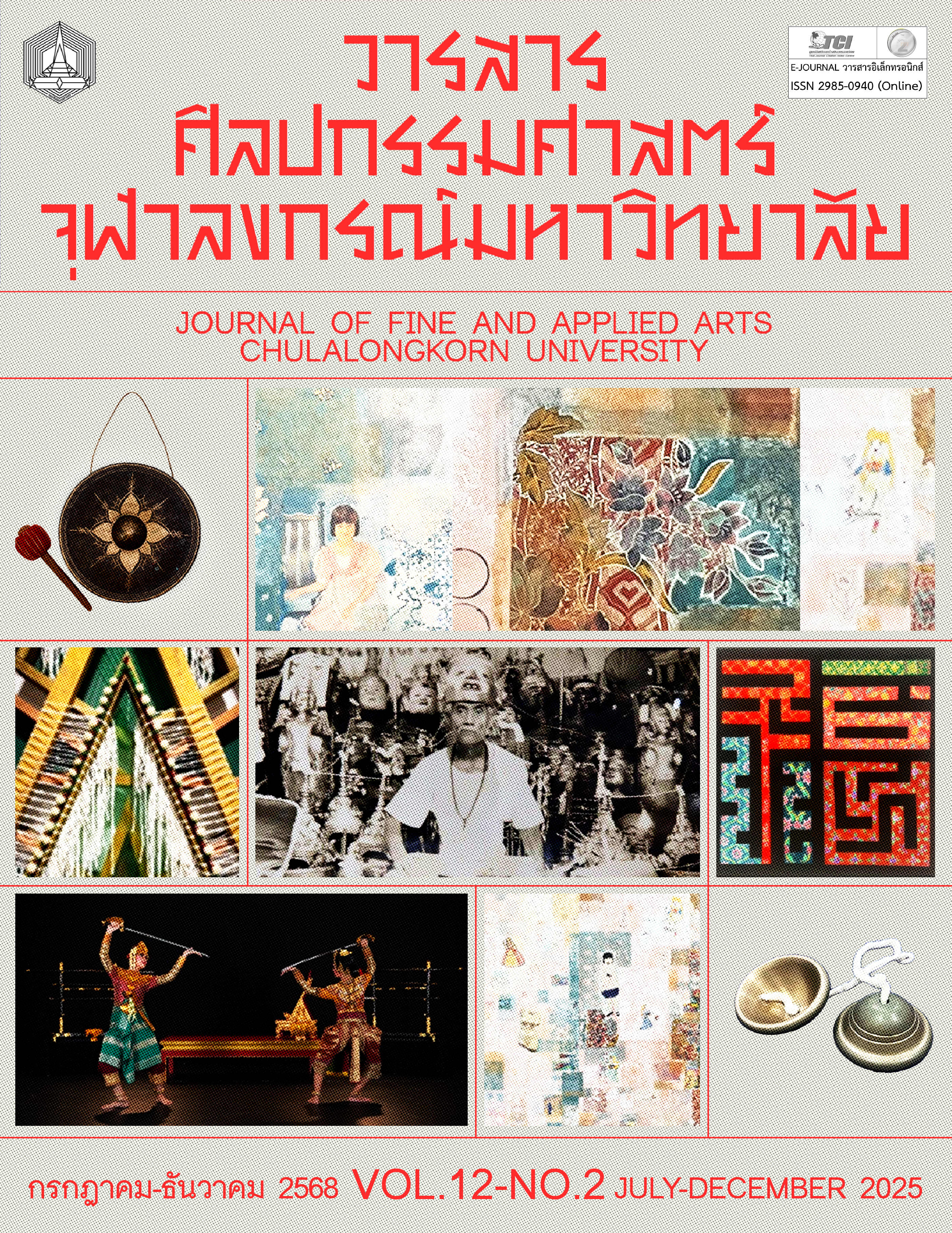
Going back and reviewing my childhood experiences in my hometown, Nakhon Si Thammarat Province, leads to an understanding of memories from past experiences. The relationship between mother and daughter leads to the concept of the overlapping of shared memories; it reveals the value of a mother’s love through the study of memory objects in creative works. This article is part of the creative research on mixed media painting: traces of me and my mother. The objectives are 1. to analyze stories from memory objects in the hometown of Nakhon Si Thammarat that convey love and the bond between mother and child leading to the creation of a unique identity; 2. to study theories and techniques for creating symbols in mixed-media painting, and 3. to create mixed-media paintings that reflect memories, love, and the bond between mother and child. There are research methods, including surveying and observing memory objects in the hometown area, Nakhon Si Thammarat. This research article studies theory of memory, semiology, and an interview with the researcher's mother about past experiences.
The results of the study resulted in gaining knowledge of the process of creating four sets of mixed media paintings that developed symbols from my mother’s Pa-teh (Batik Sarong) patterns, and my childhood paintings, which is something that communicates stories showing the existence of the past through traces on the surface of mixed-media paintings, revealing the conversation between mother and child and the harmony of different traces, and returning to interact with past experiences again shows the continuing memory, love, and bond between mother and child that continues from the past to the present.
References
จิระพัฒน์ พิตรปรีชา. (2552). โลกศิลปะศตวรรษที่ 20. เมืองโบราณ.
เจษฎากร บุญครองธรรม. (2564). ความทรงจำและการนำเสนออดีตในปอล ริเคอร์. [วิทยานิพนธ์ระดับปริญญามหาบัณฑิต, จุฬาลงกรณ์มหาวิทยาลัย].
Collins-Kreiner, N, and Yael, Z. (2011). Tourists and Souvenirs: Changes through Time, Space and Meaning. Journal of Heritage Tourism. 6(1). p. 17–27.
Na, Z., Yang, A., and Zou Y. (2015). Research on the design of tourist souvenirs based on emotional memory. Art and Design Theory. 2(3). p. 131-133.
Peters, K. (2011). Negotiating the Place and Placement of Banal Tourist Souvenirs in the Home. Tourism Geographies. 13(2). p. 234-256.
Laurence, R. (2023). Souvenirs in Ancient Rome. The Classical Review. 73(2) p. 654-656.
Salem, H. M. A. N. (2019). Specific selective media inspiring ideas of visual expression in the artistic space: an applied study in the field of painting for the interphone and transient exhibition the medium survival and the surfaces is a visual passion. International Journal of Multidisciplinary Studies in Art and Technology. 2(20) p. 7-11.
Smith, G. (2014). Contemplating Photographs in Rauschenberg’s Early Work. History of Photography. 38(2). p. 113–136.
Tellgren, A. (2007). Rauschenberg’s Swedish Combines. Konsthistorisk Tidskrift Journal of Art History. 76(1–2). p. 72–77.
Downloads
Published
Issue
Section
License
Copyright (c) 2025 NATIMA SUWANNAWONG, KAMOL PHAOSAVASDI, KITSIRIN KITISAKON

This work is licensed under a Creative Commons Attribution-NonCommercial-NoDerivatives 4.0 International License.
ลิขสิทธิ์ของบทความเป็นของเจ้าของบทความ บทความที่ได้รับการตีพิมพ์ถือเป็นทัศนะของผู้เขียน
กองบรรณาธิการไม่จำเป็นต้องเห็นด้วยและไม่รับผิดชอบต่อบทความนั้น