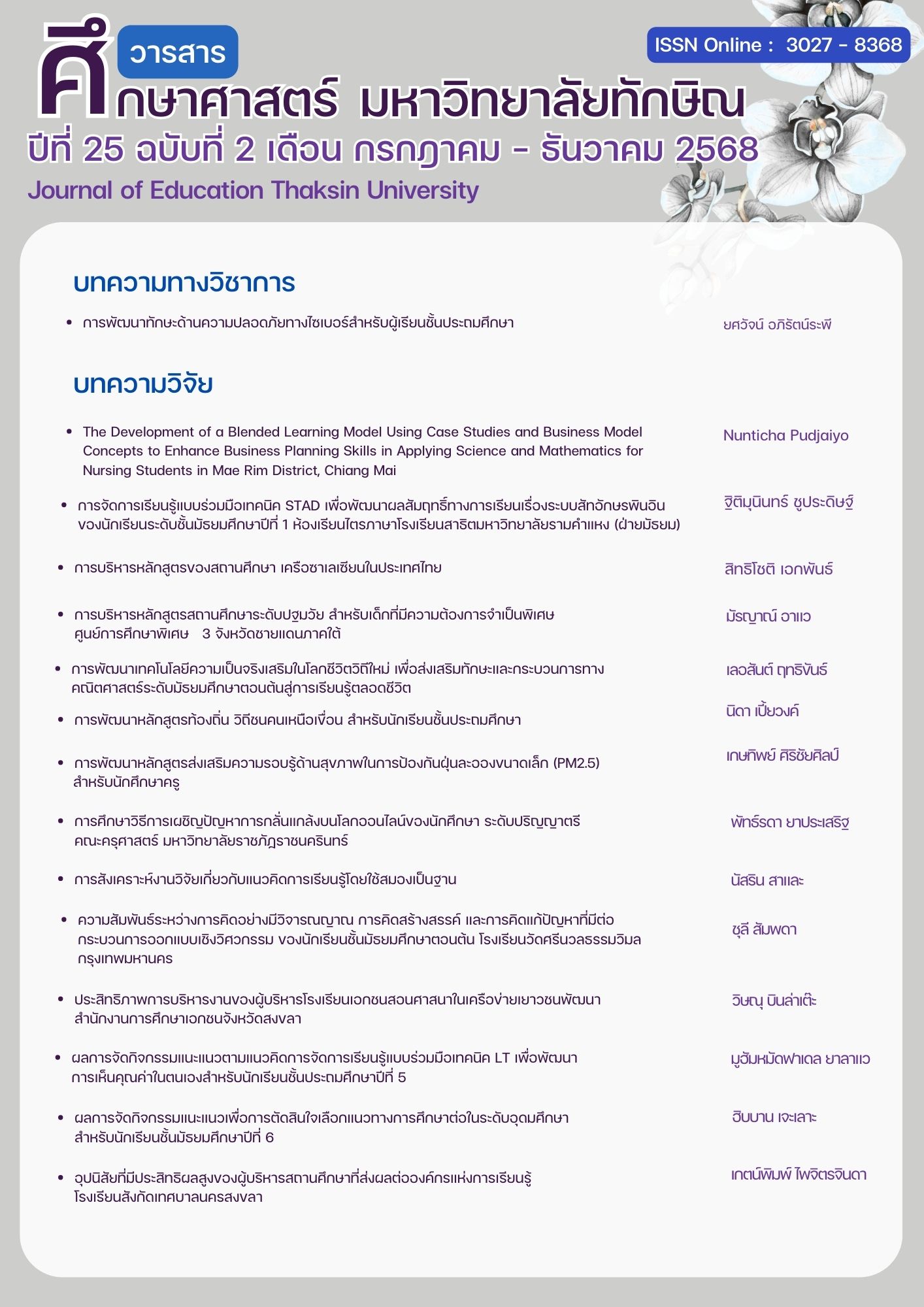
A Study of Faculty of Education Rajabhat Rajanagarindra University Undergraduate Students' Coping Strategies for the Cyberbullying.
Article Sidebar
Main Article Content
Abstract
This study aimed to 1) develop a measurement scale for coping strategies in cyberbullying among undergraduate students in the Faculty of Education at Rajanagarindra Rajabhat University, and 2) investigate the levels of coping strategies with cyberbullying among these students. Data were collected using a coping strategies scale for cyberbullying from a sample of 379 undergraduate students, ranging from first- to fourth-year students in the first semester of the 2024 academic year. The participants were from the Faculty of Education, Rajabhat Rajanagarindra University, and were selected through accidental sampling.
The results revealed that the overall level of coping strategies for dealing with cyberbullying among undergraduate students was high, with an average score of 4.14. When analyzed by specific dimensions, Online security was rated the highest, with an average score of 4.29. This was followed by self-awareness (mean = 4.12), emotional management (mean = 4.10), social support (mean = 4.09), and problem-focused management (mean = 4.09), respectively.
Article Details

This work is licensed under a Creative Commons Attribution-NonCommercial-NoDerivatives 4.0 International License.
ในกรณีที่กองบรรณาธิการ หรือผู้เชี่ยวชาญ ซึ่งได้รับเชิญให้เป็นผู้ตรวจบทความวิจัย หรือ บทความทางวิชาการมีความเห็นว่าควรแก้ไขความบกพร่อง ทางกองบรรณาธิการจะส่งต้นฉบับให้ ผู้เขียนพิจารณาจัดการแก้ไขให้เหมาะสมก่อนที่จะลงพิมพ์ ทั้งนี้ กองบรรณาธิการจะยึดถือความคิด เห็นของผู้เชี่ยวชาญเป็นเกณฑ์
References
กรรณิการ์ พันทอง. (2563). การเสริมสร้างความยืดหยุ่นทางจิตใจและกลวิธีการจัดการของวัยรุ่นที่ถูกรังแกผ่าน โลกไซเบอร์โดยใช้การให้คำปรึกษากลุ่มตามแนวคิดการปรับความคิดโดยใช้สติเป็นฐาน (ดุษฎีนิพนธ์ ปรัชญาดุษฎีบัณฑิต สาขาวิชาจิตวิทยาประยุกต์). สถาบันวิจัยพฤติกรรมศาสตร์ มหาวิทยาลัย
ศรีนครินทรวิโรฒ.
ชัชฎาภรณ์ พรมนอก, สุพร อภินันทเวช และวิมลทิพย์ มุสิกพันธ์. (2562). การศึกษาเชิงคุณภาพเรื่องพฤติกรรม
การข่มเหงรังแกกันบนโลกไซเบอร์ของนักเรียนชั้นประถมศึกษาปีที่ 4 - 6 โรงเรียนในสังกัดกรุงเทพมหานคร. วารสารพยาบาลสาธารณสุข, 33(1), 20-39.
วัชรพงษ์ ศรีสุข และปัทมนันท์ ปุณเสรีพิพัฒน์. (2567). การระรานทางไซเบอร์: มุมมองของนักศึกษาผู้ถูกระรานและปฏิบัติการในการรับมือ. วารสารวิจัยสังคมและปริทัศน์, 47(2), 1-19.
สุภาวดี เจริญวานิช. (2560). การรังแกกันผ่านพื้นที่ไซเบอร์: ผลกระทบและการป้องกันในวัยรุ่น. วารสาร วิทยาศาสตร์และเทคโนโลยี, 25(4), 639-648.
Altundağ, Y., & Ayas, T. (2020). Effectiveness of the whole school-based program for equipping high school counselors with strategies of coping with cyberbullying and cyberbullying awareness. Education and Science, 45(201), 109–123.
Chen, Q., Lu, Z., Liu, B., Xiao, Q., Zhu, Y., & Chan, K. L. (2024). Validation of the Chinese version of the coping strategies for victims of cyberbullying scale. BMC Psychology, 12, 259.
Coyne, S. M., Padilla-Walker, L. M., & Howard, E. (2021). Emotion regulation as a moderator in the relation between cyberbullying and mental health outcomes among university students. Journal of Cyberpsychology, Behavior, and Social Networking, 24(2), 123-130.
DQ Institute. (2023). 2023 Child Online Safety Index report. Retrieved from https://www.dqinstitute.org/child-online-safety/
Gavcar, E. G., Büber, A., & Şenol, H. (2024). Adolescents’ methods for coping with cyberbullying. Turkish Journal of Child and Adolescent Mental Health, 31(1), 55-61.
Heiman, T., & Olenik-Shemesh, D. (2020). Social-emotional profile of children with and without learning disabilities: The relationships with perceived loneliness, self-efficacy and well- being. International journal of environmental research and public health, 17(20), 7358.
kowalski, R. M., Giumetti, G. W., Schroeder, A. N., & Lattanner, M. R. (2017). Bullying in the digital age: A critical review and meta-analysis of cyberbullying research among youth. Psychological Bulletin, 140(4), 1073–1137.
Lemeshow, S., Hosmer, D. W., Jr., Klar, J., & Lwanga, S. K. (1990). Adequacy of sample size in health studies (pp. 1-5). John Wiley & Sons.
Smith, P. K., Mahdavi, J., Carvalho, M., & Tippett, N. (2018). Cyberbullying: Its nature and impact on secondary school pupils. Journal of Child Psychology and Psychiatry, 49(4), 376–385.
Trizano-Hermosilla, I., & Alvarado, J. M. (2016). Best alternatives to Cronbach's alpha reliability in realistic conditions: Congeneric and asymmetrical measurements. Frontiers in Psychology, 7, 769.
UNICEF. (2020). Cyberbullying: What is it and how to stop it. Retrieved from https://www.unicef.org
Wang, X., Yang, J., Wang, P., & Lei, L. (2019). Study of the influencing factors of cyberbullying among Chinese college students incorporated with digital citizenship: From the perspective of individual students. Frontiers in Psychology, 10, 1103.
Yamane, T. (1973). Statistics: An introductory analysis (3rd ed.). Harper & Row.
Yurdakul, Y., & Ayhan, A. B. (2023). The effect of the cyberbullying awareness program on adolescents’ awareness of cyberbullying and their coping skills. Current Psychology, 42, 24208–24222.
