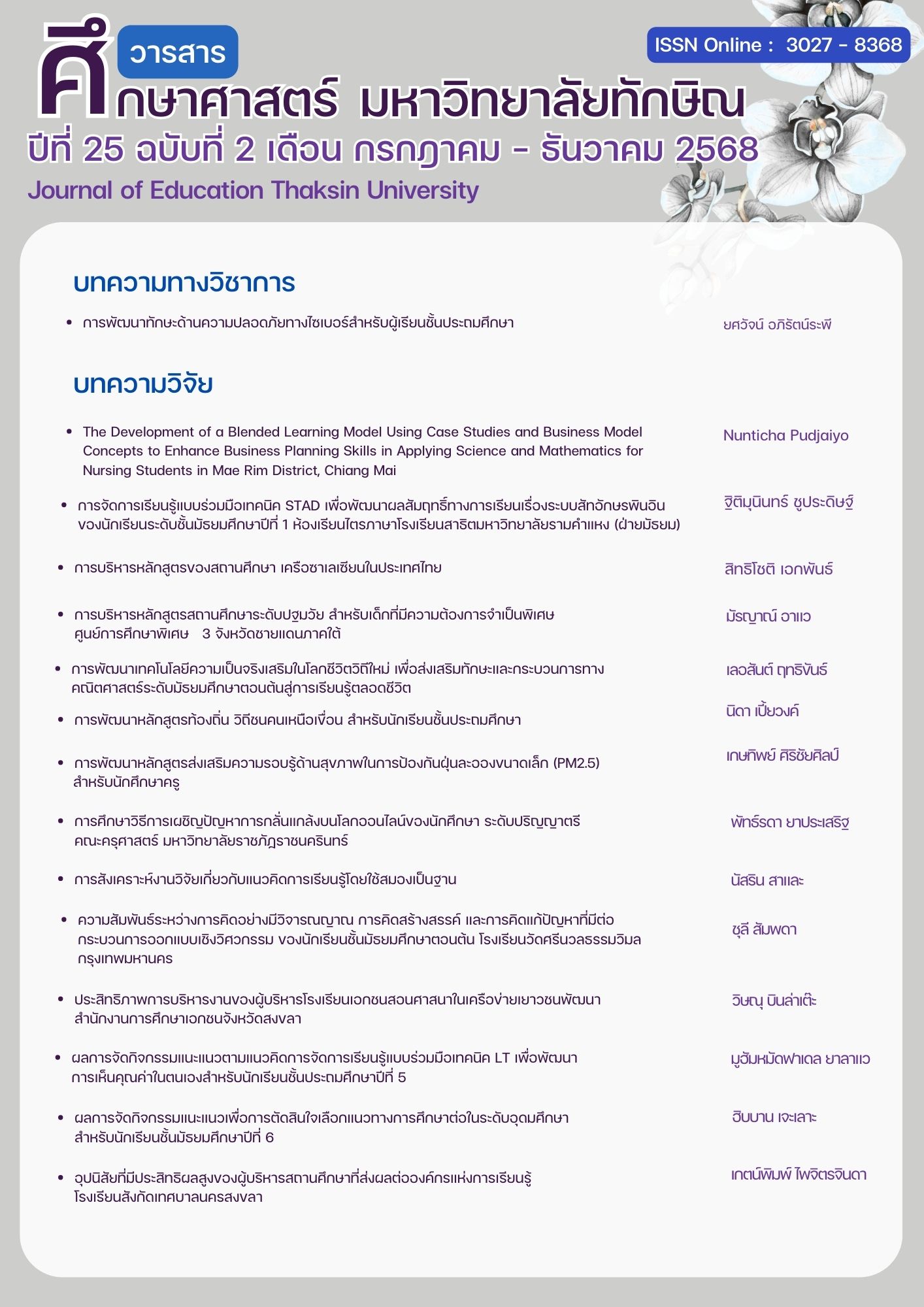
The Curriculum Development of Health Literacy to Protect of Microscopic Particles (PM2.5) for student teachers.
Article Sidebar
Main Article Content
Abstract
The objectives of this research were: 1) to develop and evaluate the quality of a curriculum designed to promote health literacy in the prevention of small particulate matter (PM2.5) for student teachers, and 2) to study the effects of using the health literacy-promoting curriculum in preventing small particulate matter (PM2.5) among student teachers. The sample group consisted of 29 second-year Thai language student teachers at Lampang Rajabhat University during the first semester of the 2023 academic year, selected by simple random sampling. The research tools included: 1) the curriculum, 2) curriculum-related documents, 3) a learning achievement test on health literacy for PM2.5 prevention, and 4) a health literacy assessment form for PM2.5 prevention. Data were analyzed using percentage, mean, standard deviation, and dependent samples t-test.
The research results revealed that: 1) The curriculum development consists of 4 learning units, which are: Learning Unit 1, 'PM Dangers,' Learning Unit 2, 'Filling Knowledge Gaps,' Learning Unit 3, 'Guru vs Dust,' and Learning Unit 4, 'Building Dreams for Health Awareness.' The total duration is 8 hours. The quality of the curriculum shows an average suitability rating of the highest level (x̄ = 4.60, S.D = 0.44). The curriculum's supplementary materials also have an average suitability rating of the highest level (x̄ = 4.51, S.D = 0.52). 2) The study of the curriculum's effectiveness revealed that second-year Thai language teacher students from Lampang Rajabhat University, totaling 29 students, who participated in the curriculum, had statistically significant higher post-test scores than pre-test scores at the .05 level. The overall level of health literacy was found to be high (x̄ = 3.63, S.D = 0.51)."
Article Details

This work is licensed under a Creative Commons Attribution-NonCommercial-NoDerivatives 4.0 International License.
ในกรณีที่กองบรรณาธิการ หรือผู้เชี่ยวชาญ ซึ่งได้รับเชิญให้เป็นผู้ตรวจบทความวิจัย หรือ บทความทางวิชาการมีความเห็นว่าควรแก้ไขความบกพร่อง ทางกองบรรณาธิการจะส่งต้นฉบับให้ ผู้เขียนพิจารณาจัดการแก้ไขให้เหมาะสมก่อนที่จะลงพิมพ์ ทั้งนี้ กองบรรณาธิการจะยึดถือความคิด เห็นของผู้เชี่ยวชาญเป็นเกณฑ์
References
ขวัญเมือง แก้วดำเกิง. (2561). ความรอบรู้ด้านสุขภาพ: ขั้นพื้นฐาน ปฏิสัมพันธ์ วิจารณญาณ, กรุงเทพฯ : อมรินทร์พริ้นติ้ง แอนด์ พับลิชชิ่ง
คณะกรรมการอำนวยการจัดทำแผนพัฒนาสุขภาพแห่งชาติ. (2559). ร่างแผนพัฒนาสุขภาพแห่งชาติ ฉบับที่ 13 (พ.ศ. 2565-2570), กรุงเทพฯ: กระทรวงสาธารณสุข.
จักรกฤษณ์ จันทะคุณ และคณะ. (2565). การพัฒนาชุดฝึกอบรมครูเพื่อพัฒนาหลักสูตรภัยพิบัติท้องถิ่นแผ่นดินไหวที่เหมาะสมในสถานการณ์การแพร่ระบาดของโควิด-19. พิษณุโลก: มหาวิทยาลัยนเรศวร.
นวพร ชลารักษ์ .(2558). บทบาทของครูกับการเรียนการสอนในศตวรรษที่ 21. วารสารวิชาการมหาวิทยาลัยฟาอีสเทอร์น, 9(1), 64-71.
ประสาท เนืองเฉลิม . (2562). ครูในศตวรรษที่ 21 Teachers in the 21st Century. วารสารมนุุษยศาสตร์และ
สังคมศาสตร์มหาวิทยาลัยมหาสารคาม, 39(1), 16-24.
พนมนคร มีราคา. (2560). ครูต้องมีลักษณะอย่างไรในศตวรรษที่ 21. วารสารศึกษาศาสตร์ มมร, 5(2), 23-35.
พาณิชย์ อินทร์จันทร์. (2563). การพัฒนาหลักสูตรสร้างเสริมการแก้ปัญหาอนาคตในการเตรียมความพร้อม รับมือ
ภัยพิบัติแผ่นดินไหว โดยใช้รูปแบบการเรียนการสอนตามแนวคิดของทอร์แรนซ์สำหรับนักเรียนประถมศึกษาตอนปลาย. วิทยานิพนธ์บัณฑิตศึกษา มหาวิทยาลัยราชภัฏลำปาง.
ไพฑูรย์ สินลารัตน์. (2557). สัตตลักษณ์ของครูผู้นำ. กรุงเทพฯ: วิทยาลัยครุศาสตร์ มหาวิทยาลัยธุรกิจบัณฑิตย์.
วิจิตตราภรณ์ สุขเจริญ และคณะ. (2563). การศึกษามาตรการจัดการปัญหาฝุ่นละอองขนาดไม่ เกิน 2.5 ไมครอน ของประเทศไทยตามแนวองค์การอนามัยโลก. วชิรเวชสารและวารสาร เวชศาสตร์เขตเมือง, 64(5), 345-356
สุภางค์พิมพ์ รัตตสัมพันธ์และคณะ. (2565). ความสัมพันธ์ระหว่างความรอบรู้ด้านสุขภาพกับพฤติกรรมการป้องกันการสัมผัสฝุ่น PM 2.5 ของหญิงตั้งครรภ์ โรงพยาบาลปทุมธานี, วารสารพยาบาลสงขลานครินทร์ 42(3), 53-62.
Taba, Hilda. (1962). Curriculum Development: Theory and Practice. New York : Harcourt, Brace &
World, lnc.
