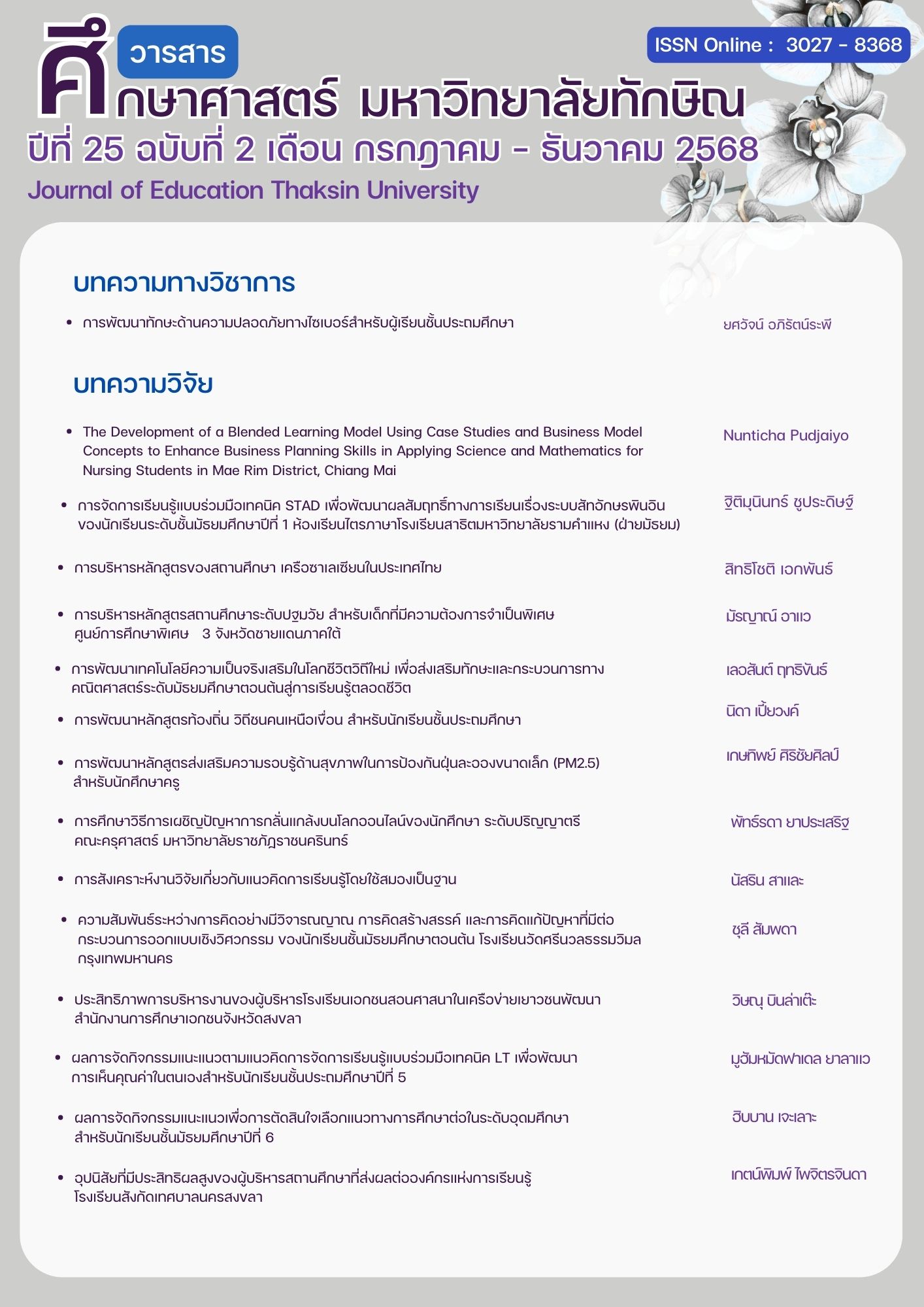
Development of Augmented Reality Technology in the New Normal to Enhance Mathematics Skills and Processes for Lifelong Learning
Article Sidebar
Main Article Content
Abstract
This study aimed to 1) develop augmented reality (AR) technology-based instructional media for mathematics courses, 2) evaluate the effectiveness of the augmented reality instructional media in mathematics for Grade 9 students based on the 80/80 criterion, 3) compare students' learning achievement before and after using the augmented reality instructional media in mathematics, and 4) examine students’ satisfaction with the use of AR media in mathematics instruction. The sample consisted of 30 students from Class Mathayom 3/3 at Nonsuwan Pittayakhom School, selected through simple random sampling, using the classroom as the sampling unit. The research instruments included AR media, an academic achievement test, and a student satisfaction survey. Data were analyzed using mean, standard deviation, E1/E2 efficiency analysis, and a paired t-test.
The findings indicated that the AR media, developed following the ADDIE model demonstrated an efficiency level of 81.83/80.17, meeting the prescribed criteria. Students' post-test learning achievement was significantly higher than their pre-test scores (p < 0.05). Additionally, students expressed a very high level of satisfaction with the AR media, with an average score of 4.62 and a standard deviation of 0.53.
Article Details

This work is licensed under a Creative Commons Attribution-NonCommercial-NoDerivatives 4.0 International License.
ในกรณีที่กองบรรณาธิการ หรือผู้เชี่ยวชาญ ซึ่งได้รับเชิญให้เป็นผู้ตรวจบทความวิจัย หรือ บทความทางวิชาการมีความเห็นว่าควรแก้ไขความบกพร่อง ทางกองบรรณาธิการจะส่งต้นฉบับให้ ผู้เขียนพิจารณาจัดการแก้ไขให้เหมาะสมก่อนที่จะลงพิมพ์ ทั้งนี้ กองบรรณาธิการจะยึดถือความคิด เห็นของผู้เชี่ยวชาญเป็นเกณฑ์
References
ชัยยงค์ พรหมวงศ์. (2556). การทดสอบประสิทธิภาพสื่อหรือชุดการสอน. วารสารศิลปากรศึกษาศาสตร์, 5(1), 7-20.
ทรงศักดิ์ ภูสีอ่อน. (2564). การวิจัยและพัฒนาทางการศึกษา. มหาสารคาม: ตักสิลาการพิมพ์.
ทองมา แป้นดวงเนตร เทียมยศ ปะสาวะโน และธิปัตย์ โสตถิวรรณ. (2564). การพัฒนาเทคโนโลยีความจริงเสริมวิชาคณิตศาสตร์ เรื่องโจทย์ปัญหา สำหรับนักเรียนชั้นประถมศึกษาปีที่ 6. วารสารมหาจุฬาวิชาการ, 9(3), 107-118.
ธนวัฒน์ เศรษฐธีรโชติ. (2567). การประเมินผลการทดสอบทางการศึกษาระดับชาติขั้นพื้นฐาน (O-NET) วิชาคณิตศาสตร์ ชั้นมัธยมศึกษาปีที่ 3 สังกัด สพฐ. วารสารการทดสอบและการประเมินทางการศึกษาระดับชาติ, 5(2), 66–82.
บุญชม ศรีสะอาด. (2556). การวิจัยเบื้องต้น ฉบับปรับปรุงใหม่ (พิมพ์ครั้งที่ 9). กรุงเทพฯ: สุวีริยาสาส์น.
ไพศาล วรคำ. (2561). การวิจัยทางการศึกษา (พิมพ์ครั้งที่ 9). มหาสารคาม : ตักสิลาการพิมพ์.
ยุวธิดา อัคฮาด. (2566). การพัฒนาความสามารถในการแก้โจทย์ปัญหาคณิตศาสตร์ของนักเรียนชั้นประถมศึกษาปีที่ 2 โดยใช้การจัดการเรียนรู้ด้วยเทคนิค KWDL ร่วมกับสื่อเทคโนโลยีความจริงเสริม. Journal of Roi Kaensarn Academi, 8(9), 19-38.
ฤชา รัตนศีล และพีระพงษ์ พรมจันทร์. (2564). การเปรียบเทียบผลสัมฤทธิ์ทางการเรียนวิชาคณิตศาสตร์วิศวกรรมเครื่องกลของนักเรียนนายเรือ ด้วยบทเรียนออนไลน์โปรแกรม Moodle. วารสารเทคโนโลยีและสื่อสารการศึกษา คณะศึกษาศาสตร์ มหาวิทยาลัยมหาสารคาม, 4(11), 38 – 53.
วิทยากร เชียงกูล. (2558). สภาวะการศึกษาไทย 2557/2558 : จะปฏิรูปการศึกษาไทยให้ทันโลกในศตวรรษที่ 21ได้อย่างไร. กรุงเทพฯ: สํานักงานเลขาธิการสภาการศึกษา กระทรวงศึกษาธิการ.
วิมาน ใจดี ชัชชญา อถมพรมราช และมนัสนิต ใจดี. (2564). การพัฒนาสื่อการเรียนรู้ด้วยเทคโนโลยีความเป็นจริงเสริม รายวิชาคณิตศาสตร์ ร่วมกับการเรียนรู้แบบร่วมมือด้วยเทคนิคกลุ่มแข่งขัน เพื่อพัฒนาผลสัมฤทธิ์ทางการเรียนของนักเรียนชั้นประถมศึกษาปีที่ 6. วารสารศึกษาศาสตร์์ มมร, 9(2), 335 – 370.
ศักดิ์คเรศ ประกอบผล. (2563).การออกแบบและพัฒนาบทเรียนคอมพิวเตอร์ช่วยสอนโดยใช้แอดดี้โมเดลและแนวคิดของกาเย่.วารสารครุศาสตร์สาร, 14(1), 17-30.
สำนักงานสภาพัฒนาการเศรษฐกิจและสังคมแห่งชาติ. (2566). แผนพัฒนาเศรษฐกิจและสังคมแห่งชาติ ฉบับที่ 13 (พ.ศ. 2566–2570). ราชกิจจานุเบกษา, 139(ตอนพิเศษ 258 ง).
Angraini, L. M., Susilawati, A., Noto, M. S., Wahyuni, R., & Andrian, D. (2023). Augmented Reality for Cultivating Computational Thinking Skills in Mathematics Completed with Literature Review, Bibliometrics, and Experiments for Students. Indonesian Journal of Science and Technology, 9(1), 225–260. https://doi.org/10.17509/ijost.v9i1.67258
Chen, A. (2024). Leveraging Virtual and Augmented Reality to Boost Student Engagement in STEM Disciplines. Region - Educational Research and Reviews, 6(12), 61. https://doi.org/10.32629/rerr.v6i12.2999
Islim, Omer Faruk & Namlı, Şenol & Sevim, Nese & Ozcakir, Bilal & Lavicza, Zsolt. (2024). Augmented Reality in Mathematics Education: A Systematic Review. Participatory Educational Research. 11. 115-139. https://doi.org/10.17275/per.24.52.11.4.
Majid, A. F., Baharuddin, B., Nursalam, N., Tayeb, T., Mattoliang, L. A., Kusumayanti, A., & Amin, B. (2024). Development of augmented reality-based mathematics learning media to facilitate students’ mathematical computational thinking skills. Mapan, 12(2), 416–439. https://doi.org/10.24252/mapan.2024v12n2a12
Prayoga, H. A., Pamungkas, M. D., & Nurjanah, A. (2024). Development of Augmented Reality media in polyhedral space-building lessons to improve the mathematical reasoning ability. Union, 12(3), 598–611. https://doi.org/10.30738/union.v12i3.17756
Susanto, R., & Nurtamam, M. E. (2024). Development of AR-Based Educational Games for Mathematics Learning in Elementary Schools. Journal of Computer Science Advancements, 2(5), 273–284. https://doi.org/10.70177/jsca.v2i5.1325
UNESCO. (2024). Digital education: What you need to know. United Nations Educational, Scientific and Cultural Organization.
