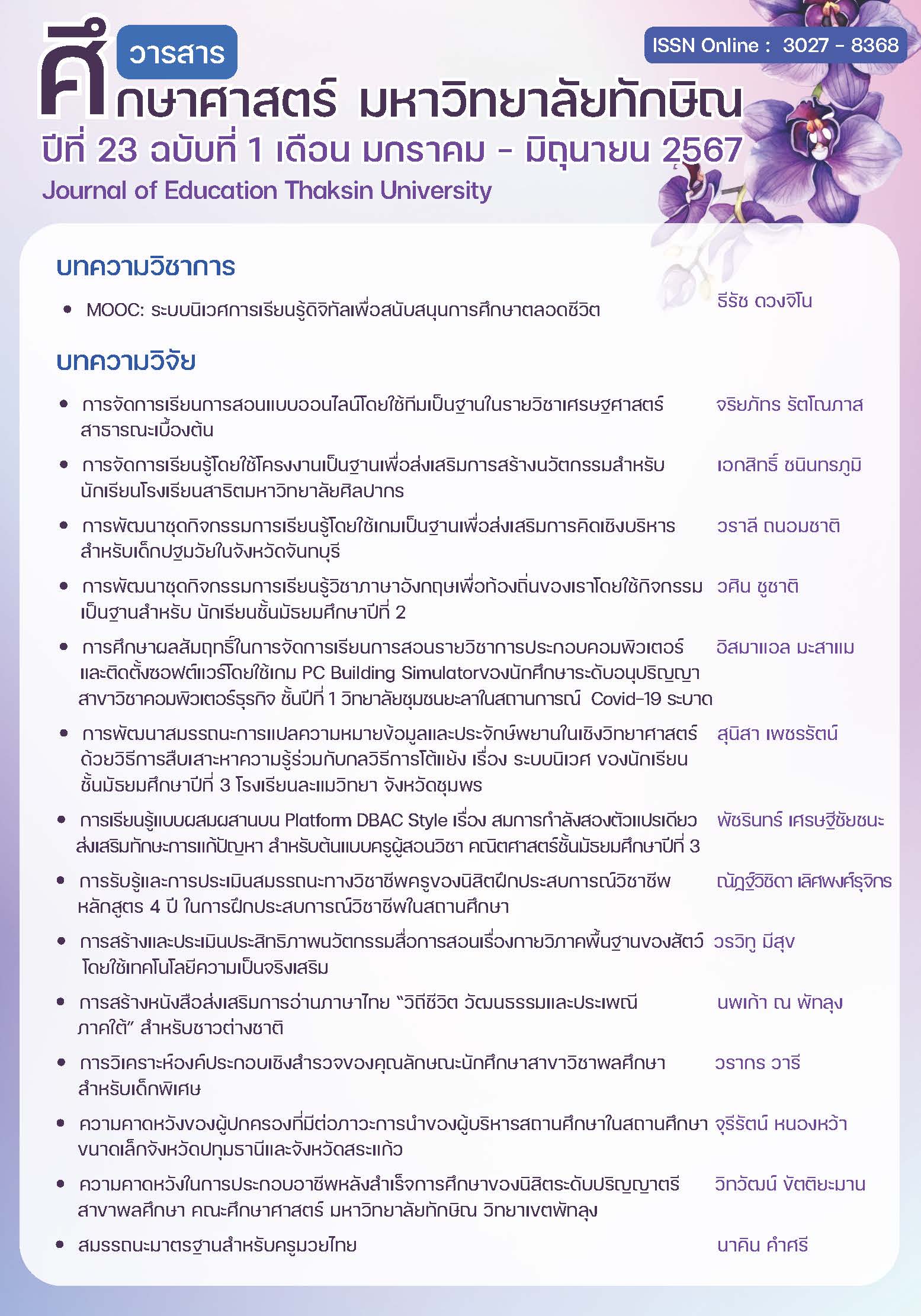
Blended Learning on Platform DBAC Style on The Topic One Variable Quadratic Equations Promote Problem-Solving Skills For a Prototype of Mathematics Teachers in Grade 3
Article Sidebar
Main Article Content
Abstract
The purpose of this research was to develop and determine the effectiveness of the blended learning management plan. To study learning outcomes and to study problem-solving skills from using the integrated learning management plan on the DBAC Style Platform on One Quadratic Equation of Variables. For the prototype mathematics teacher grade 3, the sample group consisted of 57 mathematics teachers in the second semester of the academic year 2021 under government and private schools. The researcher selects the sample from the open recruitment on a voluntary basis. The design of this study was a single-group experimental study. The research tools were the blended learning management plan. Learning Outcomes Tests and Problem Solving Assessment Tests The time spent in the experiment was 15 hours. The mean score analysis of learning outcomes on one variable quadratic equation (after school) was 92.74 points (92.74%). There was a statistical significance at the .05 level. The score obtained from the problem-solving skills evaluation test (after school) on the subject of quadratic equations with one variable was 80.68 points (80.68%). Problems after school were higher than before. Statistically significant at the .05 level.
Article Details

This work is licensed under a Creative Commons Attribution-NonCommercial-NoDerivatives 4.0 International License.
ในกรณีที่กองบรรณาธิการ หรือผู้เชี่ยวชาญ ซึ่งได้รับเชิญให้เป็นผู้ตรวจบทความวิจัย หรือ บทความทางวิชาการมีความเห็นว่าควรแก้ไขความบกพร่อง ทางกองบรรณาธิการจะส่งต้นฉบับให้ ผู้เขียนพิจารณาจัดการแก้ไขให้เหมาะสมก่อนที่จะลงพิมพ์ ทั้งนี้ กองบรรณาธิการจะยึดถือความคิด เห็นของผู้เชี่ยวชาญเป็นเกณฑ์
References
Aksorn. (2561). Blended Learning เรียนรู้แบบผสมผสานที่ครูไทยต้องให้ความสำคัญ. เข้าถึงได้จาก https://www.aksorn.com/blended-learning
Bangkokbiznews. (2562). เกิดอะไรขึ้นกับการศึกษาไทย เมื่อผลสอบ 'PISA' เด็กไทยไม่ถึงค่าเฉลี่ย. เข้าถึงได้จาก https://www.bangkokbiznews.com/social/857279
Education.Kapook. (2561). สทศ. ประกาศผลสอบ O-NET พบมีคะแนนต่ำสุดเป็น 0 ถึง 3 วิชา. เข้าถึงได้จาก httpshttps://education.kapook.com/view208264.html
Englishgang. (2561). การเรียนรู้แบบผสมผสาน (Blended Learning). เข้าถึงได้จาก https://englishgang.com/%E0%B8%84%E0%B8%B3%E0%B8%AD%E0%B8%98%E0%B8%
Jirapha Lamungkhun. (2562). การพัฒนาความสามารถในการแก้ปัญหาทางคณิตศาสตร์ของนักเรียนชั้น มัธยมศึกษาปีที่ 5 โดยใช้การจัดการเรียนรู้ตามรูปแบบ SSCS. เข้าถึงได้จาก http://202.28.34.124/dspace/bitstream
Kanchit Wongherm. (2561). การพัฒนาการแก้ทักษะปัญหาทางคณิตศาสตร์ โดยใช้วีสอนแบบร่วมมือ เทคนิค TAI สำหรับนักเรียนชั้นมัธยมศึกษาปีที่ 3. เข้าถึงได้จาก https://dspace.bru.ac.th/xmlui/handle
KKU. (2562). การพัฒนาทักษะและกระบวนการทางคณิตศาสตร์. เข้าถึงได้จาก https://avs.kku.ac.th/OER-KKU/101/UTQ-2107
Kritsada Worapin. (2561). การศึกษาปัญหาในการแก้โจทย์ปัญหาคณิตศาสตร์ของนักเรียนระดับ มัธยมศึกษาตอนต้น. เข้าถึงได้จาก https http://journal.fte.kmutnb.ac.th/download
Learneducation. (2561). Blended learning การเรียนแบบผสมผสาน ตอบโจทย์ยุค New Normal. เข้าถึงได้จาก https://www.learneducation.co.th/blended-learning/
Longtunmom. (2561). คะแนน PISA คืออะไร? แล้วเด็กไทยอยู่อันดับที่เท่าไหร่?. เข้าถึงได้จาก https://www.longtunmom.com/what-is-pisa-score/
Matichon. (2561). ไขข้อสงสัย โอเน็ตเด็กไทย ยิ่งสอบ-ยิ่งต่ำ. เข้าถึงได้จากhttps://www.matichon.co.th/education/news
Natthaphon Lertnan. (2562). การศึกษายุทธวิธีในการแก้โจทย์ปัญหาคณิตศาสตร์หนึ่งขั้นตอน ที่เกี่ยวกับการบวก การลบ การคูณและการหารของนักเรียนชั้นประถมศึกษาปีที่ 4-6. เข้าถึงได้จาก http://fulltext.rmu.ac.th/fulltext
Nipatanoy. (2561). Blended Learning การเรียนรู้แบบผสมผสาน. เข้าถึงได้จากhttps://nipatanoy.wordpress.com/blended-
PPTVHD36. (2564). Hybrid learning เทรนด์การเรียนรู้ รับมือกับวิกฤตโควิด-19. เข้าถึงได้จากhttps://www.pptvhd36.com/new
Silakarn Rungrueang. (2559). การพัฒนาทักษะการแก้โจทย์ปัญหาประยุกต์ทางคณิตศาสตร์และทักษะการทำงานร่วมกันโดยใช้กระบวนการแก้ปัญหาของโพลยาร่วมกับการจัดการเรียนรู้แบบร่วมมือของนักเรียนชั้นประถมศึกษาปีที่ 6. เข้าถึงได้จาก http://www.cmruir.cmru.ac.th/handle/123456789/1633?locale=th
Sirirat Pensaengsri. (2555). การเรียนแบบผสมผสานและการประยุกค์ใช้. เข้าถึงได้จาก https://lib.edu.chula.ac.th/FILEROOM/CU_FORMJOURNAL
Thaipost. (2563). ณัฏฐพล "ยอมรับกังวลผลคะแนนสอบโอเน็ต ป.6 และ ม.6 ต่ำลง ทุกวิชา. เข้าถึงได้จาก httpshttps://www.thaipost.net/main/detail/61233
Thaipublica. (2563). ธนาคารโลกชี้ คะแนน PISA เด็กไทยถดถอย ย้ำ 3 ประเด็นสำคัญ รัฐต้องเร่งแก้ด่วน. เข้าถึงได้จาก https://thaipublica.org/2020/12/world-bank-thailand-report-students-assessment/
Ukrit Thongyu. (2561). การพัฒนาความสามารถการแก้โจทย์ปัญหาทางคณิตศาสตร์โดยใช้การเรียนรู้ แบบร่วมมือเทคนิค TGT ชั้นประถมศึกษาปีที 2. เข้าถึงได้จาก https://grad.dpu.ac.th/upload/content/files
Vipu Moowong. (2559). การพัฒนาความสามารถในการแก้ปัญหา. เข้าถึงได้จาก http://ithesisir.su.ac.th/dspace/bitstream/123456789/1059
Wattana Rattanaprom. (2561). การส่งเสริมทักษะการแก้ปัญหาและการให้เหตุผลทางคณิตศาสตร์ของ นักเรียน ชั้นมัธยมศึกษาปีที่ 1 โรงเรียนไชยาวิทยา โดยใช้วิธีการแบบเปิด. เข้าถึงได้จาก http://www.ir.sru.ac.th/handle
