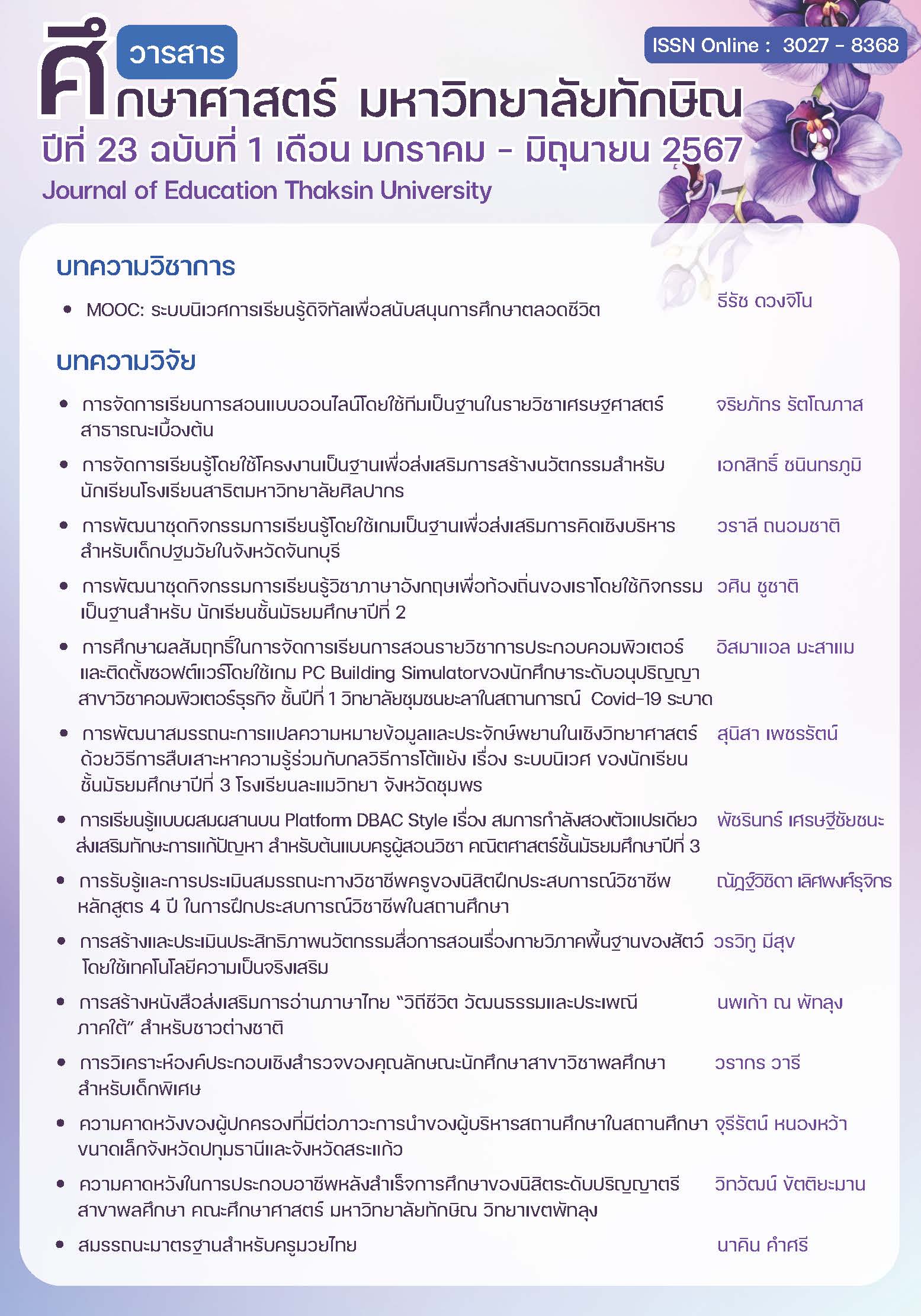
MOOC: Digital learning ecosystem to support lifelong education
Article Sidebar
Main Article Content
Abstract
Since the 21st century, information and communication technology has played an important role in education. There has been a change that affects the learning ecosystem from the original environment inside and outside the classroom, both artificially created and naturally occurring. The result is a digital learning ecosystem that brings information and communication technology into a system called online learning, which design to enable learners to learn anytime, anywhere through the internet and allows learners to choose the content they want to learn by themselves. MOOC is a well-known online learning model that has been used by the global community and higher education institutions to provide opportunities for learners to learn and access. It is an endless learning model based on lifelong learning. Open to everyone, allowing them to acquire knowledge thoroughly, easily, and conveniently. Because it is an online learning system through the Internet network, MOOC also reduces teaching issues in the classroom, especially in terms of the large number of students, large classes where communication is not thorough. Learners do not have to leave their routine work and also helps reduce travel expenses as they can study anytime, anywhere.
Article Details

This work is licensed under a Creative Commons Attribution-NonCommercial-NoDerivatives 4.0 International License.
ในกรณีที่กองบรรณาธิการ หรือผู้เชี่ยวชาญ ซึ่งได้รับเชิญให้เป็นผู้ตรวจบทความวิจัย หรือ บทความทางวิชาการมีความเห็นว่าควรแก้ไขความบกพร่อง ทางกองบรรณาธิการจะส่งต้นฉบับให้ ผู้เขียนพิจารณาจัดการแก้ไขให้เหมาะสมก่อนที่จะลงพิมพ์ ทั้งนี้ กองบรรณาธิการจะยึดถือความคิด เห็นของผู้เชี่ยวชาญเป็นเกณฑ์
References
กระทรวงศึกษาธิการ. (2551). พระราชบัญญัติหลักสูตรการศึกษาขั้นพื้นฐาน พ.ศ. 2551. กรุงเทพฯ: เกษตร สหพันธ์สหกรณ์การพิมพ์ไทย.
คณะกรรมการยุทธศาสตร์ชาติ. (2561). ยุทธศาสตร์ชาติ 20 ปี กรุงเทพฯ: สำนักงานคณะกรรมการพัฒนาการ เศรษฐกิจและสังคมแห่งชาติ.
จินตวีร์ คลายสังข์. (2556). MOOCs PEDAGOGY: จาก OCW, OCR สู่ MOOCs เครื่องมือเพื่อการเรียนรู้สำหรับ ผู้เรียนยุคดิจิทัล. ในการประชุมวิชาการระดับชาติด้านอีเลิร์นนิง ประจำปี พ.ศ.2556 วันที่ 5-6 สิงหาคม 2556. จาก http://www.support.thaicyberu.go.th/proceeding/proceedingNEC2013.pdf
จักรกฤษณ์ โพดาพล. (ม.ป.ป). การจัดการเรียนรู้ออนไลน์: วีถีที่เป็นไปทางการศึกษา สืบค้นเมื่อ 24 ตุลาคม 2565 จาก https://slc.mbu.ac.th/article/28181/
ชโรชีนีย์ ชัยมินทร์. (2562). MOOC: เพื่อการเรียนรู้ตลอดชีวิตในศตวรรษที่ 21. วารสารมนุษยศาสตร์และ สังคมศาสตร์มหาวิทยาลัยราชภัฏเชียงใหม่, 1(1), 46-69.
ณฐภัทร ติณเวส และฐาปนีย์ ธรรมเมธา. (2559). การศึกษารูปแบบการจัดการศึกษาระบบเปิดแบบ MOOC ของ อุดมศึกษาไทย. วารสาร Veridian E-Journal, มหาวิทยาลัยศิลปากร , 9(3), 1463-1497.
ณัฐพล ธนเชวงสกุล และ ณมน จีรังสุวรรณ. (2561). การออกแบบรูปแบบการเรียนการสอนด้วยกระบวนการ เรียนรู้แบบ MIAP บนเทคโนโลยีการประมวลผลแบบคลาวด์ของนักศึกษาระดับปริญญาตรี เพื่อส่งเสริม ทักษะการเรียนรู้ในศตวรรษที่ 21. วารสารศึกษาศาสตร์มหาวิทยาลัยนเรศวร, 20(4), 58-69.
น้ำทิพย์ วิภาวิน และ รุจเรขา วิทยาวุฑฒิกุล. (2557). Massive open online course (MOOC) กับความท้าทาย ของห้องสมุดมหาวิทยาลัย. วารสารวิจัยสมาคมห้องสมุดแห่งประเทศไทย, 7(1), 78-79.
ปานใจ ธารทัศนวงศ์ และ ศิริพร ศักดิ์บุญญารัตน์. (2564). บทเรียนออนไลน์แบบเปิดสู่มวลชน (MOOCs) เพื่อ การศึกษาไทยหลังการแพร่ระบาดของโรคติดเชื้อไวรัสโคโรน่า 2019 (COVID 19). Journal of Teacher Professional Development, 2 (1), 20.
ประวีณา โภควณิช. (2559). ความต้องการจำเป็นของการจัดสภาพแวดล้อมที่เอื้อต่อการเรียนรู้สำหรับสถานศึกษา เรียนรวมระดับประถมศึกษา จังหวัดปทุมธานี. วารสารศึกษาศาสตร์ มสธ., 10(2), 316.
ปลูกเอดูเคชั่น. (2560). ทำความรู้จัก “Thai MOOC” การศึกษาแบบเปิดเพื่อการเรียนรู้ตลอดชีวิต สืบค้นเมื่อ 22 ตุลาคม 2565, จาก https://www.trueplookpanya.com/knowledge/content/56332/-blog- newedu-new-newpr-
พัชราภรณ์ โพธิสัย. (2558). สภาพแวดล้อมทางการเรียนของนักเรียนโรงเรียนบ้านนาคำนา สังกัดสำนักงานเขต พื้นที่การศึกษาประถมศึกษาบึงกาฬ. (วิทยานิพนธ์ปริญญาการศึกษามหาบัณฑิต). ชลบุรี: มหาวิทยาลัย บูรพา.
พันธิการ์ วัฒนกุล และ สุรศักดิ์ มังสิงห์. (2558). ความรู้พื้นฐานและทักษะที่จำเป็นสำหรับการเรียนรู้ในศตวรรษที่ 21. วารสารวิชาการสมาคมสถาบันอุดมศึกษาเอกชนแห่งประเทศไทย วิทยาศาสตร์และเทคโนโลยี, 4(1), 84.
รัฐสภา พงษ์ภิญโญ. (2556). การพัฒนาสภาพแวดล้อมการเรียนรู้ในวิทยาลัยเทคโนโลยีพงษ์ภิญโญ : การวิจัยเชิง ปฏิบัติการแบบมีส่วนร่วม. (วิทยานิพนธ์ปริญญาดุษฎีบัณฑิต). ขอนแก่น: มหาวิทยาลัยขอนแก่น.
วรพล รัตนพันธ์. (2556). MOOC เรียนฟรีกับมหาวิทยาลัยชั้นนำของโลก. สืบค้นเมื่อ 25 ตุลาคม 2565, จาก http://www.vcharkarn.com/varticle/44387
สิโรดม มณีแฮด และ ปณิตา วรรณพิรุณ. (2561). ระบบนิเวศการเรียนรู้ดิจิทัลด้วยปัญญาประดิษฐ์สำหรับการ เรียนรู้อย่างชาญฉลาด.วารสารศึกษาศาสตร์ มหาวิทยาลัยนเรศวร, 21(2), 359-373.
Downes, S. (2016). The Quality of Massive Open Online Courses. Retrieved November 23, 2021, from http://www.downes.ca/post/66145
Grafinger, D.J. (1988). Basics of instructional systems development. Alexandria: American Society for Training and Development.
Holgado, A., & Penalvo, F. J. (2017). A metamodel proposal for developing learning ecosystems. Learning and collaboration technologies: Novel learning ecosystems. Cham: Springer International Publishing.
Higgins, S., Hall, E., Wall, K., Woolner, P., & McCaughey, C. (2005). The impact of school environments: A literature review. Callaghan, NSW: University of Newcastle.
Kondratova, I., Molyneaux, H., & Fournier, H. (2017). Design considerations for competency functionality within a learning ecosystem. Learning and collaboration technologies: Novel learning ecosystems. Cham: Springer International Publishing.
Kruse, K. (2008). Introduction Design and the ADDIE Model. Retrieved November 22, 2021, from http://www.e-learningguru.com/articles/art2_1.html
Molenda, M. (2015), In Search of the Elusive ADDIE Model. Performance Improvement, 54, 40-42.
Ritchie, D. C. & Hoffman, B. (1997). Incorporating instructional design principles with the World Wide Web. In B. H. Khan (Ed.). Web-based instruction. Englewood Cliffs, NJ: Educational Technology Publications.
Weise, M. (2018). We Need to Design the Learning Ecosystem of the Future. Retrieved May 16, 2023, from http://www.edsurge.com/news/2018-02-22-michelle
